
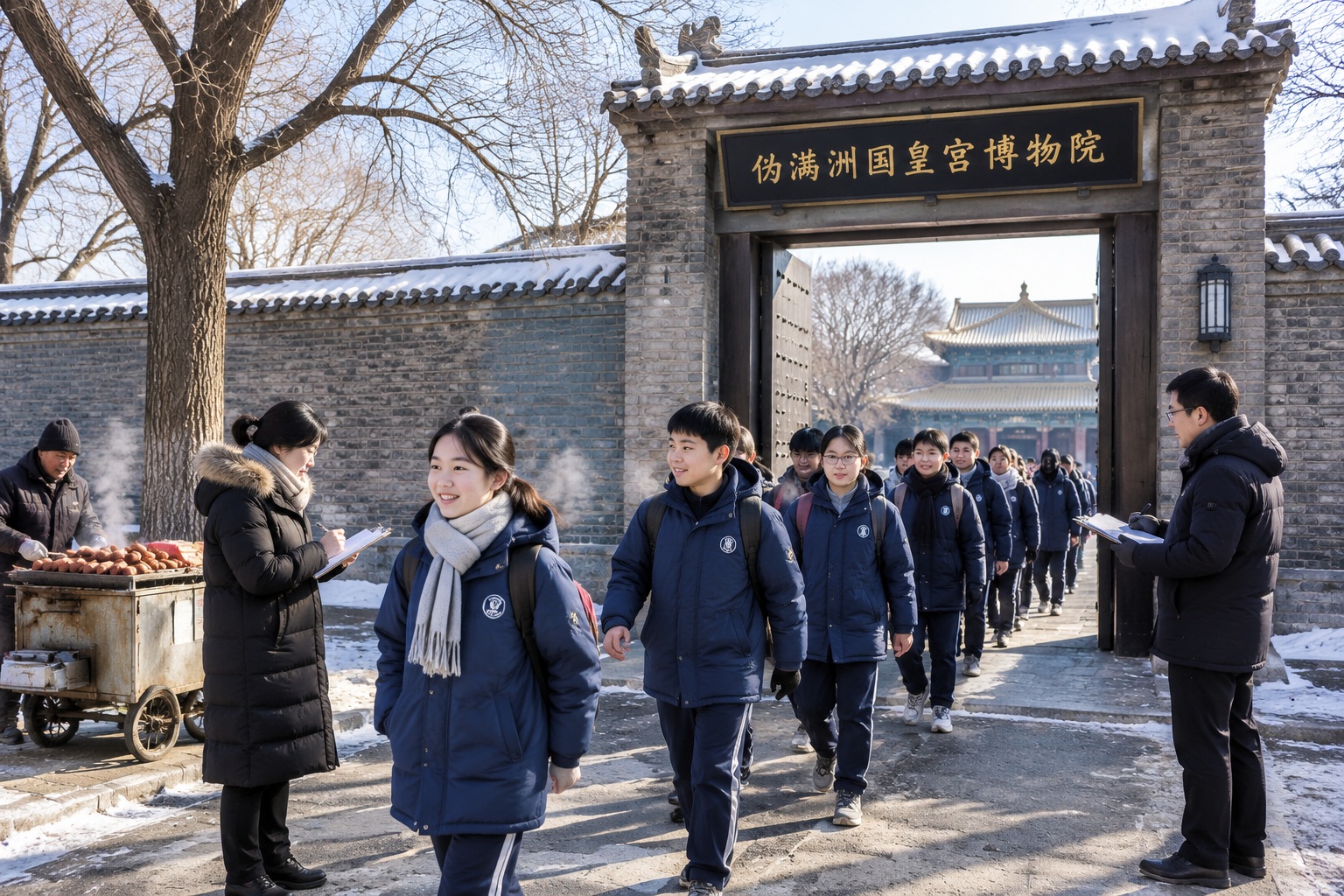

A winter morning at the gate
At nine in the morning the temperature in Changchun is minus nineteen, and the strip curtains over the ticket-office door have gone stiff. A school group in navy padded jackets jams up at the gate, breath fogging, teachers counting heads. On the sidewalk a man sells roasted sweet potatoes from a converted oil drum; the smell follows the queue for twenty metres and then stops at the wall.
The wall is the point. It runs along an ordinary commercial street in Changchun’s Kuancheng district, grey brick with a tiled coping, and behind it sits a compound of low buildings with green-grey roofs. This was the palace of Puyi, the last emperor of the Qing dynasty, who lived here as Japan’s figurehead ruler from 1932 to 1945. Today it is the Museum of the Imperial Palace of Manchukuo, and it is the most visited historic site in a city of about nine million people.
What this place actually was
Background for readers who did not learn this at school. In September 1931 the Japanese army blew up a stretch of railway track near Shenyang, blamed Chinese soldiers, and used the incident to seize Manchuria — the three northeastern provinces. In March 1932 a new state was declared: Manchukuo. Its capital was renamed Xinjing, or New Capital, and it is the city now called Changchun. Puyi, who had lost the Qing throne in 1912 as a small child, was installed as chief executive, and in 1934 promoted to emperor, with the reign name Kangde.
It was not a state in any working sense of the word. The League of Nations sent a commission chaired by Lord Lytton; its 1932 report refused to recognise Manchukuo, and Japan left the League the following year. Real authority sat with the Kwantung Army and with the Japanese officials installed as vice ministers in every ministry, outranking the Chinese ministers whose names went on the letterhead.
Inside the wall, Puyi had a court, a flag, uniforms, a family and a title. He did not have authority, and the buildings make that legible in a way photographs do not.
The rooms that show how it worked
The compound is small — a dozen structures around courtyards, most of them two storeys, all reachable in a five-minute walk. Anyone who has been through the Forbidden City in Beijing, which covers 72 hectares, will feel the difference at once. The ceilings are ordinary height. The rooms are the size of rooms in an old hotel.
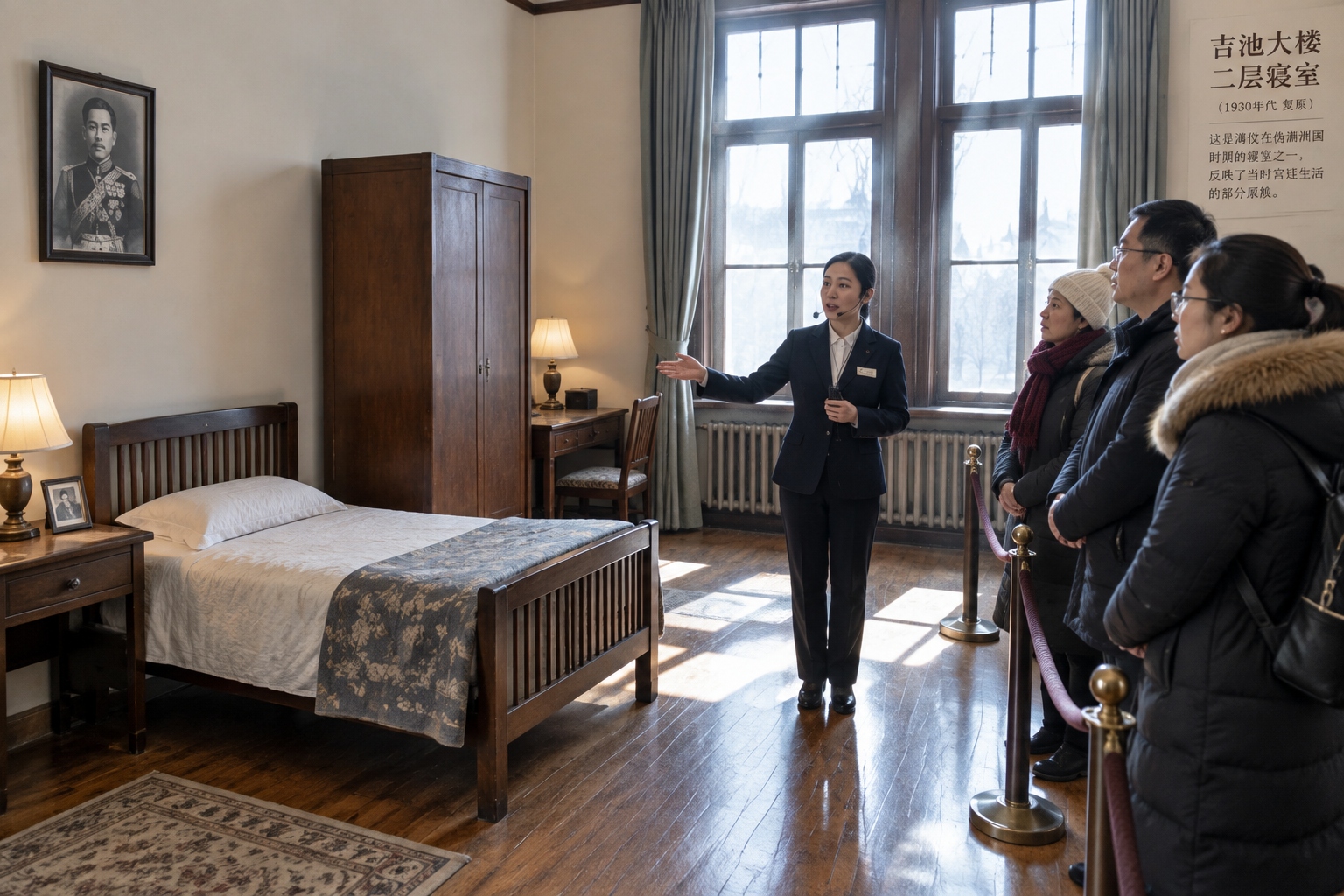
Jixi Building: the private side
Puyi slept on the second floor, on a narrow, hard bed, deliberately plain. The building’s name comes from a line in the Book of Songs and means roughly to keep walking in the light. His wife, Empress Wan Rong, had rooms on the same floor; the marriage collapsed and she was eventually kept apart as her health failed. The museum tells that part with furniture and photographs, not adjectives. Down the corridor are the rooms of Tan Yuling, a consort who died in 1942 at 22; they were kept as they were, and a small display holds her portrait and objects from the memorial rites held for her.
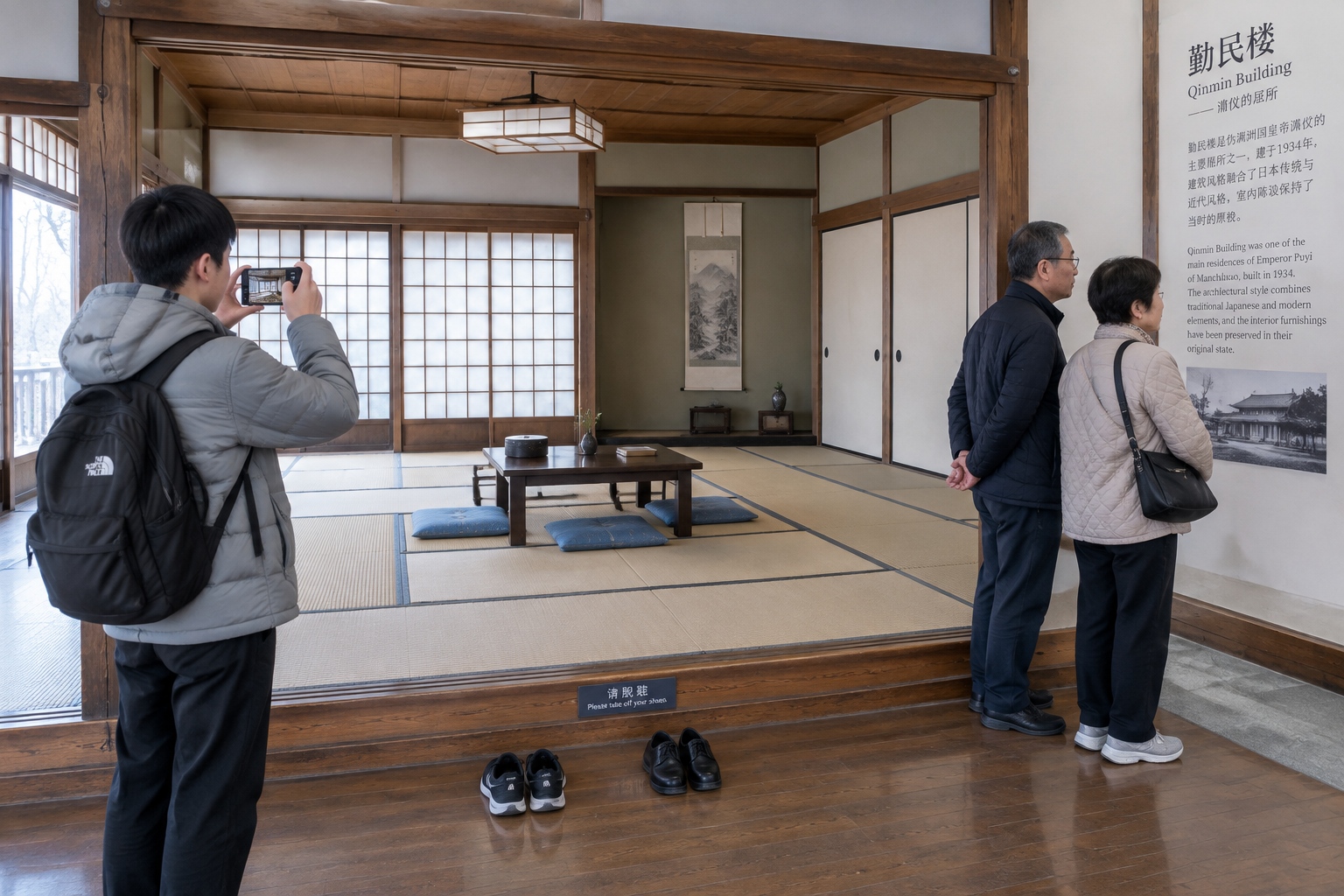
Qinmin Building: the official side
Qinmin means diligent in government and caring for the people, a name from the classics given to a man who governed nothing. His desk, his chair and the meeting rooms with their long tables have been restored, along with a Japanese-style room — tatami mats, paper sliding screens — of the kind found in a Japanese house of the period. The departments that decided what he would sign were staffed by Japanese officials. The Kwantung Army officer assigned to stay close to him, Yoshioka Yasunao, managed his schedule, his travel and his audiences. In the memoir he wrote after the war, Puyi describes the man as impossible to walk away from.
Behind the buildings, in the garden, there is a concrete air-raid shelter from the late 1930s and an outdoor swimming pool that was rarely filled. Display-case photographs show Puyi riding a bicycle in the courtyards; several doorways had their raised wooden thresholds cut down so the wheels would clear. It is a small detail, and it is the one visitors photograph most.
Fourteen years, told through objects
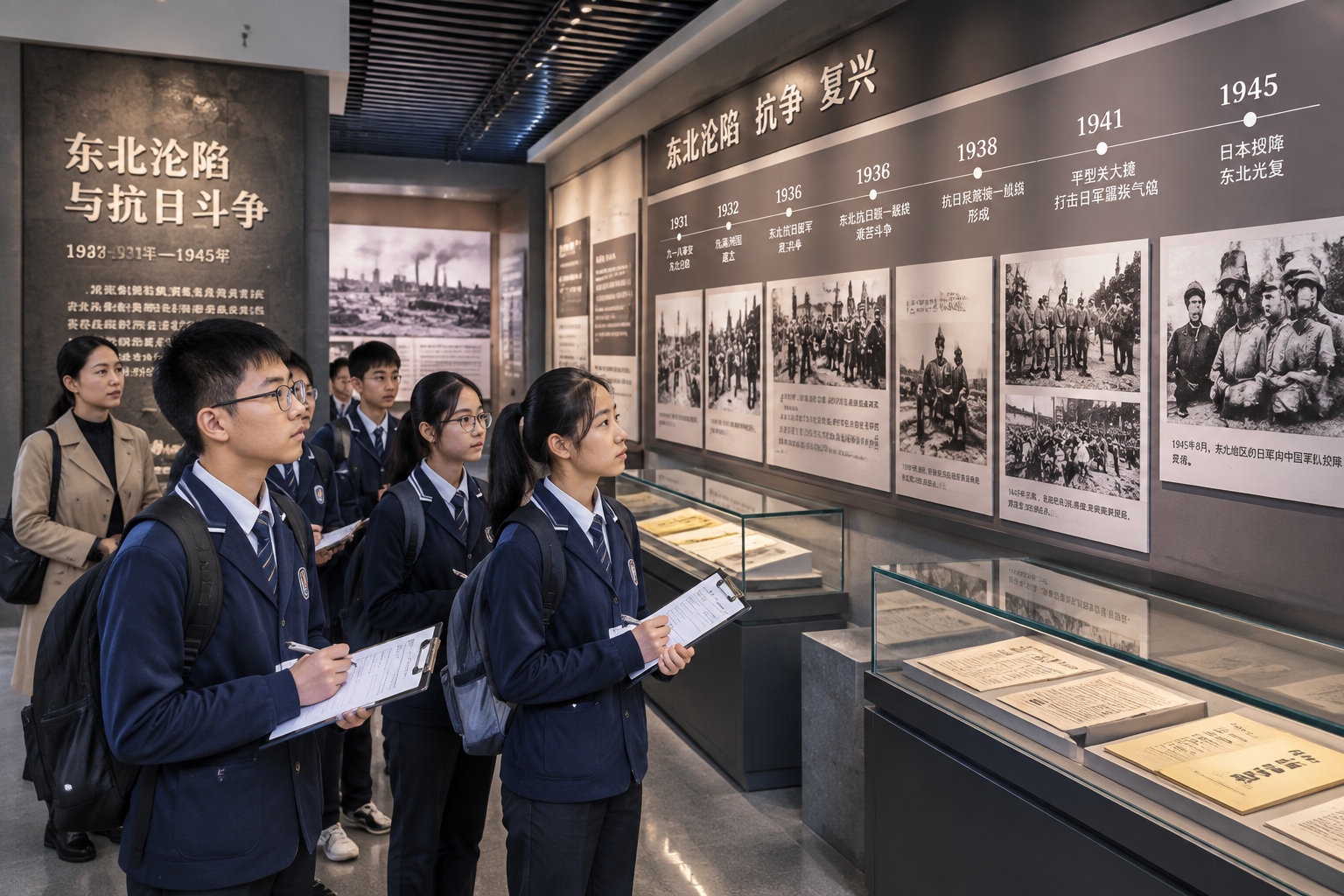
In the mid-2000s the museum opened a second building outside the palace walls: the Northeast Occupation History Exhibition Hall, purpose-built and much larger. It covers the fourteen years between September 1931 and August 1945, the period Chinese textbooks call the fall of the Northeast.
The rooms run in date order. Registration tags worn by labourers. Tools from mines and construction sites. A model of a collective hamlet, one of the controlled villages the occupation authorities created after burning existing settlements, ringed with ditches and watchtowers. Documents from Unit 731, the biological warfare programme based at Pingfang near Harbin, where prisoners were used in experiments. Records of coerced labour. Photographs of farmers removed from land taken for Japanese colonisation.
Then the resistance, which has rooms of its own. Yang Jingyu, commander of the Northeast Anti-Japanese United Army, was hunted for years and killed in 1940; the autopsy record displayed here lists only cotton wadding, bark and grass roots in his stomach. Zhao Yiman, captured in 1935 and executed the next year at 31, is shown through the letters she wrote to her son.
The final sections cover the collapse of Manchukuo in August 1945, the Soviet entry into the war, and the postwar trials. Puyi, captured in 1945 and later held at China’s war criminals management centre in Fushun, testified at the trial of Japanese defendants in Shenyang in 1956. He was pardoned in 1959, worked at the Beijing Botanical Garden and later as a researcher on historical materials, and died in 1967. His ashes were moved in 1995 to a commercial cemetery in Hebei, near the Western Qing Tombs — about a thousand kilometres from this compound.
The exhibition’s framing phrase is wuwang guochi, do not forget the national humiliation, a standard expression in Chinese history education. Some overseas visitors flinch at the word humiliation on the English labels. What the rooms actually argue, in detail rather than in slogans, is narrower: that a weak state invited occupation, and that the occupation was administered day to day by paperwork, police, and quotas of coal and grain.
How Changchun lives with it
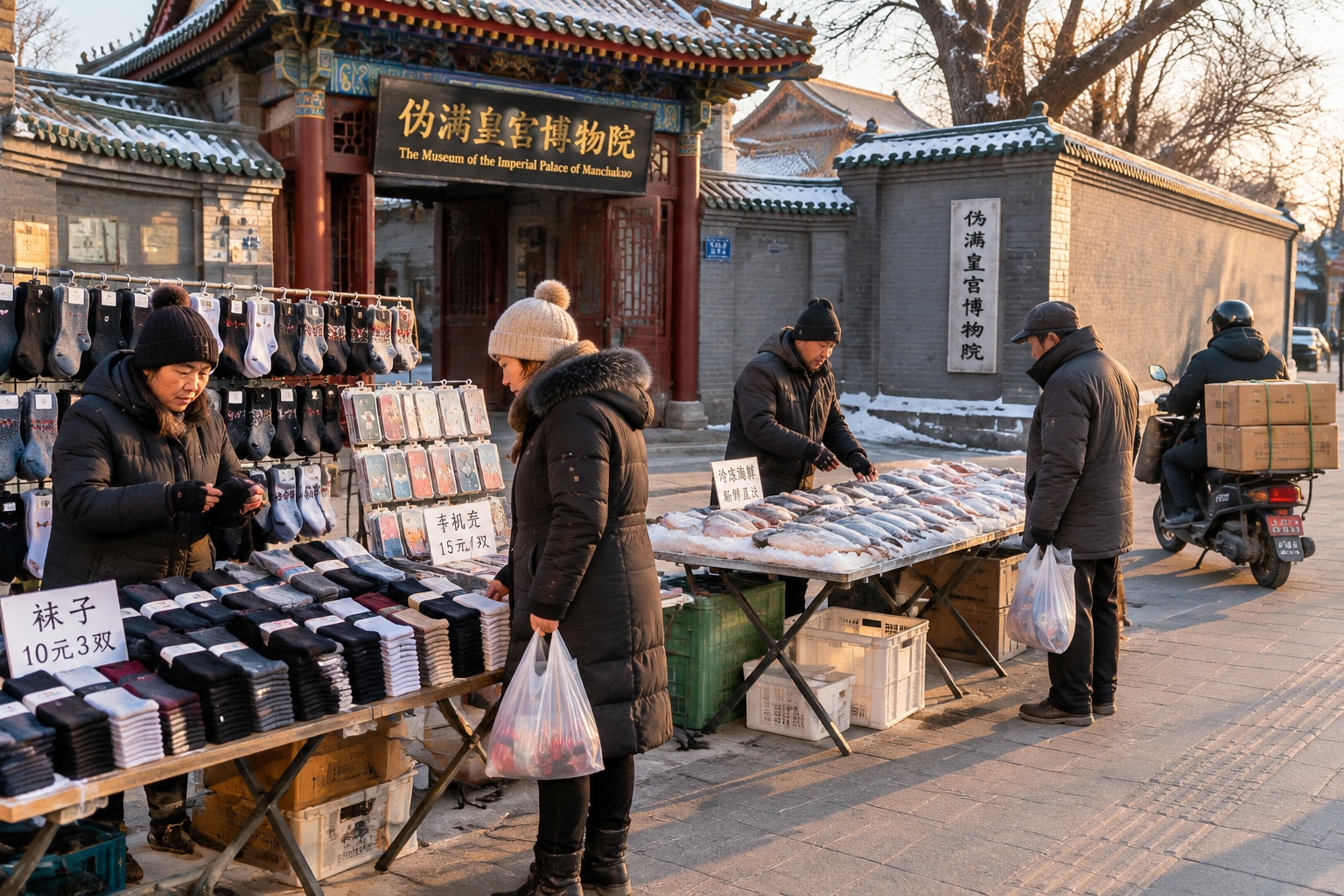
Walk out of the gate and you are in Guangfulu, a wholesale market district whose name means Recovered Road. Socks by the bundle. Frozen fish on folding tables. Phone cases, thermal underwear, scooters stacked with cardboard. Museum visitors and market customers share the same sidewalk, and it is the market that sets the noise level.
Most visitors are domestic: school groups with worksheets on clipboards, families from other provinces, locals. The site holds China’s top 5A rating in the official scenic-area system, which puts it on the coach-tour circuit, and it is often the only historic stop on an itinerary built around the ice festival at Jingyuetan or the car plants that turned this into an industrial city in the 1950s.
Local attitudes are less solemn than a foreign visitor might expect, and more layered. Changchun people come here on school trips, then come back years later when a friend visits from out of town. In the courtyards, teenagers photograph the tiles, the windows, each other. Inside the occupation hall, the same groups go quiet, phones down, teachers standing at the back. The complaints you overhear outside are about the cold and the ticket price.
There is also an argument the museum makes quietly about its own city: Changchun is a working industrial town, not a monument. It builds cars, it has universities and a film studio, and it is about four hours from Beijing by high-speed train. The palace is not its identity. But the palace is where the city’s modern history begins, and the museum knows that most people arrive with only the outline.
Leaving through the gate
By four in the afternoon the light has gone low and orange, and a class is loading onto a bus, teachers shouting names into the cold. Vendors are still working the sidewalk, breath and food-cart steam mixing. A few visitors stop at a strip of green beside the road not far from the gate to read a stone marker: the site of a shrine the occupation government built in the 1940s and required Puyi to worship at. Almost nothing remains above ground.
It is easy to walk past. That is roughly the point of the place: the machinery of an occupation was ordinary, administrative and local, and it stood in a city that kept on selling sweet potatoes and socks.
Start the discussion at forum.chinacomes.com