
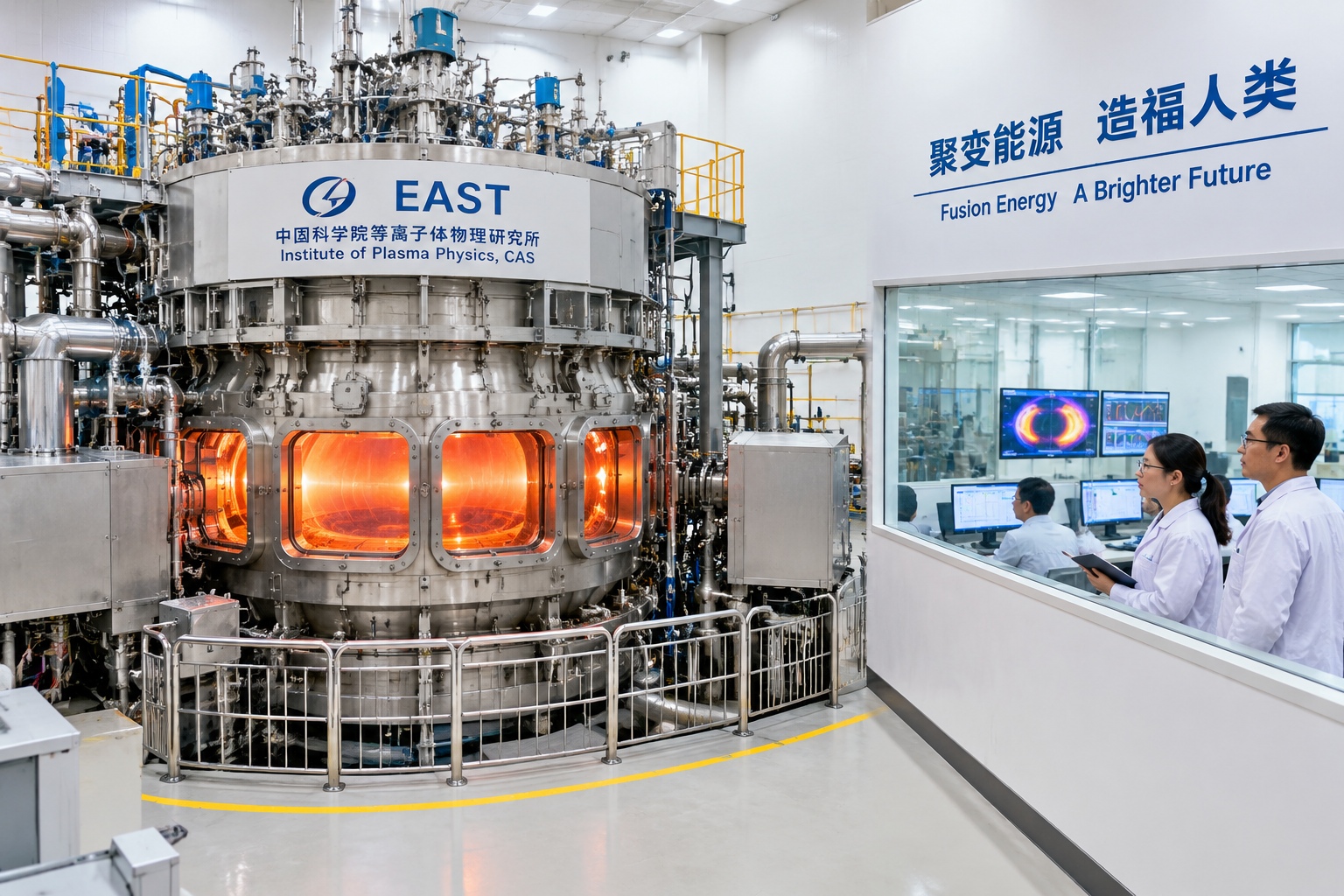

Inside the Machine: A Human-Size Star
In a control room tucked away in Hefei, a city in central China, a group of physicists and engineers watch in silence as numbers flash on a screen. The plasma inside the reactor — a donut-shaped machine called EAST — has just reached 100 million degrees Celsius. That is six times hotter than the core of the Sun. The plasma is held by invisible magnetic fields, spinning and churning, releasing energy through the same nuclear fusion that powers the stars. In January 2025, this machine held that plasma for 1,066 seconds, a world record that stunned the international fusion community. But behind the achievement lies decades of quiet work, countless failed attempts, and the stubborn belief that one day, humanity will harness a star.
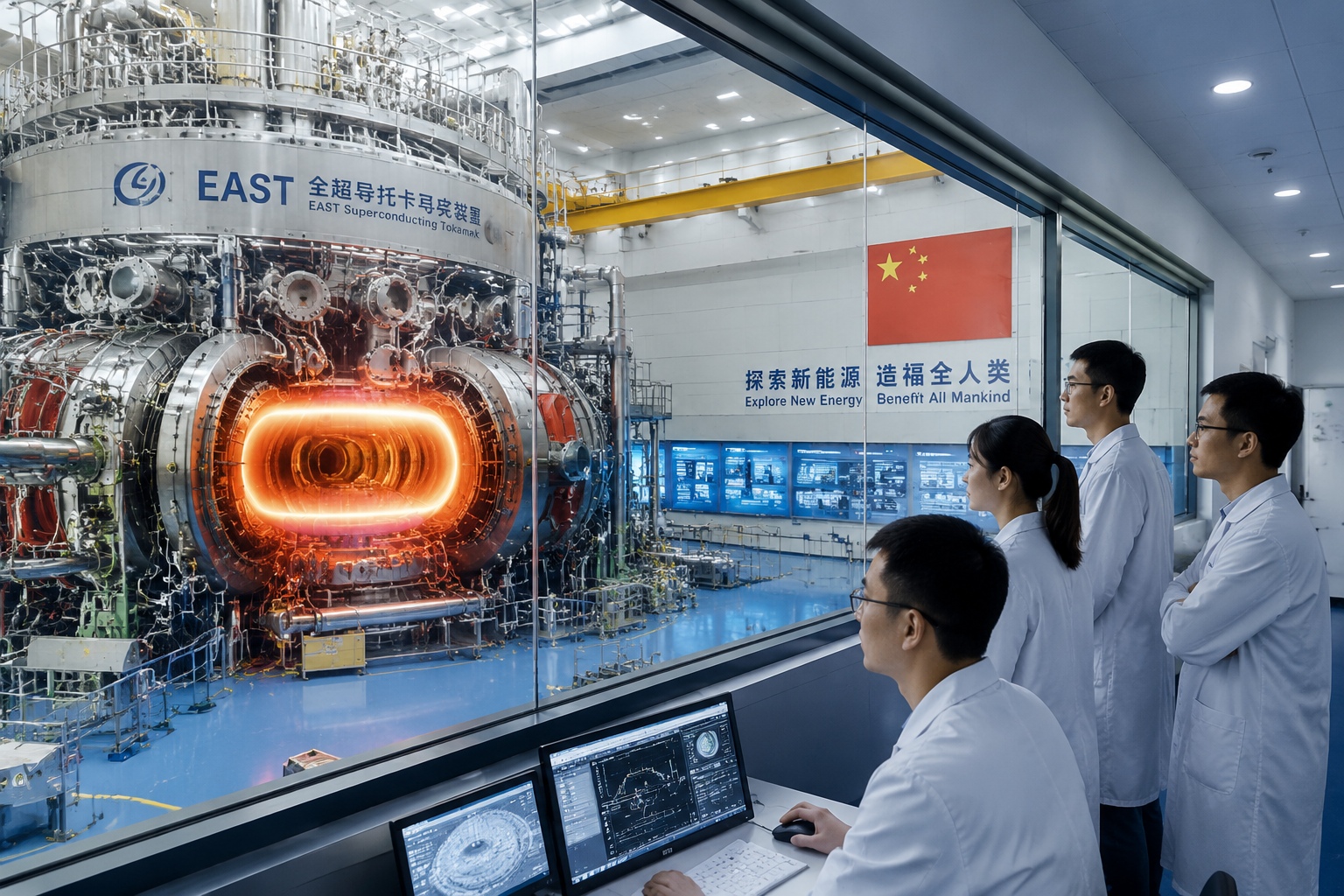
The experiment hall feels more like a factory than a sci-fi set. The tokamak itself is a massive steel ring, wrapped in cables and cryogenic pipes. Superconducting magnets inside keep the device at temperatures colder than interstellar space, while the plasma in its core burns hotter than any natural object on Earth. Scientists here often spend their nights adjusting injection parameters, analyzing data, and patiently nudging the plasma to behave. For them, the ‘artificial sun’ is not a metaphor — it’s a daily reality.
What Is the Artificial Sun?
The Chinese name for EAST is ‘人造太阳’ (rénzào tàiyáng), which translates literally to ‘artificial sun.’ It’s an apt name because the machine mimics the process that powers our Sun. But instead of using gravity to squeeze atoms together, the tokamak uses giant magnetic fields.
How a Tokamak Works
A tokamak is a type of magnetic confinement device. Inside, a gas of hydrogen isotopes — usually deuterium and tritium — is heated to millions of degrees until it becomes a plasma. In a plasma, electrons are stripped from atoms, leaving a soup of charged particles. Because these particles are electrically charged, they can be controlled by magnetic fields. The tokamak’s magnets are arranged in a ring or torus, so the plasma circulates in a donut shape, never touching the walls. Scientists use radio frequency waves, microwave beams, and neutral particle injections to raise the temperature further. At a certain point, the plasma gets so hot that the nuclei collide with enough force to fuse, producing helium and high-energy neutrons. It’s these neutrons that carry the energy out.
Why Fusion Could Be the Perfect Energy
Fusion is often called the ‘holy grail’ of energy. To understand why, consider the fuel: deuterium can be extracted from seawater by a simple process. One glass of seawater contains enough deuterium for the energy equivalent of a barrel of oil. Tritium, the other fuel, is rare in nature, but it can be regenerated from lithium. So the resource base is almost inexhaustible. Additionally, fusion doesn’t produce carbon dioxide or other greenhouse gases. The end product of the reaction is helium, which is inert. And because a fusion reaction requires exact conditions, it cannot run away — if something goes wrong, the plasma simply cools down and fizzles out, like a campfire left in the rain.
A History of Breaking Records
China began dabbling in nuclear fusion in the 1960s, but it wasn’t until the late 1990s that it started making serious progress. EAST was designed and built in the early 2000s as a national project. It’s based at the Institute of Plasma Physics at the Chinese Academy of Sciences and has been open to international scientists since operations began in 2006.
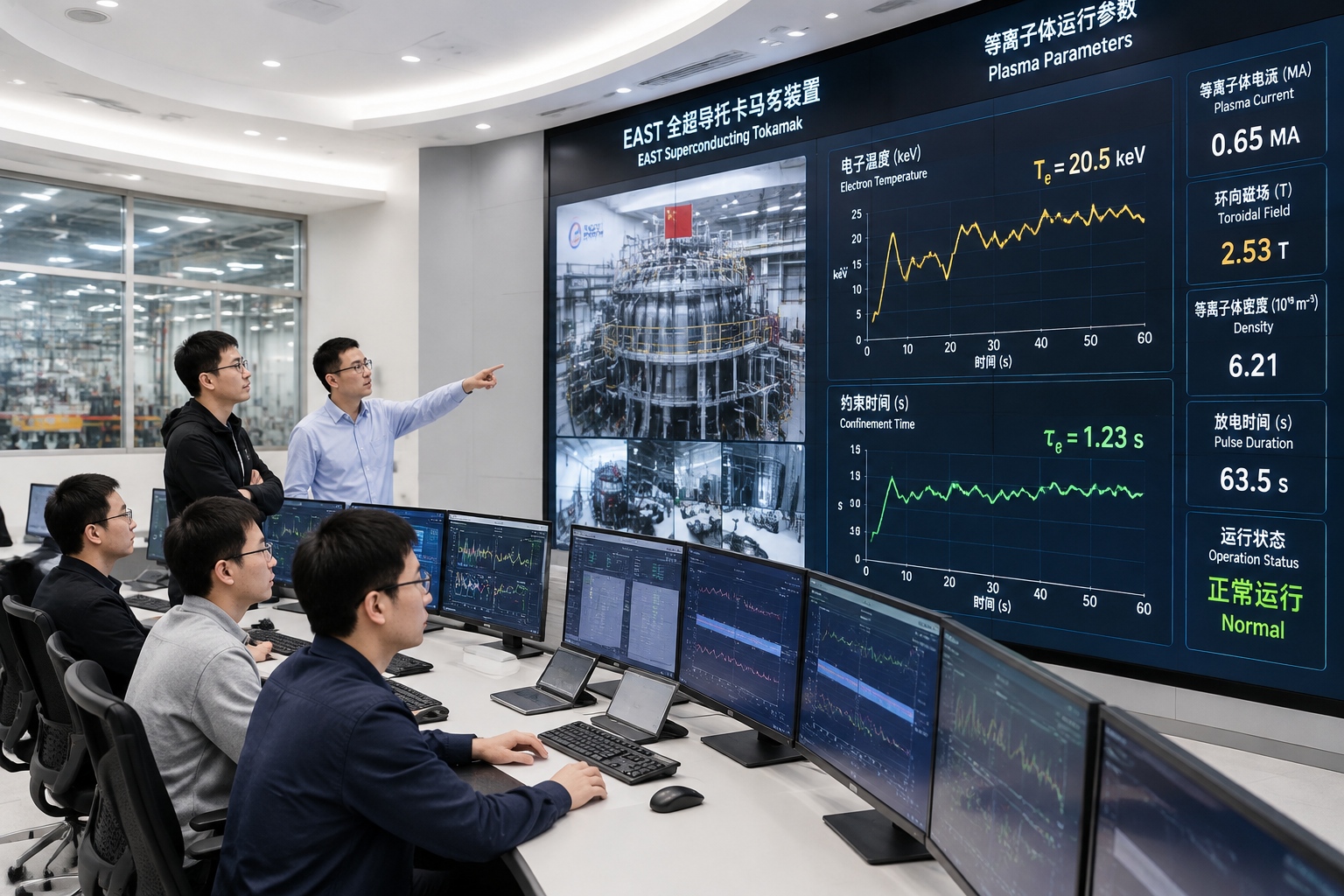
EAST has improved its performance in steady, incremental steps. In 2012, it ran for 30 seconds. In 2016, it achieved 102 seconds. By 2017, it completed a 101-second high-confinement mode — a type of operation where the plasma is better insulated, allowing higher temperature and better performance. In 2021, EAST set a world record by achieving an ion temperature of 120 million degrees Celsius for 101 seconds. In April 2023, it broke its own record with 403 seconds of steady-state high-confinement operation. And then came the big jump: on January 20, 2025, EAST sustained a high-confinement plasma for 1,066 seconds, nearly tripling the previous record.
Why 1,066 Seconds Matters
You might wonder why 1,066 seconds — just under 18 minutes — is such a big deal. In fusion research, the ultimate goal is to sustain a burning plasma for as long as possible. The longer the reaction, the more energy you can extract and the closer you get to a working power plant. Previous tokamaks, including JET in the UK and JT-60U in Japan, could only hold plasma for a few seconds in high-confinement mode. EAST’s achievement proves that superconducting magnets can keep the plasma stable for far longer periods. It also surpasses the target for ITER, the international experimental reactor in France, which is designed for 400-second pulses. That’s a huge psychological lift for the global fusion community.
The Roadblocks Between Us and Fusion Power
Despite the undeniable progress, a fusion reactor that generates electricity for the grid is still a long way off. The challenges are both physical and engineering-based.
Physics: The Uncontrollable Plasma
Plasma is notoriously difficult to control. It’s susceptible to turbulence, instabilities, and all sorts of unpredictable behavior. Sometimes it can suddenly lurch and hit the walls — a phenomenon called a ‘disruption.’ A big disruption can damage the tokamak. Scientists at EAST have to rely on sophisticated control systems and real-time adjustments to keep the plasma stable, but a single small error can ruin an experiment. Keeping the plasma stable for hours or days, as a power plant would require, is still beyond our ability.
Engineering: Materials That Survive Neutrons
The neutrons created in fusion are incredibly energetic. They bombard the reactor walls and can cause them to swell, become brittle, and lose their mechanical strength. Engineers are developing ‘plasma-facing components’ made from materials like tungsten and beryllium, but these are expensive and still not durable enough for a commercial plant. The entire reactor structure also becomes slightly radioactive over time — much less than fission waste, but still requiring careful management.
Fuel Cycle: Tritium Breeding
Natural tritium is extremely rare. It’s mostly produced as a byproduct in deuterium-based fission reactors. A single large fusion plant would burn about a kilogram of tritium per year, but the world only has a few kilograms available. So any future fusion economy must rely on ‘breeding’ tritium. This is done by surrounding the reactor with a blanket of lithium. The neutrons from the fusion reaction hit the lithium, and through nuclear reactions, produce tritium. However, the efficiency of this process needs to be very high — you need to produce more tritium than you consume. No one has yet built a working breeding blanket on a large scale.
Economics: The Billion-Dollar Challenge
Even if all technical hurdles are cleared, fusion must be economically viable. ITER, the international experiment, has already cost more than $20 billion, and it hasn’t even gone into full operation yet. Building a commercial fusion plant would likely cost tens of billions of dollars. Fusion plants would also need to compete with cheap solar and wind power, which are getting cheaper every year. Some experts argue that by the time fusion becomes available, renewables might be so cheap that fusion won’t be worth the investment. Others counter that fusion’s ability to provide constant ‘baseload’ power makes it indispensable.
What a Fusion-Powered World Could Look Like
If fusion ever reaches the grid, it could fundamentally change how we live. Energy would be so cheap that it would be virtually free. We could use it to desalinate ocean water, create synthetic fuels, recycle materials, and power the AI and data centers of the future. Countries could stop importing oil and gas, ending many geopolitical conflicts. Climate change would be tackled at the source: fusion emits zero carbon dioxide. And because the fuel supply is virtually unlimited, we wouldn’t have to worry about resource depletion.
China’s Roadmap: EAST, CFETR, and Beyond
China has a clear plan. The next major milestone is the China Fusion Engineering Test Reactor (CFETR), a larger machine that will integrate all the technologies needed for a real power plant. CFETR will be built in the late 2020s or early 2030s and is designed to produce 200-400 megawatts of fusion power. It will also demonstrate tritium breeding. After CFETR, China hopes to build a Demonstration Fusion Power Plant (DEMO) in the 2040s, leading to commercial plants by the 2050s. It’s an ambitious timeline, but China is investing billions of dollars and has a dedicated team of hundreds of researchers. The recent EAST record suggests that the roadmap is not just a pipe dream.
Conclusion: The Future Is in the Lab
In the history of energy, we’ve gone from wood to coal to oil to splitting atoms. The next leap might be in fusing them. EAST’s latest breakthrough is not just a number; it’s a proof that human ingenuity can recreate the stars. The path to commercial fusion is still long and uncertain, but the progress is undeniable. As the plasma glows in the dark hall in Hefei, it lights the way toward a future where our energy problems may be behind us. For now, the artificial sun is still a promise — but it’s a promise worth keeping.
Start the discussion at forum.chinacomes.com