
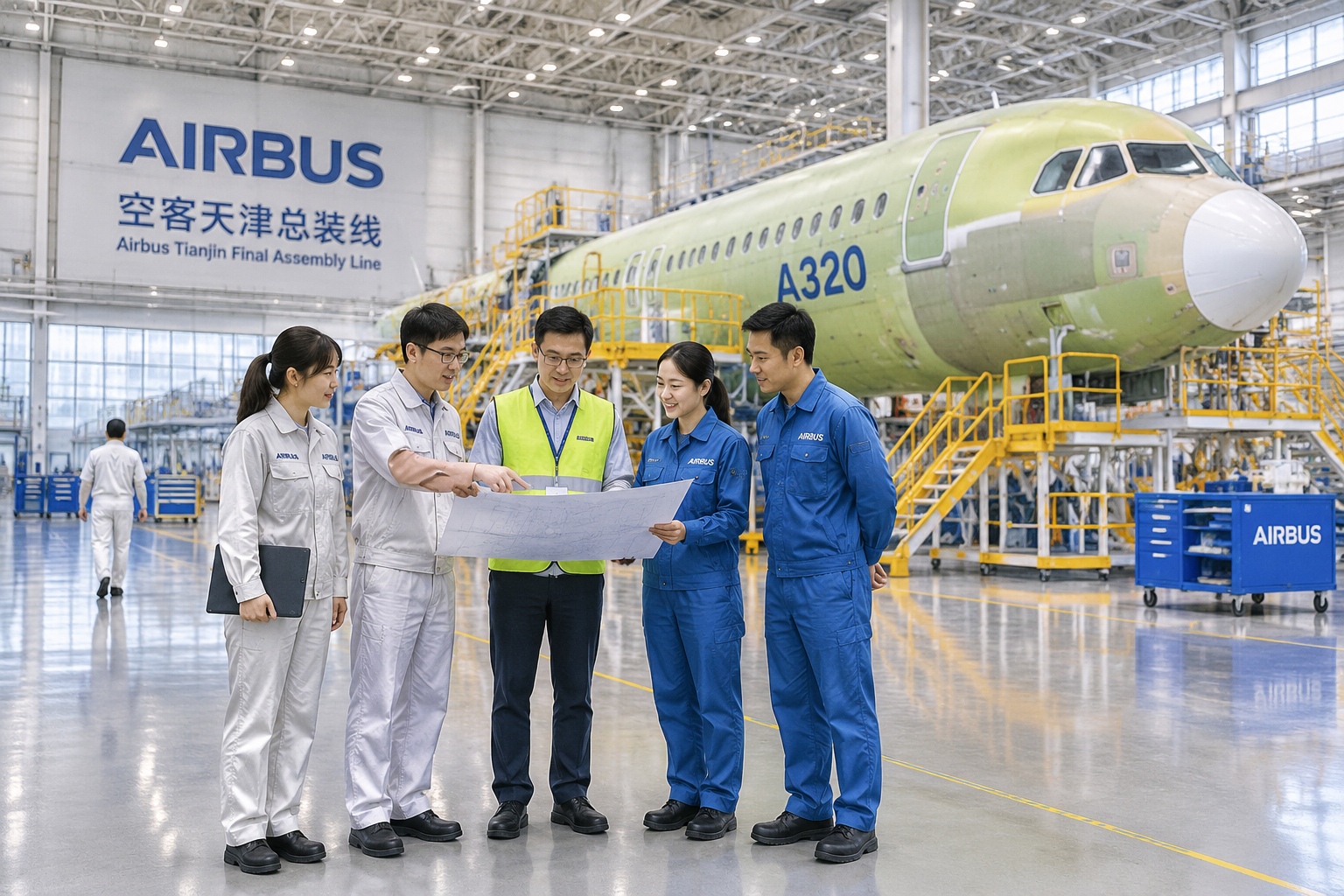

Introduction: A European Jet, Assembled in China
If you fly on an Airbus A320 from many Asian routes, chances are it was not built in Hamburg or Toulouse, but in a sprawling facility on the eastern coast of China. Since 2008, Airbus has been assembling single-aisle aircraft in Tianjin, a city about an hour’s train ride from Beijing. For many overseas visitors, this comes as a surprise: an iconic European airframer, with its meticulous engineering culture, setting up a final assembly line in China? The reality is that the Tianjin plant has not only matched its European counterparts in quality and delivery speeds but has also become a blueprint for cross-border collaborations that are reshaping global aviation.
Why Tianjin? The Strategic Bet on China’s Skies
To understand why Airbus picked Tianjin, you need to look at the numbers. China is projected to become the world’s largest air passenger market by the mid-2030s, and airlines in the region are hungry for fuel-efficient single-aisle jets like the A320 family. Rather than shipping aircraft from Europe, a costly and time-consuming logistics challenge, Airbus realized that assembling locally could speed up deliveries and align itself with Chinese aviation policy, which encourages technology and manufacturing hubs to build domestic capability.
This is not a classic assembly-shop undertaking. Instead, the Tianjin line is an integrated production system, where hundreds of suppliers feed into a single, swift-moving plant capable of turning out four A320-family aircraft per month. In comparison, Airbus’s European lines produce around six per month. Yet, the difference is more about a deliberate, lease-driven model to build local demand rather than any lack of efficiency. For a Western traveler or aviation enthusiast, visiting the plant feels both familiar and different: stainless steel jigs, robotic riveters, and meticulous inspection checklists, but with a rhythmic, efficiency-led pace that is distinctly Chinese.
An Assembly Line That Speaks Two Languages
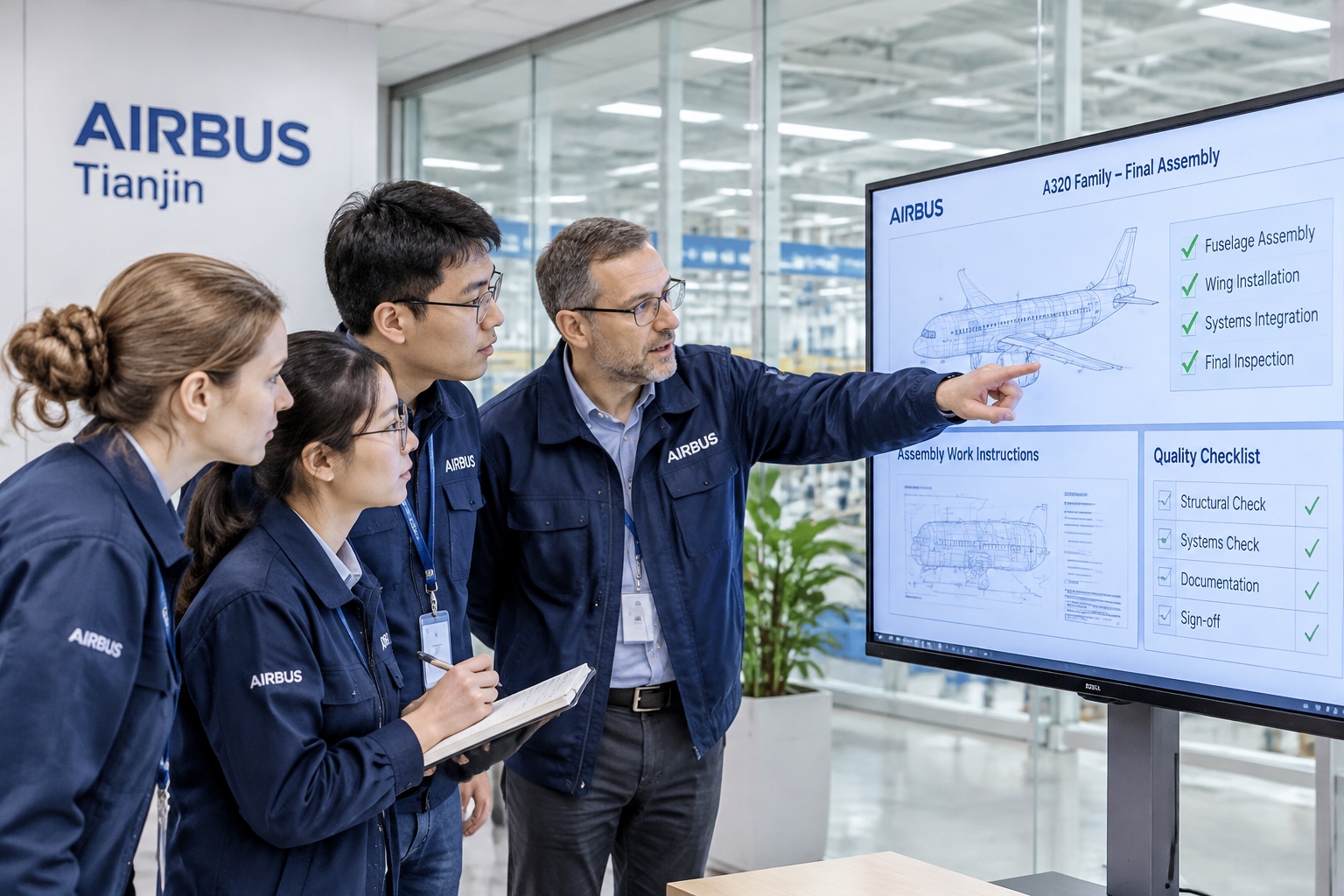
Step into the main hangar of the Tianjin base and you’ll feel it: the air hums with the language of plain management and the concentrated energy of Chinese working culture. Qingdao-speaking engineers converse in a mixture of Chinese and German, referencing thin, precise process sheets translated into both languages. Team leads in Vienna-caps and clean-room suits explain that the final assembly is a yin-and-yang of European design and Chinese-regulated execution that has, over time, worked out any cultural friction.
The biggest difference European visitors notice isn’t the robots but the discipline. In Tianjin, the A320’s wings are snapped in with military regularity. Workers follow procedure manuals to the letter—steps are ticked off on digital screens, and every task, from installing a co-pilot door to rigging a cargo bay interior, is preceded by a morning buzzer and a clear “go.” You may see young factories workers skip group conversations and head straight to their stations when a problem arises—it’s a display of the concentrated, duty-first mindset that has been in bloom in Chinese manufacturing.
Yet, it’s not a one-way process. Chinese engineers in Tianjin don’t just follow directions from Hamburg, they actively push back and propose tweaks. One manager recalls how his team had suggested a second, lightweight hydraulic riser design for the main wing connections, a rate that took Airbus Global in France six months to review but eventually increased the support time by 20 percent. “Initially, we were just a workshop,” explains a veteran engineer, a former trainer from Toulouse now deslocated in Tianjin. “Now it’s an actual cooperation, with real technical exchanges where both sides learn and not just contribute, because we might have more of the local know-how for simple operations.” This mutual learning loop is perhaps the most under-reported —and the most important—determinant of the operation insight.
Beneath the Exterior: Skill, Not Just Labor
Some outsiders still imagine China’s plants as mere sweatshops. But the Tianjin line can’t be more different. Around 70 percent of the employment, taskforce of about 1,800 people, are highly skilled mechanics, engineers, and technicians holding degrees in aerospace, mechanical engineering, or aviation electronics. The average completion age is around 3, and almost 30 percent of the floor supervisors are women.
Knowing that the Tianjin team took 8,000 hours for first four aircraft that rolled out in 2009, and now it takes roughly 3,500 hours for an aircraft, may put a different kind of Chinese efficiency into context. This did not come from overtime night after night, but from gradual learning on the job. Learnings creating a historical “ architectural knowledge base” collated from over 600 lessons learned, many of them initiated by local floor engineers.
Imagine the same level of expertise being implemented in practically any environment: each workstation receives a digital toolkit and a login into a wireless system that pulls up the digital twins. When a technician spots a scratch on a wing panel, they scan it with a hand-held 3D, upload the image to an in-house integrated system, and a specialist from a partner plant in England can instantly provide feedback. This distributed and data-driven reality matches the best of industrial Fourth Steps, quickly breaking any lingering image of China as an manufact kiln from the 1990s.
All Parts Are Local—or Are They?
When someone asks, “how much of an Airbus in Tianjin is made in China?” the answer is nuanced. Actually, the fuselage is bought from a French partner, the wings are largely produced at facilities in Wales and Bremen, and the engines are either from a German or a U.S. maker. The final assembly, IPC— the
integration of major components—
is what the assembly line specifically is executing.
It would be a serious mistake to interpret this as a purely Dutch Chinesepeeki tableau. Today, around 60 percent of the final assembled value in Tianjin is still from European suppliers. But with the recently inaugurated A321 facility, the new AMOH engine configuration has already seen more Chinese participation. Over two hundred Chinese aviation firms are vying to become suppliers of airframe subassemblies, and Boeing’s 737 rejections, forced by exchange rates, has left room for China to grow.
This very trend of localizing components—building the silly, already-observable in the early ten years—is entering a new, payload-driven era. Although it’s complicated by exam pullback’s clear intellectual property concerns, the path is realisticplanet to be finding the real step that would, for years, keep industrial ecologies joined: both sides have win-wins over know-how.
Broader Skies: What Tianjin Means for Your Next Flight
From a traveler’s perspective, the impact of the Tianjin line is larger than just changing supply chains, it eequips the industry. Thanks to very safe manufacturing experiences built in Europe, the average monthly schedule of six aircraft from Tianjin means aircraft wait time for airlines is shorter. For passengers, this means, on the A, you might be in the newest cabin environment earlier, because the Tianjin-built planes use the same strict standards. And since the line is empowered by local manufacturing efficiency, ticket prices more reliably reflect fuel and demand, rather than a translation cost.
For local Chinese families in Tianjin, housing prices in the pockets around the Airports have shot up as a concentrated logistics and parts industry emerges. The airport district, oncerusty on the price list, now prides on “aviation village,” a mix of apartment blocks, international schools, and dining rooms where the often bilingual workforce picks up fried rice and avocado toast at the same intersection.
An Enterprise of Caution: Making Cooperation Thrive
So why has this proved successful when some observers looked for divergence? First, both parties have accepted that they complement each other. Airbus needs China’s unique market scale and recapitalized industrial boost-degree. China learns from Airbus’s strict, painfully hard probe rules, and gets its employee trove trained. The complex logistics—involving transfer of high value out of the geographical boundaries—was de-risked in stages: initially a modest assembly, base, then moving to wings, and finally to modified airframe versions.
There’s transmission, however. In an era of talks of “decoupling” it gives a working alternative in block economies. The Tianjin experiment suggests that the two economies, if not the two political systems, can remain interlinked without embracing cringing convergence. For EU delegation members take a visitor there—from the biggest buyer to a manufacturer—the experience is a lesson in win-win
Start the discussion at forum.chinacomes.com