
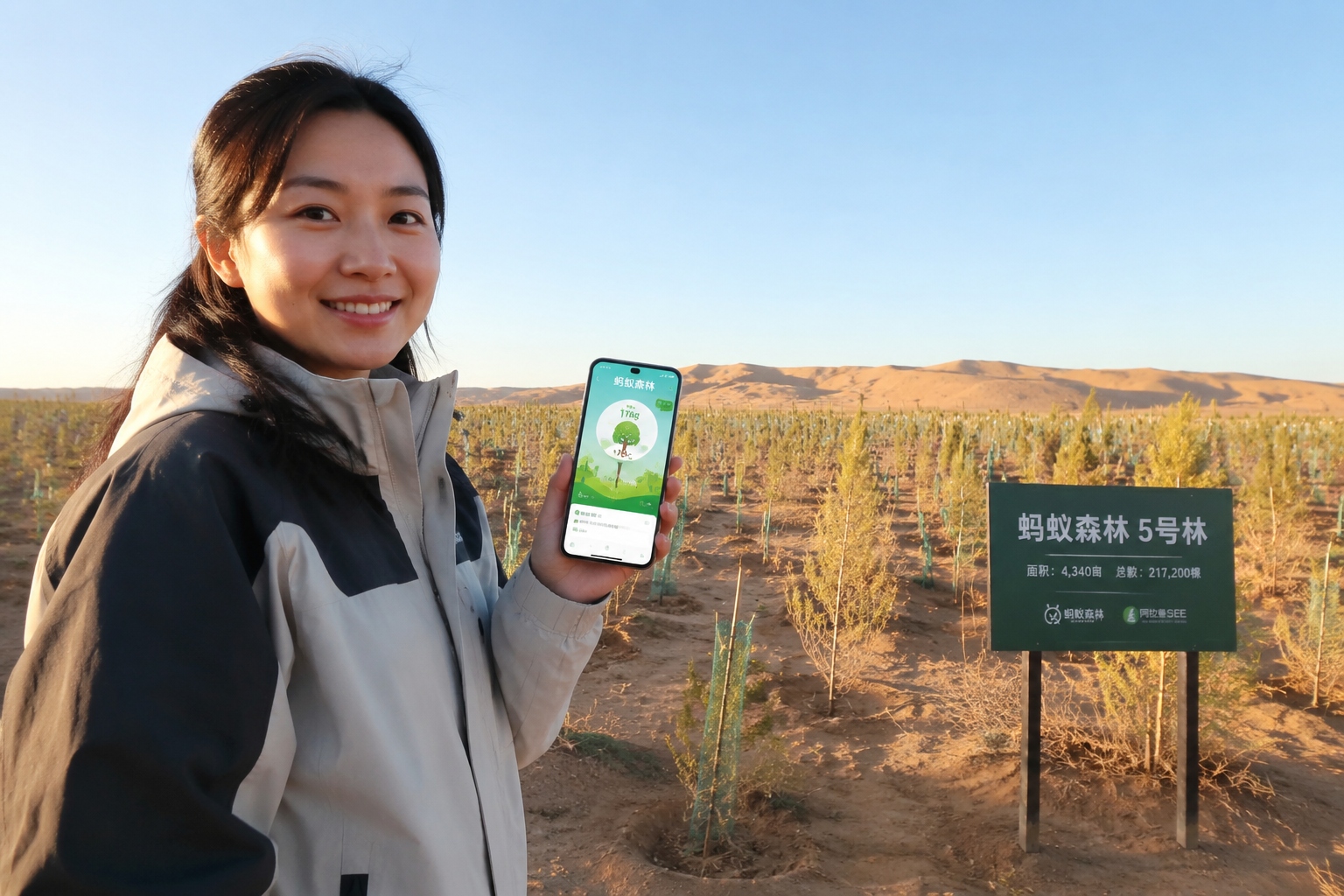

It’s 7:50 a.m. on a busy Beijing subway. A young woman in a beige coat isn’t scrolling through news or chatting. She’s staring at a small round ball on her phone screen, where tiny green bubbles are slowly filling an inner circle. When the last bubble pops, she smiles. Then her face tightens. She turns to her friend: “Did you steal my energy again?”
She isn’t playing a game—well, she is, but her gaming has planted real trees. This is Ant Forest, an app inside Alipay that has converted tiny daily eco-actions into one of the largest crowd-funded reforestation projects in history.
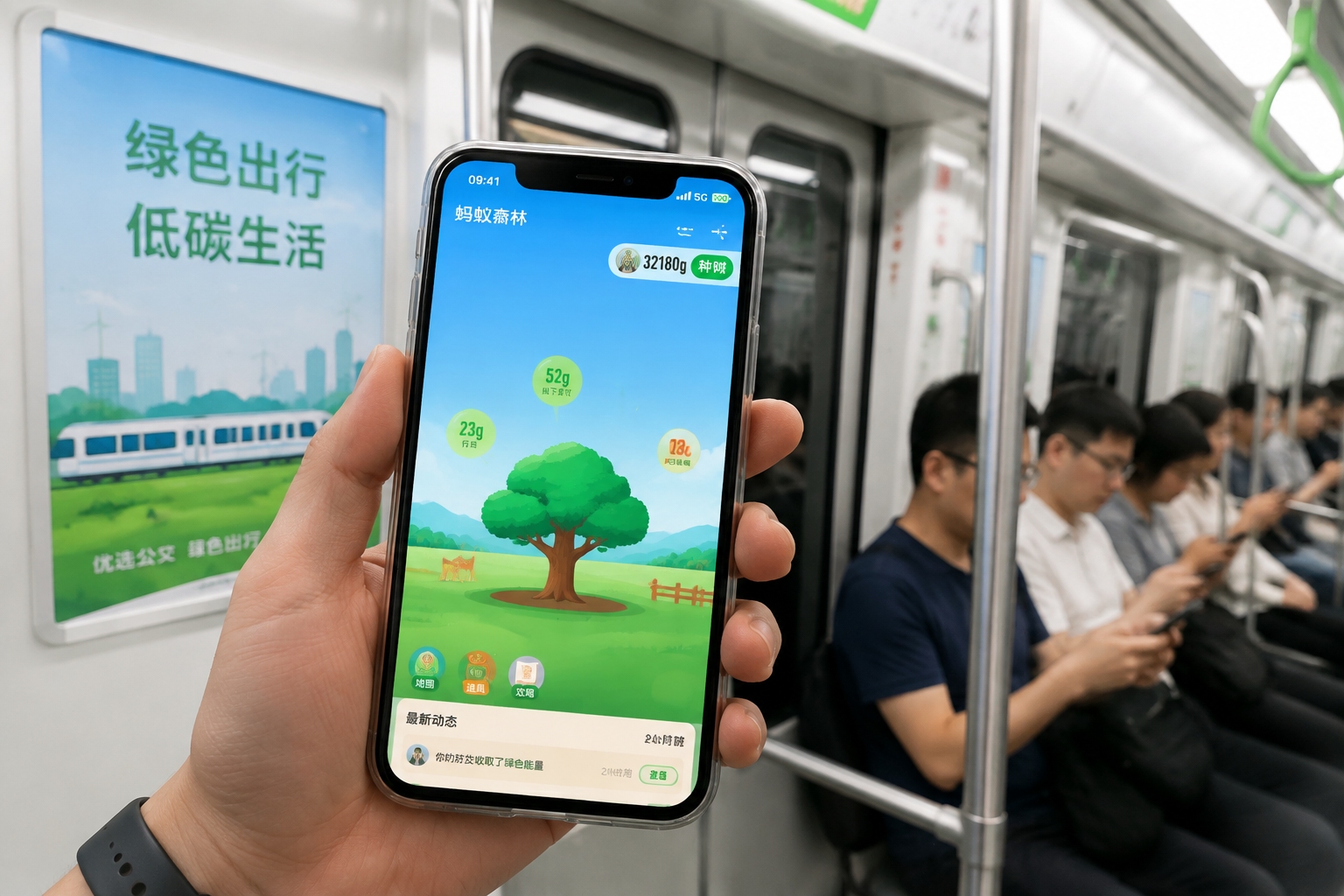
The Tree in Your Pocket
Ant Forest began in 2016 as a small feature of Alipay, China’s ubiquitous mobile payment platform. The idea was elegant: turn carbon-saving behavior into a visible, collectible reward. Walk 10,000 steps and you earn about 150 grams of “green energy.” Take the subway, pay a utility bill online, use a paperless receipt—each action earns a few more grams. When your virtual energy tank is full, you can grow a virtual tree.
But here’s the twist: when you virtually “plant” it, Ant Forest really plants one. Through its parent company Ant Group, the program funds NGOs and local governments to grow a genuine tree in some of China’s most desertified lands. Users later receive photos and GPS coordinates showing the exact location of their tree, months after it’s been rooted in the earth.
The scale is almost impossible to grasp. As of 2023, Ant Group reports more than 550 million users have taken part—about 40% of China’s population. Together they have supported the planting of over 220 million real trees, covering an area larger than Greater London.
Why Hundreds of Millions Check In Every Day
The mechanics were designed to be irresistible. Energy matures at fixed hours, so you need to return to the app “just in time” to collect it. If you don’t, a friend can sneak in and take it—like picking ripe fruit off a tree. That small piece of friendly competition, familiar from older social games, turned tree growing into a daily ritual.
My colleague in Shanghai used to set an alarm for 6:30 a.m. every day. Not for exercise—for that first burst of energy. “My whole office played,” she told me. “We had a group order. Whoever collected the most energy each month got the last slice of birthday cake.” She eventually planted three real saplings in Gansu. “I never knew what a saxaul was,” she added. “Now I get excited when someone posts a photo of one.”
There’s also a cooperative side. You can “team” with friends or family to work toward a shared tree. In some apartment blocks, neighbors form small groups to plant a little forest together. Some companies use it as a team-building exercise—the staff that plants the most trees wins an offsite day.
Inside a Reforestation Site in the Desert
I wanted to see whether these trees were real, so I joined a research trip to an Ant Forest site in Inner Mongolia. The drive felt endless, with nothing but dust and bare ground. But when we arrived, rows of waist-high saxaul bushes lined the sandy flats.
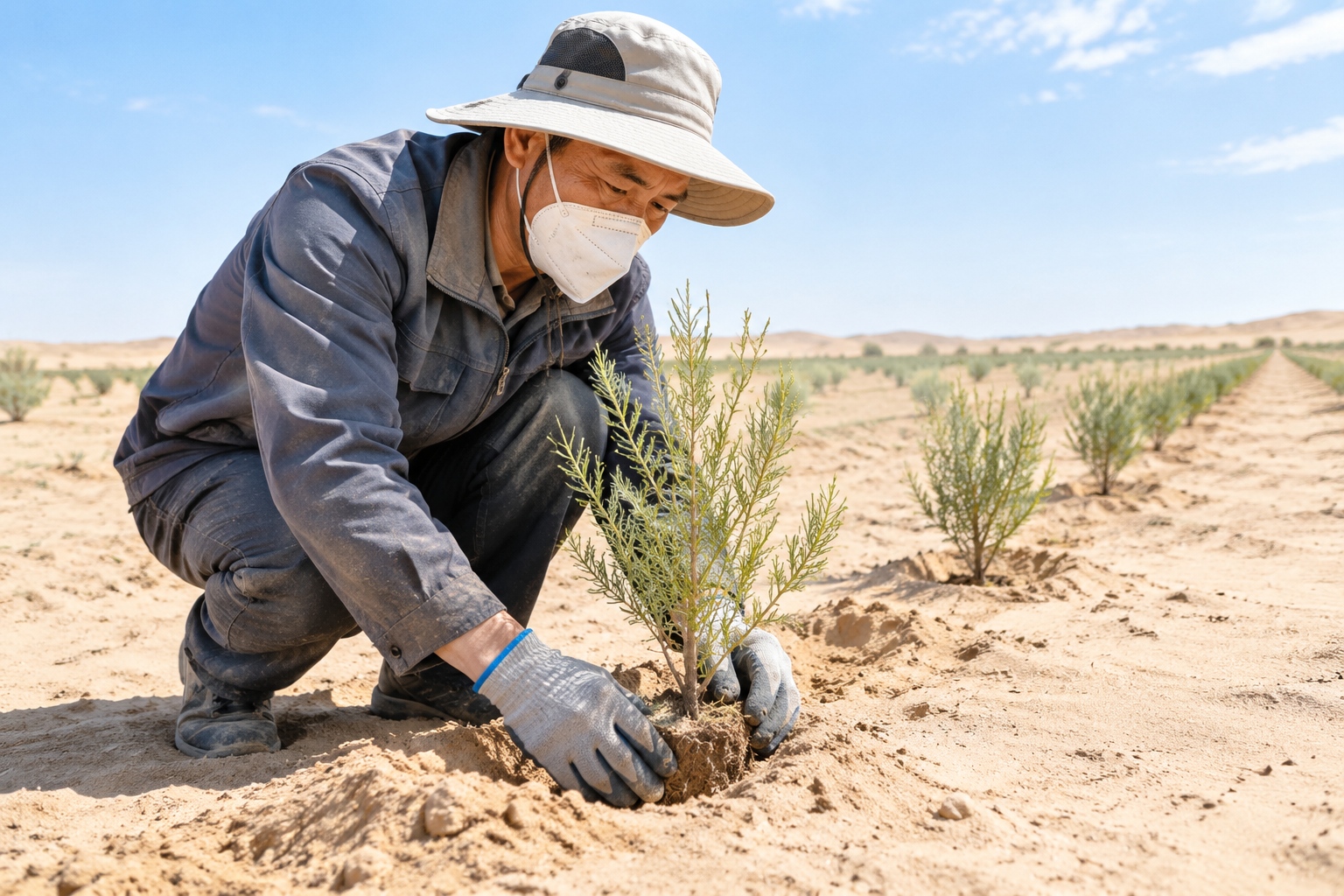
Saxaul is not majestic, but it’s perfect for such land. Its roots reach deep to stabilize shifting soil, which fights desertification. Local herders are hired to water and guard the trees. Zhang, a weathered herder in his fifties, pointed to a stretch of bushes. “Before these, the wind just shredded our land,” he said quietly. “Now the dust stays on the ground. We don’t need to wear masks every spring.”
In Gansu, where Ant Forest has planted millions of trees, satellite imagery shows a subtle but visible greening along certain slopes and valleys. It isn’t a postcard forest—the region is still dry—but it’s a foothold against the desert’s advance.
Turning Climate Action Into a Daily Habit
Beyond the trees, Ant Forest is changing the behavior of its users. Researchers from the Chinese Academy of Sciences found that, after controlling for other factors, Ant Forest users were more likely to choose walking, public transport and paper-free services than comparably placed non-users.
The reason is something psychologists call “visible feedback.” Most consequences of climate action are abstract—you can’t see your carbon footprint. Here, every small good deed adds literal drops to a tank you can watch fill up. The reward is immediate. The connection between your choices and a nearby tree is direct.
In many Chinese cities this has become part of ordinary conversation. People ask each other, “How many grams today?” as if asking about the weather. Some say they deliberately postpone a short car ride to save the environment—and collect extra energy on foot instead. These are small shifts, but multiplied across hundreds of millions of people they constitute a genuine cultural change.
A Global Blueprint for the Digital Age
The model has already received international attention. In 2019, the United Nations Development Programme named Ant Forest a “World-Leading Solution” under the Sustainable Development Goals. It also became a template for similar efforts: Philippine bank apps now offer “reward trees,” and projects in Costa Rica use mobile platforms to track seedling survival.
What makes Ant Forest different is its connection to an existing payments giant. It didn’t need a separate app or a new habit—it was a feature inside an app people were already using daily. That’s why it reached scale faster than any stand-alone environmental campaign.
There are valid questions, of course. How many trees survive over decades? How are indirect emissions calculated? Yet even with those caveats, the core idea is a breakthrough: using digital incentives to align private interest with public good. It shows that climate action doesn’t have to be a burden; it can be something people genuinely enjoy doing, together.
The Quiet Miracle
On a recent afternoon in Gansu, I met a man in his late fifties, watering young saplings from a hose. His phone was in a plastic case around his neck. I asked if he’d ever planted a tree on his phone. He laughed. “No, that’s my daughter’s hobby. She’s always telling me she has a tree somewhere out there.” He waved at the field. “Maybe it’s this one.”
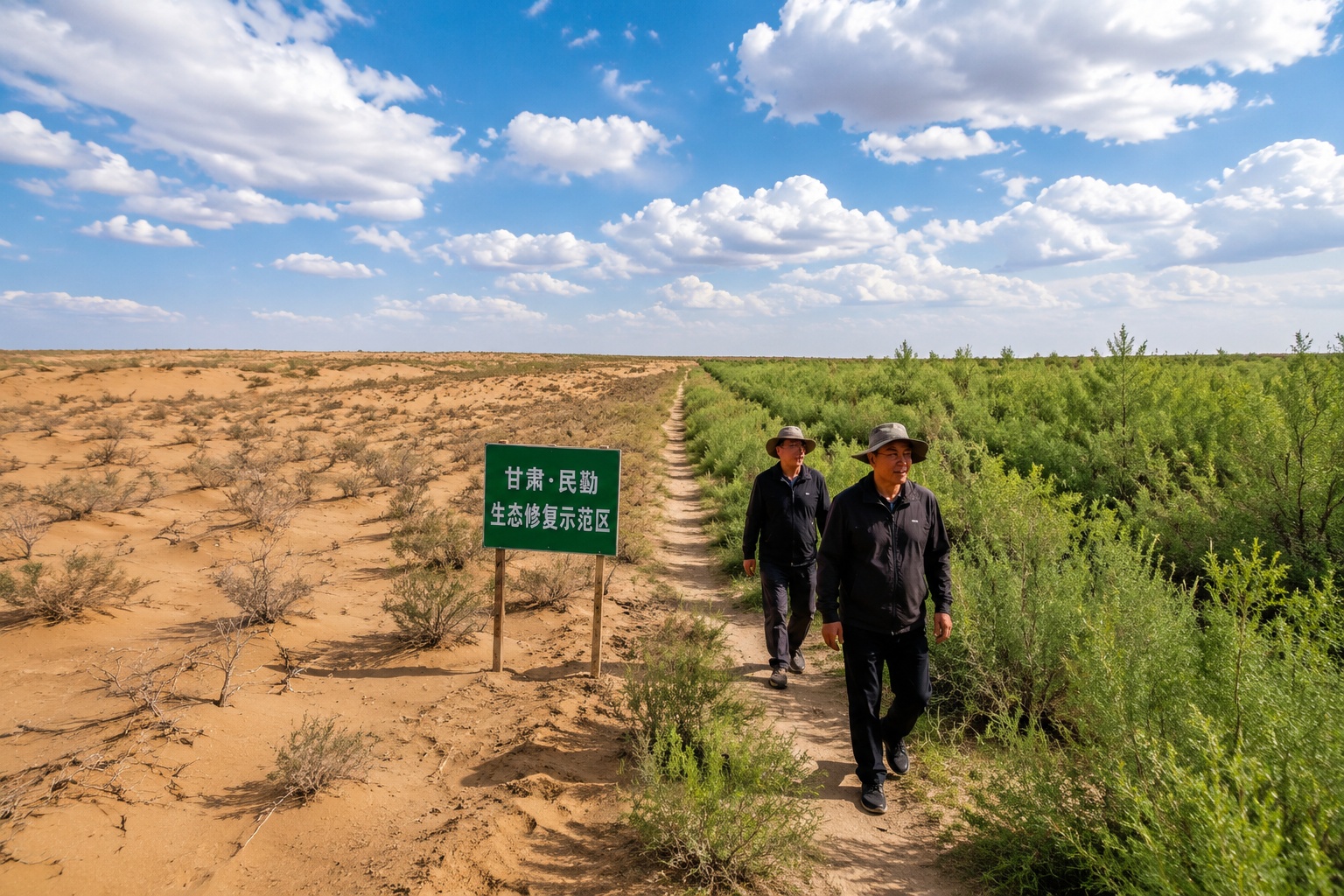
His daughter’s tree might not be exactly that one. But she helped pay for it, and she’s proud of it. The feeling that you helped create a forest—one tap at a time—is the miracle itself. The young woman on the subway, her colleagues in Shanghai, the herders in the desert: they are all part of a single, huge, quiet act of care. And it grew out of a phone screen.
That, I think, is the real story of Ant Forest. It proves that when technology makes good actions easy and fun, millions of ordinary people will, quite literally, change the landscape.
Start the discussion at forum.chinacomes.com