

A concert ticket for someone who was never born
I bought the ticket on my phone, on a Tuesday night, in about ninety seconds. 380 yuan — around $52 — for a seat on the floor in Hangzhou. The app handed me a seat number, a QR code, and a small animated portrait of the person I was going to see.
Her name is Luo Tianyi. In China she is a xuni ouxiang — a virtual idol. She sings, dances and talks to fans. She exists as a synthesized voice library and a 3D model, and she has appeared on televised New Year galas, in game crossovers and on the sides of buses. She has no body, no passport, and no way to cancel a show because of a sore throat. According to the ticket, she would perform for two hours.

What a virtual idol is, and why China has so many
The idea started in Japan. Hatsune Miku, launched in 2007, was software: a voice synthesizer that let anyone type in lyrics and get a singing voice back. The character was packaging. The fans did the rest — they wrote songs, drew her, and turned a piece of software into an idol.
China picked up the format and localized it. Luo Tianyi debuted in 2012 from a Shanghai company, with a Mandarin voice library and a catalogue of Chinese-language songs, most of them written by fans rather than by a label. ByteDance, the company behind TikTok and Douyin, launched a five-member virtual group called A-SOUL in 2020; they livestream several nights a week on Bilibili, a video platform that is roughly what YouTube and Twitch would look like if they had a baby together.
By most counts, Bilibili now hosts tens of thousands of virtual performers, from polished studio groups to teenagers with a laptop, a microphone and a 2D drawing. The entry cost is a drawing and a mic. That is a big part of why the category grew so fast here: it does not require a stage, a tour bus or permission from a record company.
Inside the room: a sheet of film and a very good projector
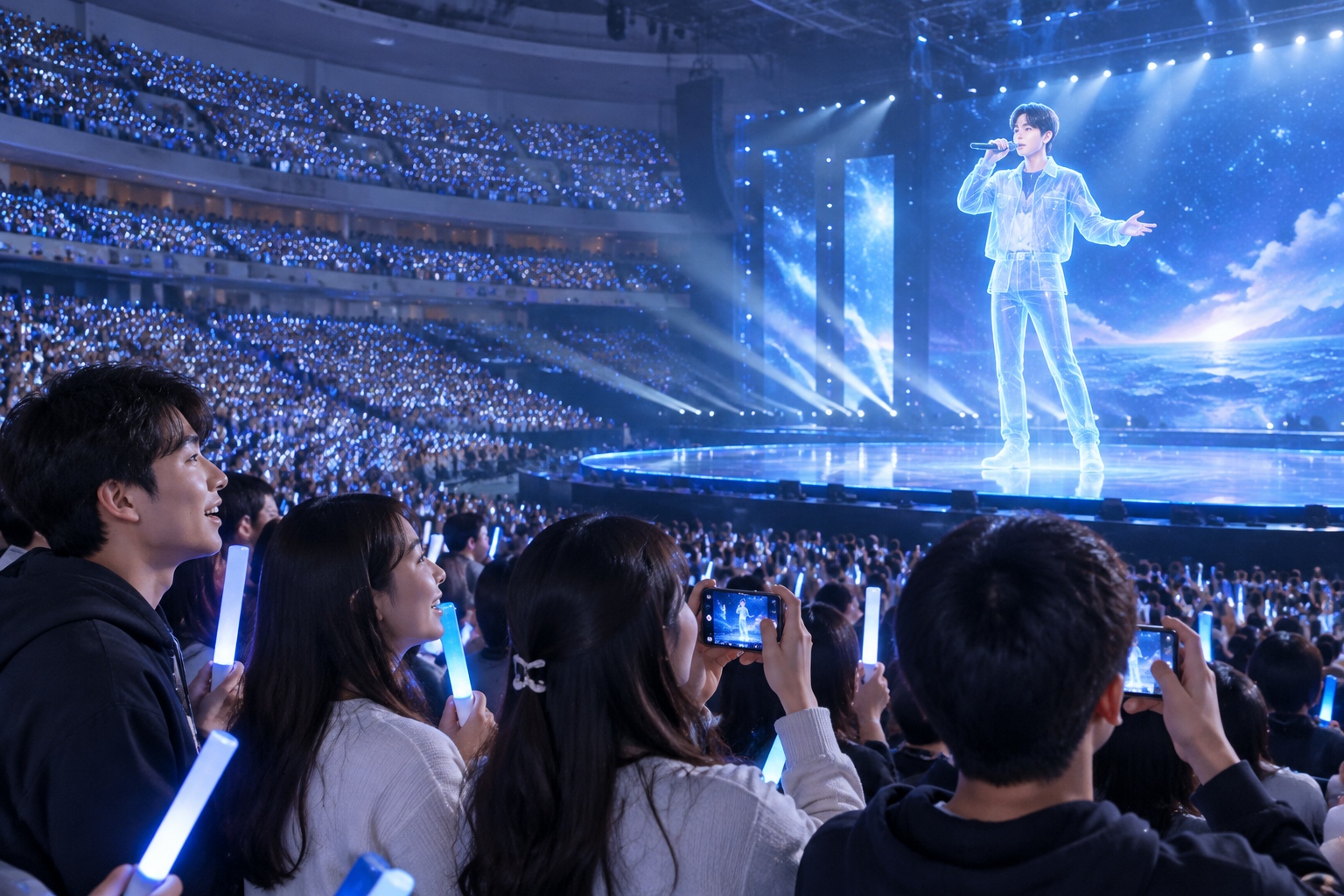
Almost none of the “hologram concerts” in China are actually holograms. The trick is older than cinema — Pepper’s ghost, the same optical illusion Victorian theatres used to make ghosts walk on stage. A huge, nearly invisible sheet of film is stretched across the front of the stage at an angle. A high-brightness laser projector throws the character’s image onto it, and the audience sees a glowing figure standing on the boards, apparently solid, apparently three-dimensional.
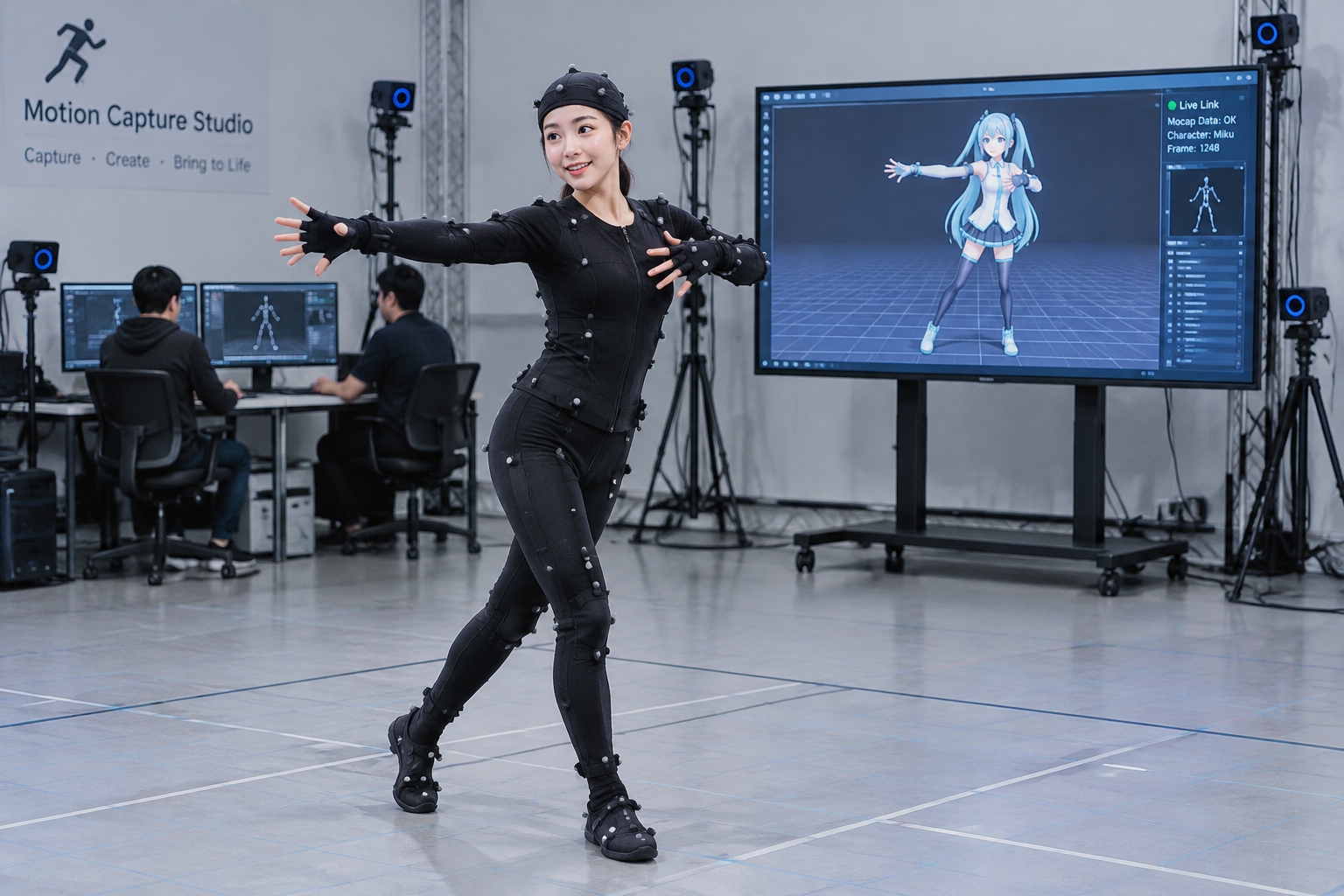
What has changed is everything around the illusion. The rendering is fast enough to be live. A performer in a motion-capture suit stands backstage, and the avatar copies their hips, fingers, head turns and mouth in real time. Giant LED panels behind the stage carry the same image, enlarged, for the people in row 40 who can’t see the film properly.
The detail that surprised me most had nothing to do with the singer. Every wristband in the arena was centrally controlled. When the song shifted, twelve thousand light sticks changed from blue to white in one second, as if the crowd had been re-rendered. The audience was part of the render.
There are tells, if you look. The character’s wave arrives a fraction of a second after the beat. Her hair passes slightly through her shoulder when she spins. Nobody around me seemed to mind. A man in his thirties next to me was filming with two phones at once.
Why people pay real money for a digital voice
“I know she’s pixels,” Chen Yuxin, 23, told me after the show. She works in e-commerce in Hangzhou and had come with two friends, all three wearing the same pale blue ribbon in their hair. “But I also know twelve thousand people were singing the same line at the same time. That part is real.”
Liu Haoran, 19, a student in Wuhan, bought the 58-yuan VR ticket instead of travelling. He watched in a headset with two friends in other cities, a voice channel open the whole time. “It’s cheaper than a train ticket,” he said. “And we were basically in the same room.” Which room, exactly, is a fair question.

The emotional logic of this fandom is different from ordinary celebrity culture. A human idol’s catalogue belongs to a label. Luo Tianyi’s catalogue mostly belongs to her fans: they write the songs, tune the voice, upload the videos, and vote on which tracks get performed. When they buy a ticket, they are partly buying back their own work.
There is a second reason, and fans say it out loud. Human idols age, get tired, say the wrong thing, get into scandals, retire. A digital one is consistent. On a bad day, she is exactly the same as she was on a good day. For some people, that reliability is the whole point.
The business: tickets, glow sticks and monthly subscriptions
Live tickets for a top-tier virtual idol in China typically run from around 280 to 1,200 yuan. Online VR or livestream tickets cost a fraction of that — often 30 to 120 yuan — and let a fan in a small city join a show in Shanghai without leaving home. That price gap is one reason the format scaled here: the audience is not limited by geography or by the size of an arena.
Merchandise does the heavy lifting. Acrylic standees, badges, plush toys and light sticks sell in the hundreds of thousands of units. On Bilibili, fans pay monthly “captain” subscriptions to support a virtual streamer, roughly 138 yuan at the top tier, plus virtual gifts during livestreams. Brands have noticed, partly because a digital spokesperson carries none of the personal risk of a human one.
Market-size numbers in this sector are generous and inconsistent — research firms quoted in Chinese media describe a market worth tens of billions of yuan, with forecasts that get sillier the further out you look. A safer observation is simpler: enough people are paying that companies keep launching new idols, and enough of them fail that this is clearly not a license to print money.
An export product nobody planned
China’s virtual idols travel more easily than its human ones. A 3D character does not need a visa, a translator or a tour schedule. A-SOUL clips get subtitled into Japanese, Thai and English by overseas fans, mostly without being asked. Chinese game companies push the same logic further: game soundtrack concerts now fill arenas from Shanghai to Los Angeles, and audiences show up for songs from games they have played for years.
This is cultural export of a particular kind — less about official promotion than about platforms, fandoms and a format that started in Japan and now has a distinctly Chinese accent. In Southeast Asia especially, Chinese-language virtual idol content sits comfortably alongside Japanese and Korean pop, in the same apps and the same fan group chats.
The awkward parts
Behind every smooth avatar is a person in a suit covered in reflective dots, and that person is usually invisible. Their name may appear in a credit roll; often it doesn’t. When A-SOUL’s fans suspected in 2022 that one of the performers behind an avatar was being treated badly, the protest that followed became one of the biggest online labour disputes in Chinese entertainment that year — fans demanding better conditions for a worker they could not see. The company involved denied mistreatment. The episode made an uncomfortable point: you can build a fandom around a character, but the character is still made by someone.
There is also the money question. Fan spending can get intense, and some of it goes into light sticks and subscriptions instead of savings. Young people in smaller cities, with fewer physical venues and thinner social circles, are often the heaviest users. Whether that is a new kind of loneliness or a cure for one is genuinely contested, and I heard both arguments from people standing in the same room.
The counterweight is real too. The same fan groups organize birthday events in shopping malls, donate to charity in the idol’s name, and run their own illustration contests. The fandom is not only consumption; a lot of it is production, and some of it is friendship.
Where the line goes
After the last song, the arena didn’t empty so much as drain slowly, everyone holding up phones, the light sticks fading to a soft grey. On stage, the figure waved. The wave arrived half a second after the music stopped.
Outside, a young woman was wiping her eyes with her sleeve. I asked her why. “It’s not that I think she’s real,” she said, and then thought about it for a moment. “It’s that she’s the only one who has never let me down.”
That sentence is doing a lot of work, and I don’t think it resolves cleanly. What is clear is that the old question — is it real, or is it fake? — is not the one the audience is asking. They already know. They paid for the parts that feel real, and they know exactly which parts those are.
Start the discussion at forum.chinacomes.com