
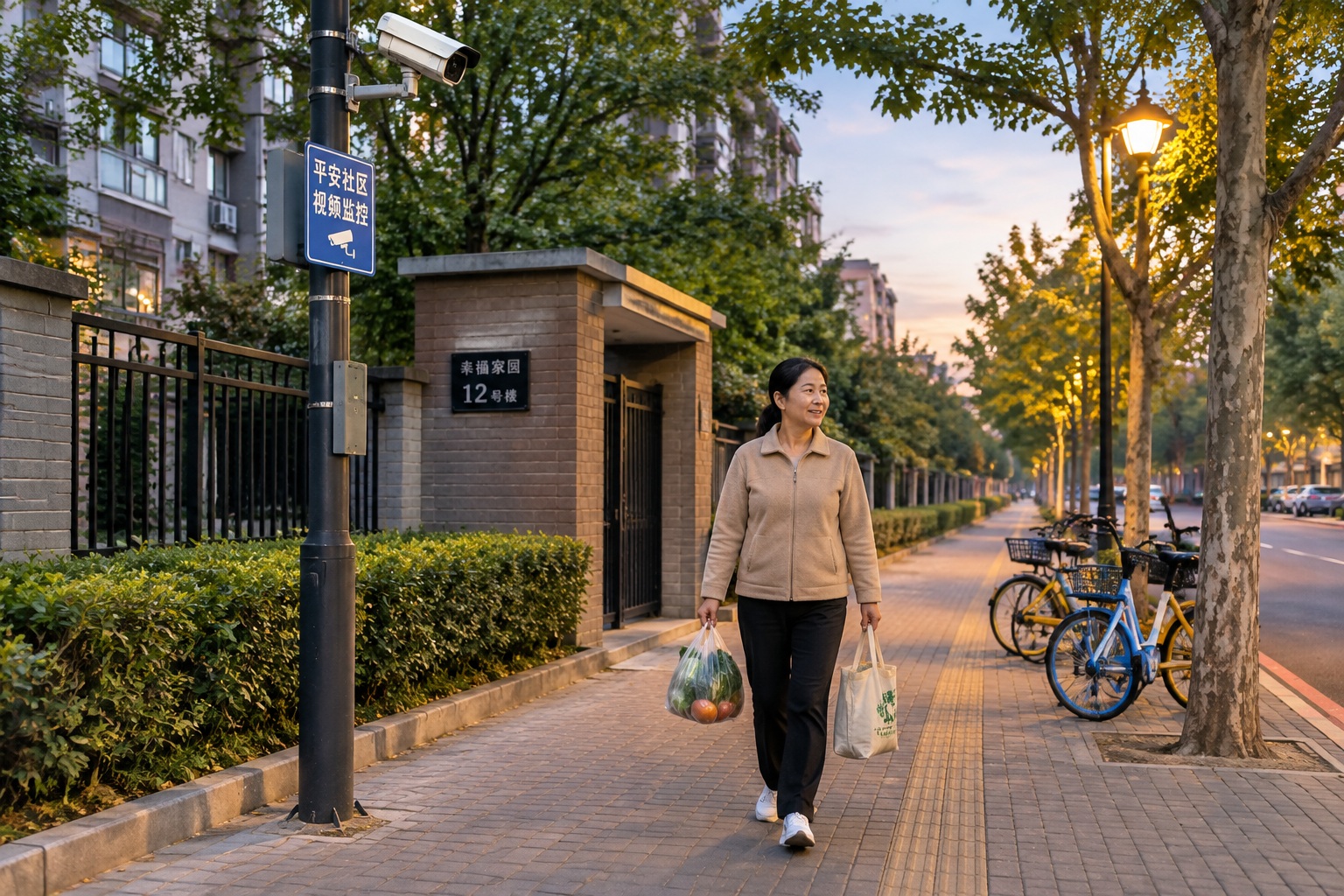

It Started With a Lost Grandfather
Last winter, my neighbor’s 82-year-old grandfather walked out of the residential compound in Beijing’s Chaoyang District and didn’t come back. He had early-stage dementia. His family called the police at 7 p.m. By 10 p.m., they had found him sitting on a bench near a subway exit four kilometers away.
How? The police pulled footage from three street cameras and one camera mounted at the entrance of a nearby supermarket. The whole search took less than three hours.
That evening, I stood in the lobby of our building with a group of neighbors, waiting for the family to bring him home. Nobody said the word “surveillance.” Everyone said “thank goodness those cameras are there.”
But if you ask a friend in London or New York about China’s camera network, the first word they’ll probably use is different. So let’s talk about it honestly.
What Is ‘Skynet,’ Actually?
The Chinese term 天网 (Tianwang) literally means “heavenly net.” It sounds ominous in translation. In practice, it’s an umbrella term that gets applied to a messy, layered reality.
There isn’t one giant system watching everything. There are at least four overlapping kinds of cameras:
- Traffic cameras operated by municipal traffic management, mostly for license plate recognition, red-light enforcement, and congestion monitoring.
- Public security cameras at intersections, subway stations, train stations, and major pedestrian areas, run by local police departments.
- Community cameras installed by property management companies at residential compound gates, parking garages, and elevators.
- Private cameras outside shops, restaurants, and office buildings, installed by owners for theft prevention and insurance purposes.
These systems don’t all feed into one room. They’re operated by different agencies, companies, and sometimes individual shopkeepers. When people abroad say “China’s surveillance state,” they’re usually imagining a single panopticon. The reality is more like a patchwork — which doesn’t make it less powerful, but does make it more complicated.
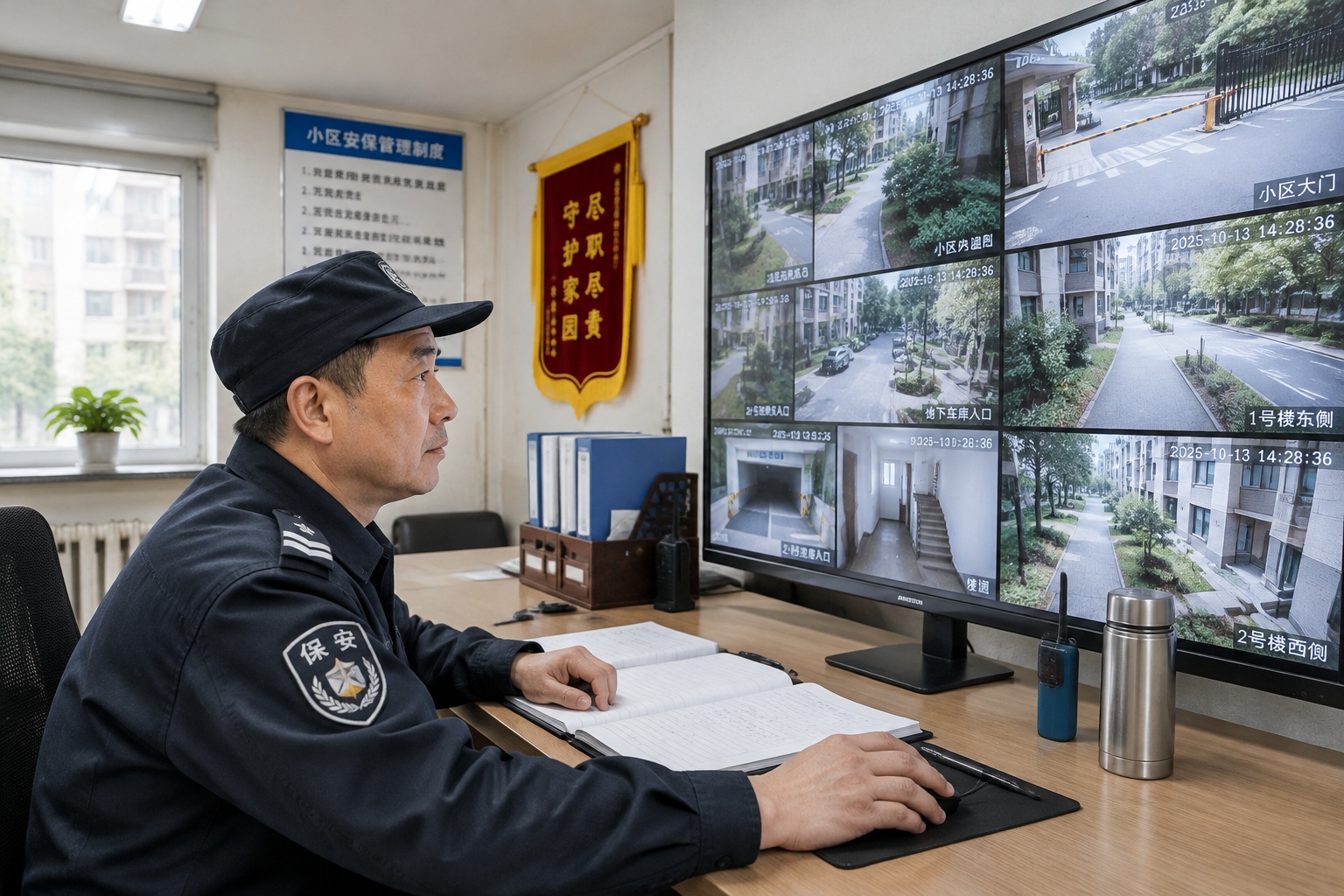
What It Feels Like on the Ground
I asked a few people in my neighborhood how they actually feel about the cameras. Not in a survey way — just over tea and in the elevator.
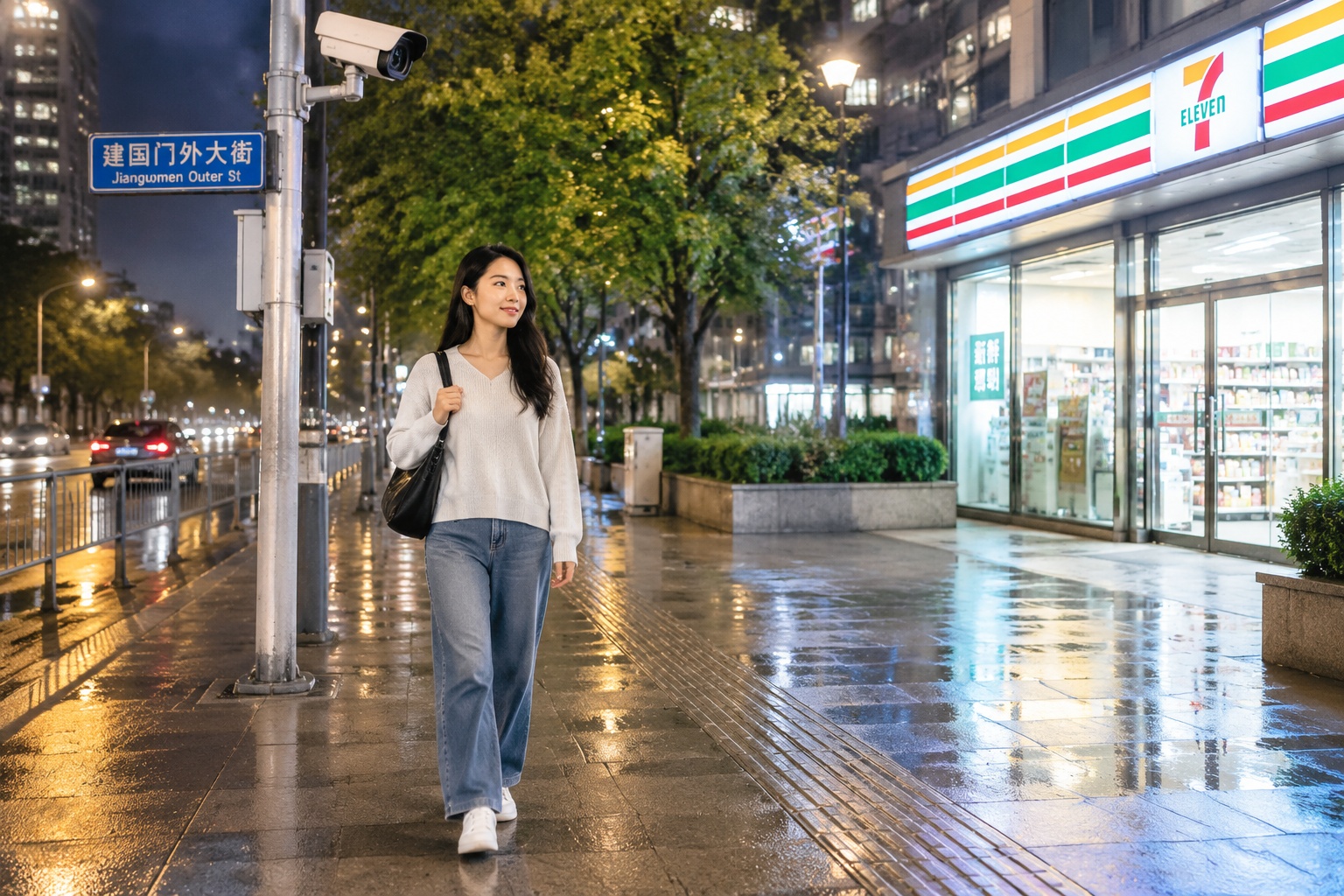
“I walk home at midnight and don’t think twice”
Liu Yan, 28, works at an advertising agency in Guomao. She often gets off the subway after 11 p.m. and walks 15 minutes to her apartment.
“Honestly, I feel safer knowing the street is covered,” she said. “I’ve lived in cities abroad. In some places, I wouldn’t walk alone at night. Here, I do. Maybe that’s naive, but it’s my real experience.”
“The camera found the guy who hit my car”
Mr. Chen, 45, runs a small stationery shop near a primary school. Last year, someone sideswiped his parked car and drove off. He filed a police report, and within two days, the traffic police identified the other vehicle from intersection camera footage.
“I didn’t have to argue with anyone,” he said. “The footage was clear. Case closed.”
“It stopped people from throwing things out the window”
In my own compound, there was a recurring problem with residents tossing garbage and sometimes glass bottles from upper floors. After the property management installed cameras pointed upward at the building facades, the incidents dropped to almost zero. One caught case led to a fine and a very public apology in the building’s WeChat group.
The Privacy Question — Yes, It’s Real
I’m not going to pretend nobody worries about privacy. Plenty of people do. I do, sometimes.
China passed its Personal Information Protection Law (PIPL) in 2021, which sets rules for how personal data — including facial images — can be collected and stored. Public security footage is generally retained for a limited period, often 30 to 90 days, unless it’s tied to an ongoing case. Unauthorized access or leaking of surveillance data is punishable by law.
That said, enforcement varies. There have been cases of security guards illegally sharing footage, and those cases usually go viral on Chinese social media — because people care. The outrage is real.
For context: London has roughly one CCTV camera for every 13 people. New York has thousands of public and private cameras, and the NYPD has experimented with facial recognition. China’s per-capita camera density in major cities is higher than both, but it’s not the only country grappling with this tension.
The difference is cultural framing. In many Western countries, the default question is: How do we limit state power? In China, the default question is often: How do we make the neighborhood safe?
Different People, Different Answers
I spoke with more than a dozen people for this piece. The range of opinions was wider than you might expect.
A college student, 21: “I don’t love it, but I also post everything on Xiaohongshu. I’ve kind of accepted that privacy is a trade-off.”
A retiree, 67: “When I was young, we didn’t even have locks on our doors in the danwei. Now we have cameras. It’s just a different kind of lock.”
A restaurant owner, 38: “The camera outside my door saved me from a false insurance claim. A customer said she slipped on my steps. The footage showed she tripped on the curb across the street. I didn’t have to pay a cent.”
A software engineer, 31: “I think about it more than most people. I cover my laptop camera. But I also use facial recognition to unlock my phone and pay for groceries. It’s contradictory. I know.”
Why the Acceptance Is Broad — but Not Blind
There are a few reasons the cameras don’t provoke the same level of public backlash in China as they might elsewhere.
First, collective safety has deep cultural roots. The idea that the group’s security matters as much as individual convenience isn’t a recent invention. It shows up in everything from neighborhood watch committees to the way people share information about local scams in WeChat groups.
Second, the results are visible. China’s homicide rate is among the lowest in the world. The clearance rate for violent crimes is high — over 90% in many provinces, according to public security reports. Petty theft in major cities has dropped significantly over the past decade. People notice.
Third, the technology is woven into daily convenience. The same facial recognition that unlocks your apartment gate also pays for your coffee. The same license plate system that tickets you for running a red light also helps you find your car in a massive parking garage. It’s not experienced as a separate “surveillance layer” — it’s just part of the city’s operating system.
So, Surveillance or Protection?
Here’s my honest answer as someone who lives here: it’s both. And the balance depends on who’s holding the controls and what rules they follow.
I’ve felt protected when a camera helped find a missing person. I’ve felt uneasy when I read about a security guard misusing footage. Both things are true.
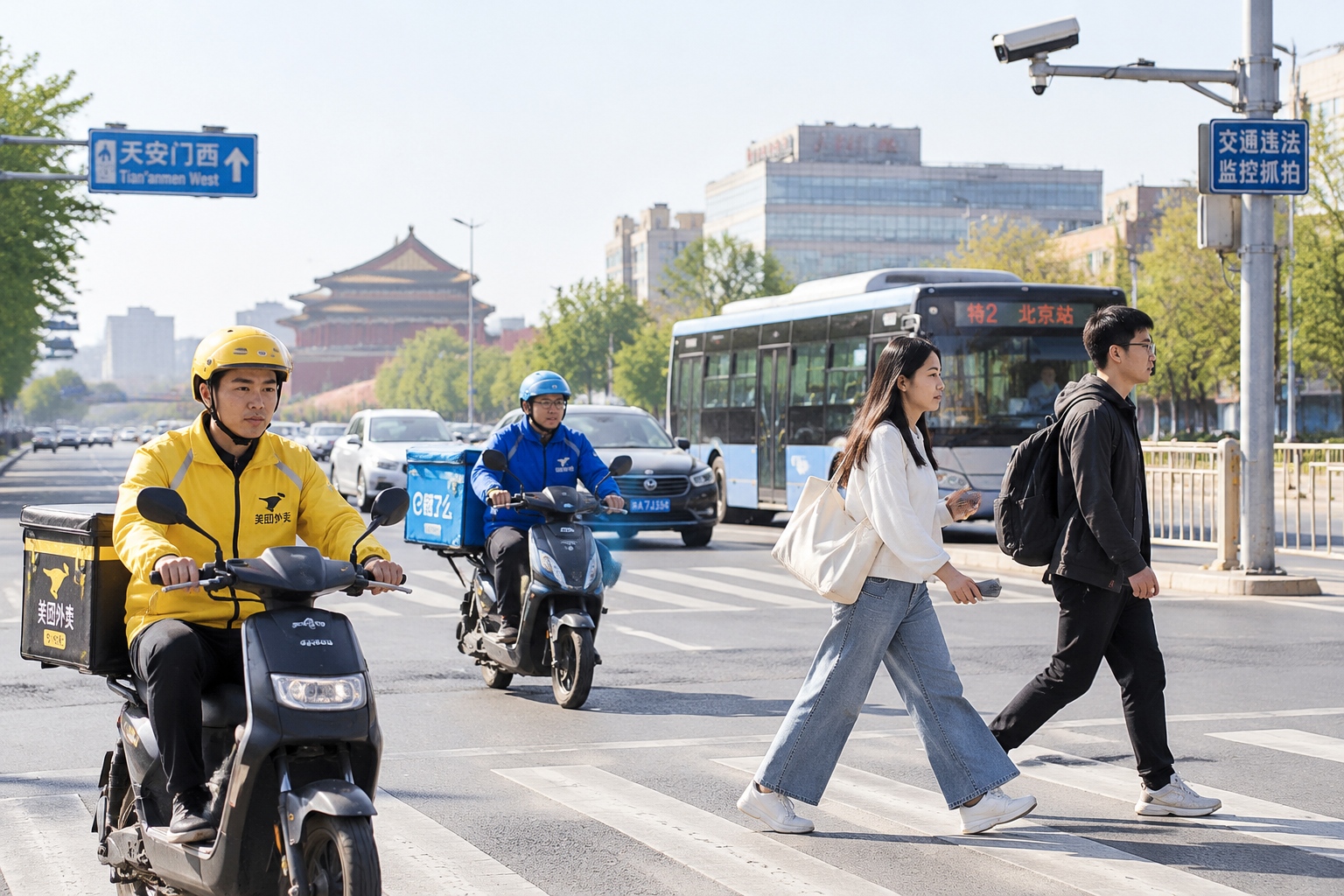
What I’d say to a friend abroad is this: don’t imagine China as a country of 1.4 billion people cowering under cameras. That’s not what I see. I see grandmothers doing tai chi in parks, kids buying street snacks after school, delivery riders weaving through traffic — and yes, cameras on almost every corner. Most people don’t think about them most of the time. When they do, it’s usually because something went wrong and the footage helped.
That doesn’t mean the debate is over. It means the debate is more nuanced than a headline.
If you live in a city with cameras — and you probably do — I’m curious: do they make you feel safer, or watched? Or both?
Start the discussion at forum.chinacomes.com