

Three Hours from Guiyang: A Market Day in a Dong Village
The bus left Guiyang at 6:40 a.m. with eight passengers and a crate of live ducks. Three hours later, after the concrete road narrowed to a single lane and the fog lifted off the terraced rice fields, we arrived in a Dong village in southeastern Guizhou. It was market day.
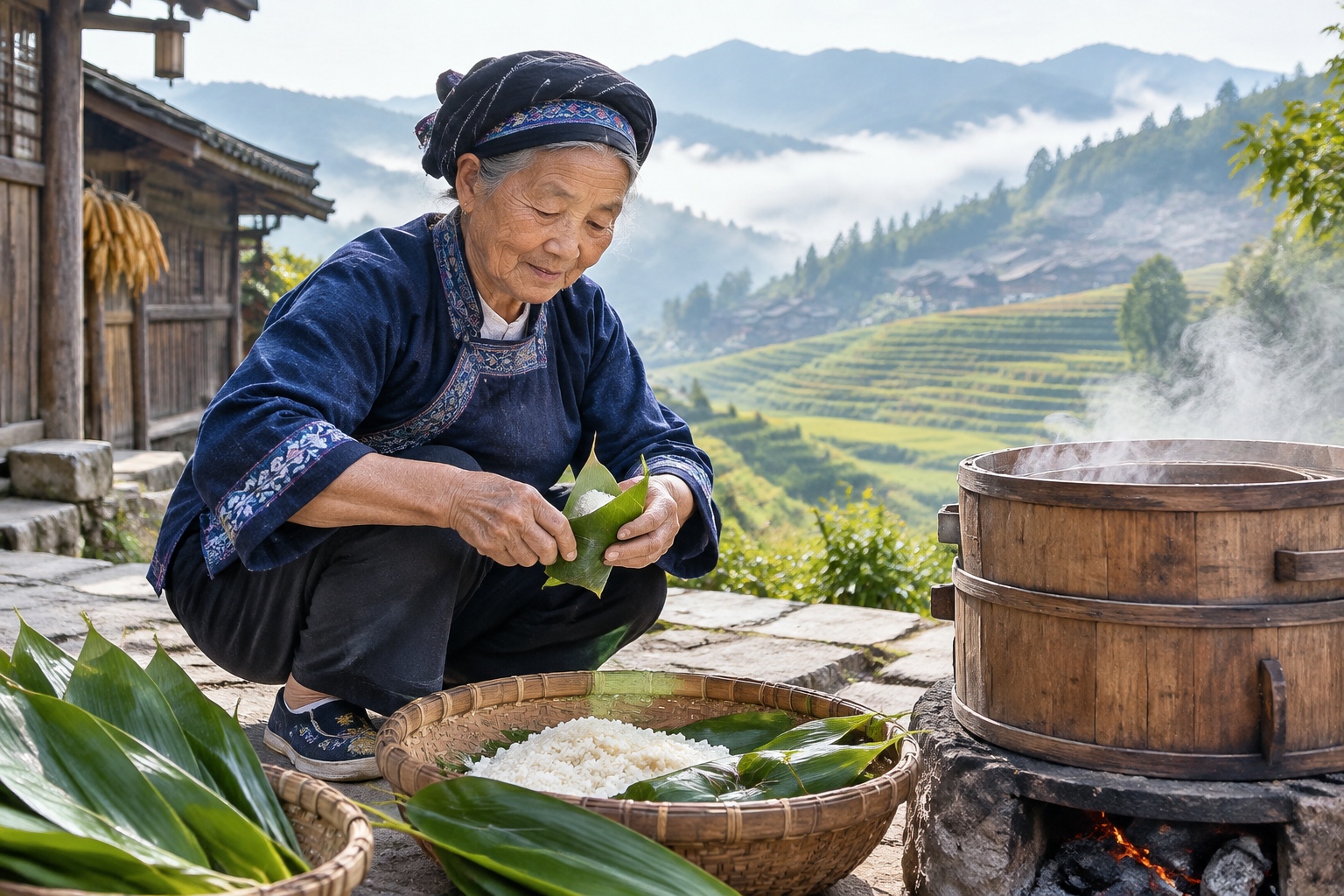
The main street—barely wide enough for two bicycles—was lined with bamboo baskets. An old woman squatted beside a wooden bucket of steaming glutinous rice, her hands moving fast, wrapping the sticky grains in a fresh green leaf. She added a spoonful of crispy fried pork cracklings and a few strands of zhe’ergen—fish mint, a root vegetable with a taste somewhere between cilantro and raw fish. She folded the leaf into a tight packet and handed it to a waiting customer. No words were exchanged. The transaction took four seconds.
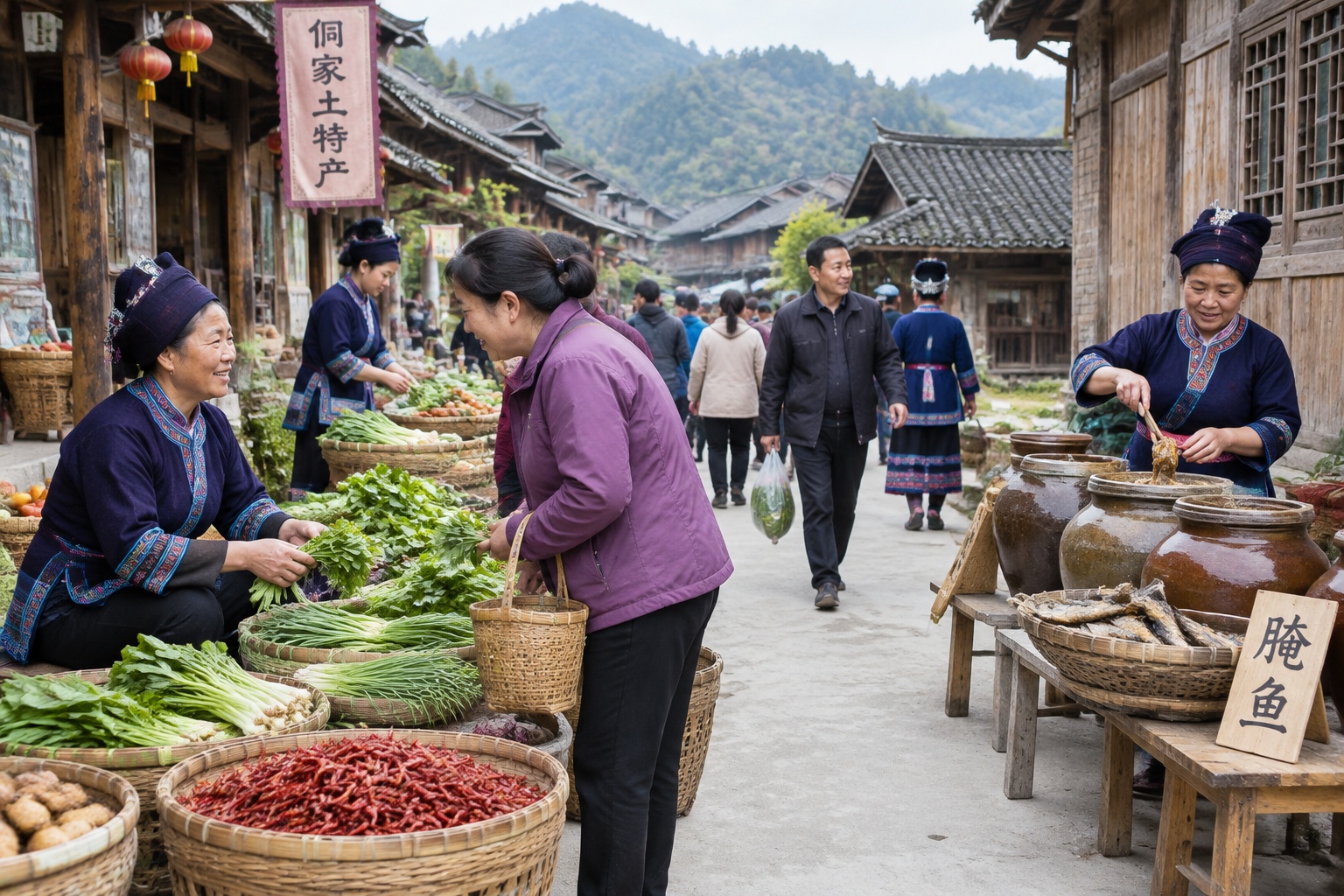
This is not a scene staged for cameras. There are no English menus, no laminated photos, no QR codes linking to a tourist review page. The food here is eaten by people who have eaten it their whole lives.
Why the Food Tastes Different
Guizhou is one of China’s poorest provinces by GDP per capita, but that statistic hides something important: it is also one of the most food-self-sufficient. The mountainous terrain—part of the Yunnan-Guizhou Plateau—makes large-scale agriculture difficult. Instead, families grow rice on terraced plots, raise pigs and ducks in courtyards, and ferment vegetables in ceramic jars buried halfway into the earth.
What this means for the food is simple: almost nothing is imported. The glutinous rice in that morning packet was harvested from a nearby field. The pork cracklings came from a pig slaughtered three days earlier. The fish mint grew wild along the irrigation ditch.
There are no chain restaurants here. No McDonald’s, no KFC, not even a Lanzhou noodle franchise. The nearest convenience store is a 40-minute walk. When I asked a villager where she buys cooking oil, she looked puzzled. “We use lard,” she said. “From our own pigs.”
Recipes are not written down. They are learned by standing next to a grandmother for twenty years. When I asked a woman in her fifties how she knows when the fermented fish is ready, she shrugged. “You smell it. You taste it. You know.”
Three Snacks You Won’t Find in Guiyang’s Tourist Streets
1. Nuomifan Tuan: The 6 A.M. Sticky Rice Packet
Every morning before sunrise, Auntie Wu sets up her stall at the edge of the village square. She steams glutinous rice in a wooden bucket over a charcoal fire. The rice is slightly purple—a local variety called heinuomi, or black glutinous rice. She scoops it onto a fresh leaf, adds either crispy pork cracklings or pickled radish, then a pinch of fish mint, and wraps it tight.
The cost: 3 yuan (about 40 US cents). The eating: you hold it in one hand, bite through the leaf, and chew. The texture is sticky, chewy, slightly smoky from the charcoal. The fish mint hits you at the back of the throat—cool, slightly medicinal, completely addictive.
For a foreign palate, fish mint is the challenge. It is not cilantro. It is not mint. It is something else entirely—earthy and raw. Most first-timers spit it out. By the third bite, they are asking where to buy seeds.
2. Niubie Tang: The Soup That Isn’t Trying to Be Weird
Let’s get this out of the way: niubie is made from the partially digested grass and herbs in a cow’s stomach. The liquid is filtered, boiled, and used as a soup base. To outsiders, it sounds like a dare. To the Dong and Miao people of Qiandongnan, it is comfort food—the equivalent of chicken soup for a cold.
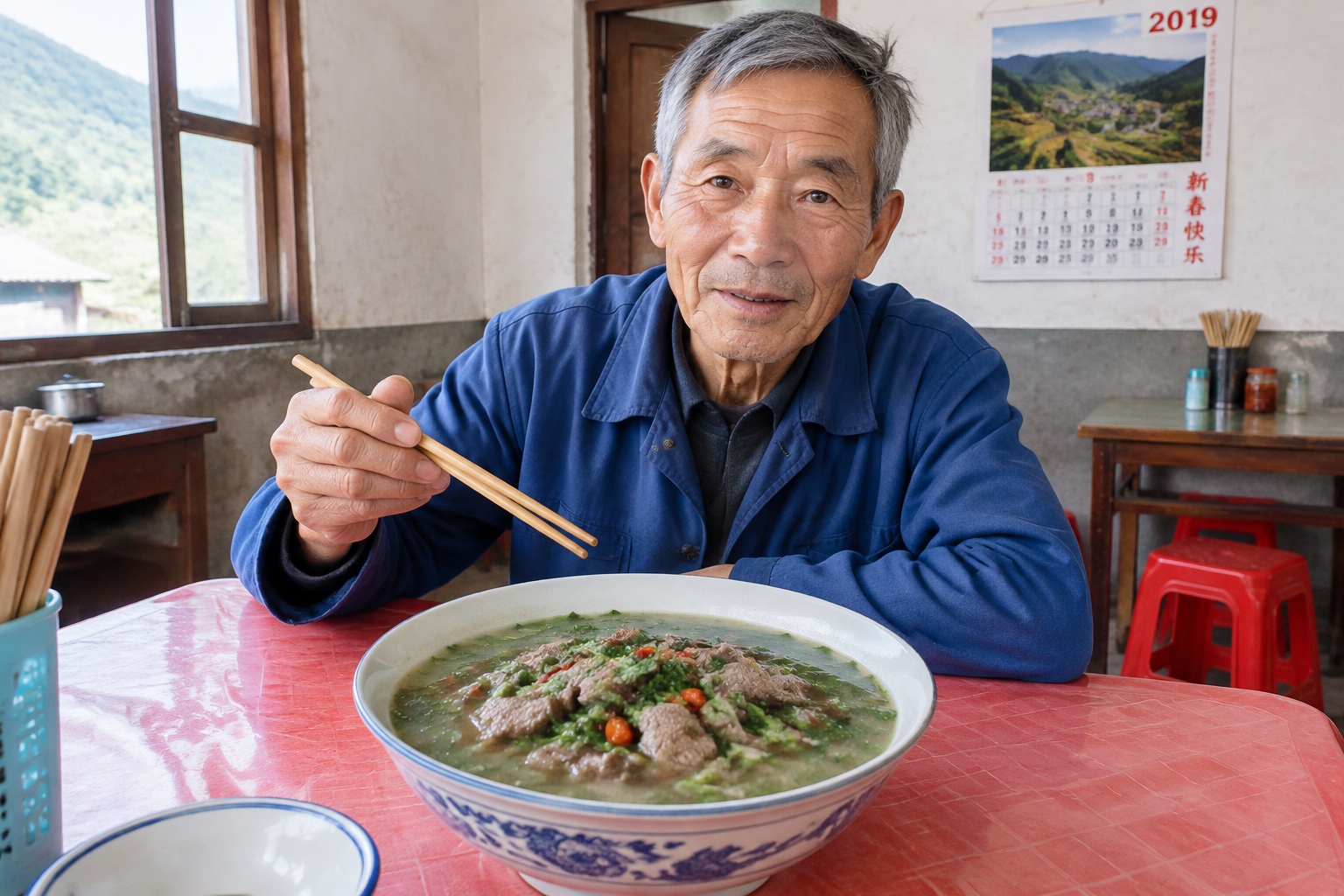
I ate it in a small family restaurant with plastic stools and a wall calendar from 2019. The owner, a man in his sixties named Lao Yang, brought out a bowl of grayish-green broth. It smelled grassy, slightly sour, with a hint of bile. Floating in it were thin slices of beef, chili, and wild herbs.
The taste is not extreme. It is bitter at first, then savory, then oddly refreshing. The aftertaste is clean—like drinking a strong green tea after a heavy meal. Lao Yang explained that the cow is fed specific herbs before slaughter—mint, ginger, and a local plant called wujiapi—which gives the broth its medicinal quality.
“This is not for tourists,” he said. “This is for when you have a stomachache, or when you are tired, or when a guest comes to your home.”
3. Yanyu: The Fish That Lives in the Rice Field and Dies in the Jar
Rice-fish farming is an ancient system: small carp or crucian carp are raised in flooded rice paddies. They eat insects and algae. Their waste fertilizes the rice. In autumn, when the rice is harvested, the fish are caught.
Some are eaten fresh. Many are preserved. The method is simple: clean the fish, rub it with salt and rice wine, layer it in a ceramic jar with cooked rice, chili, and ginger, then seal the jar with water. It ferments for at least three months. Some families keep jars for over a year.
The result is a fish that is sour, spicy, and deeply savory. The bones have softened. The flesh is dense and slightly chewy. You eat it with plain rice, a little at a time—it is too intense for large bites. The flavor is not fishy in the way Westerners might fear. It is funky, like a good aged cheese, but with chili heat.
A Day with a Young Restaurant Owner
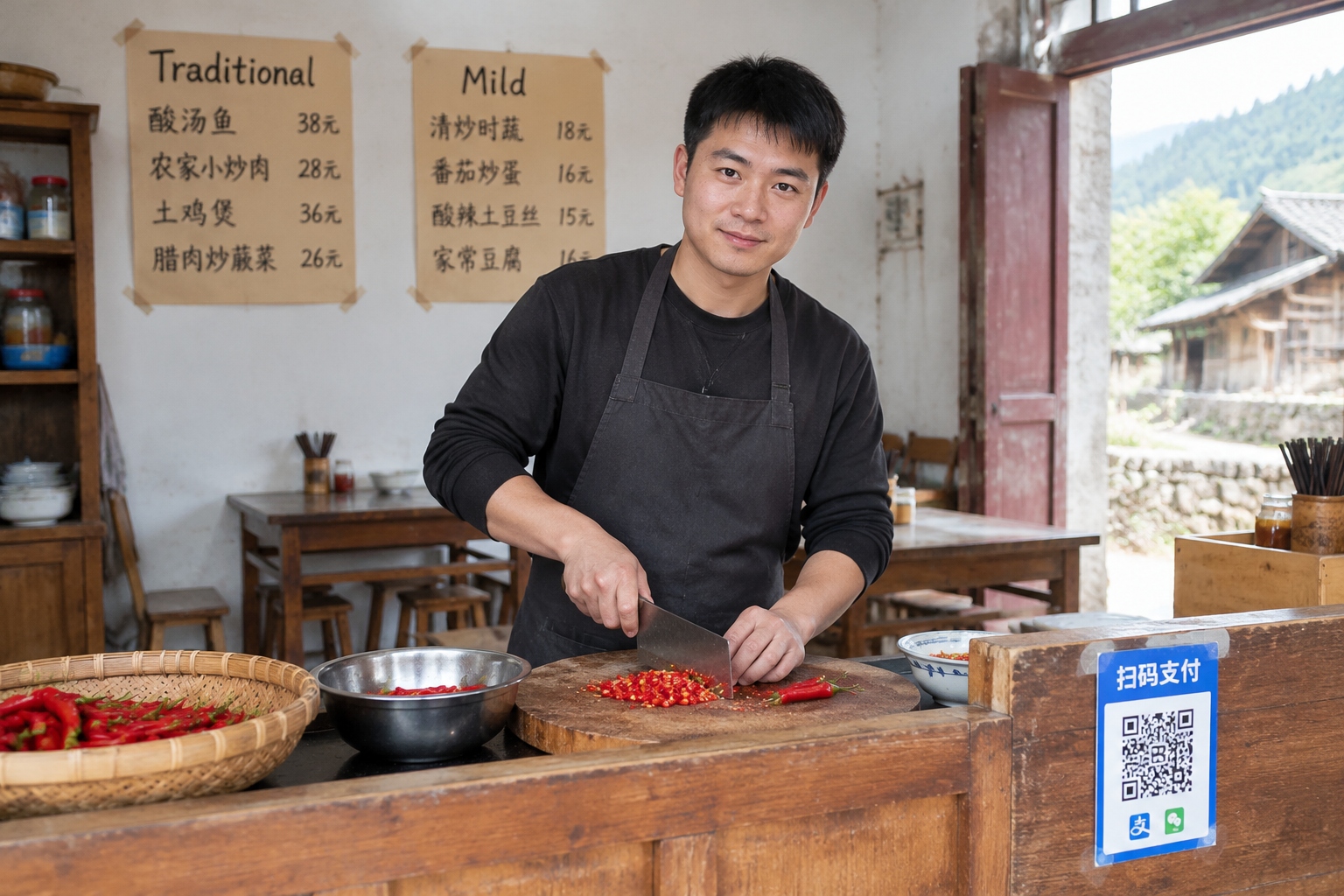
Yang Fan is 28 years old. He left the village at 18 to work in a factory in Dongguan, making phone cases. He returned three years ago to open a small restaurant next to the village school. He serves traditional Dong dishes, but with small adjustments.
“The older people want the food exactly as it has always been,” he said, while chopping chili peppers. “But the younger people, and the few tourists who come, they want less salt, less oil, less fermentation.”
He showed me his menu. There were two columns: “Traditional” and “Mild.” The traditional yanyu is served straight from the jar. The mild version is stir-fried with fresh vegetables and less chili. The traditional niubie soup is made with the full-strength broth. The mild version uses only a small amount of the broth, diluted with chicken stock.
“I don’t want to change the food,” he said. “But I also want to make a living. So I give people a choice.”
His restaurant seats 20 people. On market days, it is full. On other days, he closes at 2 p.m. and works in his family’s rice field. He makes about 3,000 yuan a month—more than he made in the factory, but less stable. He is not sure if he will stay. “If the village gets more tourists, maybe,” he said. “If not, maybe I go back to Dongguan.”
Change Is Arriving, Slowly
The concrete road to the village was built in 2017. Before that, it was a dirt track that turned to mud in the rainy season. Now a truck can reach the village in 90 minutes from the nearest town. This has made it easier to sell rice and buy supplies. It has also made it easier for young people to leave.
There are 47 households in the village. Ten years ago, there were 12 children in the school. Now there are four. The village elder told me that most young people work in factories in Guangdong or Zhejiang. They send money home. They come back for Spring Festival. They complain that the village is boring.
But something else is happening. Tourists are starting to come. Not many—maybe 20 a week in the summer. They arrive on motorbikes or in small tour vans. They take photos of the wooden houses and the terraced fields. They buy sticky rice packets and ask what’s in them.
Last year, Auntie Wu, the sticky rice vendor, started accepting mobile payments. She has a QR code printed on a piece of cardboard. She doesn’t own a smartphone—her grandson set it up for her. The money goes directly to his account. She says it’s easier than counting coins.
What “Undisturbed” Really Means
It would be easy to romanticize this village as a place untouched by modernity. That would be false. The village has electricity, satellite TV, and 4G signal. The young people have TikTok accounts. The old people complain about young people’s clothes. The local government is building a new parking lot for tourist buses.
But the food is still made the way it has always been made. Not because the villagers are trying to preserve culture, but because they don’t see any reason to change. The rice tastes good. The fish is what they have. The soup keeps them healthy. Why would they buy frozen dumplings from a supermarket when they can make something better themselves?
This is what “undisturbed” means in practice: not frozen in time, but not yet packaged for mass consumption. The food is not a performance. It is lunch.
For a visitor, the experience is not about checking off exotic dishes. It is about sitting on a plastic stool, watching a woman wrap rice in a leaf, and realizing that the transaction is not just about money. It is about knowledge that has been passed down through generations, adapted to the land, and served without apology.
Practical Information for Visitors
Getting there: The village is about 3 hours by bus from Guiyang, or 90 minutes by car from Kaili, the capital of Qiandongnan Prefecture. Buses leave Guiyang’s East Bus Station twice daily. You can also hire a car with a driver for about 400 yuan per day.
Best season: Autumn (September to November) is best. The rice fields are golden, the fish are fat, and the weather is cool. Spring is also beautiful but rainy. Summer is hot and humid. Winter is cold and foggy.
What to say: A few words of Dong or Miao will earn you a smile. “Nyac” (pronounced “nyah”) means “eat” in Dong. “Kua” means “delicious.” If you want to try the fermented fish, say “Yanyu, kua!”—”Fermented fish, delicious!” The vendor will laugh and give you an extra piece.
What to avoid: Don’t ask for a fork. Don’t ask if the food is “safe.” Don’t take photos of people without asking. And don’t call the food “weird.” It’s not weird. It’s just not yours.
Start the discussion at forum.chinacomes.com