
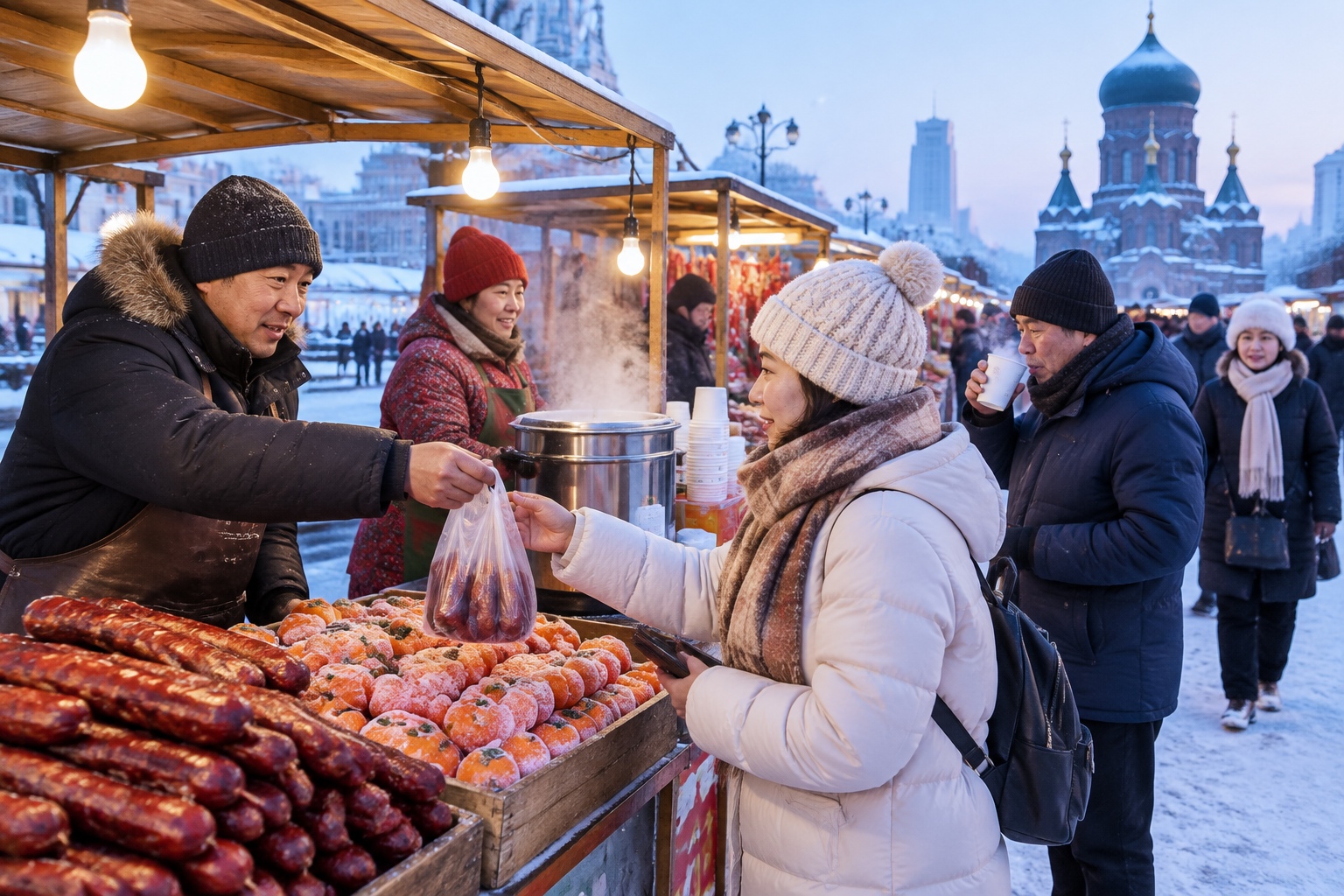

A Morning Market at Minus 20 Degrees
At 6:15 a.m. in Harbin, the sky is still the color of wet slate. The temperature is minus 20 degrees Celsius. On Hongzhuan Street, stall owners are already pulling on thick cotton gloves and arranging smoked sausages on wooden boards. Steam rises from a pot of soy milk. A vendor shouts: “Fresh red sausage! Just out of the smokehouse!” The smell is smoky, salty, and slightly sweet.
This is the Hongzhuan Street Morning Market, one of the oldest in Harbin, the capital of Heilongjiang Province in northeast China. It runs from about 5 a.m. to 9 a.m. every day. Locals come for breakfast. Tourists come for photos. Both leave with full stomachs and frozen fingers.
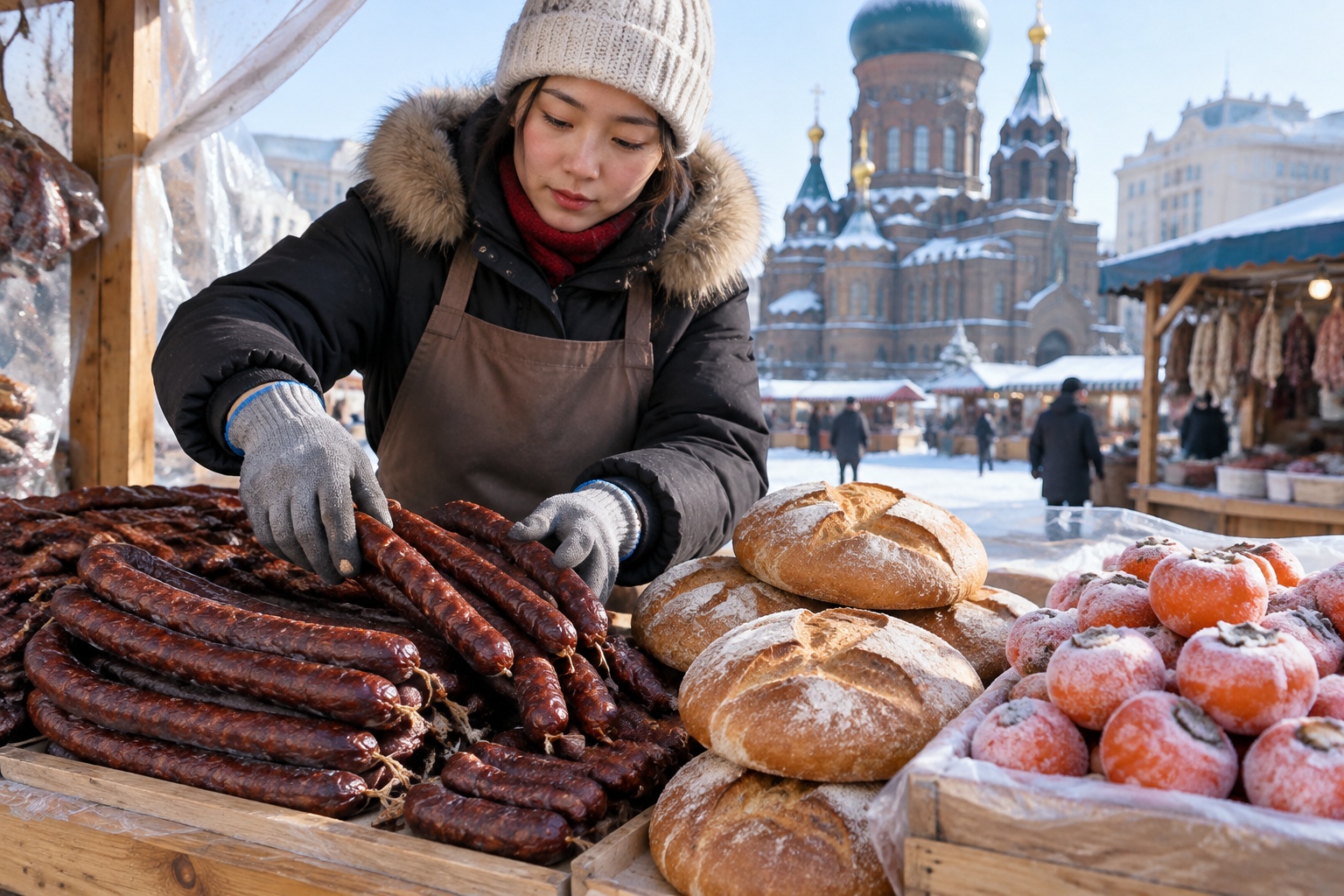
What They Sell: Red Sausage, Big Bread, Frozen Persimmons
The stalls are simple: wooden tables, plastic crates, handwritten signs. But the food tells a story. Harbin red sausage (hongchang) is smoked over fruitwood, giving it a dark red skin and a dense, savory bite. A large link costs about 10 yuan (roughly $1.40). Next to it, you will find da lie ba, a big, round Russian-style bread that is heavy as a brick and slightly sour. A whole loaf sells for 15 to 20 yuan.
Then there are the frozen persimmons. In winter, they are rock-hard, covered in a thin layer of white frost. Vendors stack them like small orange stones. You buy one for 5 yuan, take it home, and let it thaw in cold water until the inside turns into a soft, sweet pulp. You eat it with a spoon. It tastes like winter itself — cold, bright, and oddly comforting.
Other stalls sell frozen pears, candied hawthorn sticks (tanghulu), and hot bowls of offal soup. A woman in a pink down jacket hands over a paper cup of hot ginger tea. “Hold it with both hands,” she tells a shivering customer. “Otherwise your fingers will stick to the cup.”
The Ice Sculptors Behind the Festival
While the morning market winds down, another kind of work is just beginning on the other side of the Songhua River. In a temporary workshop near Sun Island, a team of ice sculptors is preparing blocks for the annual Harbin International Ice and Snow Sculpture Festival.
The blocks are cut from the frozen Songhua River in December. Each block is about 1 meter thick and weighs nearly 500 kilograms. Workers use chainsaws, chisels, and sometimes bare hands to shape them. The air inside the workshop is so cold that breath turns to ice on eyelashes.
“We start at 7 a.m. and stop when it gets dark,” says Zhang Wei, a 42-year-old sculptor who has worked on the festival for 11 years. “The hardest part is not the cold. It is that the ice can crack if you rush. You have to listen to it.”
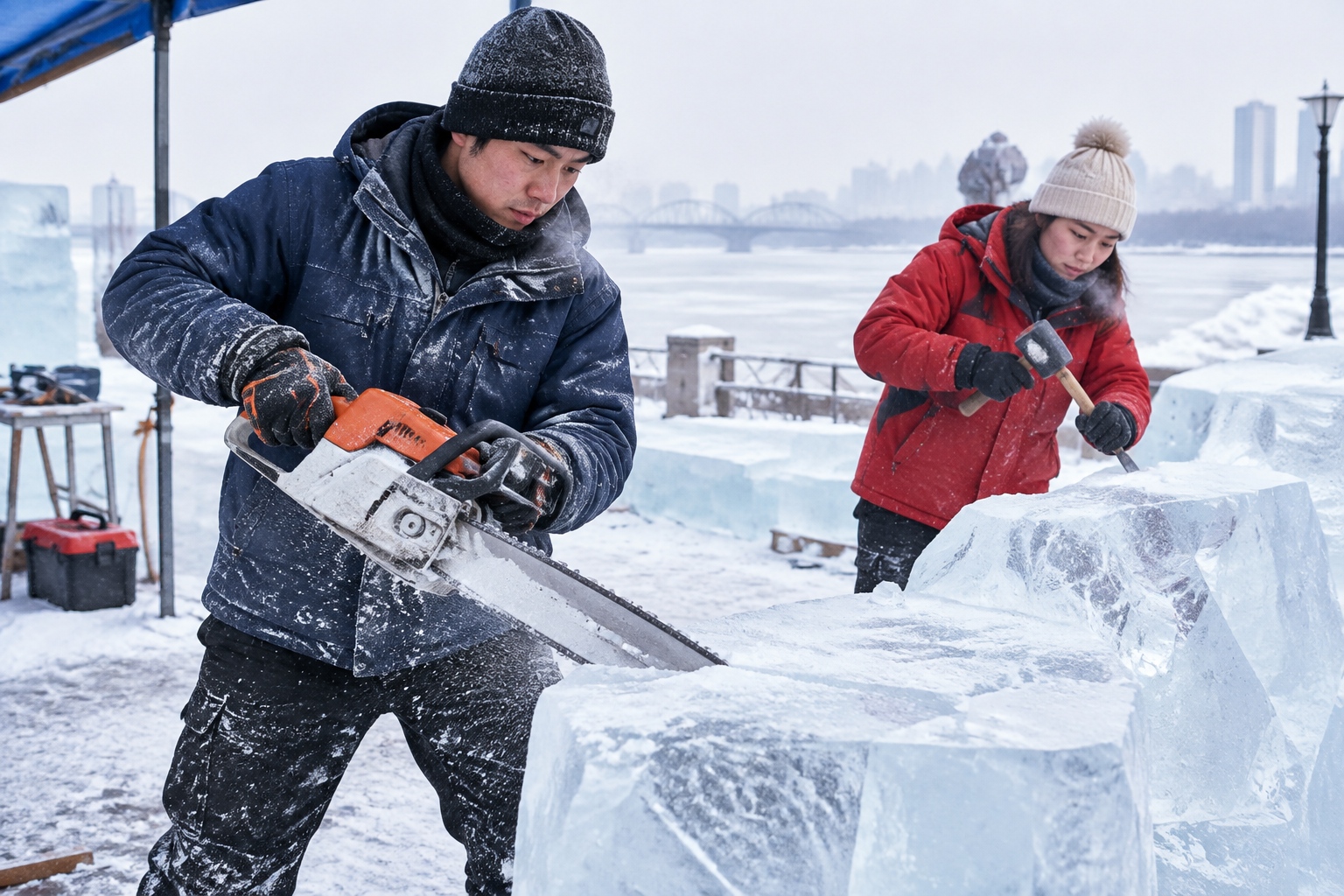
Zhang and his team are building a 12-meter-tall castle. It will take 15 days and more than 200 blocks. At night, colored lights are placed inside the ice. The castle glows blue and purple. Tourists take selfies. Zhang stands to the side, sipping hot water from a thermos. “It looks beautiful,” he says. “But tomorrow we start the next one.”
Why Harbin Eats Russian Bread and Smoked Sausage
The food at the morning market is not accidental. Harbin was shaped by Russian influence in the late 19th and early 20th centuries, when the Chinese Eastern Railway was built and Russian engineers, merchants, and families settled here. They brought rye bread, smoked meats, and dairy traditions.
Local Chinese cooks adapted these flavors. Red sausage became smokier and slightly sweeter than its Russian cousin. Da lie ba became denser, designed to survive long winters. Even the word “lie ba” comes from the Russian word “khleb,” meaning bread.
Today, this blend is simply Harbin food. At the morning market, a 70-year-old vendor named Auntie Liu says she has been selling da lie ba for 30 years. “My mother sold it too,” she says. “People from the south think it is hard. But you dip it in soup, and it becomes soft. Like this city.”
Southern Tourists and Northern Vendors: A Friendly Clash
In recent winters, Harbin has become a top destination for travelers from southern China, especially from Guangdong, Fujian, and Shanghai. They arrive in thin jackets, unprepared for the cold. The morning market is often their first stop.
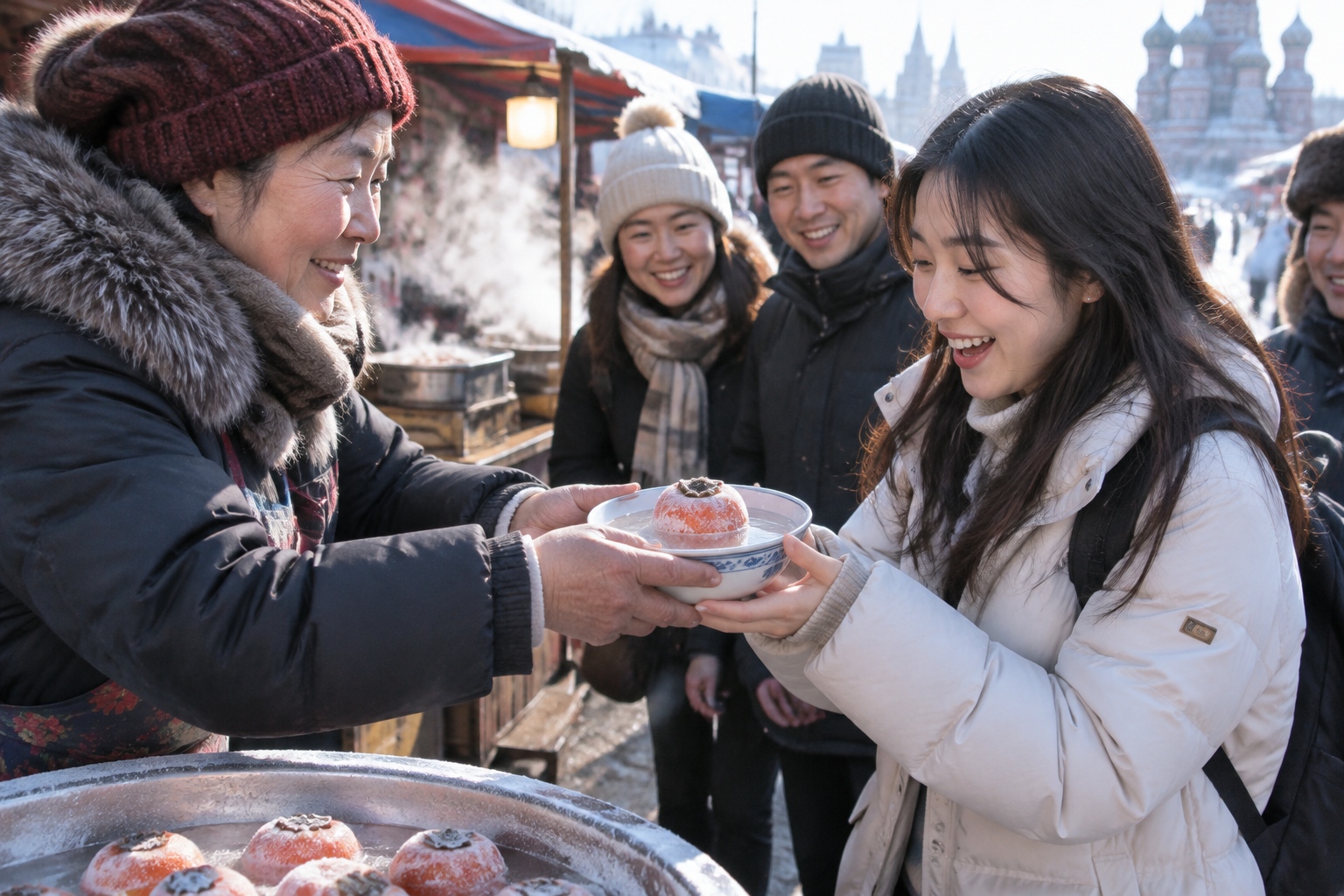
The interactions are warm and often funny. A young woman from Shenzhen asks a vendor: “Is this ice cream?” The vendor laughs. “No, it’s frozen pear. You have to wait for it to soften.” Another tourist tries to bite a frozen persimmon and nearly loses a tooth. The vendor hands her a bowl of cold water. “Put it in here. Wait ten minutes. Then eat.”
Vendors have learned a few southern phrases. Tourists have learned to say “xie xie” with a heavy northeastern accent. The market becomes a small stage where two very different parts of China meet, trade, and laugh together.
Northeastern Warmth: Humor, Generosity, and Hard Work
What stands out most in Harbin is not the cold. It is the warmth of the people. Northeastern Chinese are known for being direct, funny, and generous. At the morning market, a vendor will give you an extra sausage if you look hungry. A stranger will help you tie your scarf. A taxi driver will tell you a joke about the weather.
This warmth is built on hard work. The market vendors wake at 3 a.m. The ice sculptors work in freezing wind for weeks. The city keeps moving because people keep showing up, even when the thermometer drops below minus 30.
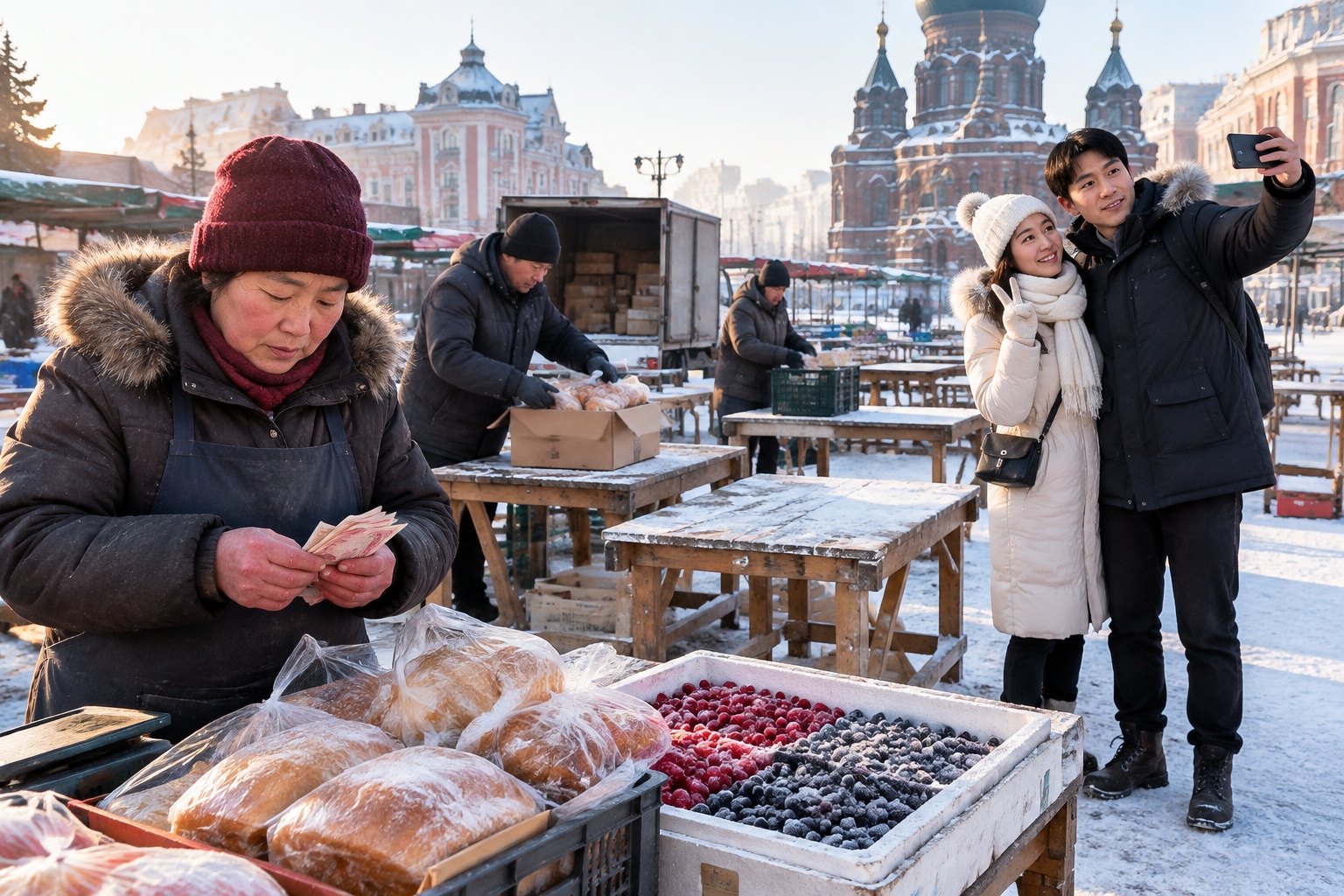
At 8:30 a.m., the morning market begins to close. The sausages are gone. The frozen persimmons are packed away. Auntie Liu counts her money with bare hands, her fingers red from the cold. A young couple from Guangzhou takes a final photo. “It’s so cold,” the woman says, laughing. “But I don’t want to leave.”
That is Harbin in winter. A city of ice, smoke, and human heat.
Start the discussion at forum.chinacomes.com