
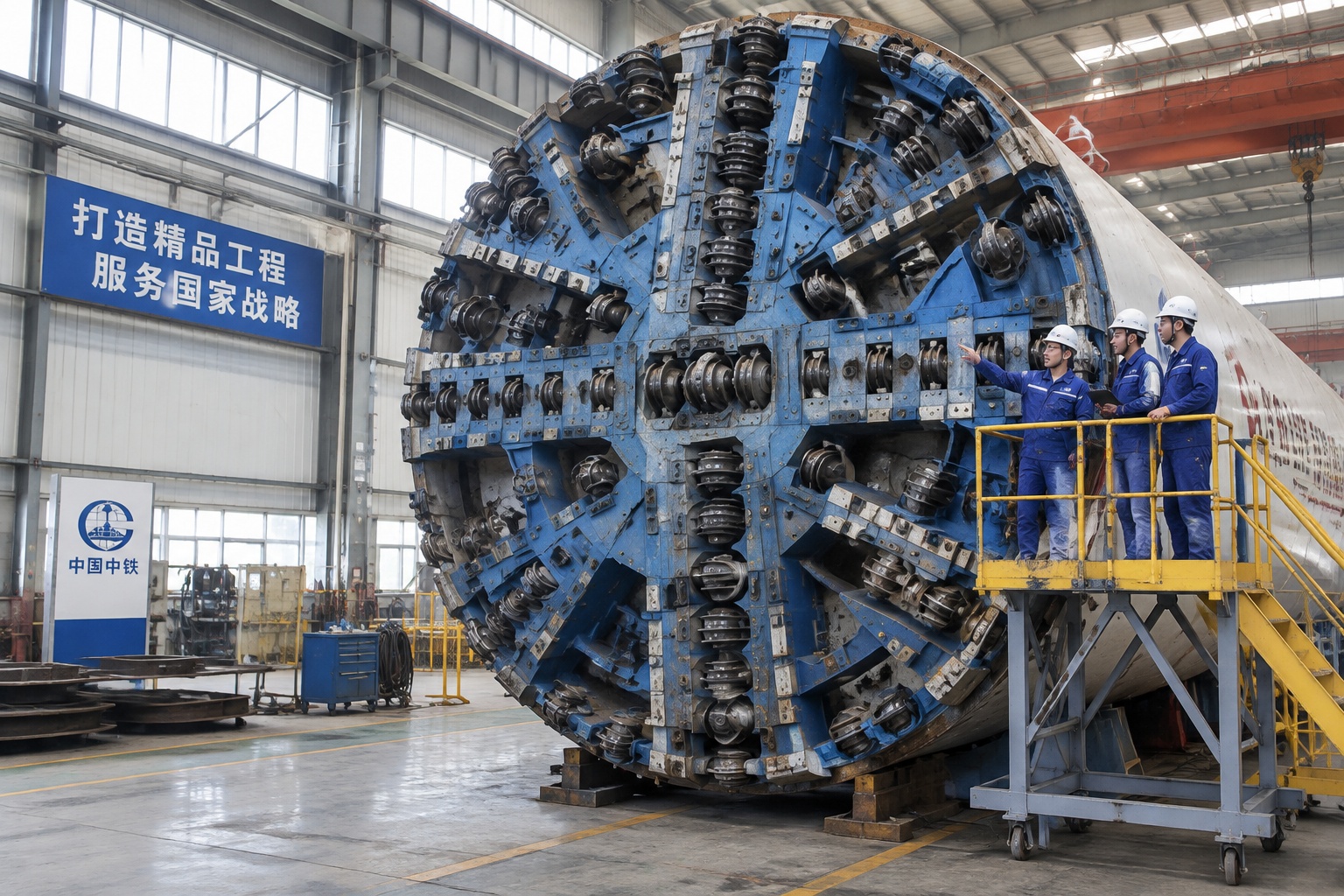

Walk along a stretch of road in Tongzhou, on the eastern edge of Beijing, and the most striking thing about the ground beneath you is how ordinary it feels. No shaking. No hum. No crack in the asphalt. Thirty-odd metres down, a machine weighing around 4,300 tonnes is turning a cutting wheel more than 16 metres across, grinding through sand, clay and groundwater at a few metres a day.
That machine is the Jinghua, one of the largest tunnel boring machines (TBMs) ever assembled in China. It bored much of the 7.3-kilometre underground section of Beijing’s East Sixth Ring Road, a project that moved a motorway below ground and freed the surface for something other than traffic.
Why the ground above barely moves
The first reason is depth. The second is the method. A tunnel boring machine does not simply dig a hole and hope the roof holds. It holds the face while it cuts.
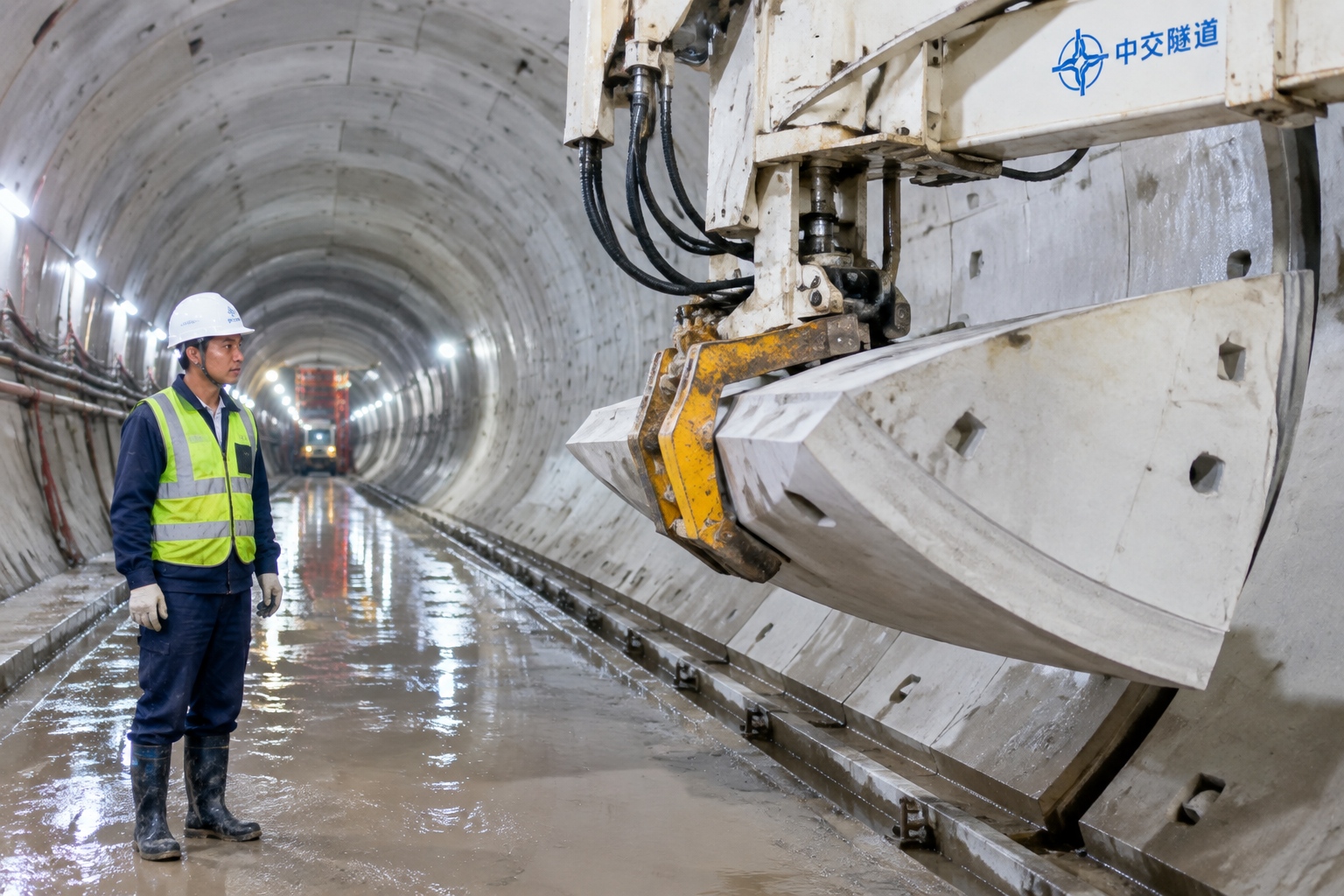
The cutterhead rotates and breaks the soil or rock. Behind it, a chamber of pressurised soil or slurry pushes back against the ground with roughly the same force the ground pushes in. That balance keeps the excavation face from collapsing. As the machine inches forward, a ring of precast concrete segments is assembled just behind the cutterhead and pressed against the tunnel wall. Grout is pumped into the gap between the segments and the surrounding soil almost immediately.
The whole cycle — cut, remove, line, push — repeats in a rhythm measured in minutes. Settlement at the surface is monitored in millimetres. On a project like the East Sixth Ring Road, which passes beneath roads, buildings and a canal, readings above a set threshold are fed straight back into the machine’s operating parameters.
So the ground does not move because the movement has been engineered out of it.
How wide is “super-large”?
The Jinghua has an excavation diameter of 16.07 metres. The machine is about 150 metres long and weighs roughly 4,300 tonnes. For comparison, the most common shield diameter on Chinese metro lines is 6.28 metres.
By width, 16.07 metres is about 2.5 times a metro tunnel. By cross-sectional area — the number that actually determines how much you can put inside — it is around 6.5 times. A single bore of that size carries roughly as much space as six or seven ordinary metro tunnels side by side.
In Chinese industry usage, “super-large diameter” generally means an excavation diameter of 14 metres or more. Within that band the machines vary a lot: 15-metre, 16-metre and 17-metre classes all exist, and specifications differ from model to model. The figures above belong to the Jinghua, not to the category as a whole.
What the machine does all day
Strip away the engineering and the work is a four-step loop.
Cut. Steel disc cutters are mounted on the cutterhead. The machine pushes the head into the ground; the cutters roll, crush and chip the material in front of them. In soft ground they scrape. In rock they press and fracture.
Remove. In an earth-pressure-balance machine, a screw conveyor carries the spoil out. In a slurry machine — the type usually chosen for river crossings and high water pressure — a pressurised slurry carries the spoil up through pipes to a separation plant on the surface, where soil is separated out and trucked away and the slurry is recirculated.
Line. A segment erector lifts precast concrete blocks into place one at a time. A ring is typically 1.5 to 2 metres wide and made of six to a dozen segments.
Push. Hydraulic jacks press against the newly built ring and shove the whole machine forward by one ring. Then the loop starts again.
On a good day a large machine advances ten to twenty metres. On a bad day — a boulder, a sudden change from soft clay to hard rock, worn cutters — it advances a few.
Why 16 metres is much harder than 6
Size is not a linear problem. Doubling the diameter quadruples the area of the face and roughly doubles the circumference that has to be sealed, powered and steered.
The main bearing is the first constraint. The cutterhead is driven through a bearing that, on a 16-metre machine, is close to 8 metres across and has to carry enormous torque under uneven load. Very few companies worldwide can make bearings at that scale reliably. China imported them for years; domestic bearings above 8 metres only came off the line in 2023, and their reliability still has to be proven over long projects.
Seals are the second. Under a river, water pressure can reach six to eight atmospheres. The larger the diameter, the greater the area over which that pressure pushes against the main drive. A failed seal is not a maintenance item; it is a months-long recovery operation.
Steering is the third. A machine weighing more than 4,000 tonnes, working through ground that shifts from soft clay to sand to cobbles, has to hold its alignment to within a few centimetres. Drift too far and the next ring will not fit.
Then there is the human side. Cutters wear out, and changing them means sending workers into a pressurised chamber — the same physics as saturation diving. Every intervention is planned, timed and risk-assessed.
Until the 2000s, China imported almost every TBM it used, mainly from Herrenknecht in Germany and from Kawasaki, Komatsu and Mitsubishi in Japan. The machines were expensive and so was the service. A story Chinese engineers still repeat: when foreign technicians serviced a machine, they would rope off the area so local staff could not watch. The details vary by project, but the underlying situation was real — China could build tunnels, but not the machines that dug them.
In 2008, engineers at what became China Railway Engineering Equipment Group completed the country’s first domestically developed composite earth-pressure-balance shield machine. Over the following fifteen years, Chinese manufacturers moved from 6-metre metro machines to 12, 15 and 16 metres, and then to exports. Chinese-built TBMs now work on projects in Europe, the Middle East and Southeast Asia.
What people above ground actually get
The machine is only interesting because of what it makes possible.
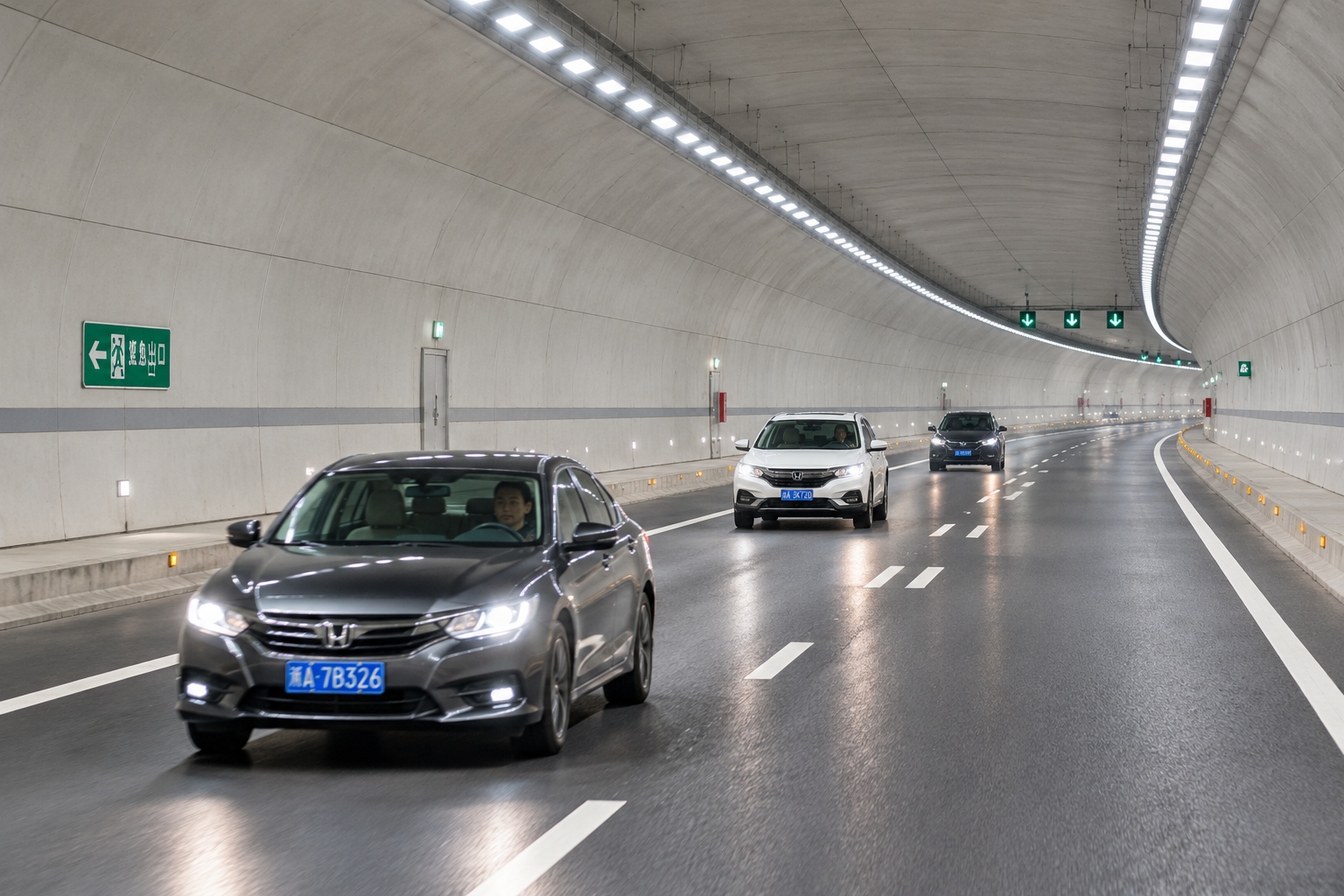
In Jinan, Shandong province, the Jiluo Road Yellow River Tunnel opened in September 2021. Its boring machine had an excavation diameter of 15.76 metres. Before it opened, driving from central Jinan to the north bank of the Yellow River usually meant joining a queue for a bridge; forty minutes was normal. Through the tunnel, the crossing takes about four minutes.
In Beijing, the East Sixth Ring Road project put a motorway underground and released the land above it. Under the plans, the old road corridor becomes parks and green space, and neighbourhoods that were split by eight lanes of traffic are reconnected.
On metro systems, one large bore carrying both tracks — “one tunnel, two lines” — uses less underground space than two smaller bores. That means less demolition, fewer worksites at street level, and less disruption above. For a commuter, the payoff shows up as shorter transfers and straighter routes rather than anything you would recognise as engineering.
And along the Yangtze, the Pearl River and the coast, a large share of the river crossings and subsea links built in the past fifteen years were dug by the same category of machine.
A machine is the visible part of a system
In 2025, the China Association for Science and Technology (CAST) published a list of ten high-tech achievements from the 14th Five-Year Plan period, covering 2021 to 2025. Super-large diameter tunnel boring machines were on it. Placing a piece of heavy equipment in that company says something about what is being measured: not a single machine, but a capability.
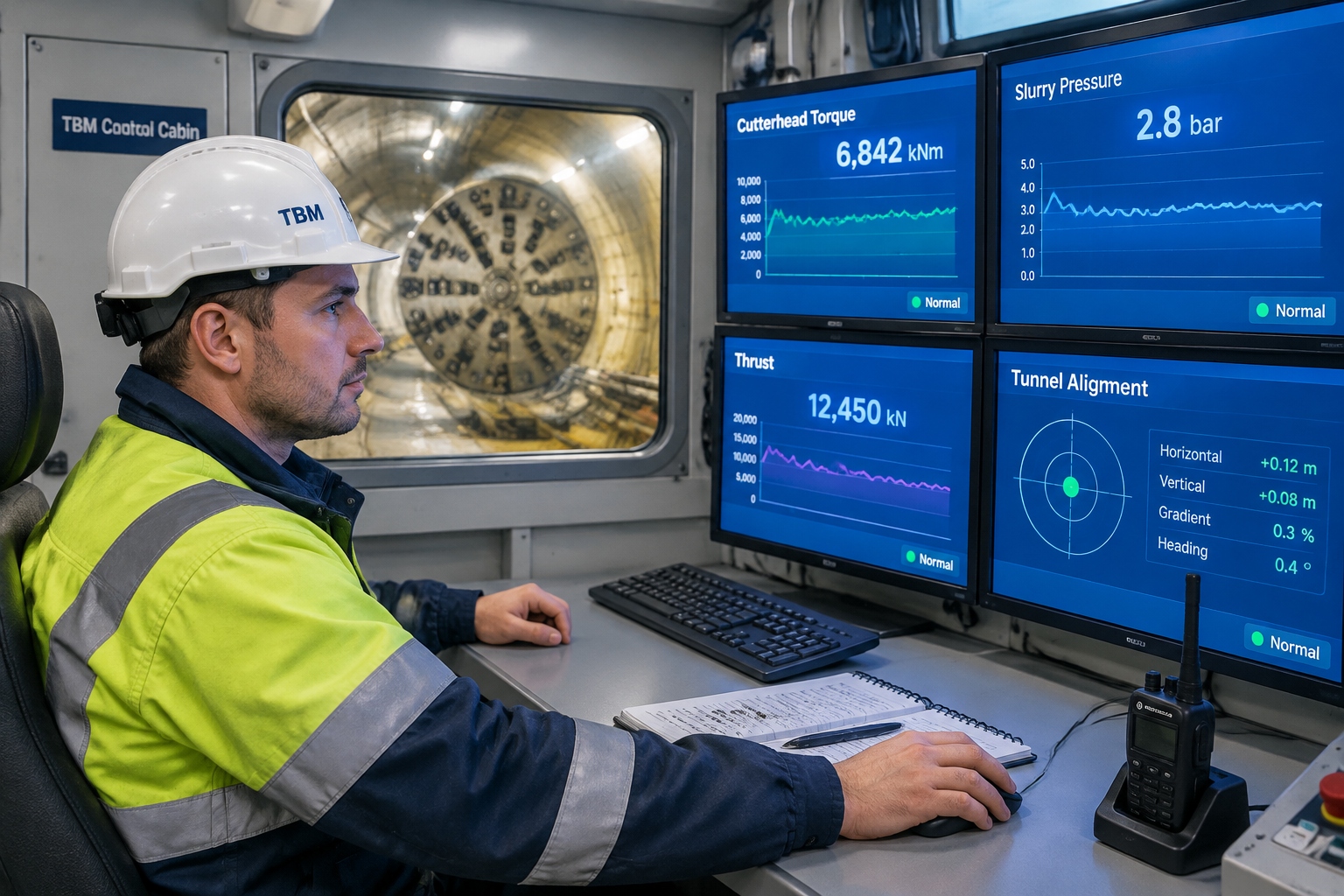
Behind one 16-metre machine sits a supply chain — steel mills, bearing makers, hydraulic suppliers, control-system developers, concrete segment plants, survey teams, and crews who have learned to read ground conditions from the sound of the cutterhead. Every disc cutter, every seal set, every curve on the control-room screen comes out of that chain.
The chain has its problems. Domestic production pushed prices down sharply, competition is fierce, and parts of the industry face overcapacity and price wars. Not every tunnel needs a 16-metre bore, and bigger machines carry bigger cost and risk. Being able to build a machine is also not the same as being able to operate, maintain and staff it well for a decade.
Still, the shift is real. Twenty years ago China could not make a metro shield machine. Now it builds the largest ones in the world and sells them abroad.
Back on the surface
Return to that road in Tongzhou. In a few years the motorway will be gone from the surface and there will be a park where the traffic used to be. People will push strollers across it in the evening and will not think about the machine that was once down there, turning at one or two revolutions a minute.
That is usually how infrastructure succeeds: quietly enough that nobody notices the work is finished.
Start the discussion at forum.chinacomes.com