
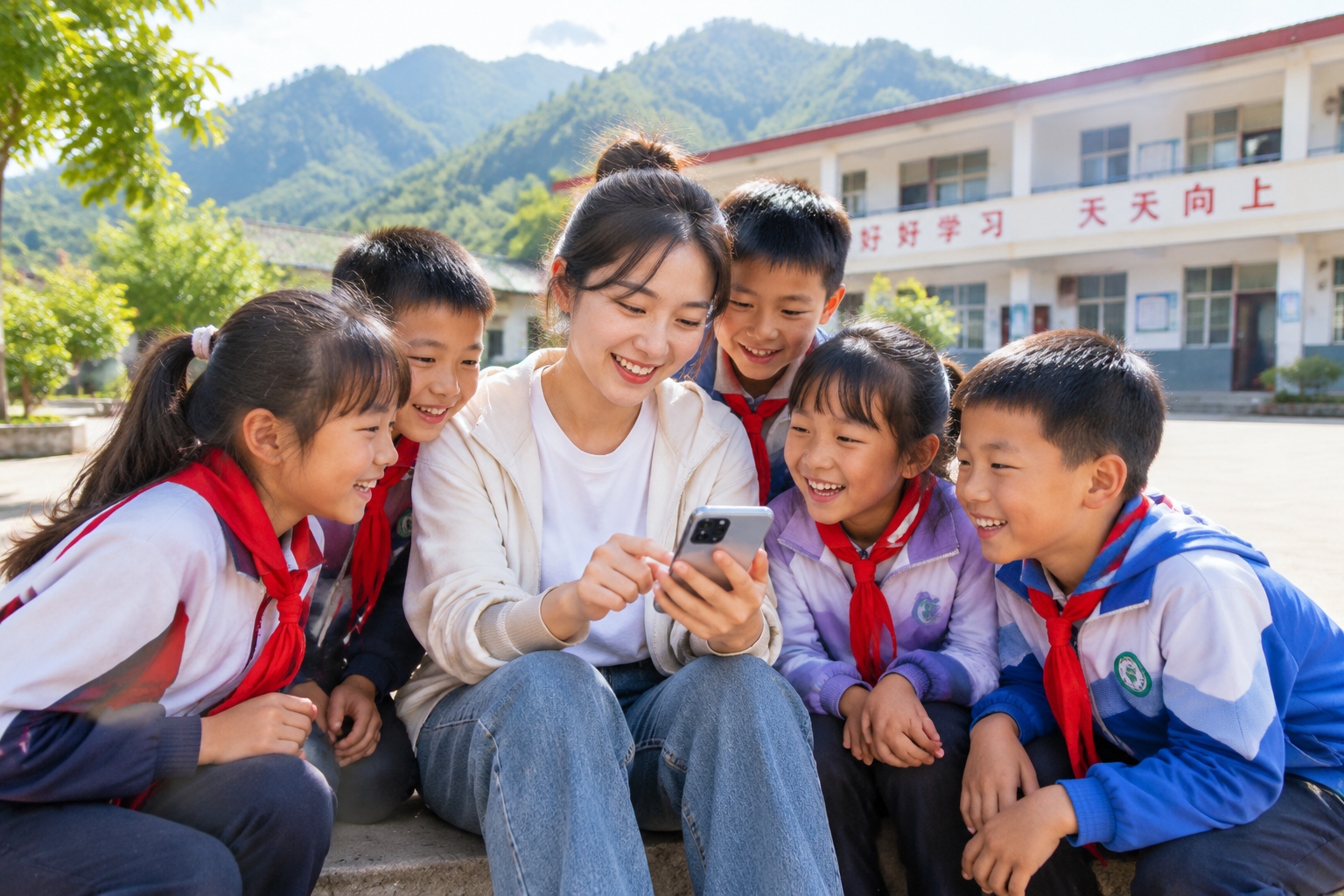

The first day
The first time Chen Yue walked into the fourth-grade classroom in a mountain village in Guizhou, the room went quiet in a way that made her nervous. Twenty-three pairs of eyes took her in. Then a boy asked, half serious: “Are you going to leave at the end of the term?”
Chen Yue, 24, grew up in Shanghai, where she studied design. For a year she worked as a volunteer teacher at a rural elementary school. She did leave at the end of the term — but before that, she started a photography club with a few donated smartphones. “It wasn’t about shiny cameras,” she says. “It was about showing kids their own world is worth paying attention to.”
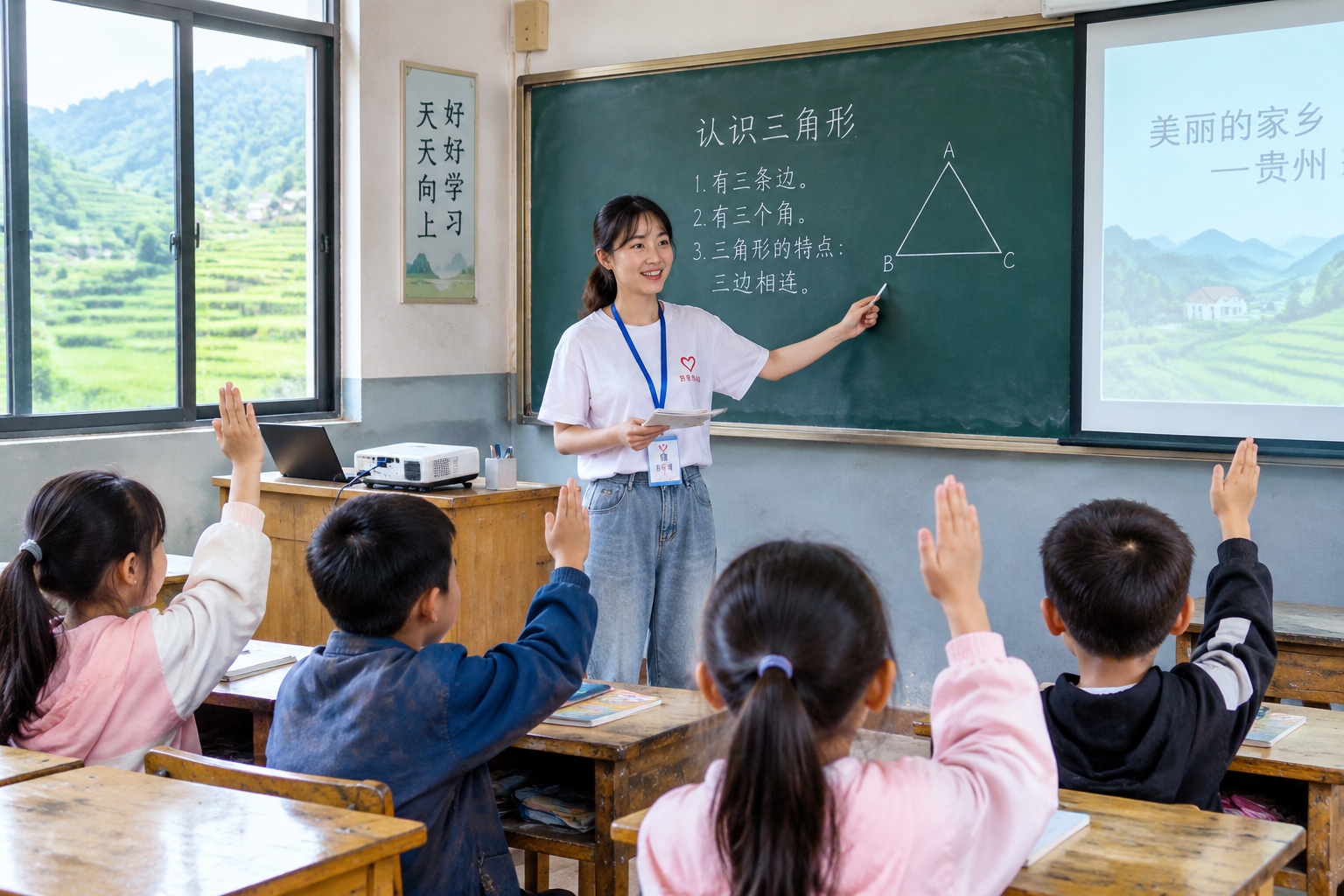
Chen Yue is one of tens of thousands of urban youth in China who spend time teaching in the countryside every year. They come under volunteer programs run by universities, provincial education bureaus, and civil society organizations. They stay from a few months to two years. They fill gaps that local schools often cannot fill themselves: English, music, art, and anything involving computers.
But what does that actually add up to? To understand, I spoke with volunteer teachers, a rural school principal, local teachers, students, and a program coordinator. The answer is not simple, and it’s more interesting than the usual “saving the countryside” story.
Why do rural schools need help at all?
China’s countryside has changed a lot in the last two decades. Nearly all school buildings have been rebuilt and connected to electricity and internet. The Ministry of Education says more than 90% of rural primary and secondary schools now have access to the internet, and many have multimedia classrooms. But having a screen in the classroom isn’t the same as having a teacher who knows how to turn it into a lesson.
Rural schools still face teacher shortages, particularly for music, art, English, and technology. Many small village schools have just a few teachers for all subjects. And because rural parents often move to big cities for work, a large share of children are “left-behind children” who live with grandparents. That means teachers often do double duty: instructor, counselor, and occasional caregiver.
“The educational infrastructure is there,” says Wang Jie, who coordinates a volunteer teaching program in Sichuan. “What is missing is human connection — someone with time and energy to sit beside a child and say, ‘I see you.'”
What can urban volunteers actually bring?
Volunteers are not usually better teachers than local staff. They are usually younger, less tired, and less burned out. They often have a different skill set. And they bring something less tangible: attention.
“Most people imagine they bring knowledge,” says Wang Jie. “In reality, the biggest thing is attention — time, energy, and a kind of curiosity about children that a teacher with fifty kids in one class can’t always offer.”
Subjects that are otherwise skipped
In many rural schools, Chinese and math are covered by local teachers who know their community deeply. But specialized subjects are often skipped. Art, music, technology, and English are where urban volunteers fill the biggest gaps.
Chen Yue’s school, for example, had never had a formal art class. “I taught the kids a design exercise. I asked them to draw a poster that would make someone want to visit their village. I thought they’d draw the river or the bridge. Instead, they drew the school itself, and wrote ‘Come play with us.’ I cried.”
A different way of asking questions
Mr. Liu has taught math at the same school for 18 years. “Volunteers sometimes ask the kids ‘why?’ more than I did,” he says, laughing. “I was always under pressure to finish the textbook. They have time to say ‘what do you think?’ That’s good for children. It loosens them up.”
That looseness shows up in ways not easy to measure. Students start speaking up, asking for help, and arguing about things. “When no adult asks for your opinion,” says Wang Jie, “you quickly stop having one in class. Volunteers re-open that door.”
What do the kids think?
Li Na is 12. Chen Yue remembers her as the quietest girl in the photography club. Li Na took a photo of her grandmother’s hands holding a flashlight while working at night. “I didn’t know I could say that in a picture,” Li Na later told her. “I didn’t know anyone would look at it and say it’s beautiful.”
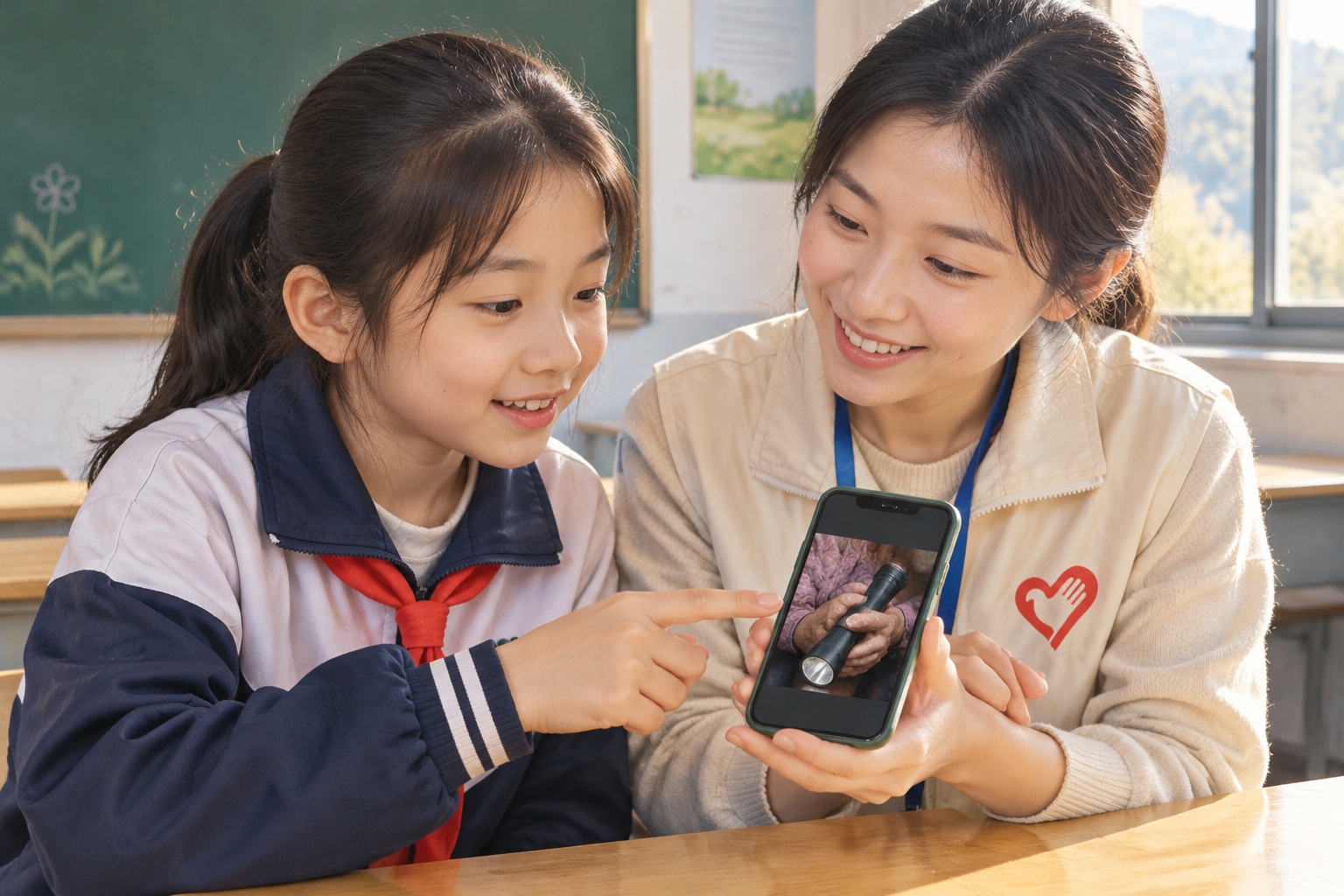
For many rural students, an urban volunteer is the first young adult from outside who treats them as an individual. “My parents work in Shenzhen,” says Li Na. “I see them twice a year. The volunteers are not parents, but they are someone who remembers your name and your birthday.”
Another student, 13-year-old Haoran, says his future changed after interacting with a volunteer from Beijing. “He taught me how to make a simple robot out of a battery and a motor,” Haoran says. “I always thought science was something in books. That was the first time I thought maybe I can do it, too.”
What goes wrong?
It would be dishonest to pretend the model is easy. Volunteers come with enthusiasm but not always training. Some struggle with rural life: unreliable internet, unfamiliar food, loneliness. A few schools complain about volunteers who treat the experience as a resume line or a way to “see the real China” without committing to the job.
Wang Jie’s program asks for a one-year commitment. “A semester is the absolute minimum,” she says. “Children at these schools have seen too many adults come and go. Almost any program that sends people for two weeks is doing more harm than good.”
There’s also a mismatch between what volunteers want to teach and what schools truly need. “I know a really enthusiastic engineering student who spent half a semester teaching 3D printing,” Wang Jie says. “The school didn’t even have a reliable 3D printer. Eventually he set it up himself, but the kids were not actually ready. They needed basic English, not a machine.”
Does anything last after they leave?
The harder question is sustainability. Some programs are building bridges that survive the volunteer’s departure.
Chen Yue now works at a Shanghai tech company, but she still teaches her photography club online for one hour every Sunday. “The school now has a stable internet connection,” she says. “I see the kids’ faces on a screen. When I visit, they show me photos they’ve taken in the past year.”
Other programs pair volunteers with local co-teachers. “We ask every volunteer to develop one teaching plan with a local teacher before they leave,” says Wang Jie. “That way, the knowledge doesn’t leave with the person.” A rural school in Yunnan now has an online art club started by a former volunteer; another in Gansu keeps a reading corner because the volunteer convinced the school librarian to join a teacher exchange group.

Remote support is becoming a serious supplement to in-person teaching. Even after the city volunteer returns home, they can still teach evening classes, mentor students for exams, and keep a door open for questions. “I call my old teacher when I don’t understand my homework,” says Haoran. “He answers from Beijing, sometimes on his phone.”
Can urban youth really fix rural education?
No. Anyone who says they will is misleading you.
“Urban youth can’t replace rural teachers,” says Mr. Liu, bluntly. “They don’t know what it’s like to live here season after season. They don’t have the same relationship with the community. But they can help the community imagine new possibilities.”
The deeper issues — rural teacher salaries, housing, school funding, family poverty, and the long distances between villages and towns — are not solved by young volunteers. Government investment, better pay for local teachers, and infrastructure improvement are the real levers.
But volunteers do act as a signal. They bring stories, resources, and online connections that would otherwise not arrive in a mountain village. They also become professionals who, later in life, might design a new teaching app, start a scholarship, or support better policy from within the system.
“I used to think I went there to teach,” Chen Yue says. “Now I think I went there to learn what I didn’t know about the country I live in.”
How to get involved
If you’re young and thinking about teaching in the countryside, a few things are worth considering before you sign up:
- Commit more than your vacation time. A semester or a year. If you can only go for a short time, choose a program that doesn’t put you alone in front of a classroom. You might instead bring supplies, repair something, or help train local teachers.
- Bring practical connections. Teachers can’t pay their bills with laughter, but they also can’t teach without software, internet, and simple resources. Reaching out to your city friends for donations of devices or digital courses can make a lasting difference.
- Build something that can outlive you. A co-teaching plan, a teacher-training session, a library program, an online Q&A for high school students. Ask yourself: if you leave tomorrow, what stays?
- Respect the local school’s goals. You are a guest, not a savior. The school knows its children; your job is to add what you can, not redesign what you don’t understand.
Rural education in China is still uneven. But it is not an empty field. It’s a place where young people from cities and towns can meet children from villages — and both sides get transformed.
Chen Yue still remembers the boy’s question on her first day: “Are you going to leave at the end of the term?”
“I did,” she says, “but I’m still here every Sunday. And next month, I’m going back to see their photos.”
Start the discussion at forum.chinacomes.com