

At six in the morning, the cows are already online
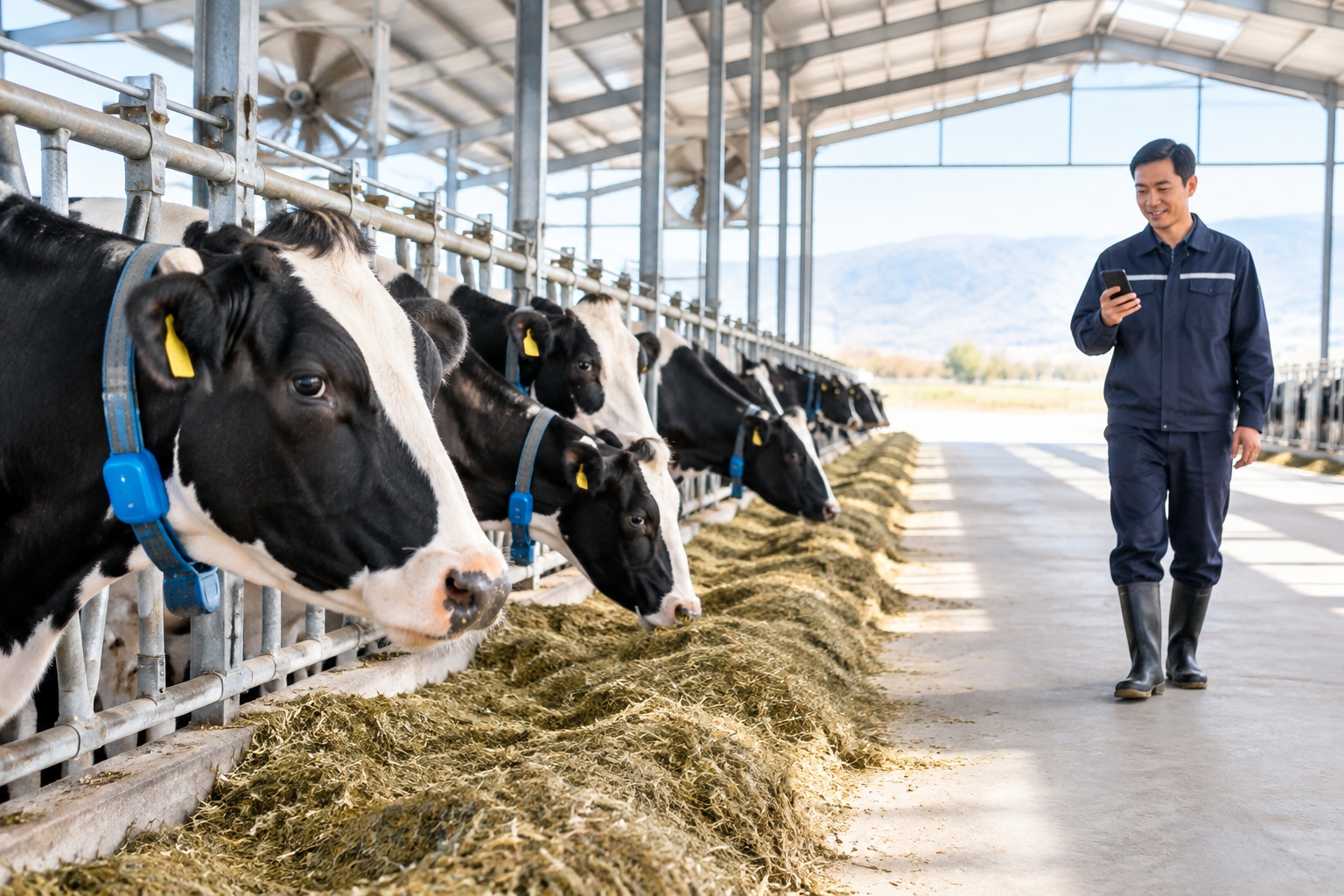
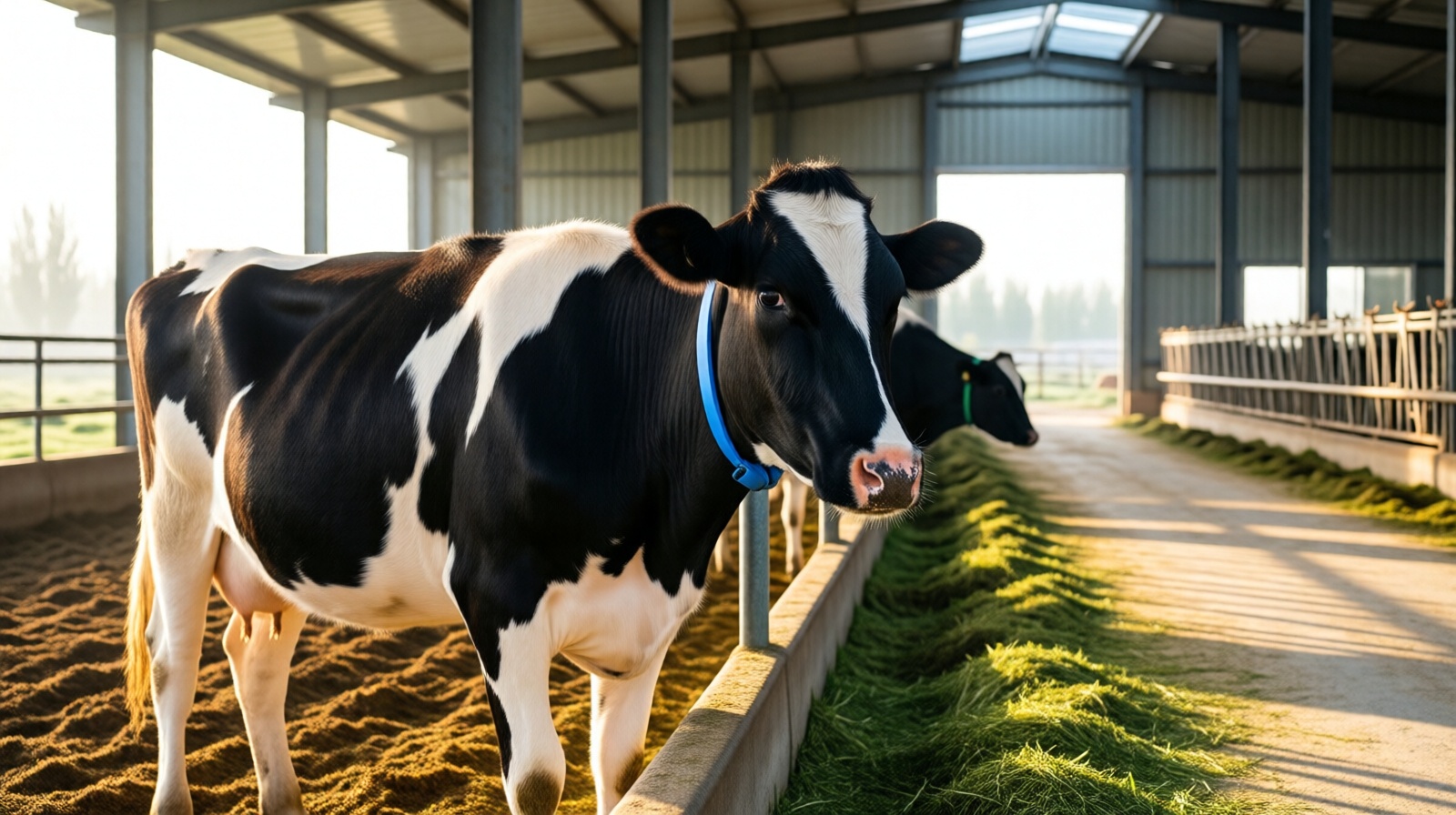
On a dairy farm just outside Yinchuan, the capital of Ningxia in northwest China, a Holstein cow named Huaihua is eating her breakfast. She chews, swallows, and occasionally looks up. Around her neck, she wears a blue collar. It is not a bell or decoration. It is a smart collar, about the size of a television remote, packed with sensors, a small battery, and a communication chip.
Every few minutes, the collar records her body temperature, the number of steps she takes, how long she lies down, and how many times she chews her cud. The data travels over a local wireless network to a mobile phone app used by farm manager Ma Jun. “If a cow gets sick, we usually know before she looks sick,” Ma says. “If she is ready to be bred, the app tells us that too. I used to spend hours walking through the barns. Now I can check the whole herd from my phone while I drink tea.”
What is a smart collar?
Think of it as a Fitbit for dairy cows. The collar contains an accelerometer, a temperature sensor, and software that measures rumination—the time a cow spends chewing her cud. Rumination is one of the most reliable early signs of health in dairy cows. A healthy cow chews her cud for about eight to ten hours a day. If that number drops sharply, something is off. She might be developing mastitis, ketosis, or heat stress.
Heat stress is a particular problem in Ningxia. Summers are hot, and cows eat less when they are overheated, which means less milk. The collar detects the small changes in activity that come before a cow’s condition becomes serious. Because it is checked around the clock, it gives the farmer a chance to act early rather than respond after the cow is visibly ill.
The collar also tracks estrus. Dairy cows are usually bred by artificial insemination, and the timing has to be right. A cow may show signs of standing heat for only a few hours. The collar’s motion sensor can identify that brief window with more accuracy than the human eye. Miss it, and the farm has to wait another 21 days for the next cycle. Every missed cycle costs money.
This technology is not new in Europe or the United States. What is new is how quickly it is being rolled out in China. The companies that make these collars say the cost has fallen sharply in recent years, and farms in Ningxia are among the biggest buyers.
Why Ningxia?
Ningxia is an arid region squeezed between the Yellow River and the edge of the Gobi Desert. Rain is scarce, but the river provides irrigation. The region has a long history of dairy farming, and in the past decade, the local government has made milk production a strategic industry. Farms have grown bigger. Old barns have been replaced by long, open structures with fans and water sprayers. Automatic milking machines are now standard.
But bigger farms mean bigger risks. Disease can spread quickly through a herd of thousands, and labor is expensive. Young people in China are less interested in the old, physically demanding farm work. Smart collars are an attempt to solve this problem. They allow a small team to manage more animals while collecting data that makes each animal’s care more precise.
For the region itself, smart collars are also a statement. Ningxia wants to be known not as a remote outpost but as a modern agricultural center. This is an economic ambition, not just a technological curiosity.
What a smart collar changes in a working day
For Ma Jun, the manager, the day starts with a phone. He opens the farm’s app and sees a list of cows that need attention. If a certain cow has not been chewing enough, he sends a technician to check her. If another is showing signs of estrus, he arranges for insemination. “It used to take me two hours to walk the barn and count cows,” he says. “Now I do that in ten minutes, and I do a better job.”
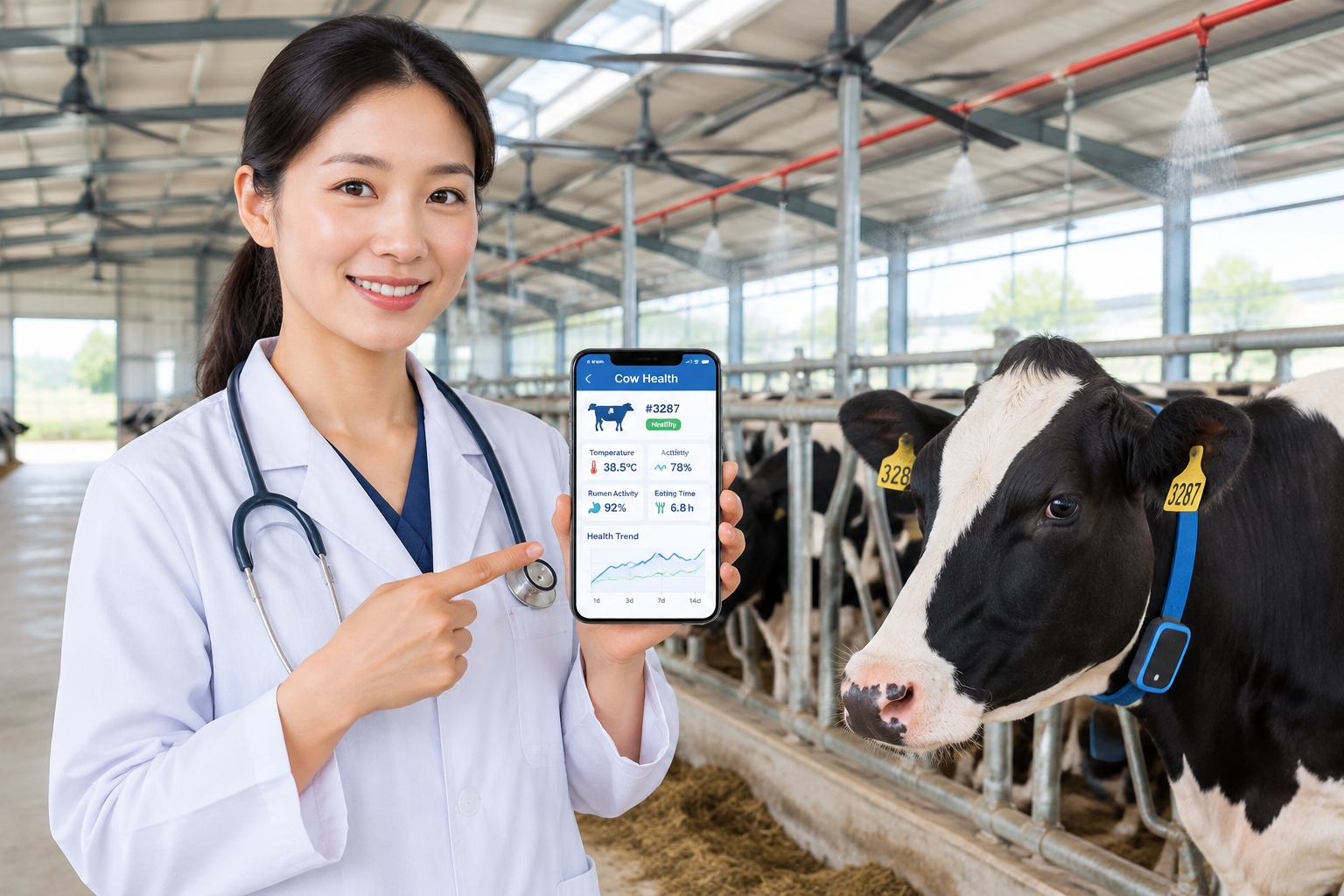
Veterinarian Wang Jie, 29, has worked on the farm for three years. She says the collar gives her a reason to visit a cow before the problem becomes severe. “A sharp drop in rumination might tell me she has ketosis, which is a metabolic disease,” Wang explains. “If we catch it early, we can treat it with an oral gel. If we catch it late, the cow might lose part of her milk production for the season.”
The collar does not make veterinary knowledge unnecessary. It makes it more effective. “The app shows me which cow to look at,” Wang says. “But I still have to decide what is wrong and what to do.”
Does the collar cause the cow any trouble?
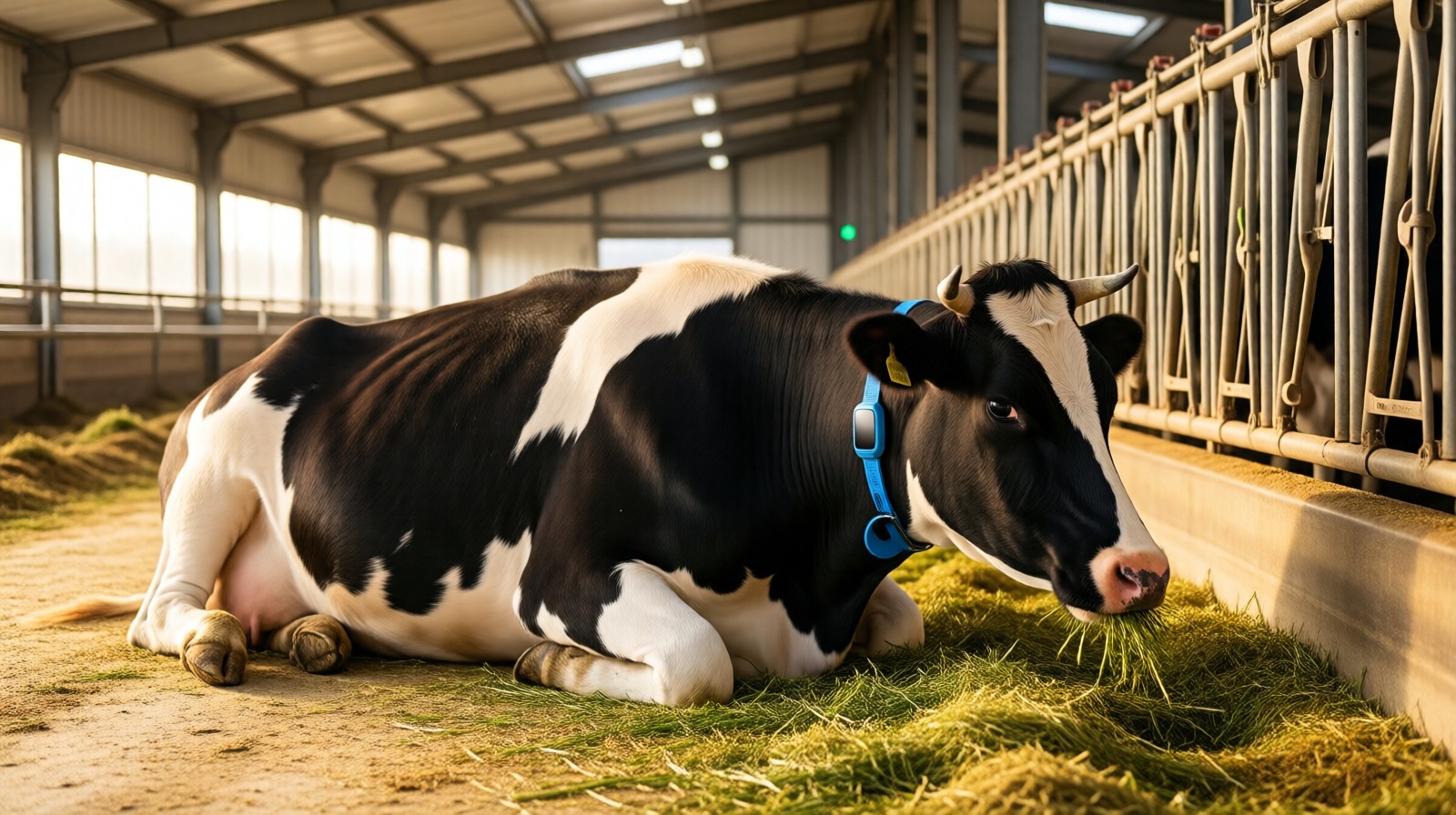
This is one of the first questions visitors ask. The answer, according to farmers and veterinarians, is that the collar is light and comfortable. Cows get used to it within a day. It hangs loosely enough not to press on the neck. It does not restrict eating or sleeping. There is no electric shock. The main technical challenge is battery life. The collar runs for months before it needs to be recharged or replaced.
Farmers even say the collar makes the cows easier to handle. If a cow has a problem, the system can flag her before she is brought into the milking line. That means fewer surprises and less stress for the animal. In that sense, the technology is not about watching the cow all the time. It is about giving the cow a quieter life.
What does this mean for consumers?
For a shopper in Shanghai, Beijing, or Singapore, the smart collar is invisible. But it changes the food system. Some dairy companies in Ningxia now connect the collar data to a milk traceability system. When you scan the QR code on a bottle of yogurt, you can call up information about the farm, the barn, and the health history of the cows that produced the milk. The information is not always perfect, but it is a start.
At a broader level, the smart collar is an example of China’s push for “digital agriculture.” The same pattern is visible in other sectors across the country. Rice fields in the south are monitored by drones. Apple orchards in Shaanxi use soil sensors. Fish farms in Zhejiang use underwater cameras. This is not a single trick, but a widespread shift toward data-driven farming.
What is still missing?
The story in Ningxia is not all smooth. The cost of a smart collar is still high for small farms. A single collar can cost between 500 and 1,000 yuan, depending on the brand and features. A small farm with 200 cows would need to make a significant investment. Many small farmers cannot afford it. So the benefits of this technology, at least for now, are concentrated in large, well-funded operations.
There is also an internet problem. In remote barns, a weak signal can interrupt real-time monitoring. The collar stores data locally when offline, but the farmer still needs to walk to a spot with better reception to see it. Wang Jie points out that the technology is only as good as the training behind it. “If you hand a digital tool to a farmer who has never used a smartphone, it will take time,” she says. “Some of our older colleagues were suspicious at first. Now they trust it, but only after they saw it work.”
The road ahead
Ningxia is already expanding the experiment. Many new farms are being built with smart collars as standard equipment, and prices are falling. Other dairy provinces in China are paying attention. Hebei, with the country’s largest dairy herd, is testing similar systems. So is Heilongjiang in the northeast. Chinese dairy companies have also begun cooperating with international sensor manufacturers, hoping to bring the next generation of collars to market.
None of this means cows will replace humans. It means humans can make better decisions with more information. The collar is not a robot that runs the farm. It is a quiet observer that never blinks. It helps a busy farmer notice a problem that could ruin an animal’s season, or catch a moment of fertility that could lead to a new calf.
On a cold winter morning in Ningxia, Huaihua finishes her breakfast and lies down in the straw. Her collar blinks once. Somewhere in the farm office, the data is saved. She does not know it, and she does not care. But the farmer will look at that data before the morning tea is finished. And that, in the end, is what a digital revolution looks like on a dairy farm.
Start the discussion at forum.chinacomes.com