

A Locker at 4,500 Meters
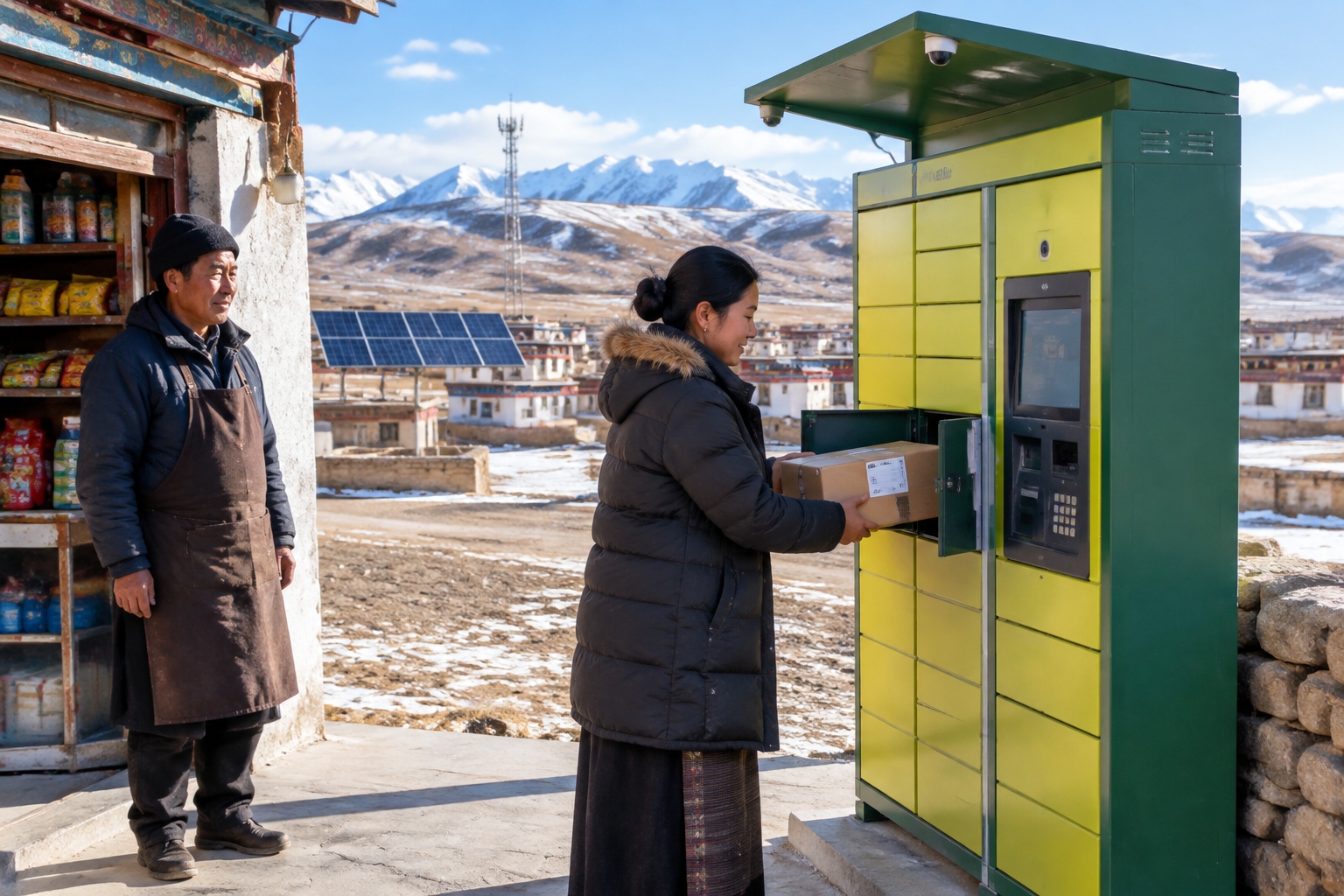
Mid-afternoon in Nagqu, a city on the northern Tibetan Plateau. A woman in a padded coat parks a motorbike outside a small shop, pulls off one glove, and taps the screen on a green-and-yellow parcel locker. A door clicks open. Inside is a phone case she ordered two days earlier, shipped from a warehouse roughly 3,000 kilometres away. She does all of it slowly. The air up here holds about 60 percent of the oxygen it would at sea level.
Nothing about that scene would surprise anyone in Shanghai. Parcel lockers sit on half the street corners in China, and the country’s couriers moved 174.5 billion packages in 2024, roughly 5,500 every second. What stops you is the address. Nagqu sits at around 4,500 meters, in a prefecture larger than Germany with about half a million residents.
Who Pays for a Tower Where Nobody Profits?
The short answer is the state, through a mechanism most outsiders have never heard of. Since 2015, China has run a universal telecommunications service programme: telecom operators pay into a fund, and the money subsidises base stations and fibre in villages no company would otherwise wire. Around 130,000 villages were connected in the first phase. By the end of 2021, every administrative village in the country, the lowest formal tier of local government, had broadband. China now has more than four million 5G base stations, and the large majority of villages have either fibre or 5G.
Tibet is an extreme version of that policy. County towns across the plateau got 5G around 2020, Nagqu included. Villages with a few hundred residents got fibre. That is not a market outcome. A base station overlooking a valley of 200 people will never pay for itself, and no commercial operator would build it alone.
It is not pure charity either. The three big carriers are state-owned and are handed coverage targets. Local governments supply land, power connections and road access. The calculation is political and industrial at the same time: connect the periphery, keep the periphery inside the network, and create a market where none existed.
Keeping a Signal Alive at Minus 30
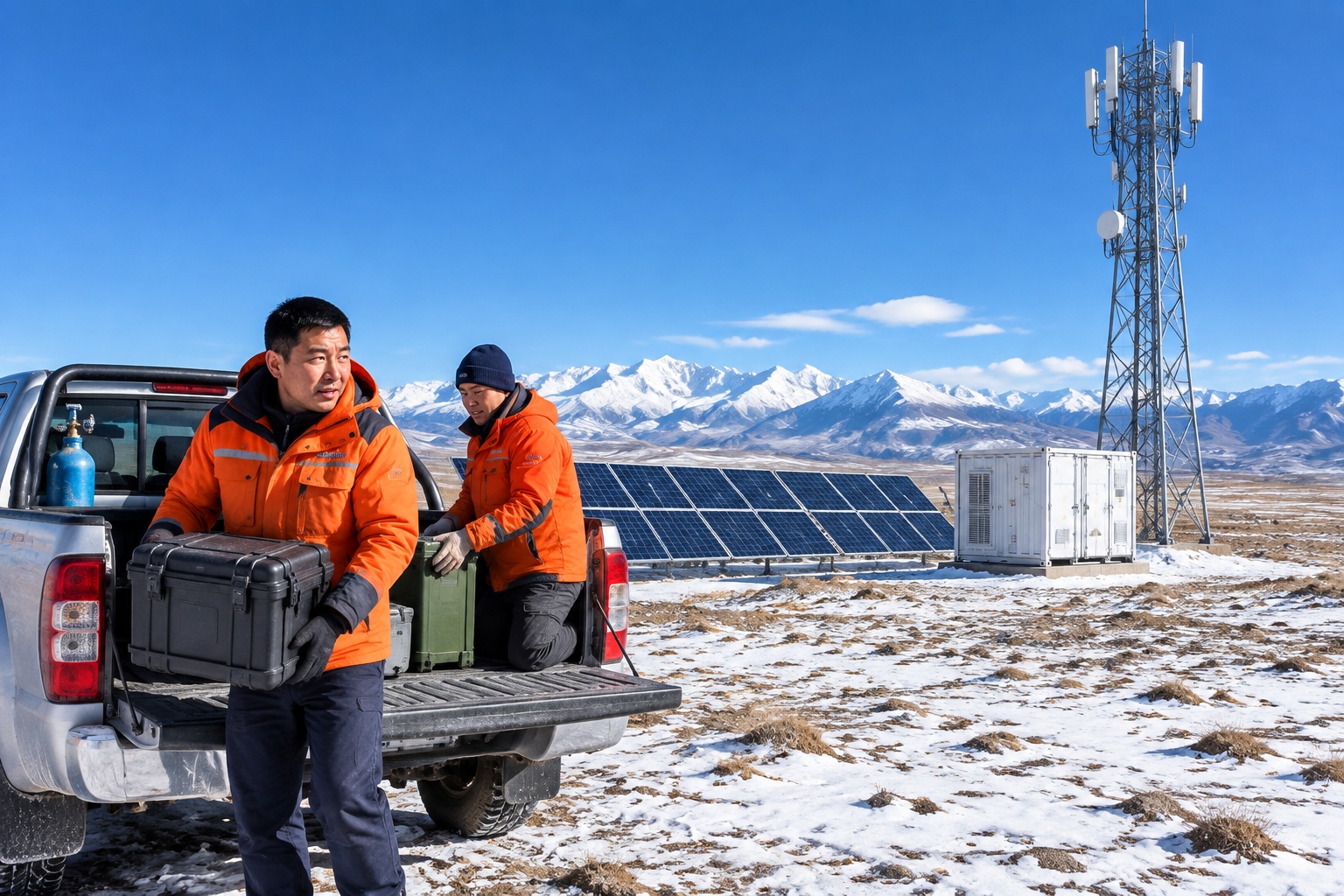
The engineering rarely makes it into the promotional videos. Plateau base stations run on hybrid power: solar panels, a battery bank, and a diesel generator for the weeks when snow covers the array or wind damages it. Technicians drive for hours on gravel roads, often with oxygen bottles in the cab, to swap a frozen battery or realign an antenna.
Electricity was the older problem. Until the Qinghai-Tibet grid interconnection entered service in 2011, Lhasa and the towns along the route lived with winter shortages and rotating blackouts. The plateau now generates more power than it consumes, mostly hydro with a fast-growing share of solar, and sends the surplus east.
Communications followed the same route, then went higher. In 2020, engineers installed a 5G base station at 6,500 meters on the north side of Mount Everest, above the camp most climbers reach. Climbers streamed video from the summit that spring. The exercise was partly symbolic and everyone involved knew it. It also proved the equipment could survive cold and wind that destroy ordinary electronics in an afternoon.
What the Signal Changes, and What It Does Not
Ask herders on the plateau what the network is for, and you seldom hear about technology. You hear about children.
Many families around Nagqu send kids to boarding schools in the county town or in Lhasa, a decision made by distance and weather rather than preference. A video call is no longer a luxury. It is how a grandmother sees a grandchild during term time.
Money changed next. QR codes are standard in small shops and at roadside stalls selling butter, dried yak meat and cordyceps. Livestreaming is the newer layer: herders and their grown children film short videos of yaks on a pass or meat drying on a line, sell directly to buyers in Guangdong or Zhejiang, and skip the middlemen who used to set the price. Some do well. Plenty discover that shipping costs and cold-chain limits eat the margin, which is why local governments keep funding collection points and cold storage.
Telemedicine is quieter and possibly more consequential. Village clinics with no resident specialist can now put a patient in front of a doctor in Lhasa or Chengdu over a video link, with basic readings sent alongside. It is not a hospital. It shortens a decision that used to require a two-day drive.

The Harder Half: Getting a Box to a Tent
Signal is the easy part next to the last mile. One base station on a hilltop can serve thousands of people. A parcel still has to reach one door, or one tent that moves with the season.
China’s answer is a patchwork rather than a single system. The postal service has stations in essentially every village, and private couriers hand off rural parcels to it under a cooperation scheme. Shopkeepers in village centres act as pickup points and earn a small fee per parcel. In county towns, smart lockers appeared because herders are often away from home for weeks and nobody answers a doorbell.
Coverage numbers are easy to overstate, but the direction is clear. Express service now reaches the large majority of villages, part of a push the government markets as express delivery into villages. In Tibet the parcels tend to be practical: phone accessories, school supplies, winter boots, small appliances. Less impulse buying than in a coastal city, more things that are genuinely hard to find locally.
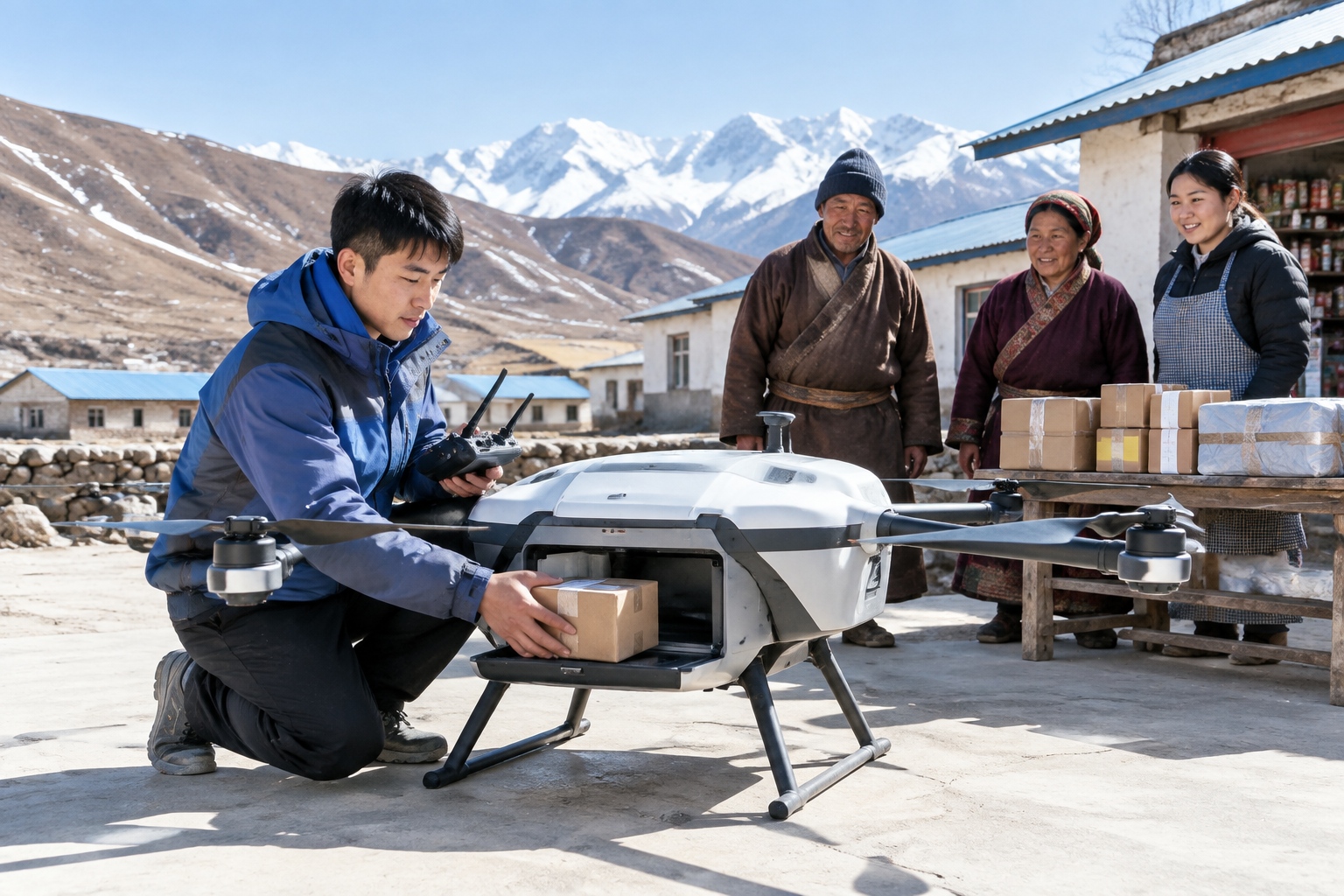
Drones are the experiment layered on top. Test routes carry tea, medicine and documents between county towns and remote townships in several highland areas. The limits are obvious: payload, wind, battery life in cold air, and rules. China’s first national regulation for civil unmanned aircraft took effect in 2024, which makes routine flying easier to plan but still far from automatic. A drone dropping a parcel at a nomad camp is a demonstration today, not a business.
What Still Does Not Work
Any honest account of connectivity on the plateau has to include the parts that do not fit the pitch.
Cost per user in Nagqu is enormous compared with Shenzhen, and the gap is covered by subsidy that could go elsewhere. Maintenance is permanent: diesel trucked to remote sites, equipment that fails in the cold, outages during heavy snow. Older herders who never learned Mandarin and never used a smartphone sit on the wrong side of a real divide, and cash still circulates widely.
Some villages are shrinking as young people leave for Lhasa, Chengdu or further. Running fibre to a place that may hold 60 residents in ten years is a bet, and not always a good one. Delivery speeds that feel normal in Beijing are still measured in days here, and longer in winter.
Why It Is Worth Watching From Outside
Most countries let demand pull infrastructure. If a tower cannot pay for itself, it does not get built. China often does the opposite, building first and waiting to see what people do with it. The results are mixed, which is precisely what makes the experiment interesting. Livestream selling and telemedicine are real uses that appeared only after the connection existed. Empty base stations near emptying villages are real too.
For mountain regions in Nepal, Pakistan, Kyrgyzstan, Peru or Ethiopia, the plateau is the closest thing to a large-scale test of one question: what happens when you connect the hardest places first? So far the answer is that connectivity on its own changes less than expected, and more than expected in ways nobody planned.
What Comes Next
The next layer is already visible. Plateau sites are among the first to trial 5G-Advanced, partly because there is so little interference up there. Satellite backhaul is being tested for valleys where laying fibre makes no sense. Solar microgrids are replacing some diesel generators, cutting the cost of keeping a remote site alive.
None of that answers the human question. The interesting part of the story at 4,500 meters is not signal strength. It is a woman in a padded coat standing in thin air, holding a phone case that travelled 3,000 kilometres to a locker in a town most maps barely show, and treating the whole thing as unremarkable.
Start the discussion at forum.chinacomes.com