
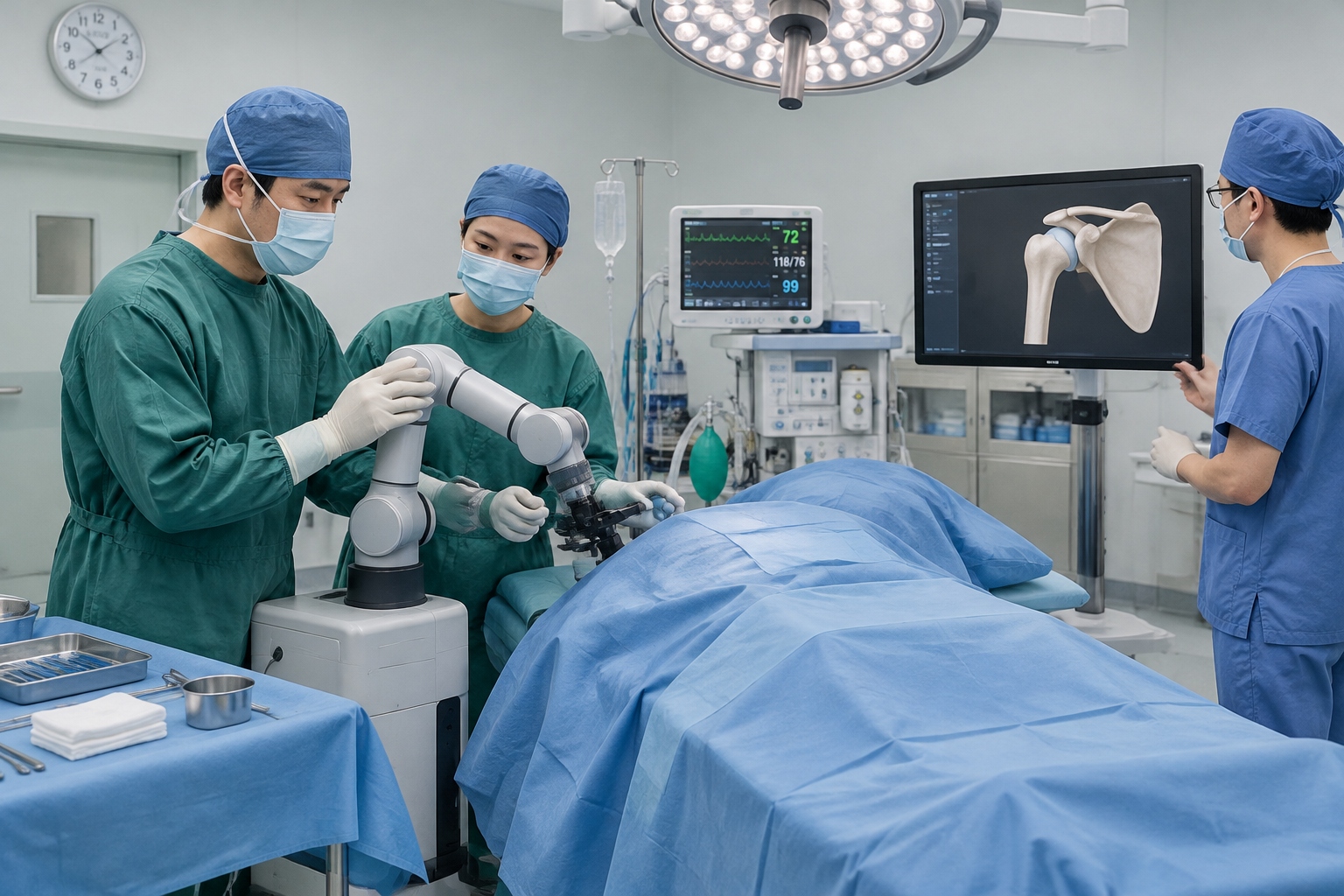

Before the first incision, a surgeon checks a three-dimensional shoulder model on a monitor. A nurse counts instruments. Beside the operating table, a tracking camera needs an unobstructed view of the equipment that connects the surgical plan to the patient’s bones. The team must confirm that the anatomy on screen matches the shoulder in front of them.
This is an illustrative workflow for computer-assisted shoulder replacement, not an eyewitness account of a particular Chinese operation. It captures the practical question behind a homegrown robot entering the operating room: what does the machine help the surgeon do, and what changes for the person under the drapes?
Why shoulder replacement is a demanding operation
For a patient, the problem may begin with ordinary movements: putting on a coat, washing their hair, or turning over in bed. Severe arthritis, certain fractures, and damage involving the rotator cuff—the tendons that help move and stabilize the shoulder—can make these actions painful or impossible. Replacement becomes an option for selected patients after assessment; a robot does not change that basic decision.
The shoulder is a ball-and-socket joint. Its shallow socket, called the glenoid, sits on the shoulder blade. During replacement, the surgeon works through a restricted view, close to nerves and other vulnerable structures. Wear can distort the socket, leaving less bone for securing an implant. Positioning a component requires balancing alignment, fixation, movement, and the risk of instability.
There are also different operations. An anatomical replacement broadly reproduces the original ball-and-socket arrangement. A reverse replacement switches their positions and changes how muscles move the arm. The American Academy of Orthopaedic Surgeons describes reverse replacement as an option for conditions including certain shoulders with major rotator-cuff damage. Choosing the procedure remains a clinical judgment.
What the robot can contribute
Depending on its design and approved purpose, a system may combine planning software, tracking equipment, surgical instruments, and a robotic arm. These parts have different jobs. A navigation display can show where an instrument is pointing; an active robotic mechanism may help constrain or guide its movement. A three-dimensional plan alone does not establish that an operation is robot-assisted.
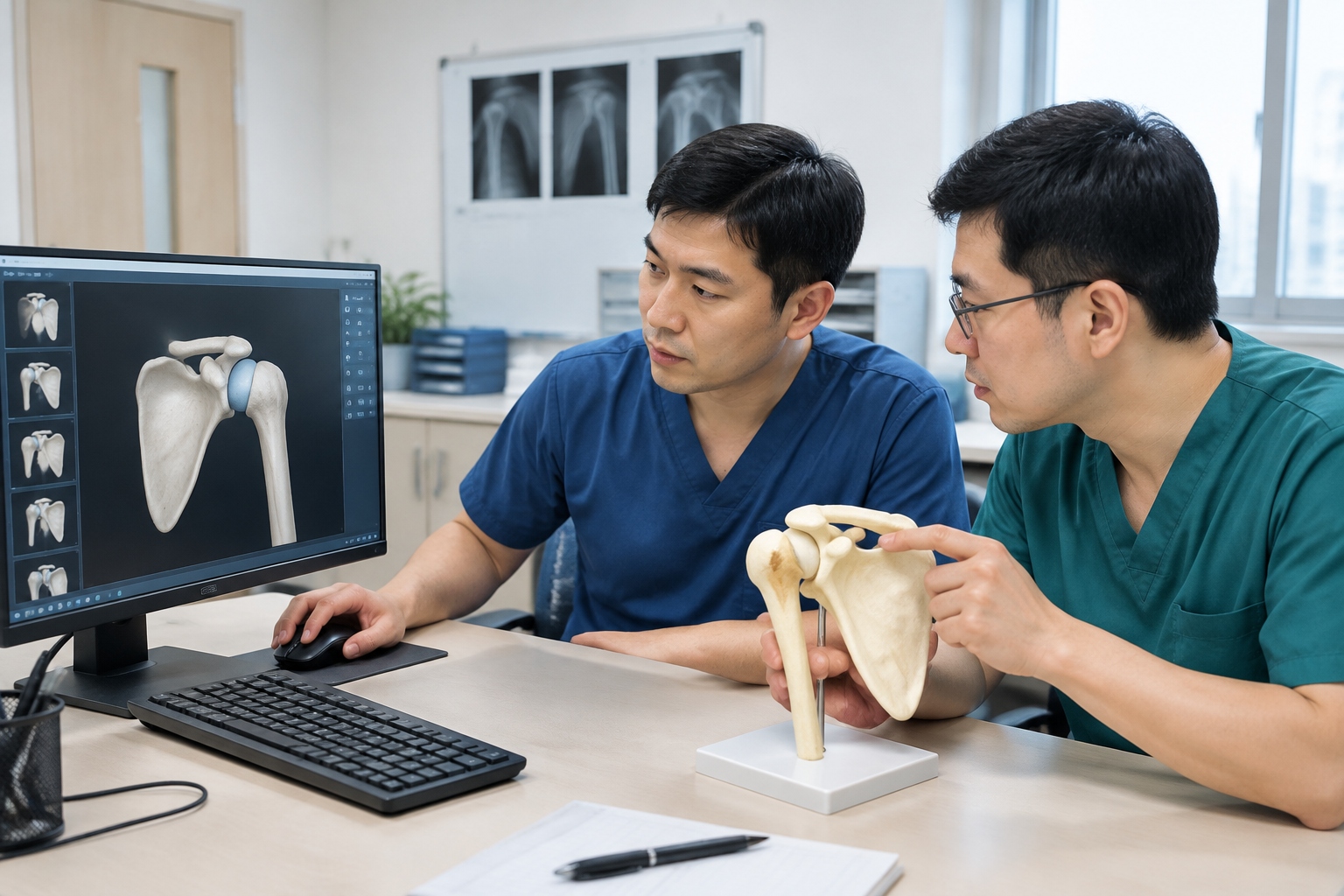
In a typical CT-based workflow, software builds a model from the patient’s scan. The surgeon reviews bone loss, tests implant sizes, and plans a position. During surgery, registration links points on the actual bone to that digital model. Tracking equipment then helps the team relate instruments to the plan. The exact sequence depends on the device.
The potential benefit is a more reproducible way to execute difficult positioning tasks. Depending on the system, assistance might involve guiding a drill or controlling preparation of the socket. It does not establish that every patient will have less pain, fewer complications, or a longer-lasting implant. Those outcomes require clinical evidence.
What changes for doctors inside the operating room
The surgeon acquires another set of responsibilities: reviewing the plan, checking registration, understanding the machine’s limits, and recognizing when its information is unreliable. A displaced tracker or blocked camera view may interrupt guidance. If the digital model and the visible anatomy disagree, the team must investigate before continuing.
Preparation extends beyond the surgeon. Nurses need to know which components require sterilization and how equipment fits around the sterile field. Operating-room staff must accommodate the camera and robotic arm without obstructing anesthesia access. Technical support needs clear boundaries, while responsibility for clinical decisions stays with the treating team.
Hospitals also need a workable fallback. If guidance becomes unavailable, can the surgeon continue safely with conventional instruments, or should the plan change? That answer belongs in training and case preparation. Early operations may take longer because setup and registration add work, although the effect on total operating time must be measured for the specific system.
What “China’s first” needs to establish
A domestically developed system could give Chinese hospitals closer access to engineering support, maintenance, and software development. Whether that produces quicker repairs or lower costs depends on procurement contracts and actual service performance. Domestic manufacture alone does not establish affordability, availability, or better outcomes.
The phrase “China’s first” needs an equally precise explanation. It might refer to a prototype, a first human procedure, a clinical study, or regulatory approval for a defined use. These milestones are different. Readers need the manufacturer, device model, hospital, procedure date, and National Medical Products Administration registration details to understand the claim.
The material supplied for this article does not identify those details or include hospital and surgeon interviews. Consequently, no specific first-use claim, surgeon quotation, or device-specific clinical result is presented here as verified. Those gaps matter: a report about one successful operation cannot establish routine access across China’s hospitals.
Clinical data: accuracy is only part of the answer
A useful study should report how many patients were treated, which procedures they underwent, what comparison group was used, and how long follow-up lasted. It should distinguish planned implant position from the position actually achieved. Complications, additional surgery, operating time, and conversion to conventional instruments also belong in the account.
Patients need a second set of measurements: pain, sleep, ability to dress, usable movement, and satisfaction. Greater placement accuracy may be valuable, but its effect on everyday function must be tested. Small early series can show feasibility; they cannot reliably establish uncommon complications or implant survival over many years.
Hospital and surgeon interviews would help explain what published numbers leave out. How were early patients selected? Which cases were excluded? What failed during setup? Has the team changed its workflow? For this particular system, those questions remain unanswered in the available material, rather than being filled with anonymous praise.
Recovery still happens one movement at a time
After surgery, the patient experiences an operated shoulder, regardless of how the implant was positioned. Pain management, wound care, and protection of healing tissues still matter. A sling is commonly part of recovery. The permitted movement and exercise schedule differ between procedures and according to the surgeon’s instructions.
Patient guidance from the AAOS describes rehabilitation as a gradual process extending over months. Some daily activities return earlier than strength and full recovery. A robotic procedure does not justify promising a fixed discharge date or an accelerated exercise schedule. Fracture severity, tendon condition, other illnesses, and help at home all influence progress.
In China, that help can involve practical arrangements beyond the hospital: a relative taking leave, travel back to a specialist clinic, or finding rehabilitation near home. For someone living far from the surgical center, repeated follow-up may be a substantial burden. A sophisticated operation does not automatically solve the journey afterward.

Costs, training, and the route into ordinary care
There is no reliable price reduction to quote without a hospital bill and a clear comparison. Costs may include imaging, implants, anesthesia, admission, rehabilitation, and any separately charged robotic assistance or consumables. Insurance reimbursement and local pricing rules affect what the patient actually pays. A cheaper machine does not necessarily produce a cheaper treatment episode.
For hospitals, adoption means funding equipment, maintenance, staff training, and operating-room time. Training should cover patient selection, supervised procedures, registration checks, troubleshooting, and conventional techniques. A surgeon experienced in shoulder replacement still needs instruction on a new platform; proficiency on the platform does not replace surgical experience.
The questions a patient can reasonably ask are concrete: Why is replacement appropriate for me? What would this robot add in my case? How experienced is this team? What happens if guidance fails? What will I pay, and where will I receive rehabilitation?
The eventual test is equally concrete. Months after the operation, can someone reach a shelf, put on a shirt, or sleep more comfortably—and has the hospital documented the complications as carefully as the successes? That is where the promise of a Chinese-developed shoulder-replacement robot has to meet ordinary life.
Sources and reporting scope
General clinical background: AAOS OrthoInfo, Shoulder Joint Replacement and Reverse Total Shoulder Replacement. These explain established shoulder care; they do not validate a particular Chinese robotic system. The opening is illustrative, and no original hospital or doctor interviews were available for this article.
Start the discussion at forum.chinacomes.com