
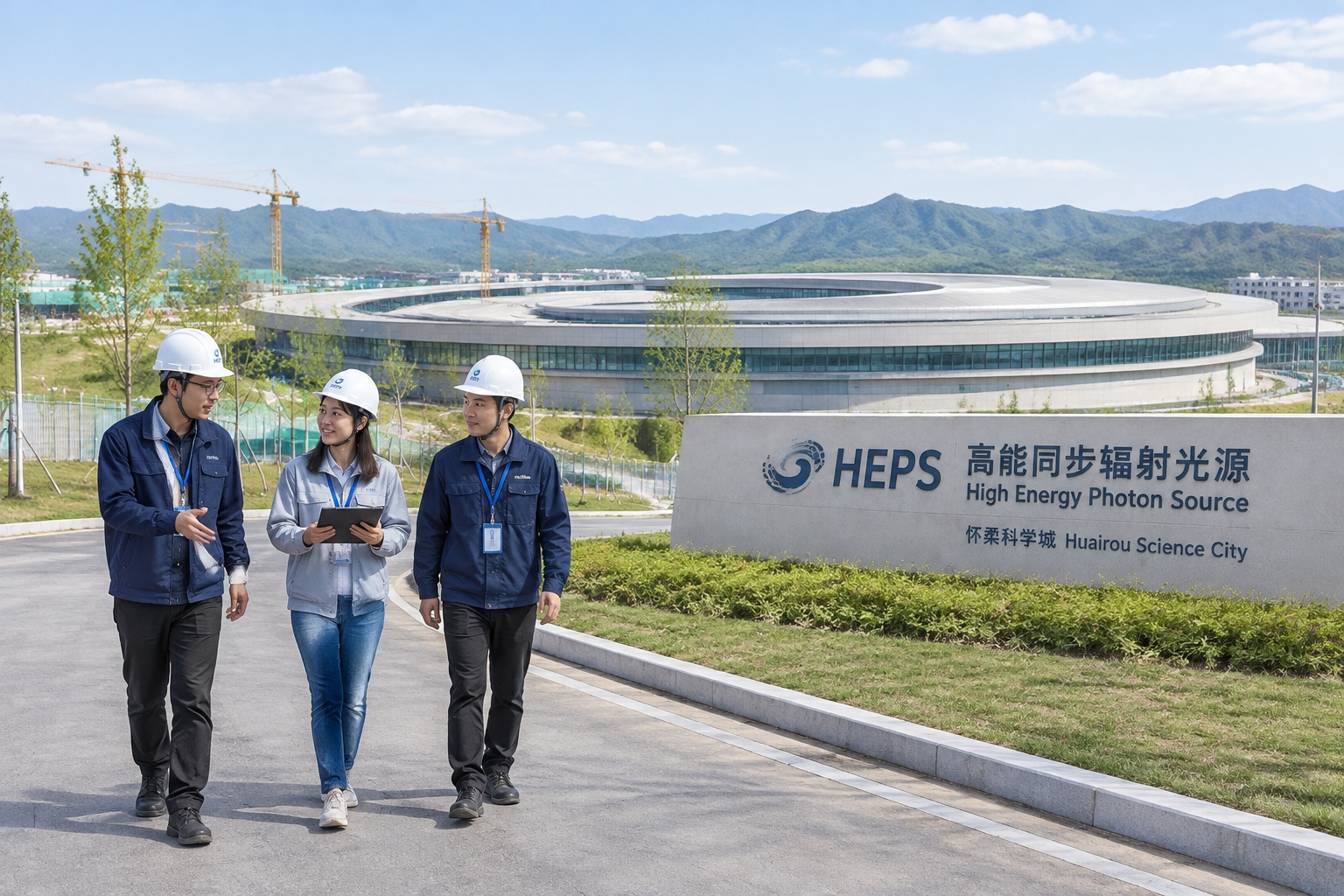

A ring of light in Beijing’s northern suburbs
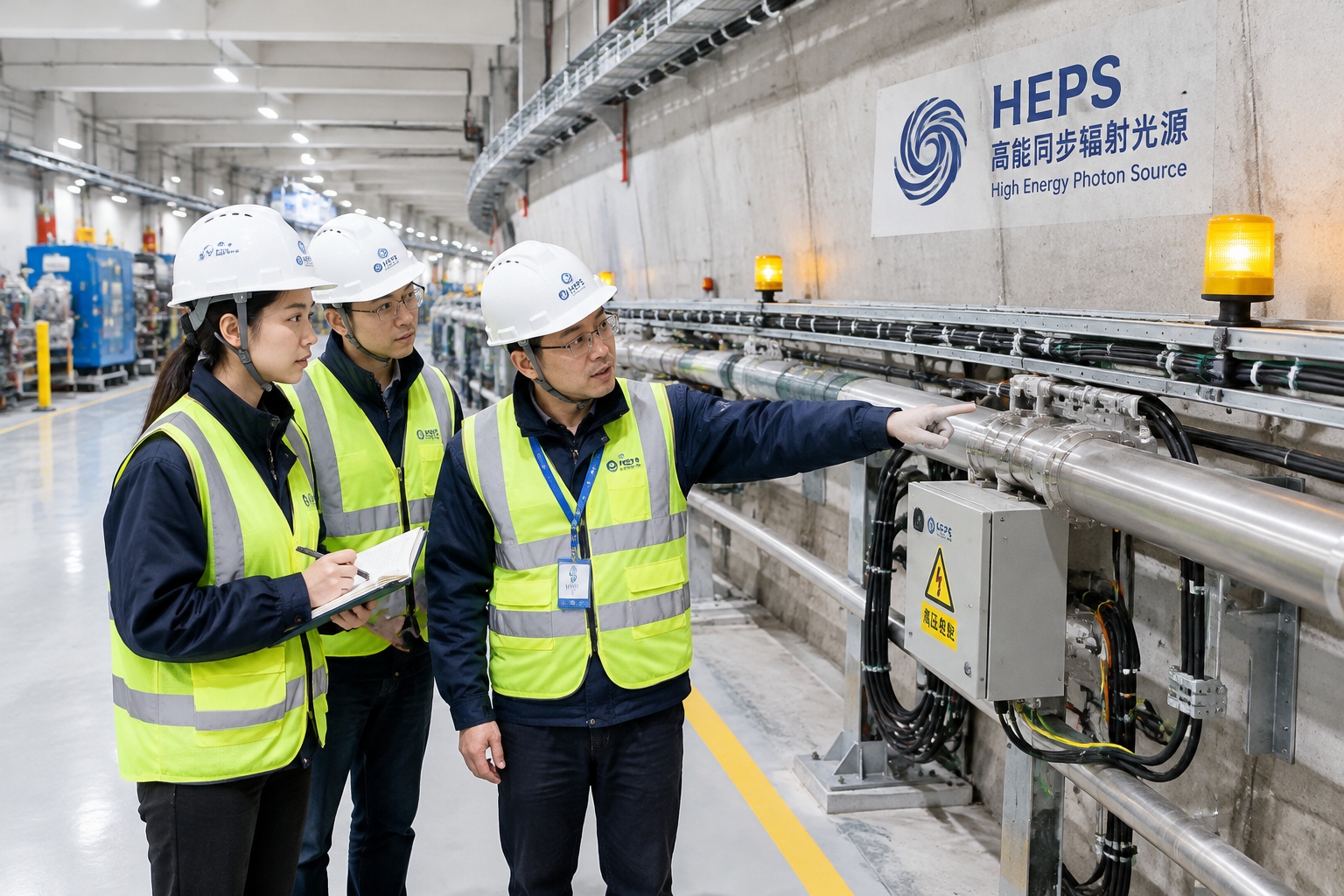
Inside the experimental hall in Huairou, a district about an hour’s drive northeast of central Beijing, a concrete tunnel curves out of sight. The tunnel is part of a ring 1.36 kilometers around. Electrons are meant to circulate inside it at 6 GeV, close to the speed of light. Every time magnets bend their path, the electrons shed X-rays. The facility is HEPS, the High Energy Photon Source.
HEPS is officially described as Asia’s first fourth-generation synchrotron light source and as the world’s highest-design-brightness synchrotron. Both phrases are precise in Chinese official usage. They refer to design parameters, not to a guarantee that every experiment run there will be world-leading.
What a synchrotron light source actually does
A synchrotron is not a camera. It is closer to a very bright, tunable torch. Electrons are accelerated and steered by magnets; as their path bends, they emit electromagnetic radiation. That light is filtered, focused and sent into samples. Detectors record how it scatters, diffracts, is absorbed or passes through. From those signals, researchers reconstruct atomic arrangements, chemical states, strain, cracks and magnetic order.
The difference from a hospital X-ray is scale and control. A hospital X-ray gives a shadow. A synchrotron gives a map: which atoms sit where, how a battery interface changes as it charges, why a turbine blade cracked. The “synchrotron” part is the accelerator. The “light source” part is the network of beamlines that feed dozens of experimental stations. Each beamline tunes the light for a particular job.
Why “fourth generation” is more than a label
Synchrotron facilities are grouped by generations. First-generation machines were parasitic users of accelerators built for particle physics. Second-generation facilities were dedicated to light. Third-generation sources added insertion devices, such as wigglers and undulators, to push brightness higher. Fourth-generation sources use multi-bend achromat lattices to shrink the electron beam’s emittance.
Emittance is the spread of the electron beam. An electron beam is never a mathematical line; it has a width and an angular spread. A low-emittance beam stays tight as it travels, and the X-rays it emits are also tighter and more coherent. Think of a garden hose: same water pressure, narrower nozzle, tighter stream. HEPS’s storage ring is designed for an emittance of about 34 picometer-radians. A typical third-generation high-energy source sits in the nanometre-radian range, thousands of picometer-radians. The difference is roughly one to two orders of magnitude.
That matters for resolution and for experiments that need coherent light. Coherent X-rays can image nanometre-scale structures, detect weak signals and follow fast chemical changes. The fourth generation is not simply “brighter.” It is more focused, more coherent and better suited to looking at very small things inside thick materials.
What “highest design brightness” means, and what it does not
Brightness is a technical quantity: photons per second per unit area per unit solid angle per bandwidth. HEPS’s official design value is 5 × 10^22 photons/s/mm²/mrad²/0.1%BW. The key word is “design.” It describes what the machine is expected to deliver when fully tuned, not routine performance on every beamline.
At commissioning, machines rarely hit design values immediately. Heat loads, beam instabilities, insertion devices and beamline optics all affect what users get. The design number is a target, not a logbook entry.
Comparisons also depend on photon energy. HEPS is a high-energy source at 6 GeV, optimized for hard X-rays that penetrate thick samples. A lower-energy source may be better for soft X-rays, surface chemistry or magnetism. “Brightest” is not a single league table. Beamline quality, stability, sample environment and user support often decide whether a good experiment is possible. Researchers choose a source by energy range, equipment and schedule, not by a headline ranking.
Where the light goes: materials, chips, energy and life science
A turbine blade is a good example. A single-crystal blade carries internal stresses from casting and coating. High-energy X-rays can map those stresses without cutting the blade open. A chip has layers only nanometres thick; X-rays can probe residual stress in packaging, tiny voids, or the interface between copper and dielectric. A battery cell can be cycled in place while X-rays watch the cathode change. A catalyst can be studied at working temperature and pressure, not only in vacuum.
Life sciences use synchrotron light too. Protein crystallography at high-energy beamlines can collect data from small crystals, though radiation damage is always a trade-off. Medical imaging, archaeology and cultural heritage also use synchrotron X-rays to look inside objects without damaging them.
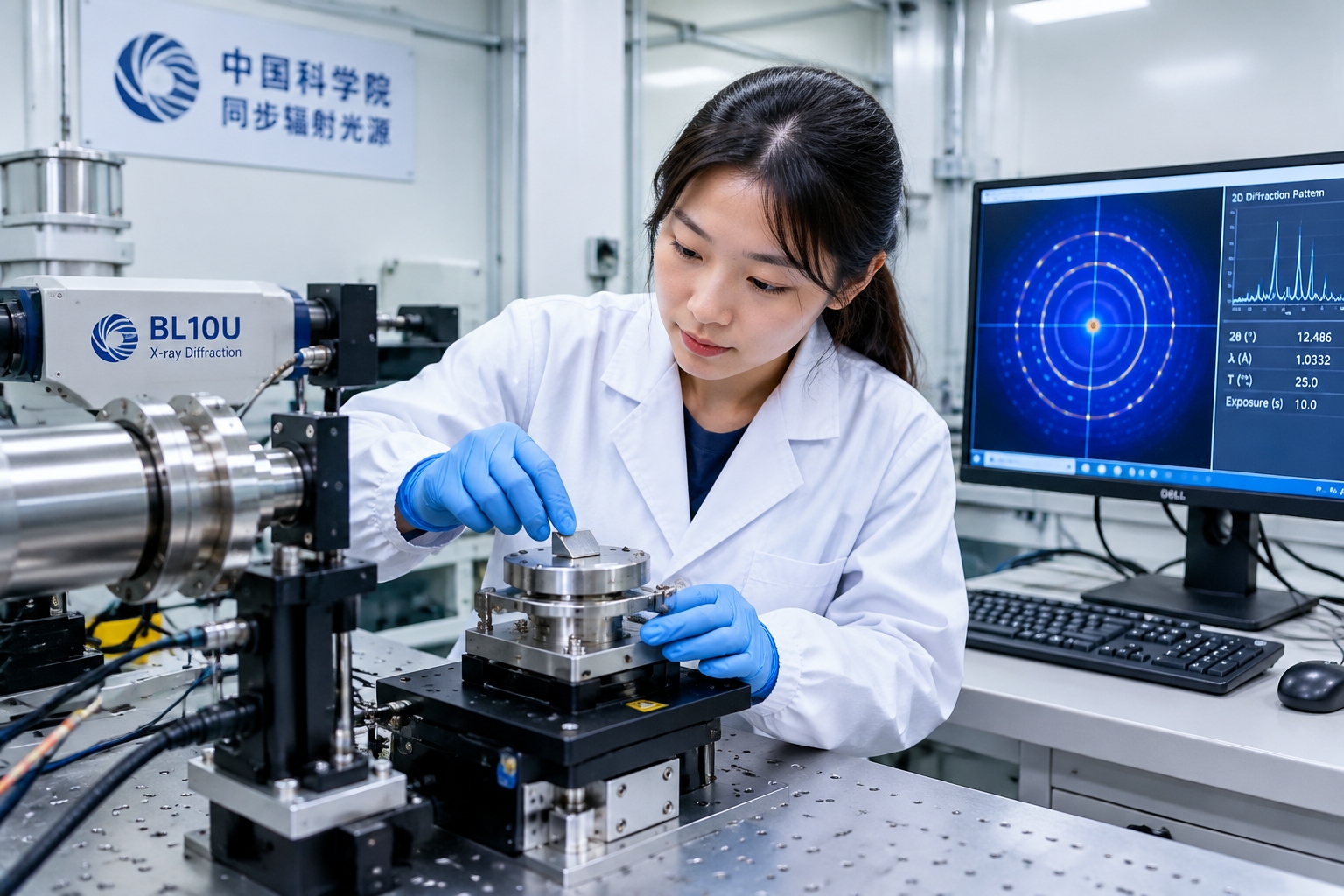
None of this is automatic. Each application needs a beamline, a sample environment and a research team. A light source is infrastructure, like a port or a power grid. The ships and factories decide the trade.
A user facility, not a monument
HEPS sits in Huairou Science City, a planned cluster of research institutes, universities and residential blocks. The ring is the big visible object. The less visible work is proposal review, beam-time scheduling, sample mounting, data reconstruction and maintenance.
Chinese researchers have relied heavily on the Shanghai Synchrotron Radiation Facility, and demand for beam time has long exceeded supply. A new source adds capacity, especially for high-energy X-rays. It also adds competition: users must write strong proposals, and staff must keep the machine reliable.
Industrial users can apply for beam time as well. For a semiconductor firm, a battery maker or a catalyst producer, a few shifts at a beamline can answer a question that would take months of trial and error. But it requires a well-prepared sample and a clear question. A light source is not a magic scanner.
The gap between construction and output
Big science facilities are slow by nature. The building and accelerator can be finished before the beamlines are fully commissioned. Staff need to learn the machine; users need to learn how to use it. The first papers often come from a handful of beamlines. Broader output can take five to ten years. Europe’s ESRF, the US’s APS and Japan’s SPring-8 all went through this.
China’s record with big facilities is mixed. Some have become highly productive; others have struggled to match early expectations. The difference is rarely the accelerator itself. It is the user community, the beamline staff, the maintenance budget and the willingness to say no to weak proposals.
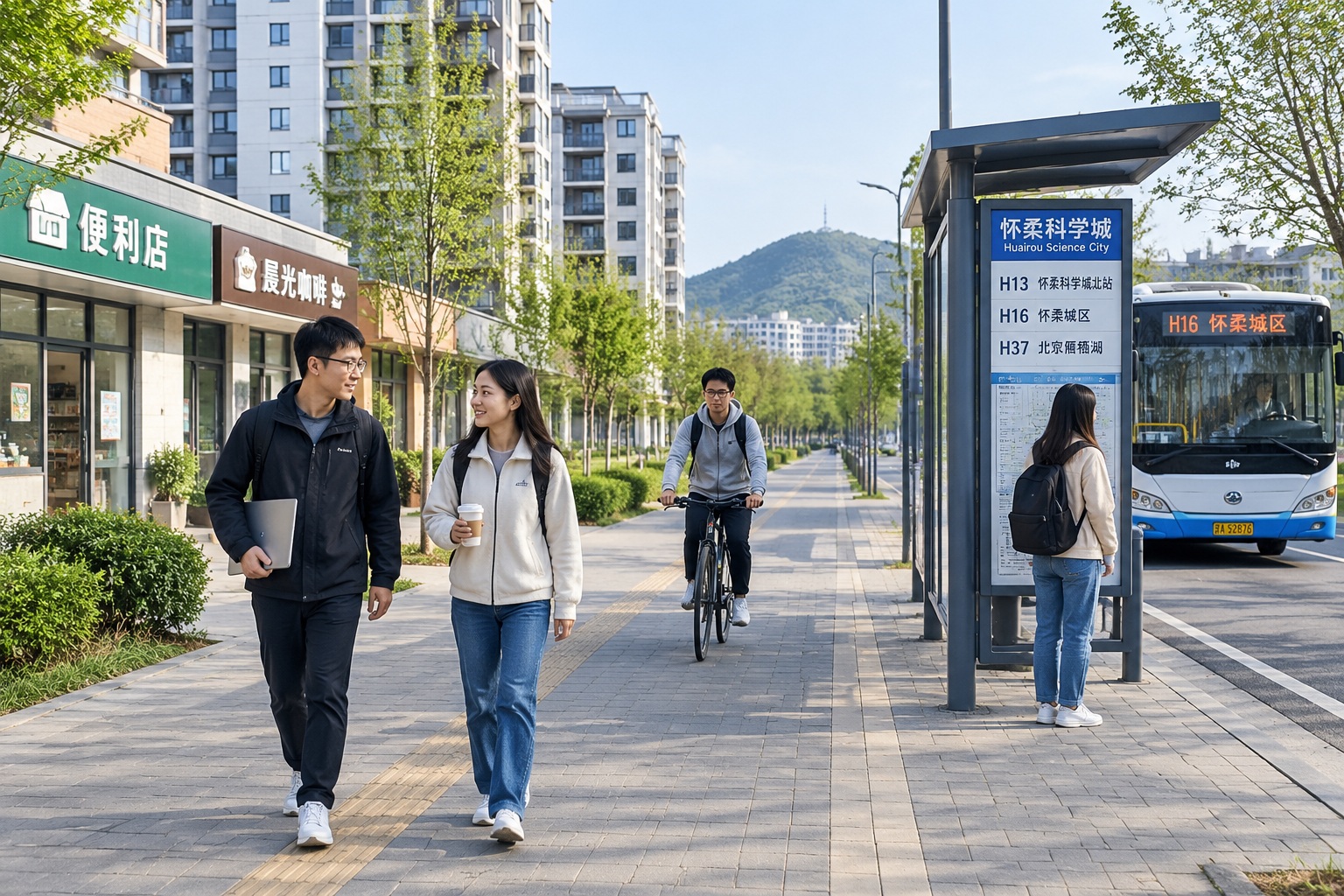
An advanced machine in an ordinary landscape
Outside the ring, Huairou still looks like a suburb under construction: new apartment blocks, wide roads, buses, small restaurants. The facility has brought jobs and visitors, but it has not turned the district into a science-fiction city. That is probably the most honest image of China’s research infrastructure: a very advanced machine in an ordinary landscape, with people in safety helmets trying to make it work.
The “first” and “highest” labels are useful for engineers and for public communication. For everyone else, the test is simpler: can researchers get the beam time they need, and does the light reveal something that matters? A synchrotron is not a trophy. It is a lamp. The point is what it lets people see.
Start the discussion at forum.chinacomes.com