
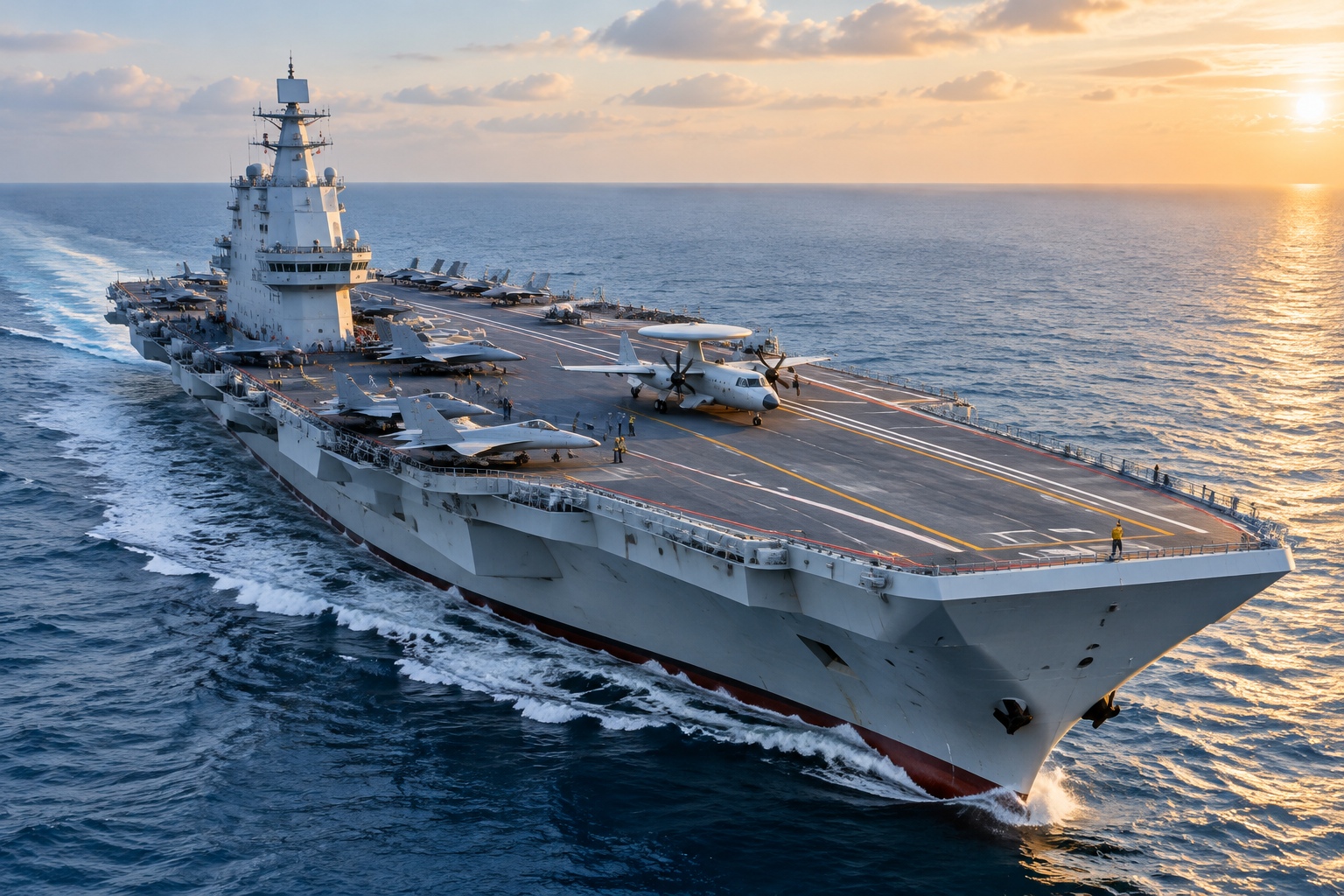

Watch a fighter leave the deck of a ski-jump carrier and something odd stands out: the ship barely does anything. The pilot holds the brakes, spools the engines to full power, releases, and the aircraft accelerates up a ramp that curves into the sky. The ramp adds no energy. It tilts the last thirty metres upward and lets physics do the rest.
That constraint runs through the whole ship. A J-15 launching from the Shandong cannot leave with a full tank and a full weapons load at the same time; it trades one for the other. Nor can the air wing include a slow, heavy turboprop carrying a large radar — precisely the aircraft that lets a fleet see hundreds of kilometres past the horizon.
The Fujian, China’s third carrier and the first built without a ramp, is designed to remove that trade-off. Flat deck, three electromagnetic catapults, no ski jump. Chinese state media reported the ship entering service in late 2025, after sea trials that began in May 2024.
What a catapult actually does
A catapult is an external engine bolted to the deck. It grips the aircraft’s nose landing gear and drags it down a track, adding in roughly a hundred metres the kinetic energy the jet’s own engines could not produce over that distance.
The first consequence is weight. Every extra tonne at takeoff becomes fuel, which means range and time on station, or ordnance, which means reach and effect, or both. US Navy publications put the upper end of its electromagnetic catapult envelope at about 100,000 pounds — some 45 tonnes — and describe finer control across that range than steam provided.
The second is tempo. A catapult launch is more repeatable than a ski-jump launch, because the ship rather than the pilot sets the energy going into the aircraft. Wind shifts and deck motion matter less, and the aircraft does not spend fuel building speed on its own.
The third is easiest to underestimate: a catapult makes room in the air wing for aircraft that could never use a ramp at all.
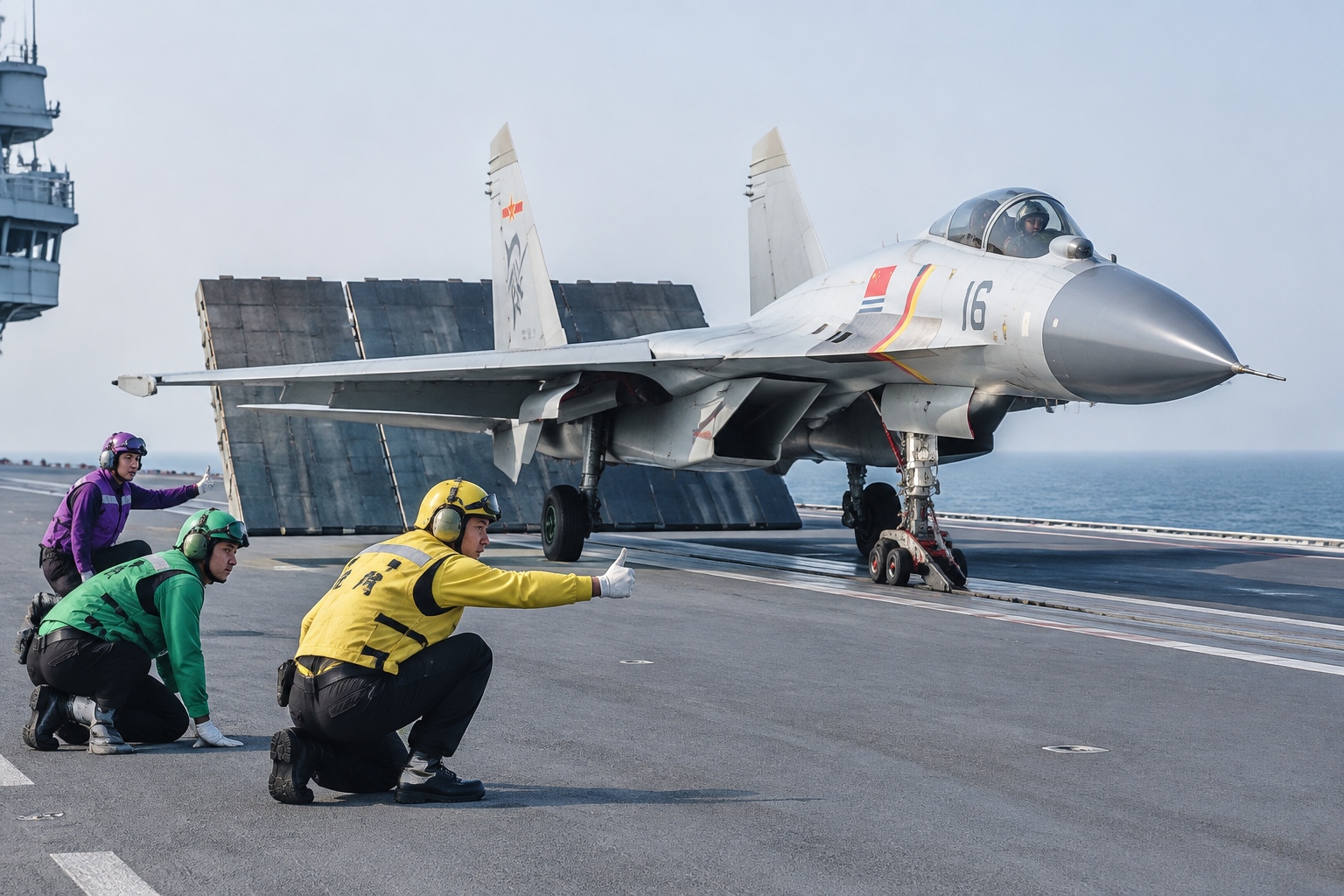
Steam versus electromagnetic, in plain terms
Steam catapults have been the standard since the 1950s. Boilers raise steam, some of it is held in large accumulators, and a launch releases it into a cylinder to drive a piston along a slot in the deck.
Think of pushing a heavy shopping trolley with one hard shove. Nearly all the force arrives at the start and fades as the trolley rolls. Steam catapults behave the same way: acceleration peaks early and tapers off. Airframes feel that. So do the crews who maintain a high-pressure plumbing network spread across the ship, one that also consumes a great deal of fresh water.
An electromagnetic catapult replaces the piston with a linear induction motor. A travelling magnetic field pulls a shuttle along the track, the way a conveyor belt moves a box. Energy no longer comes straight from a boiler. It is generated earlier, stored — in flywheels, in the US design — and released as electricity in a pulse lasting about two seconds.
That changes the shape of a launch as much as its size. Software sets the acceleration curve, so a 30-tonne fighter, a light drone and a heavy turboprop can each get a profile suited to them, with less structural strain than a single hard shove delivers. The system resets faster between launches, and there are far fewer high-pressure pipes to inspect.
Why “conventional power plus EMALS” is the interesting part
This is where the Fujian stops being a Chinese version of an American idea and becomes a configuration nobody has put to sea before.
The US Navy’s electromagnetic catapults on the Gerald R. Ford run on two nuclear reactors. France’s next carrier is also planned as nuclear-powered with electromagnetic catapults. A conventionally powered hull — oil-fired steam turbines driving the ship — combined with electromagnetic launch has not been deployed by any other navy. Chinese state media describe the Fujian as the world’s first conventionally powered carrier with electromagnetic catapults, and on the narrow question of configuration, that statement holds.
The reason no one else has done it is power. A single launch draws an enormous electrical pulse in a very short window. Nuclear plants deliver that comfortably. A conventional ship has to build it: generators sized for the pulse, a storage system to buffer it, and power electronics able to hand it over without dimming the rest of the ship. That is an electrical architecture problem at least as much as a catapult problem. It is also the part Chinese naval engineers have discussed in public — the naval engineer Ma Weiming and colleagues at the Naval University of Engineering have published on integrated power systems using medium-voltage direct current, the kind of backbone such a ship needs.

The American experience shows why this is harder than a launch video suggests. The Pentagon’s Director, Operational Test and Evaluation documented, year after year, that the Ford’s catapult failed more often than the Navy’s own reliability targets during testing. Closing that gap took most of a decade. Building a catapult that works once is a demonstration; building one that works on the four-hundredth launch of a deployment is a different order of achievement, and no such figure for the Fujian has been published.
The ship you can actually see
Publicly reported figures put the Fujian at about 316 metres long with a flight deck roughly 76 metres wide, and a full-load displacement in the 80,000-tonne class — larger than the Shandong, smaller than a Ford-class ship.
The deck layout is the giveaway. Two catapult tracks run forward from the bow and a third sits on the angled deck, so aircraft can be launched while others recover. Three arresting wires are strung across the landing area at the stern. Two aircraft elevators sit on the starboard side. The island, the ship’s superstructure, is noticeably smaller than the Shandong’s, with flat phased-array panels set into its sides instead of the earlier generation’s rotating radars.
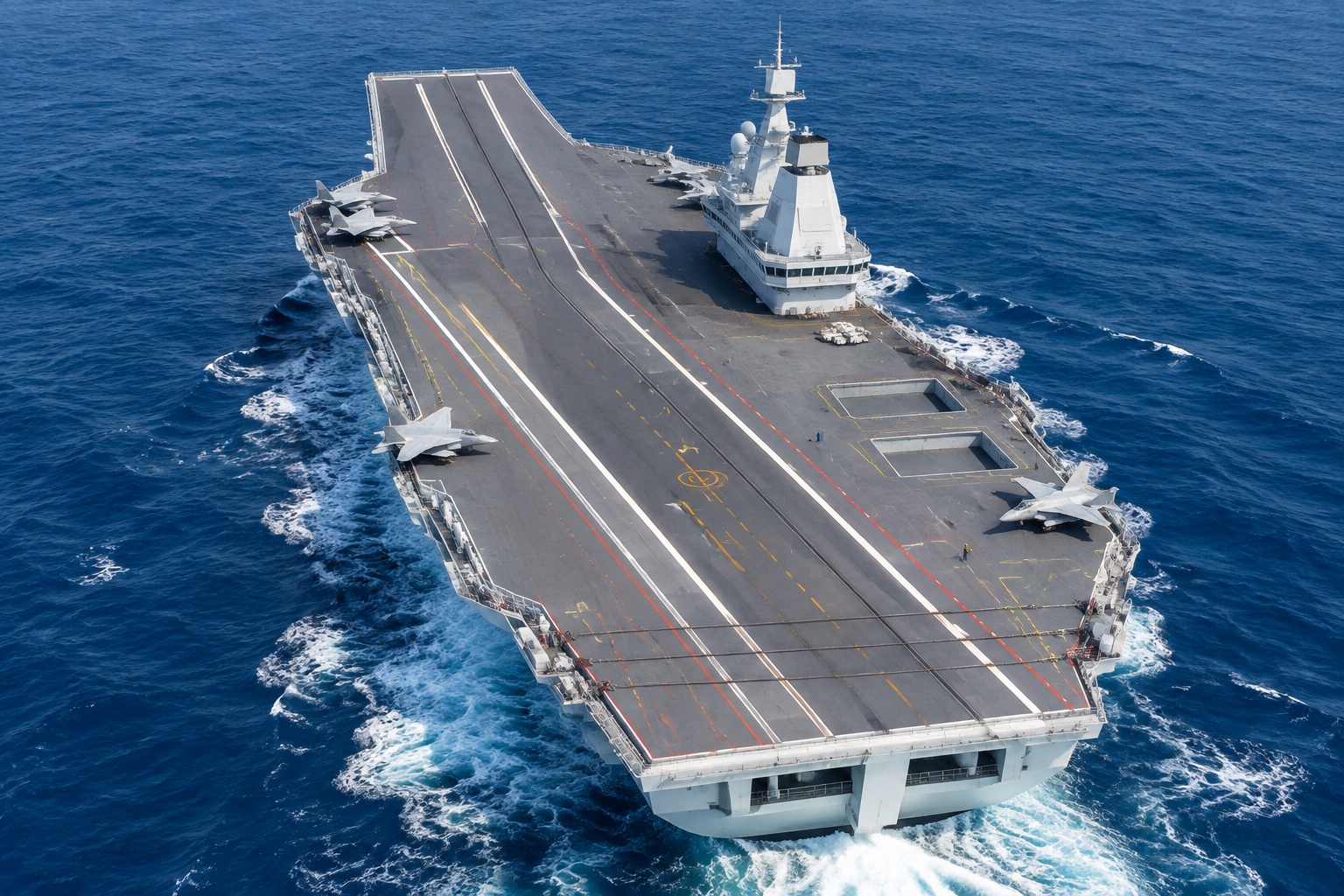
Sea trials began in May 2024 and ran in stages, starting with propulsion and electrical systems and widening from there. In September 2025, Chinese state media reported that three aircraft had carried out catapult launches and arrested landings on board during trials: the J-15T, the J-35 and the KJ-600. The released footage showed deck crews in colour-coded vests, the jet blast deflector rising behind each aircraft, and the shuttle running back down the track after release — the unglamorous half of the story.
What it changes — and what it doesn’t
The biggest single change is probably the KJ-600. Helicopter-borne early warning, which the Liaoning and Shandong rely on, flies low and stays up for a limited time. A fixed-wing turboprop with a large radar can operate several kilometres higher and for hours, which extends how far the carrier group can detect aircraft and missiles, and lets it direct fighters onto them. That is a difference of kind, not degree.
Second, strike aircraft can go out heavier. The J-15T, a catapult-capable derivative of the J-15, and the stealthy J-35 both gain from launching with more fuel and more weapons than a ramp would allow.
Third, sortie rate. Catapults permit faster, more consistent cycles than ski jumps. But the catapult is one component in a chain that includes weapons loading, fuel, maintenance and how many aircraft can be parked without blocking the deck. The Ford offered a useful lesson here: its advanced weapons elevators, not its catapult, turned out to be the more stubborn bottleneck.
What does not change is experience. The US Navy has run catapult carriers since the 1950s. China has operated carriers since the Liaoning entered service in 2012. Deck crews, maintenance culture and safety habits are learned over years, not delivered with the hull. A carrier is also a system inside a larger system — escorts, submarines, tankers, shipyards — and no single piece of equipment decides how that system performs.
How to read “world first” and “world advanced”
Chinese official and state media descriptions of the Fujian use phrases such as “the world’s first conventionally powered aircraft carrier equipped with electromagnetic catapults” and describe the catapult technology as being at a world-advanced level. The first phrase is a narrow factual claim about configuration, and it holds. The second is a judgement. It reflects design ambition and what has been shown in public — launches of heavy aircraft from a flat deck — but not measured reliability, because no failure-rate data has been released.
The distinction matters beyond China. The Ford’s catapult was also described as advanced, and its early years were defined by the gap between design and dependability. The interesting questions about the Fujian are the boring numbers: launches between failures, maintenance hours per launch, how many aircraft the deck can cycle in a day, and whether the air wing can sustain that at night, in bad weather, in the sixth month of a deployment. Those numbers are not public, and probably will not be for a while.
What is not in doubt is plainer. The deck is flat, the ramp is gone, and a turboprop carrying a radar dish the size of a small boat can now fly off a Chinese carrier. That changes what the ship can see. Everything after that depends on whether the machinery keeps working.
Start the discussion at forum.chinacomes.com