

A Chandelier That Makes Things Cold
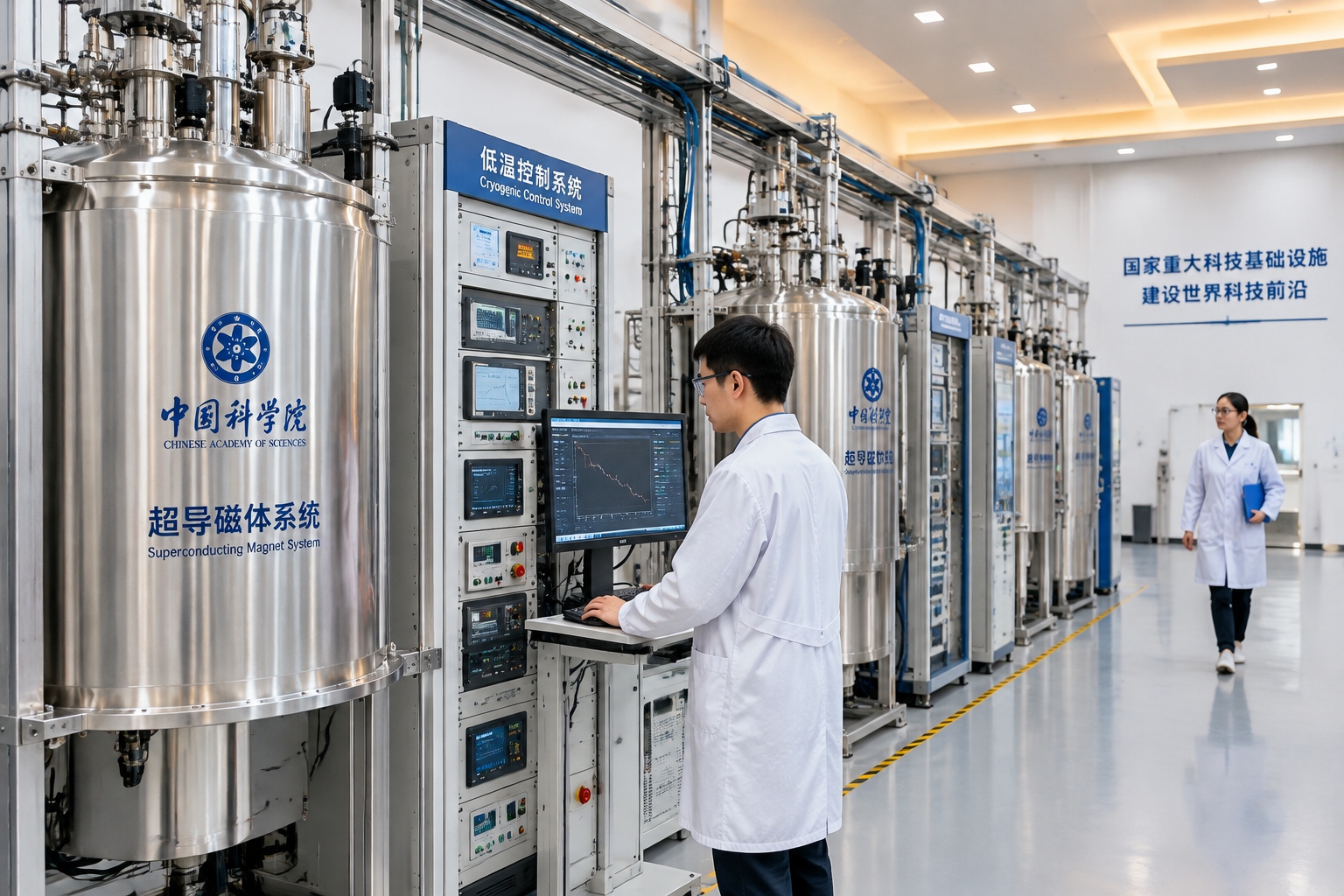
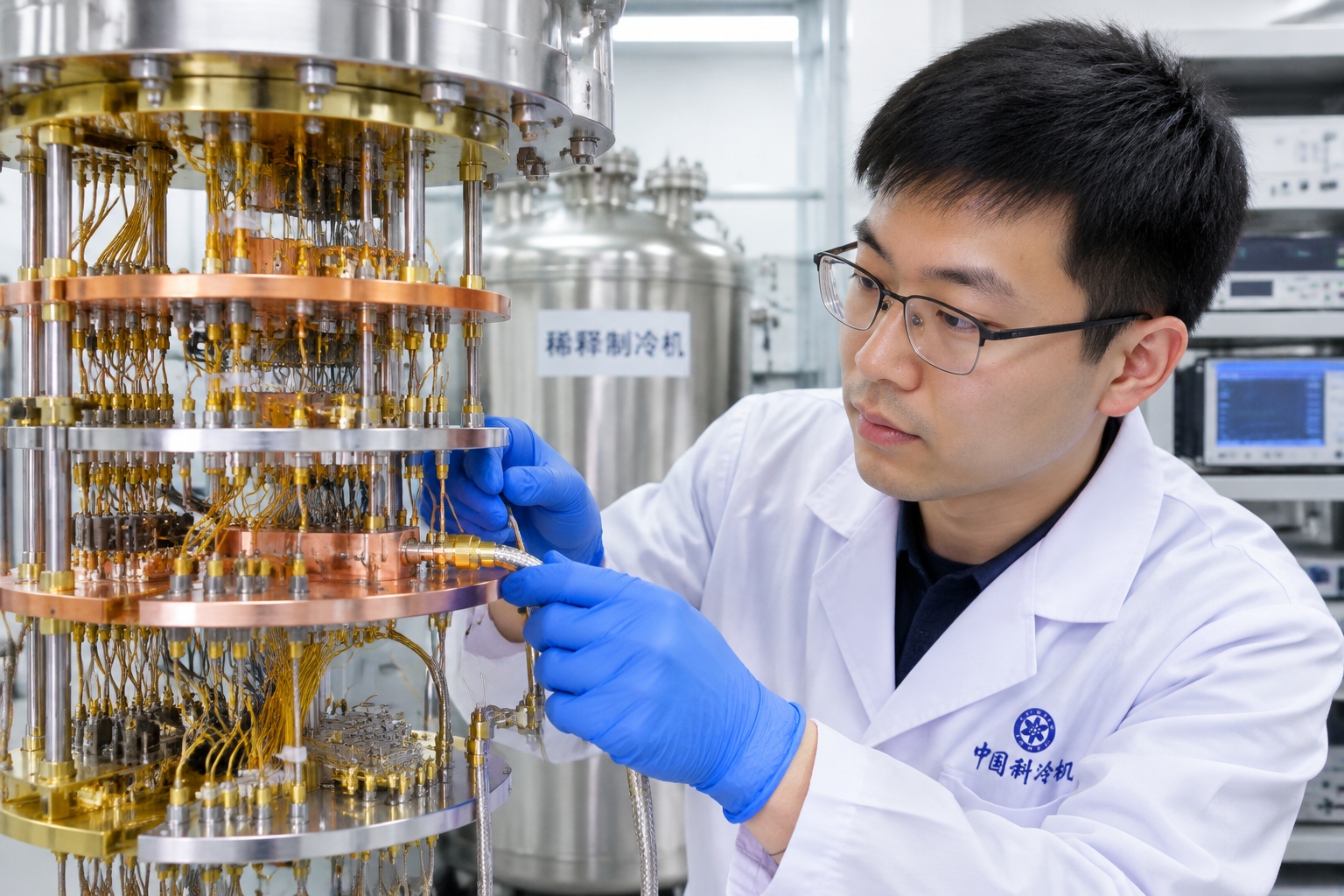
A dilution refrigerator looks like an upside-down chandelier: a stack of copper and silver plates, threaded with thin tubes, hanging inside a vacuum can. The sample sits at the very bottom, usually a crystal smaller than a grain of rice. Cooling it to a few thousandths of a degree above absolute zero takes hours, sometimes days. Once it is cold, nobody opens the door.
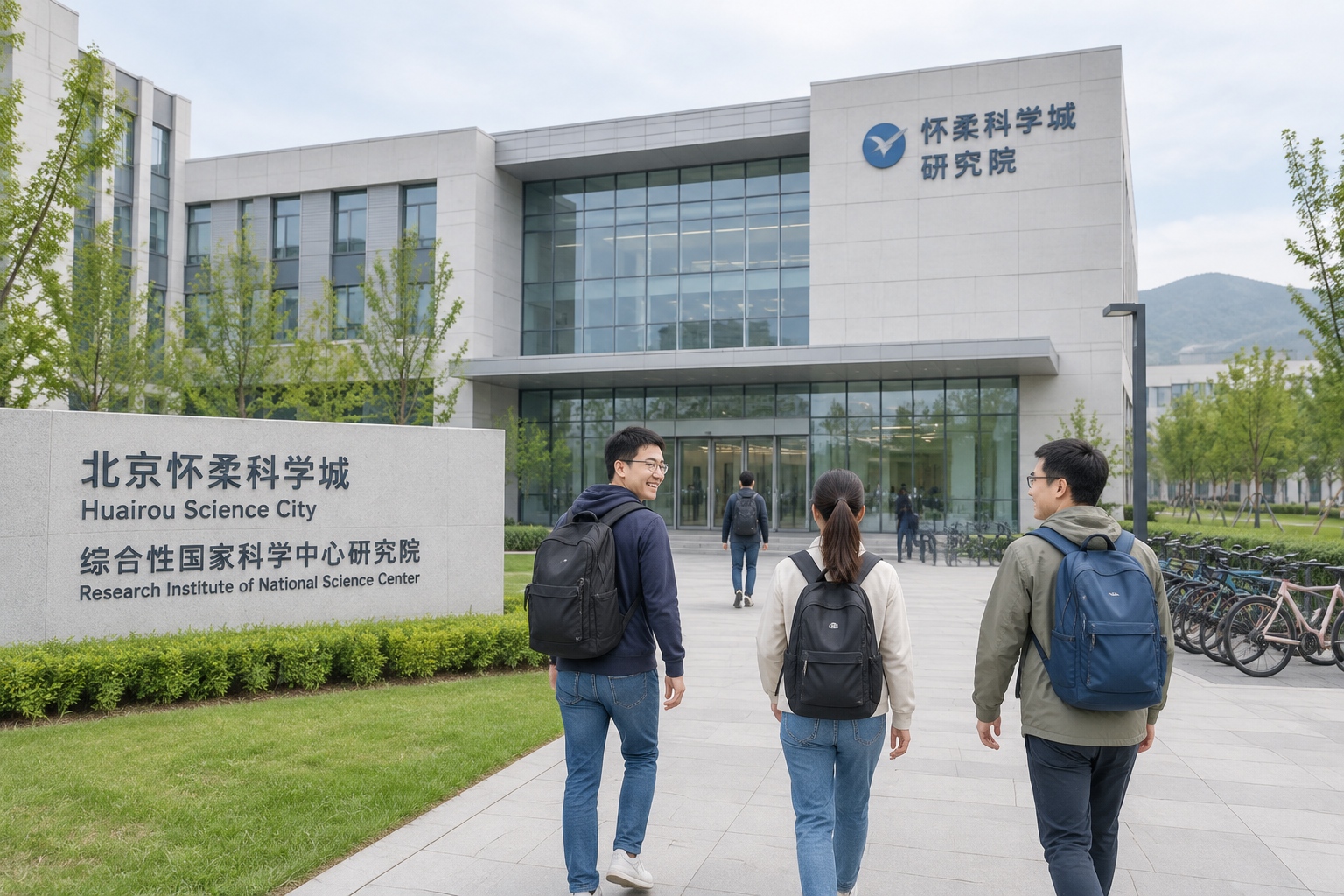
This machine is one reason a cluster of new buildings exists in Huairou Science City, a research town about an hour’s drive north of central Beijing. The project’s Chinese name is 综合极端条件实验装置 — literally “comprehensive extreme conditions experimental facility.” In English it is usually called the Synergetic Extreme Condition User Facility, or SECUF. It was built by the Institute of Physics under the Chinese Academy of Sciences, and it has passed national acceptance: the formal review that closes construction and clears the equipment to run as a shared research platform.
That sentence is easy to read past. So let’s unpack it — what “extreme conditions” means, why anyone wants them, what the facility can and cannot do, and what acceptance does and does not promise.
Four Knobs, Turned at the Same Time
“Extreme conditions” is lab shorthand for four physical parameters that are hard to reach and much harder to reach together.
Cold
Absolute zero is −273.15 °C, and it is unreachable. Deep space sits at about 2.7 kelvin. A millikelvin is a thousandth of a kelvin — colder than anything that occurs naturally, anywhere. At those temperatures, the random jostling of atoms fades away and the quantum behaviour of electrons becomes visible instead of being washed out by heat.
Magnetic field
A hospital MRI runs at roughly 1.5 to 3 tesla. Research magnets of the kind installed in facilities like this reach tens of tesla continuously, and higher still for very short pulses. Strong fields pry at the spin and orbital motion of electrons, changing which state a material prefers.
Pressure
One gigapascal is about 10,000 times atmospheric pressure. The centre of the Earth is somewhere around 330 to 360 GPa. Labs reach such numbers by squeezing a microscopic sample between two diamond tips — diamond anvil cells — where the pressure can exceed what exists inside the planet.
Fast light
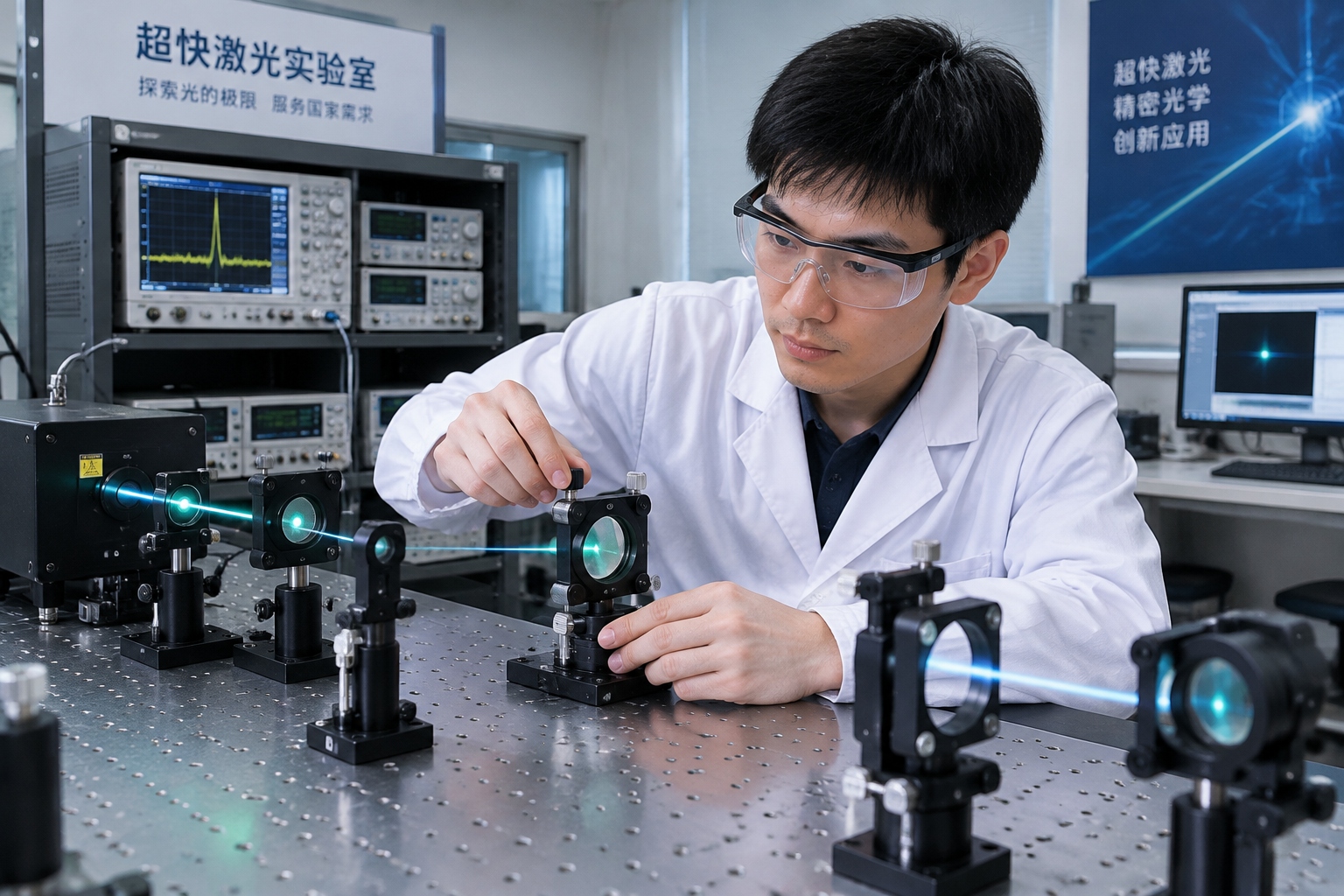
A femtosecond is 10⁻¹⁵ seconds. The ratio is hard to hold in your head: one femtosecond to one second is one second to roughly 32 million years. Pulses this short work like a stroboscope for atoms, freezing the motion of electrons and lattice vibrations frame by frame.
The word 综合 — combined, synergetic — is the point. Plenty of labs have a cold stage, or a magnet, or a laser. The engineering difficulty is stacking them on the same sample, so that a material can be cooled, squeezed and hit with light while you measure it.
Why Physicists Deliberately Make Materials Uncomfortable
Water turns to ice, then to steam, depending on temperature and pressure. Electrons inside a crystal do something similar. Depending on conditions, they can pair up and flow without resistance, align into magnets, or settle into stranger arrangements with names like topological insulators and quantum spin liquids. Change the conditions and you cross a boundary into a different state.
Push a material far from ordinary conditions, and the electrons reorganise. Sometimes they reorganise into something nobody has catalogued yet. That is the entire business model of an extreme-conditions lab: not to make a product, but to find out which states of matter the rules allow.
A concrete example. In 2019, a team working with lanthanum hydride reported zero electrical resistance at around 250 kelvin — roughly −23 °C — while the sample was squeezed to about 170 GPa. Superconductivity at a temperature you could survive in a kitchen, inside a cell a few micrometres across. Nobody is putting that in a power line. But it moved the boundary of what physics permits, and it required pressure, low temperature and precision measurement in the same experiment.
A Workshop, Not a Single Machine
The facility is not one gigantic instrument with one purpose. It is closer to a workshop with many benches: sample growth and preparation, low-temperature measurement stations, high-field stations, high-pressure stations, ultrafast optical stations, and combinations of these. There is supporting infrastructure for characterising what you made, and theory and computation alongside the hardware.
Practically, a visiting team does not “use the facility.” It uses one station, for an allocated block of days, with its own sample and its own question.
Placement matters too. Huairou Science City was planned as a cluster of large instruments and institutes rather than a single building in a field; a high-energy photon source is rising nearby. Putting cryogenics, magnets, lasers and materials scientists within walking distance creates a kind of everyday collision that is hard to plan on paper.
What It Might Study
The research directions attached to platforms like this tend to cluster in a few areas.
Quantum materials. Many candidate systems for quantum computing and quantum sensing only reveal their useful behaviour at millikelvin temperatures and in strong magnetic fields.
Superconductors. Both the copper-oxide family and the hydrogen-rich compounds under pressure are still not understood at a fundamental level. Better measurements mean better theories, and theories are what eventually produce useful materials.
Magnetism. Permanent magnets sit inside electric motors, wind turbines and hard drives. Small improvements in magnetic behaviour translate into large efficiency gains.
Energy and structural materials. Battery electrodes, catalysts and alloys all change their structure under stress; watching that happen in real time is a genuine experimental challenge.
Planetary science. Squeeze iron to 300 GPa and heat it, and you are doing geophysics — testing models of Earth’s core, or of the interiors of icy moons, without leaving the building.
Most of this will end as journal papers, not products. That is what basic research looks like from the inside.
What “Accepted” Means — and What It Doesn’t
验收, national acceptance, is an administrative and engineering milestone. An outside panel of experts checks each subsystem against its design specifications, looks at how the systems work together, reviews safety and measurement standards, and concludes that the facility can operate and serve users. It marks the end of construction as a project.
It does not mean the scientific goals have been achieved. Those goals were never a checklist of discoveries; they were, and remain, open questions.
Large research facilities have a long ramp-up. Instruments need commissioning. Staff need to learn their own machines. Outside users need a year or two to figure out which experiments are worth bringing. History offers a useful calibration: gravitational-wave detectors were built and running by the early 2000s, and the first direct detection came in 2015. Synchrotron light sources typically take a decade between opening and the biomedical or materials output that justifies the investment.
A realistic reading of the next few years is: instrument papers, method papers, first user results, training of a generation of students who know how to run a millikelvin experiment. The high-output period, if it comes, tends to arrive five to fifteen years in.
Who Gets Time on the Machine
These are user facilities, not private labs. The operating model is familiar from synchrotrons and neutron sources worldwide: periodic calls for proposals, external peer review, and instrument time allocated in blocks of hours or days. Non-proprietary academic work is typically free of charge in exchange for publishing the results; industrial users can pay for confidential access.
Applicants come from universities and Chinese Academy of Sciences institutes, with international collaborators on many projects. Students who learn to run an experiment here carry that skill to whatever lab they join next — one of the quieter forms of technology transfer.
The unglamorous parts matter just as much. Helium recovery, cryogen supply, spare magnet coils, the compressor that must not fail at 3 a.m. A cryogenic plant is as central to the operation as any scientific instrument.
Why This Matters Beyond the Lab
Basic research feeds technology with a lag measured in decades. MRI scanners grew out of nuclear magnetic resonance physics. Superconducting magnets for those scanners grew out of low-temperature research. The dilution refrigerators that quantum computing companies now buy are direct descendants of the equipment described at the start of this article.
China long imported nearly all of this hardware. Building facilities at this scale also creates a domestic market for cryostats, magnets, vacuum systems and precision electronics — the sort of demand that lets instrument makers grow beyond servicing university labs.
There is a second, less obvious effect. Shared facilities widen the circle of who can do frontier work. A mid-sized university without the budget for its own millikelvin system can still run one experiment a year at a national platform, with its own idea and its own graduate student.
None of this settles questions about industrial competitiveness. One building does not decide who leads in quantum technology or energy materials; it is one input among many, and the returns arrive slowly and unevenly.
Back to the Cold
If you visit the facility, you will not see a breakthrough. You will see monitors showing a temperature curve, a student adjusting a cable, a compressor humming in the next room, and a scientist explaining, again, why the sample has to wait until tomorrow.
The building is finished. The science has only just been handed the keys.
Start the discussion at forum.chinacomes.com