

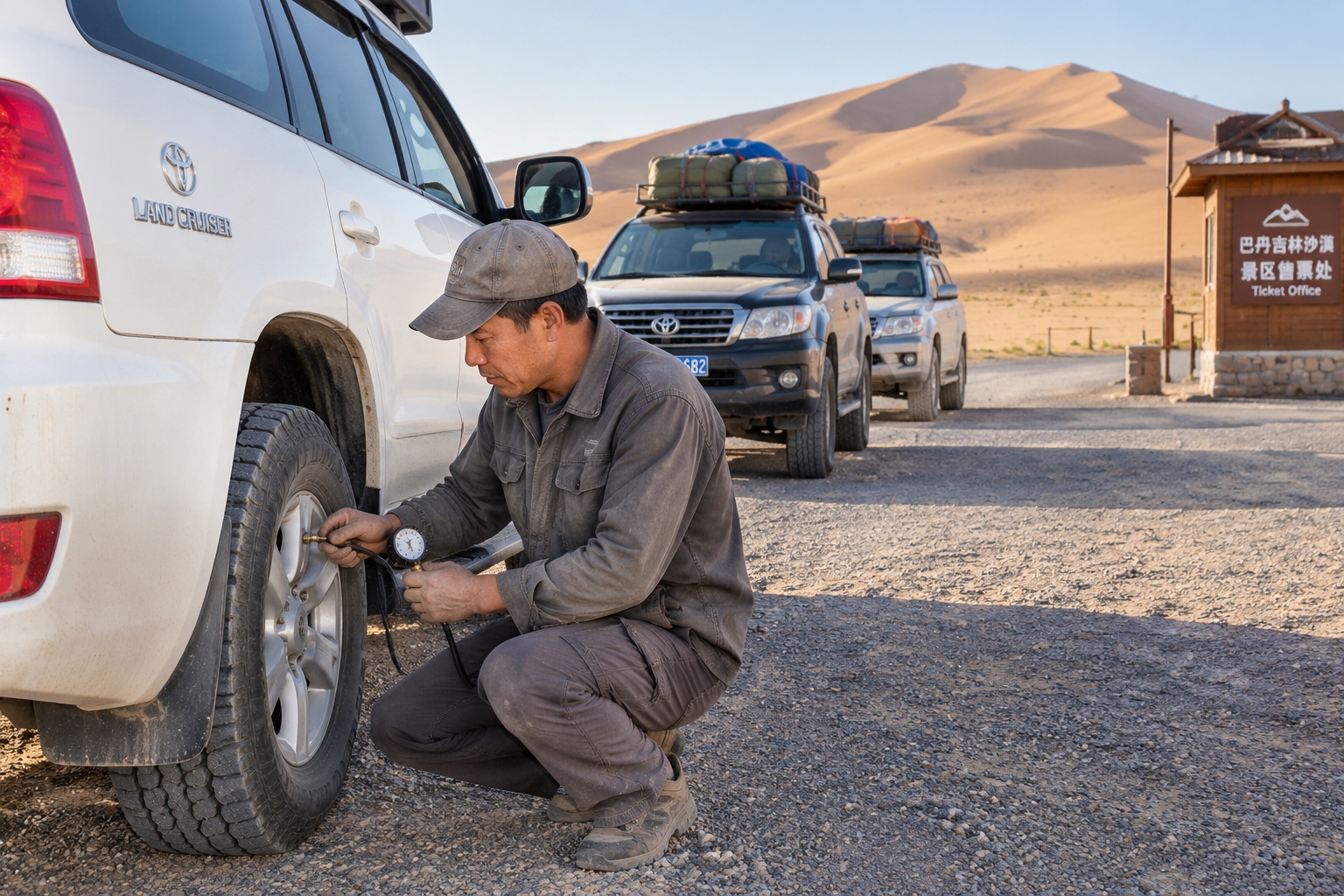
Four tires, one long hiss: the ritual at the desert gate
The first sound at the edge of the Badain Jaran Desert isn’t wind. It’s air escaping four tires.
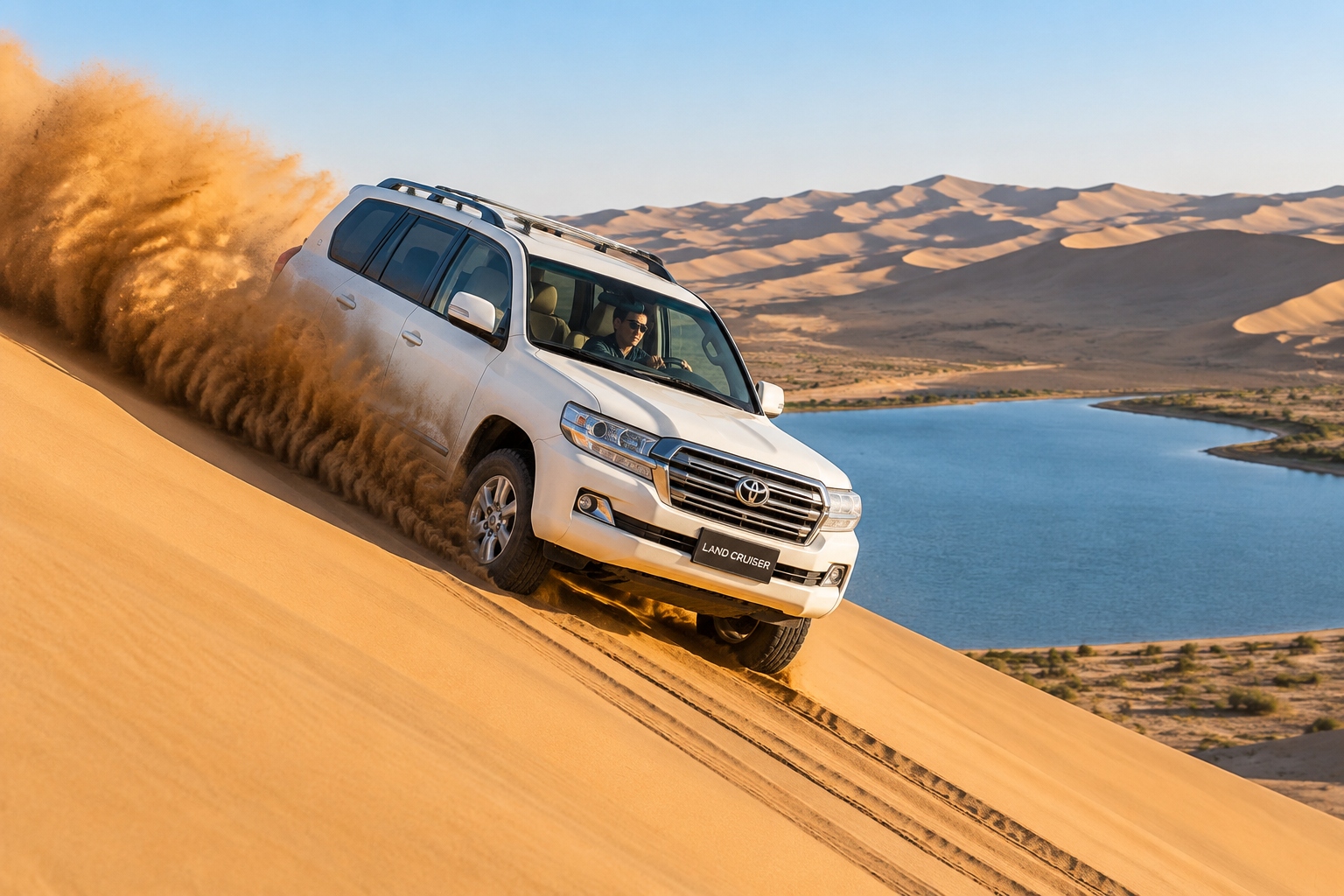
A driver in a faded cap kneels beside a white Toyota Land Cruiser, checking each valve with a brass gauge. Thirty-five psi drops to twelve. The car sags, and on the gravel this looks like a mistake. Twenty minutes later, when that same vehicle floats over a dune instead of plowing into it, it looks like the only sensible decision anyone made all day.
Badain Jaran sits in Alxa League, in the far west of Inner Mongolia, with Gansu province curling around its southern and western edges. At roughly 49,000 square kilometres — about the size of Slovakia — it is China’s third-largest desert, and for most of its history it was a place caravans went around rather than through. There are no roads inside. No buses. No phone signal once you drop behind the first ridge. Two rules govern entry: hire a local driver, and let the air out of your tires.
Bilutu, the dune locals call the Everest of the desert
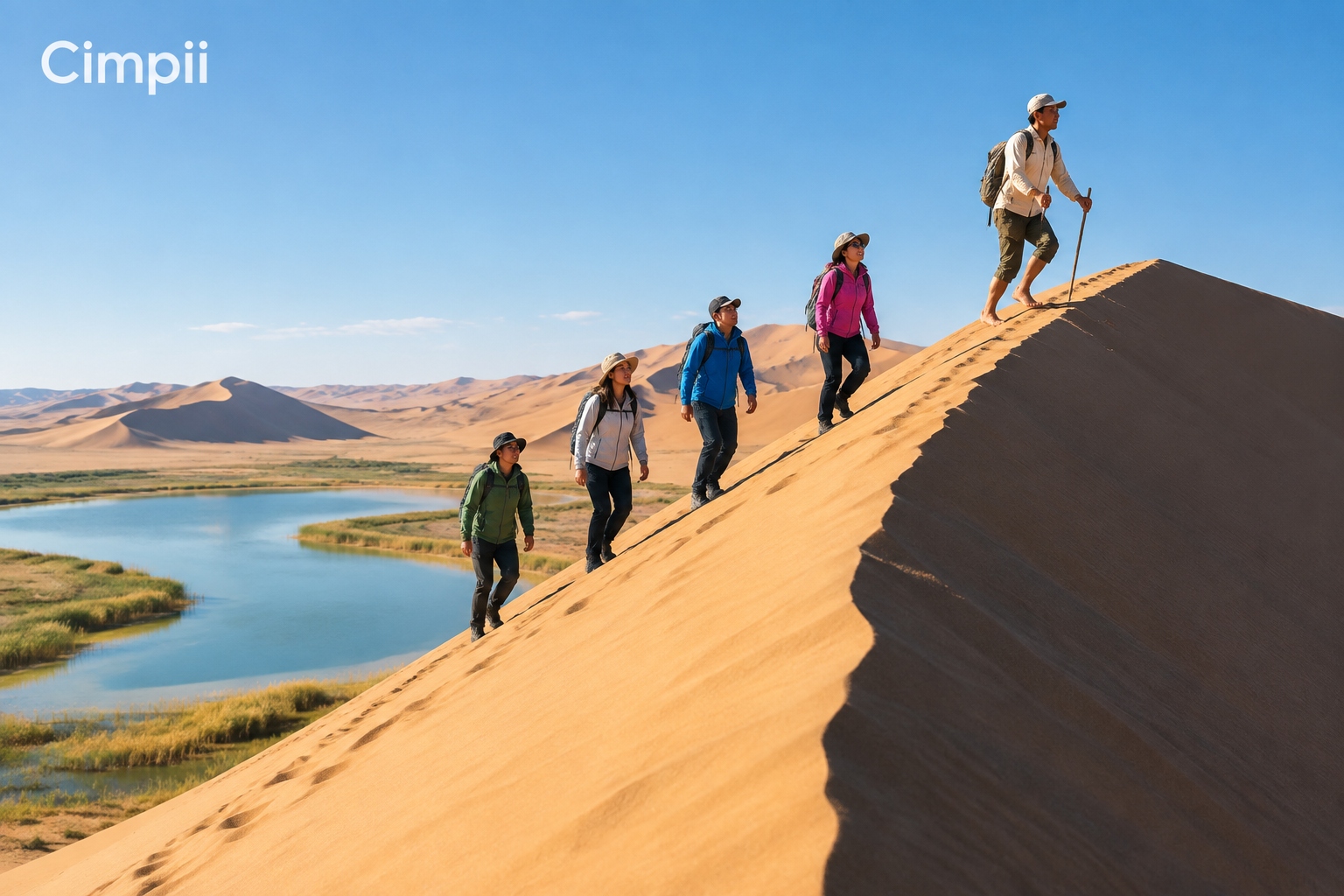
Every desert has a landmark, and Badain Jaran’s is Bilutu Peak. Measured from the lake basin at its foot, it rises about 460 metres — the tallest sand dune on Earth, a claim that starts arguments in every guesthouse from Alxa Right Banner to Zhangye, mostly about where you begin counting.
You climb it on foot, and the mountain fights back. Each step sinks ankle-deep, then knee-deep; the sand slides down behind you and wipes out the steps of the person ahead. An hour of walking covers maybe 400 metres of ground. Guides go barefoot or in cotton slippers, because shoes fill up in ten steps.
What you get at the top is the reason people come. The ridge line runs away in both directions in a series of sharp, wind-carved crests, each with a crisp shadow on one side and bright ochre on the other. Below, in the basin, the sand stops abruptly and a lake begins, ringed with reeds and the dark green dots of willows. From up here you can count six or seven of them, scattered across the sand like dropped mirrors.
Then you slide down. If the surface is dry and steep enough, the dune makes a sound — a low, throaty hum, somewhere between a bowed cello and a plane engine heard from far away. Chinese geographers call it 鸣沙, “singing sand,” and it is one of the few desert phenomena that still surprises people who have spent their whole lives out here.
A hundred lakes where no lake should be
The lakes are the thing nobody expects. Counts vary — most surveys say more than 100 permanent lakes, with some numbering 140 once seasonal ponds are included — and they sit in the troughs between dunes, sometimes only a few hundred metres apart.
Most are saline. A few are fresh enough to drink. At Yindeeritu Lake, a spring pushes fresh water up through the middle of a salt lake; herders have brought their animals to it for generations. Elsewhere the water is so shallow and mineral-heavy that the shoreline is a white crust that cracks underfoot.
The water has to come from somewhere. The accepted explanation is snowmelt and rainfall from the Qilian Mountains, several hundred kilometres to the southwest, travelling underground through fractures in the bedrock and surfacing here as springs. Not every hydrologist agrees on the proportions, and it is still debated whether the lakes are fed mainly by deep groundwater or by local rainfall. What is not in dispute is that the balance is delicate: several lakes have shrunk measurably in recent decades, and more water is being pumped out of the regional aquifer than the desert can replace.
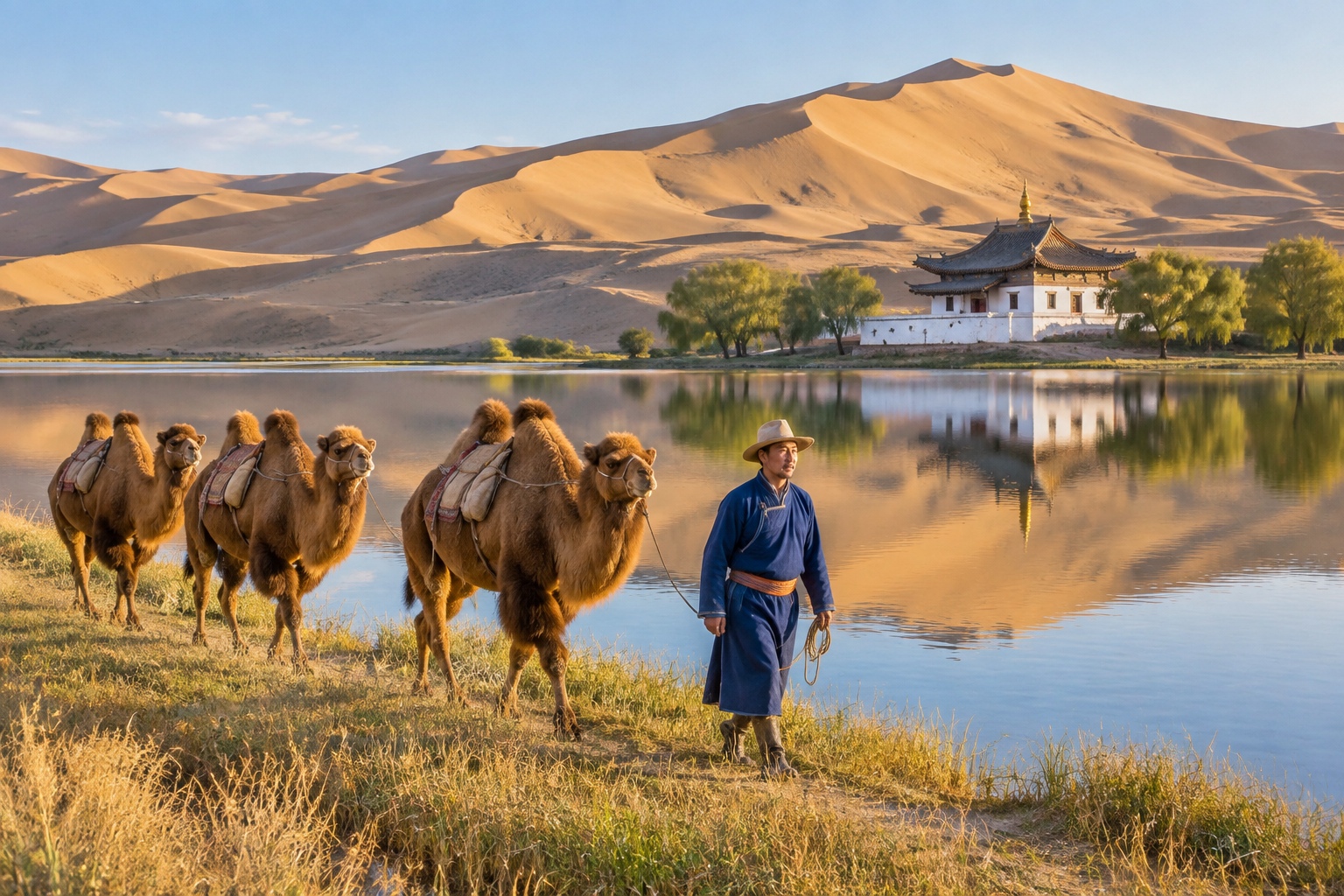
People live here, though fewer than before. Families of Mongolian, Han and Hui herders keep Bactrian camels, sheep and goats, moving between wells and lakes with the seasons. At Lake Sumin Jilin, a small Tibetan Buddhist temple has stood at the shoreline since the Qing dynasty — a white-walled building with a handful of monks and a fame that outstrips its size. Drivers call it Miaohaizi, Temple Lake.
What forty minutes of dune driving does to your body
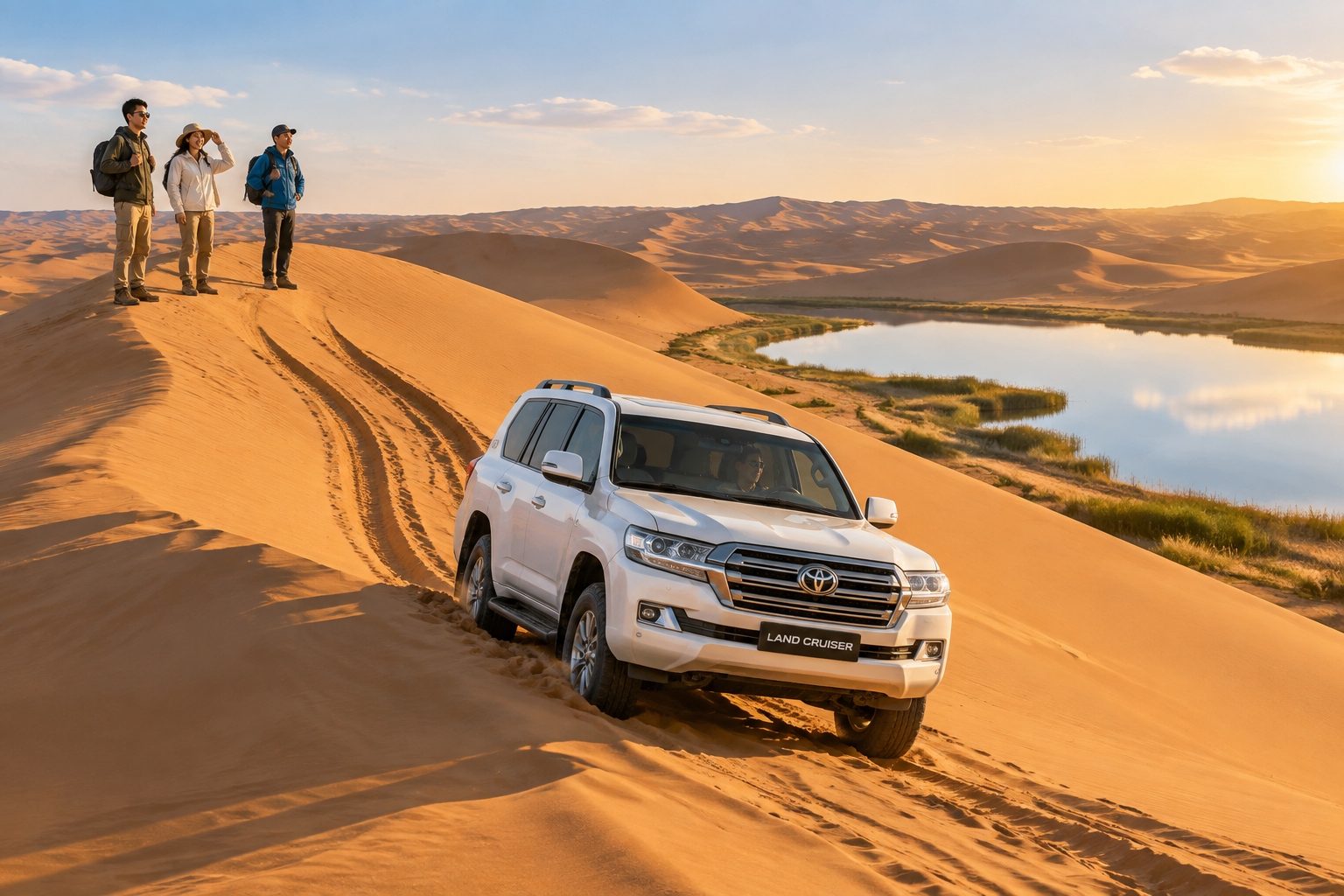
Off-roading in Badain Jaran isn’t a road trip. There is no track. The driver picks a line up a 40-degree slope, holds the wheel steady, and uses momentum the way a skier uses gravity.
The first climb is quiet except for the engine. Then the nose lifts, the horizon disappears, and for a second at the crest the car seems weightless. After that comes the descent — a long, controlled fall, sand spraying past the windows, the driver’s hands making small corrections that mean the difference between a smooth slide and a very expensive afternoon.
Local drivers call it 沙漠冲浪, dune surfing, and after twenty minutes most passengers understand why. It is genuinely fun and genuinely rough. Motion sickness is common; a soft neck is more useful than a strong stomach. Anyone with back or neck problems should sit in the front, and everyone should agree with the driver in advance on a signal for “stop, I need a minute.”
The people who drive here grew up reading sand the way sailors read water. They know which slopes are firm after a windy night, which are hollow, and where a hidden spring has left the sand soft. Self-driving without that knowledge isn’t adventurous. It’s how vehicles get buried.
Night, and the temperature you didn’t plan for
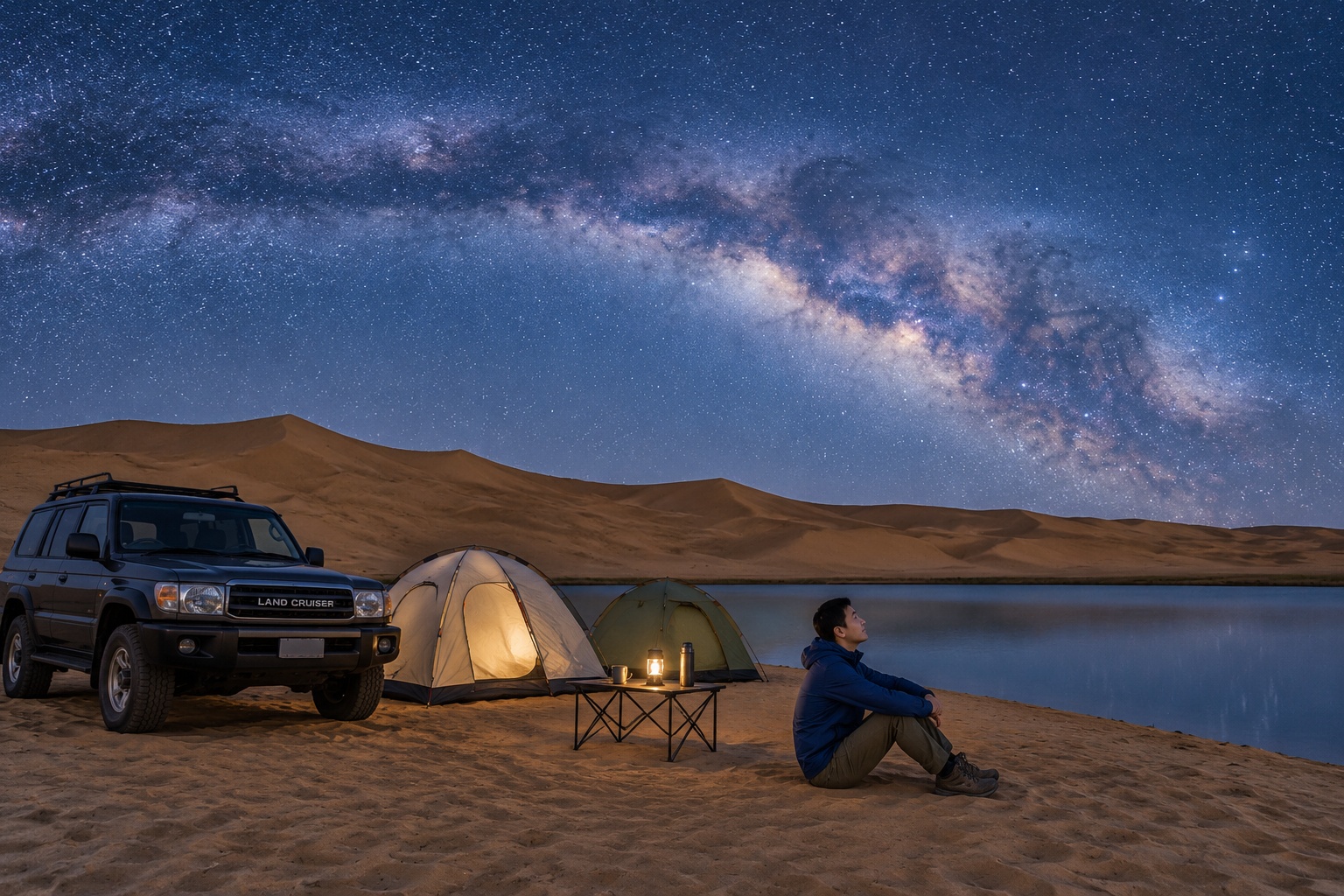
Camp is usually a lake shore at the foot of a dune: a few tents, a folding table, a gas stove. Guesthouses exist too — simple, low rooms of mud brick or prefab panels with communal meals and a solar panel on the roof, run by herding families who started taking in travellers once the off-road tours began.
Two things happen after sunset. First, the temperature. A 38°C afternoon can drop to 12°C by midnight, and the wind that felt refreshing at four o’clock is not refreshing at ten.
Second, the sky. Badain Jaran has no towns and almost no light pollution, and on a clear, moonless night the Milky Way is not a faint smudge but a band with depth in it. Around eleven the wind usually dies. What’s left is the far-off clanking of a camel bell, and, if you walk a few steps out onto the cool sand, the small creak of your own footprints.
What changed in 2024
In July 2024, UNESCO added the Badain Jaran Desert to the World Heritage List under the name “Towers of Sand and Lakes,” recognising both the dune system and the lake group as globally significant.
The listing is a real economic event for Alxa Right Banner, a town of a few tens of thousands of people where almost every second storefront advertises desert tours. Visitor numbers have grown, and local authorities have tightened rules — vehicle quotas in some areas, designated campsites, restrictions on driving across vegetation. Herders who once ran one vehicle now run four, and their children increasingly go to school in town rather than at the lake.
Nobody in the desert pretends this is simple. Money from tourism keeps families on the land, and it also puts more vehicles on fragile ground. Water levels are the longer-term worry, and they have nothing to do with tourists.
If you go: the practical part
Getting there
Fly to Jinchang Jinchuan (JIC) or Zhangye Ganzhou (YZY), both in Gansu, then drive two to three and a half hours to Alxa Right Banner (阿拉善右旗). From the town, the desert scenic gate is about an hour by car. Most visitors overnight in Zhangye or Jinchang and pick up a local outfitter there or in the banner town.
Costs
Park admission is around 160 RMB. A chartered 4WD with driver runs roughly 800–1,500 RMB per vehicle per day depending on route and season, seating up to four people. Most people do a two-day, one-night loop. Lake guesthouses cost about 100–300 RMB per person including simple meals. WeChat Pay and Alipay work at the gate and in the guesthouses; carry some cash anyway.
When to go
Late May to early October. Mid-September to mid-October is the sweet spot: warm days, cold nights, clear air. July and August afternoons reach 35–40°C. April and May bring sandstorms. Winter is brutal, but the desert is empty and the light is extraordinary.
What to bring
Three litres of water per person per day, a scarf or buff for your face, sunglasses, lip balm, a headlamp, a warm layer, motion sickness tablets and a power bank. Signal disappears beyond the gate, so download offline maps and leave your itinerary with someone.
Health and safety
Never self-drive without a guide. Don’t wander off alone after dark. If you’re prone to motion sickness, take the tablets before you get in, not after. And be honest with your driver about your back and neck — they will adjust the route.
The last thing you hear
On the way out, you stop once more at the gate to re-inflate the tires. The compressor rattles for a few minutes, the car rises back onto its springs, and the desert in the mirror turns back into a flat line of yellow under a very large sky. Drivers do this every day. Most of them still get out of the car to watch the light on the dunes for a minute before they pull onto the paved road.
Start the discussion at forum.chinacomes.com