


A Forgot ID Card, A Two-Second Entry
It is 7:40 a.m. at Shanghai Hongqiao Railway Station, one of Asia’s busiest transport hubs. A young woman in a beige trench coat rushes toward the departure gates, patting her pockets with growing panic. She has left her ID card at home. Five years ago, this would have meant a frantic detour to a temporary ID counter, a queue, and almost certainly a missed train.
Today, she walks up to a turnstile, looks into a small camera for less than two seconds, and the gate opens. She is through. No card, no paper, no human interaction.
This is not a scene from a science fiction film. It is a routine Tuesday morning in China, made possible by a quiet but vast technological infrastructure: the country’s unified digital identity system.

What Exactly Is China’s Unified ID System?
The term sounds bureaucratic, but the concept is straightforward. China’s unified identity system is a government-backed digital framework that links a person’s real-name identity — verified through the national ID card — to various online and offline services. Think of it as a digital layer sitting on top of the physical ID card, allowing verified identity to be transmitted securely across different platforms and scenarios.
In practice, it means your identity can be confirmed through multiple channels: a physical ID card, an electronic ID in a smartphone app, or increasingly, biometric data such as facial recognition. The system is not a single app or a single database. It is a set of standards and authorizations that allow different government departments, financial institutions, and service providers to verify who you are without each one independently storing your documents.
For ordinary people, the most tangible expression of this system is the electronic ID card (电子身份证) available through apps like WeChat and Alipay, as well as the nationwide roll-out of facial recognition terminals at transport hubs, government service centers, and hotels.

Real Moments: Where the System Meets Daily Life
High-Speed Rail: From Fumbling for Cards to a Two-Second Glance
China’s high-speed rail network handles over 1.6 billion passenger trips annually. At major stations like Beijing South, Guangzhou South, and Hangzhou East, facial recognition gates have largely replaced manual ticket checks. The process is simple: you walk up, look at the screen, and if your face matches the ID photo linked to your ticket, the gate opens.
The time difference is striking. A manual ID check typically takes 10 to 15 seconds per person. Facial recognition gates process passengers in under two seconds. At a station with 20 gates running simultaneously, that translates into thousands of additional passengers per hour during peak travel periods like Spring Festival.
For travelers, the experience is almost anticlimactic. There is no drama, no friction. You simply walk through. As one frequent commuter put it: “I used to have a small panic every time I reached the ticket gate. Now I don’t even think about it.”
Government Service Halls: Retrieving Documents Without Documents
In cities like Shenzhen, Hangzhou, and Chengdu, government service centers — where residents handle everything from property registration to social security — have integrated electronic ID verification into their queuing and service systems. If you forget your physical ID card, you can often retrieve your electronic ID through a smartphone app, scan a QR code, and proceed with your business.
In some halls, facial recognition kiosks allow you to pull up your electronic documents without even opening an app. The system matches your face to your government record and displays the necessary information on the service counter’s screen. What used to require a trip home or a trip to a police station for a temporary ID can now be resolved in minutes.
According to China’s State Council, over 90 percent of provincial-level government services are now available online or through integrated offline systems, with identity verification being the foundational layer.
Hotel Check-In: Faster, But Not Always Simpler
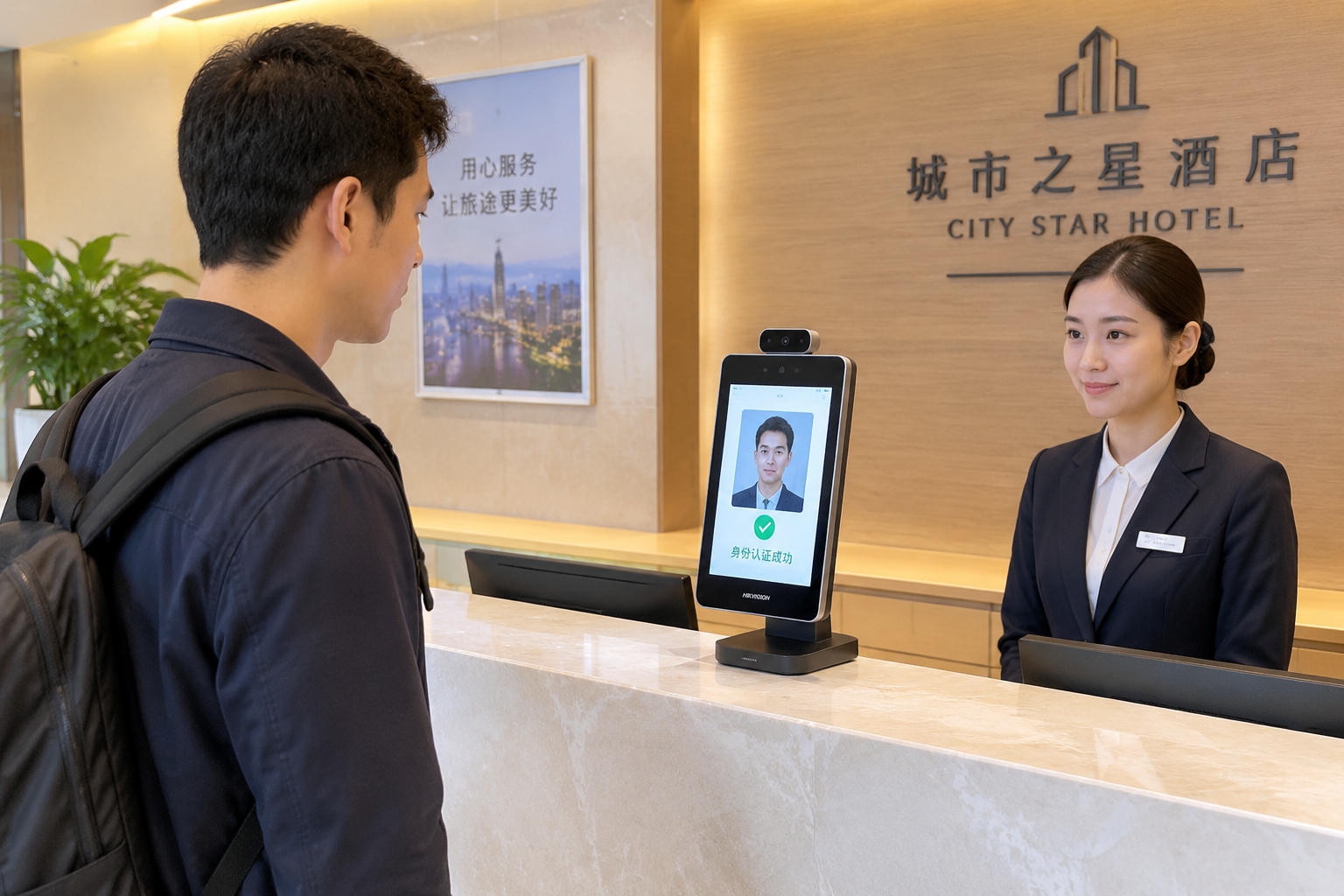
Hotel check-in in China has traditionally required a physical ID card and a manual scan. Today, many hotels — especially chains like Huazhu, Atour, and international brands operating in China — use facial recognition terminals that verify your identity against the national database. The process takes about five seconds. Your check-in is faster, and the front desk no longer needs to photocopy your ID.
But the experience is not uniform. Some smaller hotels in rural areas still rely on manual registration. And a few cities, notably in Guangdong province, have begun scaling back mandatory facial recognition in hotels after privacy concerns were raised, offering guests the option to use traditional ID verification instead.
This patchwork reality is important. China’s digital identity system is not a monolith. It is a rapidly evolving patchwork of national standards, local implementations, and periodic pushback.
The Technology and the Privacy Questions
For readers outside China, the immediate question is often: who controls this data, and how is it protected?
How Is Data Stored and Who Can Access It?
China’s personal information protection law (PIPL), enacted in 2021, is modeled in part on Europe’s GDPR. It requires explicit consent for collecting biometric data, mandates that data be stored within China, and imposes penalties for misuse. Facial recognition data collected at a train station, for example, is supposed to be stored locally and used only for identity verification, not shared with commercial third parties.
In practice, enforcement varies. Government audits have found cases of over-collection, and public pushback has led to corrections. In 2023, for instance, a widely reported case involving a wildlife park in Hangzhou that required facial recognition for annual pass holders resulted in a court ruling that the park had overstepped, ordering it to allow alternative verification methods.
The Link to Phone Numbers and Bank Accounts
China has required real-name registration for mobile phone numbers and bank accounts since the mid-2010s. This means your phone number is already tied to your national ID. The unified identity system extends this logic: your face, your ID number, and your phone number can all be used as verification factors. The goal is to reduce fraud, simplify transactions, and enable services like remote account opening.
For many Chinese consumers, this linkage is convenient. You can open a bank account through an app, verify your identity with a selfie, and receive a card in the mail. You can register for a hospital appointment with your face. The friction of daily bureaucracy drops significantly.
Can You Opt Out?
Yes, in many contexts. Train stations still accept physical ID cards at manual counters. Hotels are increasingly required to offer alternatives. Government service halls must provide non-biometric channels. The system is designed to be layered, not mandatory at every touchpoint.
But the reality is that opting out often means slower service. The convenience gap between using facial recognition and not using it is widening. This is a familiar trade-off in digital societies worldwide: efficiency versus control.
What This Means for International Visitors
If you are a foreign traveler planning a trip to China, you will encounter this system at specific points.
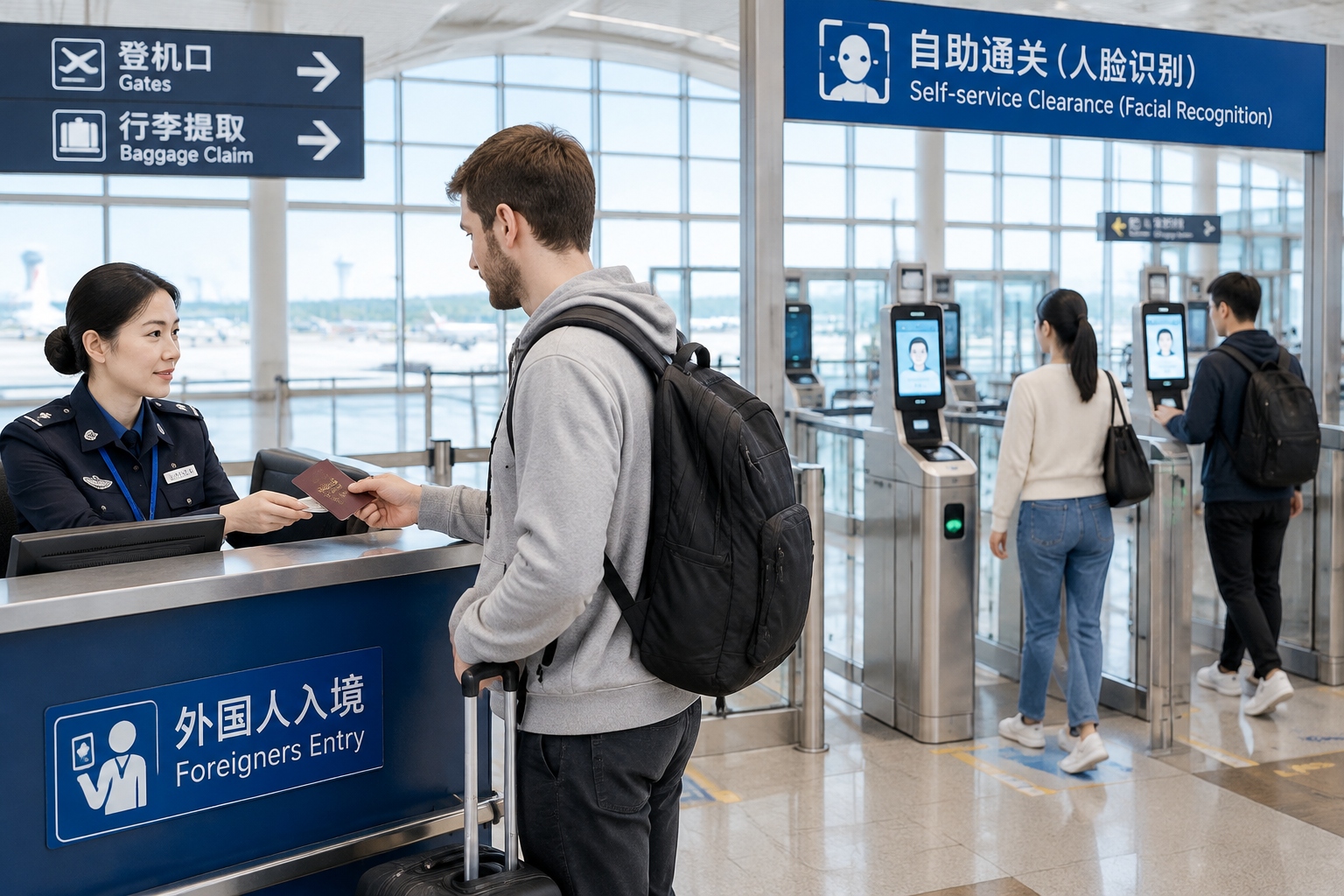
At major airports and high-speed rail stations, facial recognition gates are primarily for Chinese citizens whose biometric data is already in the national system. Foreign passport holders typically use manual counters or automated gates that scan passports, not faces. However, some airports — including Beijing Capital and Shanghai Pudong — have begun piloting facial recognition for foreign travelers who pre-register their biometrics.
At hotels, foreign guests are still required to present a passport. The facial recognition terminals are generally not used for foreign passports, though this varies by hotel and city.
For short-term residents, the most visible impact is the speed of domestic travel and government services. If you live in China with a residence permit, you can register for the electronic ID system and use it for train tickets, hospital appointments, and some government services. The system is gradually opening to foreign residents, but the coverage is uneven.
How Does This Compare to Other Countries?
China is not alone in building digital identity infrastructure. India’s Aadhaar system, launched in 2009, now covers over 1.3 billion people and is used for everything from welfare payments to mobile phone registration. Estonia’s e-Residency program is a pioneer in cross-border digital identity. The European Union is developing a digital identity wallet that will allow citizens to verify their identity across member states.
What distinguishes China’s approach is the degree of integration with daily life — transport, healthcare, banking, and government services — and the speed of adoption. In a country of 1.4 billion people, the scale is unprecedented. The system is not just a technological achievement; it is a social experiment in how a society balances efficiency, security, and individual choice.
Conclusion: Convenience and Choice in Flux
The woman at Hongqiao Station caught her train. She did not think about the data centers, the encryption protocols, or the policy debates that made her two-second entry possible. She just walked through.
That is the paradox of successful infrastructure: it disappears into the background. China’s unified identity system is not perfect. It raises real questions about privacy, consent, and the limits of convenience. But for hundreds of millions of people, it has already changed what a normal day feels like — less waiting, less paperwork, less friction.
For outside observers, the question is not whether this system is good or bad. It is how societies choose to draw the line between efficiency and autonomy. China is drawing that line in real time, in train stations, hotels, and government halls. The rest of the world is watching — and, in its own way, experimenting too.
Start the discussion at forum.chinacomes.com