
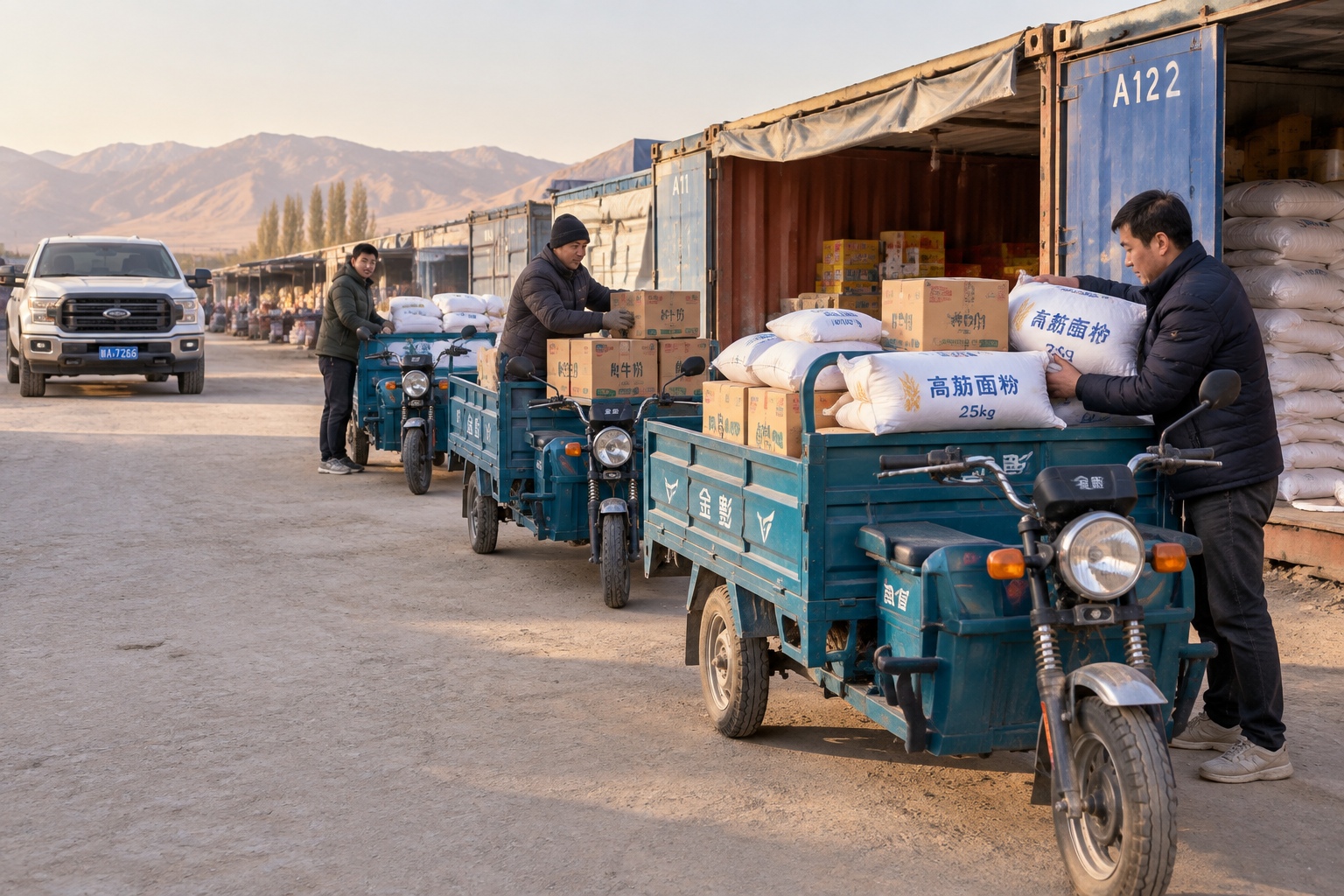

At Dordoy Bazaar, nobody is shopping for a pickup
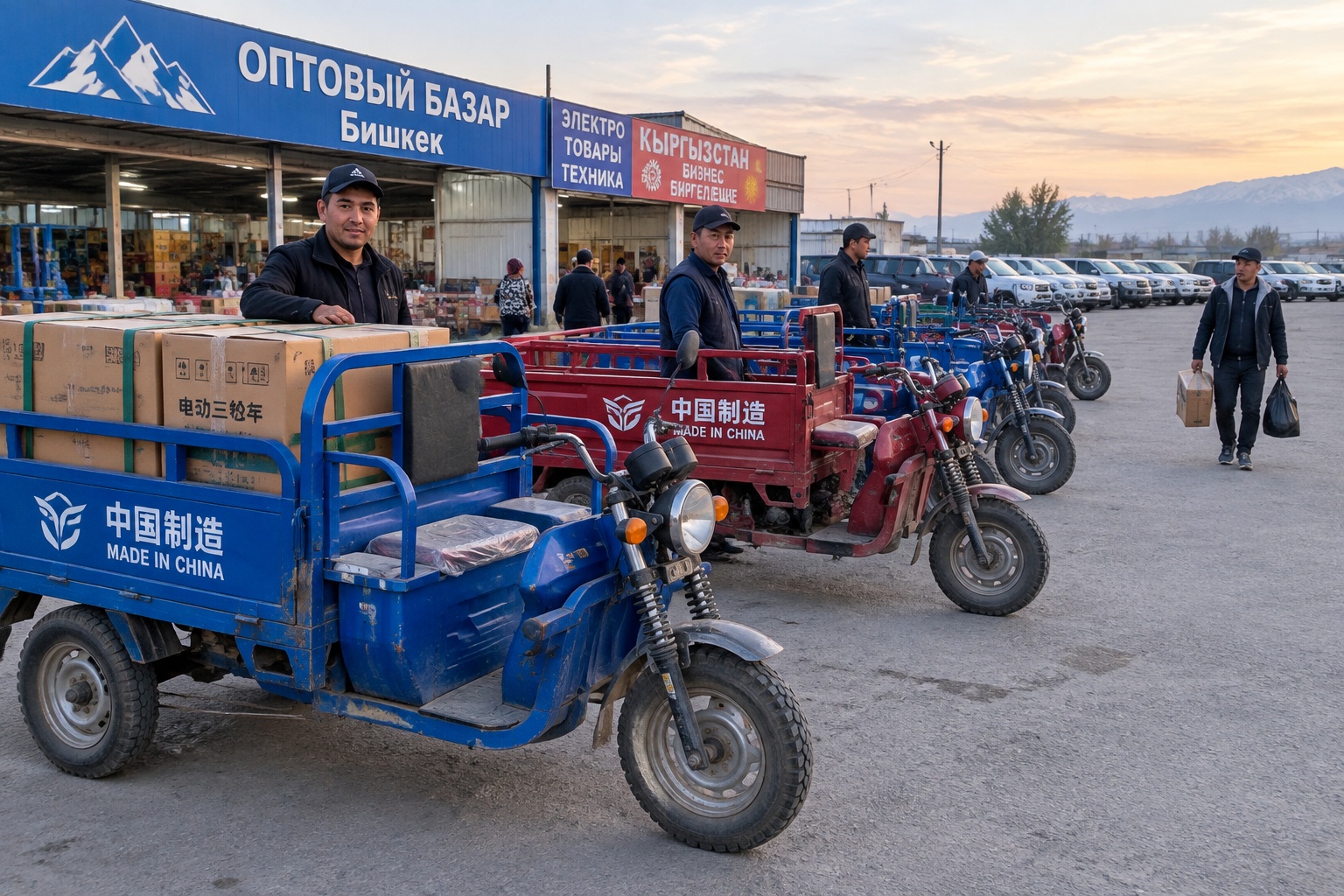
On the eastern edge of Bishkek, Kyrgyzstan, Dordoy Bazaar covers more ground than a mid-sized airport. Container stalls, wholesale clothing, Chinese hardware, sacks of flour stacked to shoulder height. Behind the shoe section there is a parking row that says more about the local economy than any trade report.
Almost none of the vehicles are pickup trucks. Most are three-wheeled cargo trikes: flat bed, open cab, no doors. Their owners are traders, delivery drivers, a few farmers in from the Chu Valley. They load a hundred boxes of socks, a pallet of cooking oil, twenty watermelons, then thread the trike back into lanes where a full-size pickup would scrape both mirrors and block the whole aisle.
In Chinese these vehicles are called sanbengzi — “three-bouncer,” after the ride. In export catalogues they are electric cargo tricycles. From Bishkek to Tashkent to Kazan to the smaller Russian towns along the Volga, they have quietly become the default small-haul workhorse, and in plenty of places they are outselling pickups outright.
What the thing actually is
A typical model coming out of Jiangsu or Henan province has three wheels, a bed roughly 1.2 to 1.6 metres long, and a payload rating between 300 and 1,000 kilograms. Top speed is usually 25 to 40 km/h. Range on a charge is 40 to 80 kilometres, more if the load is light and the road is flat.
In China, a basic version costs between 2,000 and 5,000 yuan — roughly 280 to 700 US dollars. A better one with a lithium battery, a hydraulic tipper and a closed cabin runs 8,000 to 15,000 yuan. Shipped to Kyrgyzstan or Kazakhstan and cleared through customs, the delivered price is still usually under 1,500 dollars.
Charging happens from a household socket overnight. That matters more than it sounds. Across most of Central Asia and provincial Russia, the grid reaches the house, but a dedicated high-power charger does not.
Buyers are rarely households. They are the woman who sells bottled water outside a hospital in Tashkent, the courier who moves parcels from a sorting yard to three pickup points, the mason who needs sand and cement on site by seven in the morning. Nobody in that group is shopping for a lifestyle vehicle.
The arithmetic that decides it
Compare a trike with a used pickup. In Bishkek or Almaty, a fifteen-year-old imported pickup in working condition starts around 8,000 to 12,000 dollars, and a new Chinese pickup is 20,000 and up. Insurance, registration, tyres, oil, filters and fuel all follow it through the years.
A trike buyer usually moves 300 kilos at a time, five days a week, within a ten-kilometre radius of a market. For that job, the pickup’s extra capacity is dead weight. The trike costs a fifth as much, burns no petrol, and can be fixed with a wrench and a spare controller bought from the same stall that sold the vehicle.
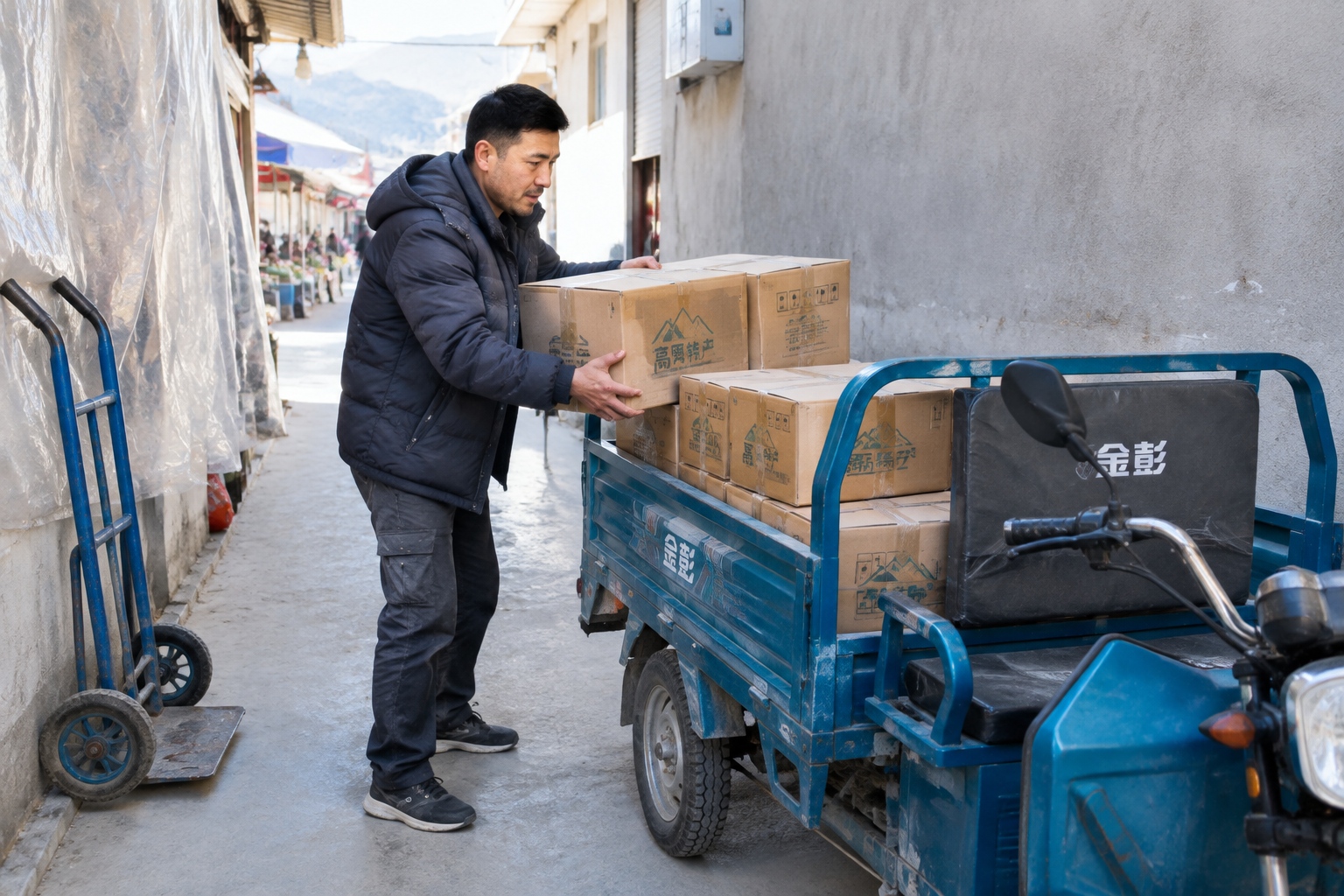
There is also the question of where it can go. Central Asian bazaars were not planned for vehicles. Dordoy’s internal lanes are barely two metres wide in places. The same is true of the older wholesale quarters in Tashkent, Samarkand and Osh, and of countless dacha lanes outside Russian cities. A trike fits. A pickup parks at the edge and the owner carries everything by hand.
Why this is happening now, not ten years ago
Three things changed.
First, the Chinese supply chain matured. Electric trikes have been made in China since the late 1990s, mostly for rural users and street vendors. Battery costs fell, brushless motors became reliable, and quality control at the better factories stopped being a gamble. What you buy in Bishkek today is not the rattling contraption of 2010.
Second, the trade routes got shorter. Fengxian County in Xuzhou, Jiangsu — often described as China’s electric tricycle capital — sits near the Longhai railway line. From there, containers move by rail and road through land ports such as Khorgos and Alashankou into Kazakhstan, or through Manzhouli and Erenhot into Russia. A trike can leave a Jiangsu factory floor and be standing in a Kyrgyz bazaar about three weeks later.
Third, demand on the ground changed. Cross-border e-commerce and market trading have multiplied the number of people who need to move small loads every single day. Food delivery, parcel lockers, small construction crews, flower sellers, water delivery. All of these are short-haul, sub-500-kilogram jobs, and that is exactly what a trike is built for.
Where the pickup still wins
Any honest answer has to include this. In Yakutsk in January, a lithium battery loses a third of its range and plastic panels go brittle. Deep snow, unpaved roads and 200-kilometre runs are pickup territory, and so is anything above a tonne.
Then there is status. In Russia and Central Asia, a pickup or an SUV still signals something a trike never will. The trike is not aspirational. It is a tool, and buyers treat it that way — buy it, use it hard, replace it.
Regulation is an open question too. Rules for small electric vehicles have been tightening in Russia and Kazakhstan over the past two years, and requirements for registration, licensing and helmets differ by country and even by municipality. A trader in Almaty and a trader in Osh may face different rules for the identical machine.
The county in Jiangsu that makes them
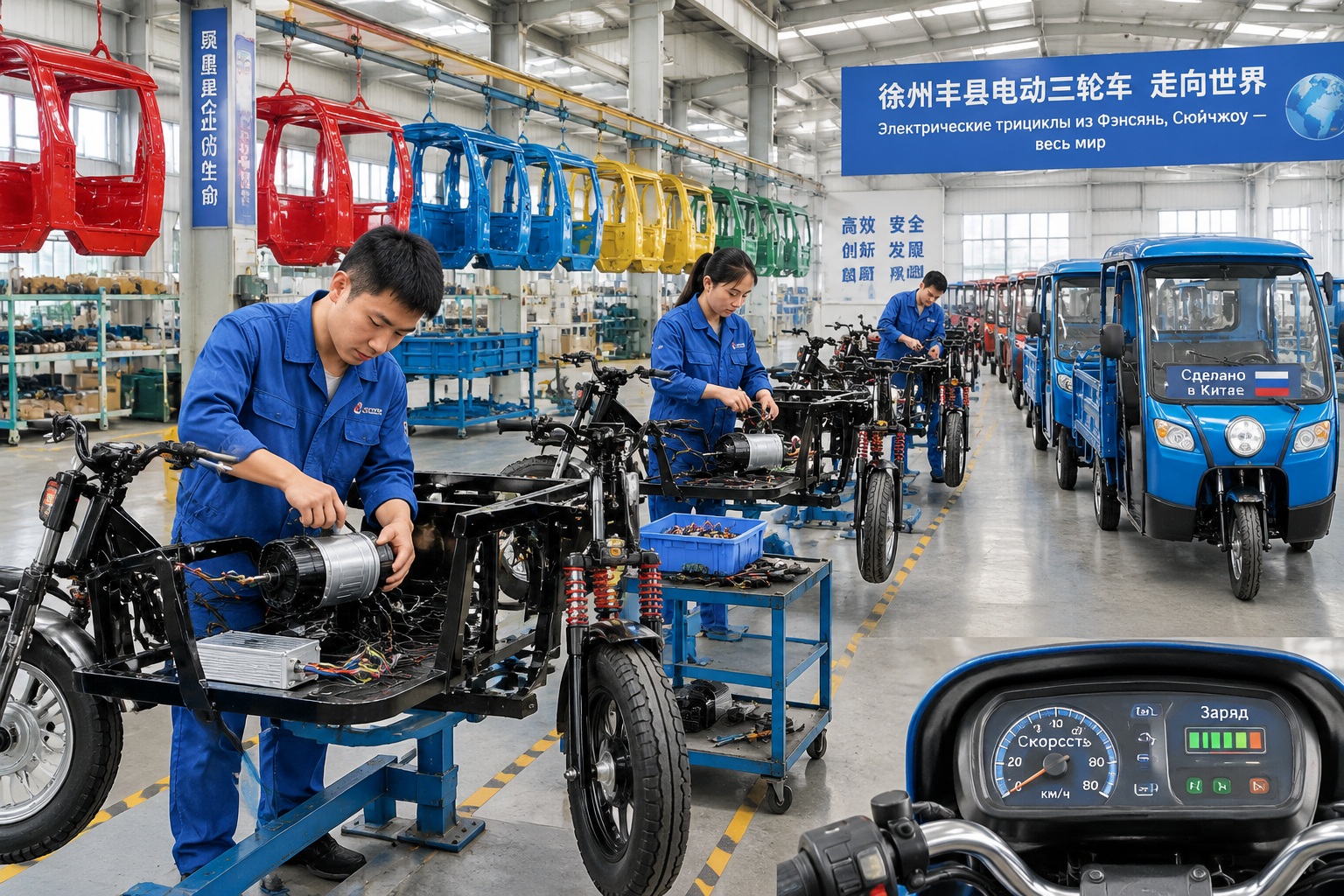
Fengxian County produces several million electric tricycles a year by local industry estimates, across hundreds of workshops and assembly plants. The county has essentially one industry, and it is vertically integrated: frames, controllers, motors, seats, paint, and the little parts stalls that feed them all.
Walk through the industrial parks and you see the vehicles lined up in export colours and export specifications — reinforced suspension, wider tyres, Russian-language instrument labels, sometimes a heater kit for cold regions. The factory does not much care whether the buyer is a farmer in Anhui or a trader in Samarkand. The product has been refined for twenty years by Chinese users telling manufacturers what breaks first.
If you are reading this from Europe or America
The closest thing you already know is the cargo bike.
In Amsterdam, Copenhagen, Paris and increasingly New York, the small electric cargo vehicle is a policy project: subsidies, protected lanes, congestion charges, delivery-company mandates. It arrived from the top down, and it works where the infrastructure was built to receive it.
In Russia and Central Asia, the same class of vehicle is arriving from the bottom up. No subsidies, no lane design, no plan. It is winning because it costs less than the alternative and fits through the door. Same idea, different road.
That is probably the most useful way for an outside reader to hold this. In the United States, a pickup truck is often identity — a statement about who you are. In a Kyrgyz bazaar, a vehicle is a calculation about what the next load weighs and how far it has to go. Both are rational. They just answer different questions.
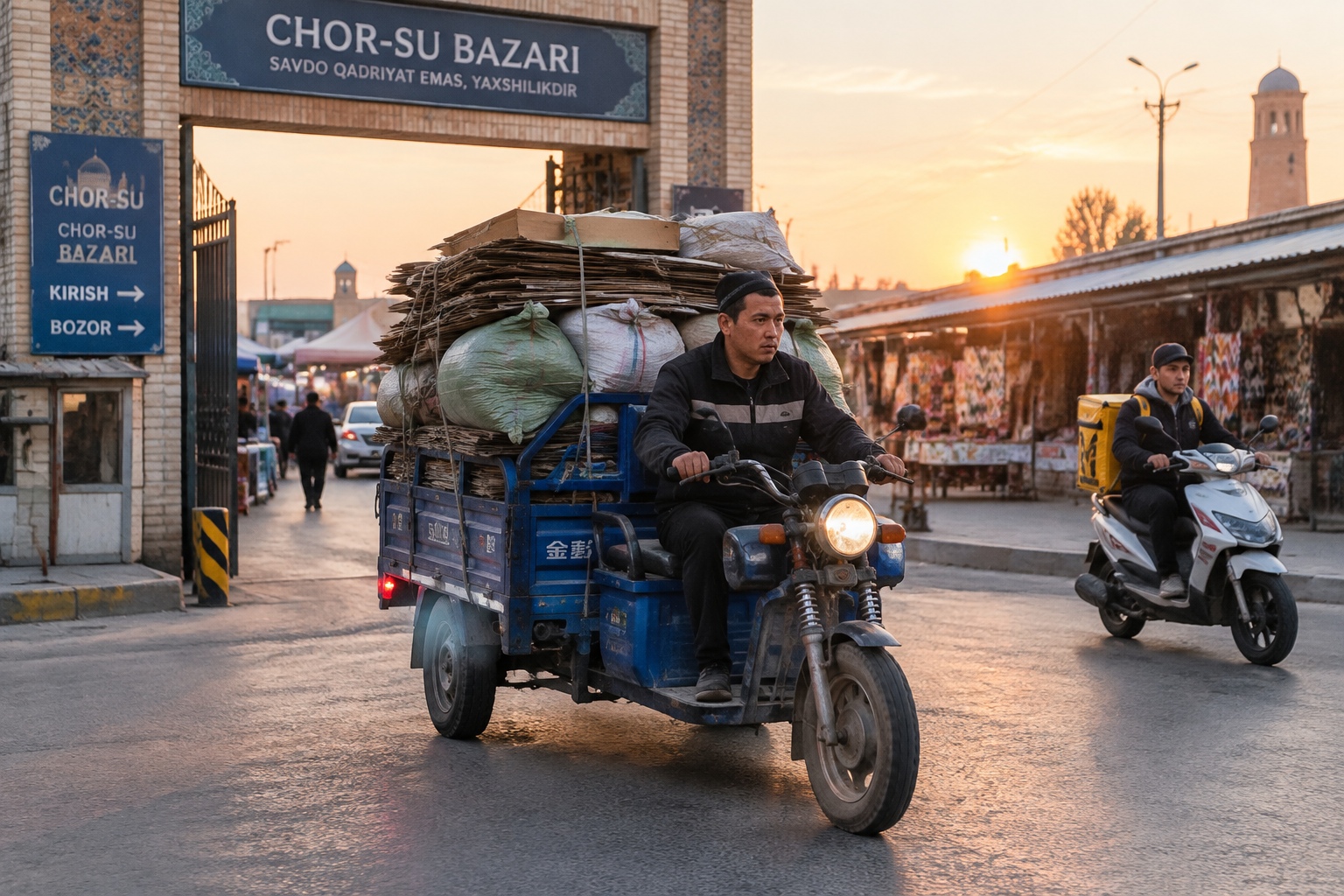
Back at the bazaar
By late afternoon at Dordoy, the trikes are still working. A man in a padded jacket stacks the last of the day’s cardboard onto a bed that is already sagging, ties it down with a bicycle lock and an old inner tube, and pulls into traffic at maybe 20 km/h.
Behind him, in the same row, a pickup has been parked since morning. It is bigger, faster and more capable in almost every measurable way. It just does not have a job here.
Start the discussion at forum.chinacomes.com