

A horizon that has changed
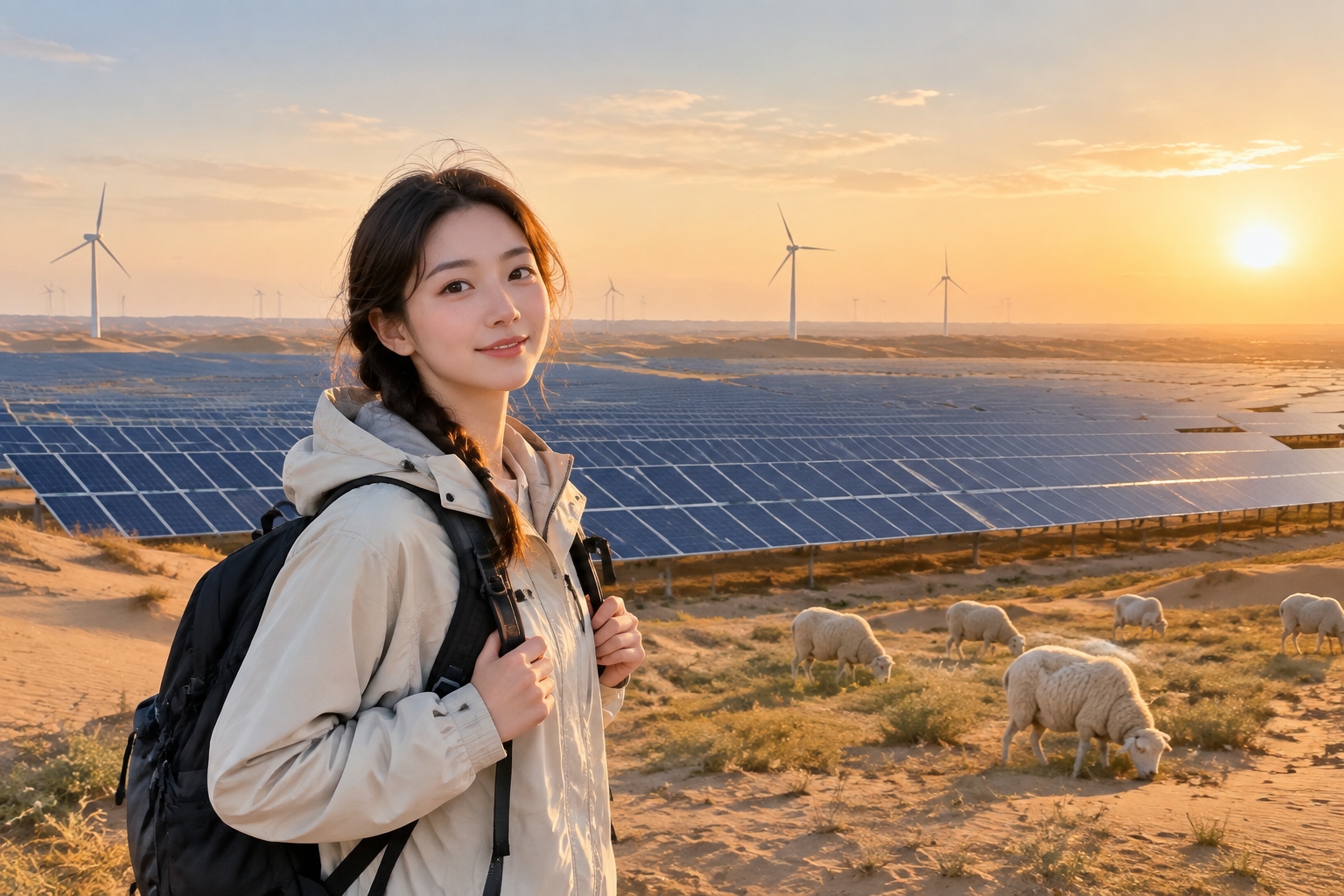
Drive north out of Ordos, in Inner Mongolia, and the road eventually runs into the Kubuqi Desert: dunes, gravel, sparse scrub, and, increasingly, row after row of dark blue solar panels laid along the flats between the sand.
Herders still move sheep through this landscape. So do maintenance trucks. On the low ridges, white wind turbines turn above the panel arrays. It is a working desert now, in a way that would have been hard to picture 15 years ago.
Chinese planners have a shorthand for places like this: shagehuang — sha for sand, ge for gobi (the gravel deserts of the north), huang for barren land. Since 2021, this category has become the centerpiece of the country’s renewable energy build-out. The first batch of large bases announced that year totaled about 97 gigawatts of wind and solar, spread across Inner Mongolia, Qinghai, Gansu, Ningxia, Xinjiang and Shaanxi.
Why build in the desert
Three reasons, all practical.
Land. These areas are vast, cheap and mostly empty. No villages to relocate, no farmland taken out of production, no mountains casting shadows across the panels.
Sun and wind. The Kubuqi area receives roughly 3,000 hours of sunshine a year, and the wind sweeping the Inner Mongolia plateau is steady enough to be worth building for. The two sources also complement each other: wind peaks in spring and winter, sun in summer.
Distance. This is the catch. China’s electricity demand sits in the east and south — Shandong, Jiangsu, Zhejiang, Guangdong. The deserts are 1,000 to 2,000 kilometers away. Building the power plant is one problem. Moving the power is another.
The policy backdrop matters too. China has pledged to peak carbon emissions before 2030 and reach carbon neutrality before 2060. It also set a target of 1,200 gigawatts of installed wind and solar capacity by 2030 — a number it had already passed by the end of 2024, six years early. Inner Mongolia, the country’s largest coal-producing region, is now also its largest builder of renewables.
Kubuqi: what a 10-gigawatt base looks like
The Kubuqi central-northern new energy base was among the first of the batch to break ground, and it is planned at the 10-million-kilowatt level: 10 gigawatts, a qianwan qianwa project — the scale marker Chinese energy planners use the way other industries talk about million-unit factories.
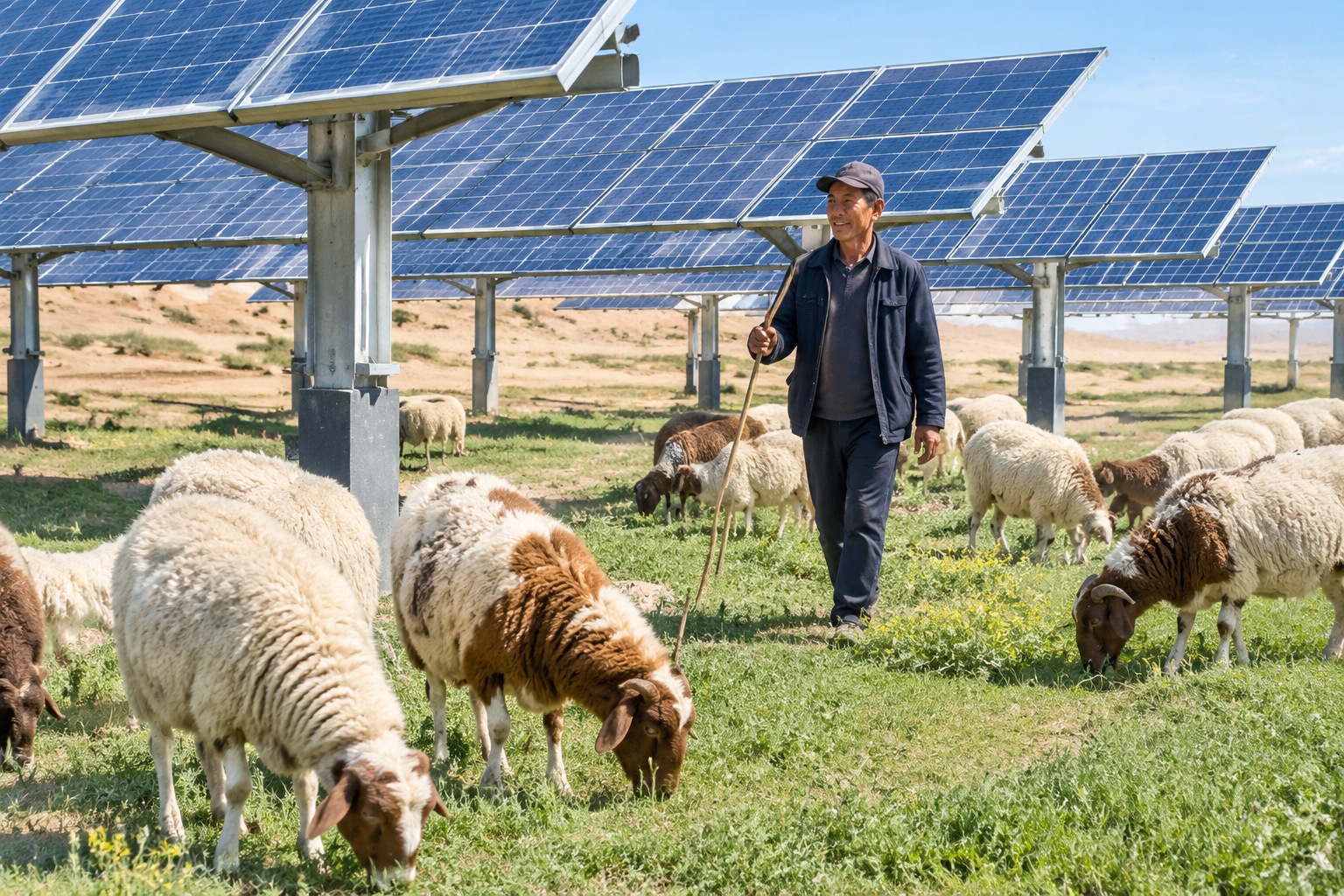
For a sense of what that means, 10 gigawatts is roughly the entire installed generating capacity of a country like Portugal, or about ten large nuclear reactors. It is built in stages rather than all at once. One of the better-documented pieces is the 2-gigawatt solar and sand-control project in the western part of the desert, where panels are mounted high enough for machinery — and animals — to pass underneath.
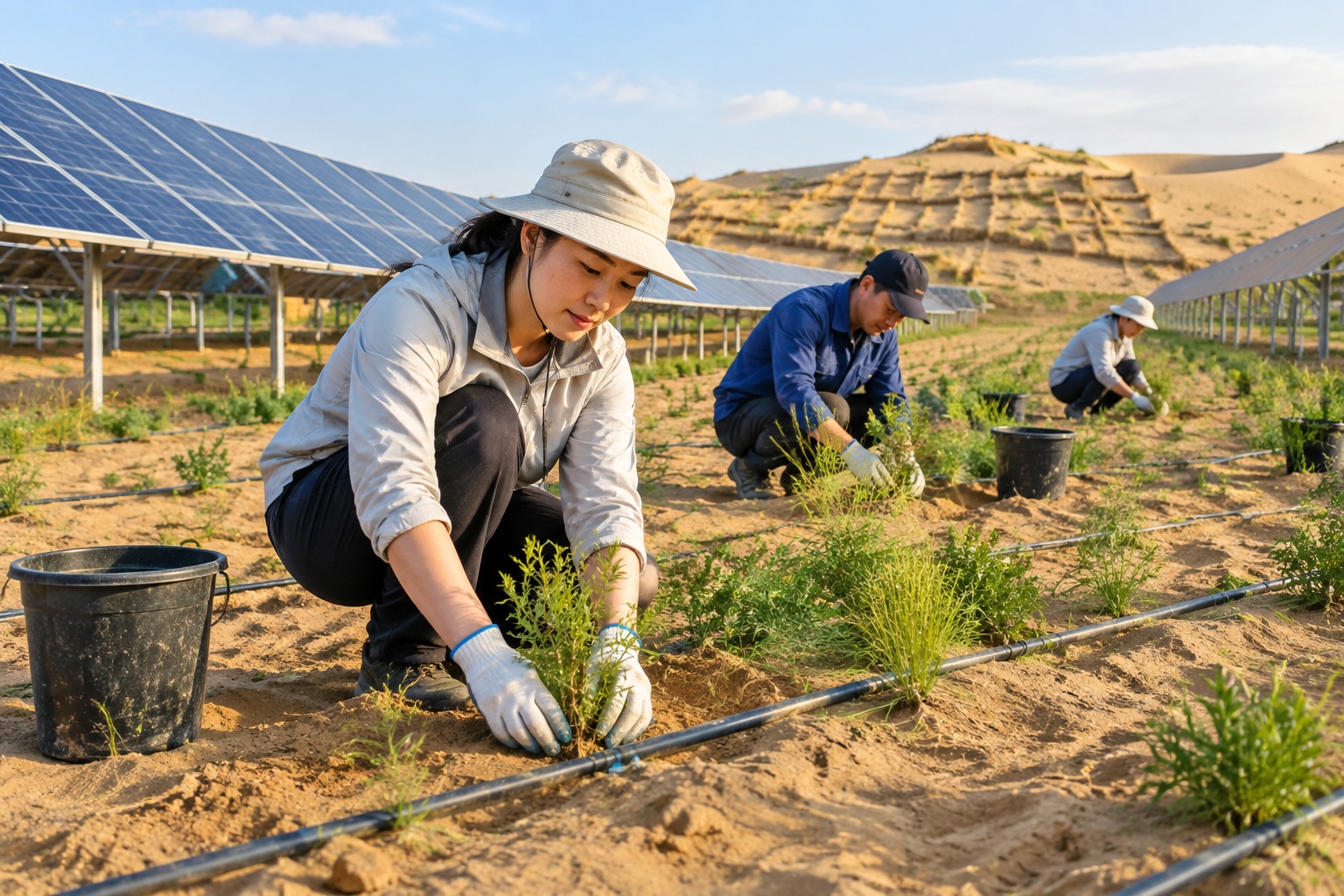
The design idea is written into the Chinese phrase for it: generate on top of the panels, plant beneath them, graze between them.
Getting the electricity out
Wind and solar plants that cannot deliver their power are expensive scenery. That is why the desert bases are built as packages: generation, storage, a flexible backstop, and a transmission line.
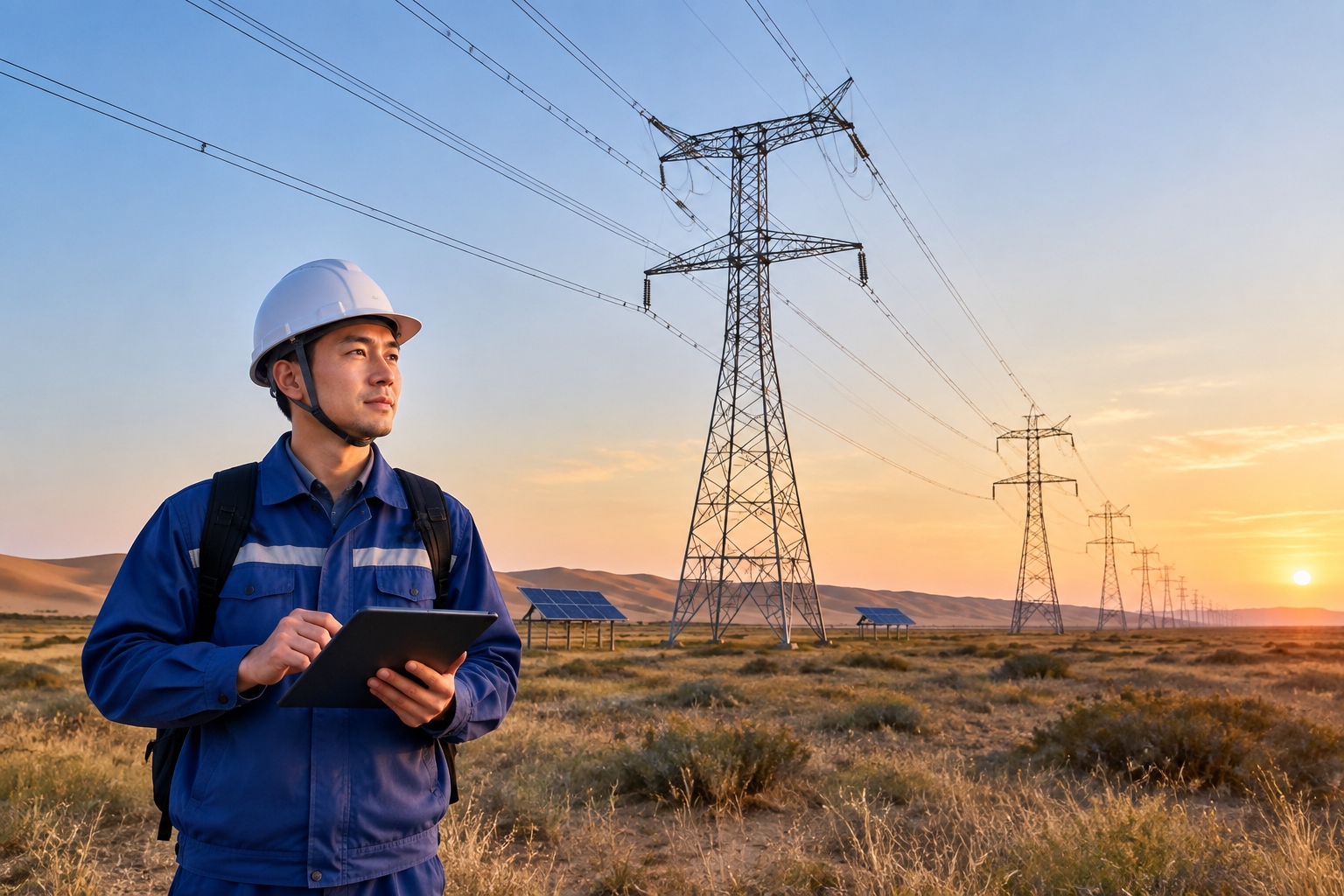
China has spent more than a decade building ultra-high-voltage (UHV) lines — 1,000-kilovolt AC and ±800-kilovolt DC — that carry electricity 1,000 to 2,000 kilometers with losses of only a few percent. More than 40 such lines are in service. Several begin in Inner Mongolia and end in Shandong, Tianjin or the Yangtze Delta.
Storage fills the gaps. By the end of 2024, China had installed about 74 gigawatts of new-type storage, mostly lithium-ion batteries, alongside pumped-storage hydro. Pumped storage — pumping water uphill when power is cheap, releasing it when demand spikes — is targeted to reach 62 gigawatts in 2025 and 120 gigawatts by 2030.
Even so, the desert bases are usually paired with coal plants. Not to run as usual, but to provide the steady, dispatchable power that keeps a 10-gigawatt variable supply from destabilizing the grid. Climate analysts dislike this part, and they are not wrong to. It is also the honest description of how the system currently works.
What the desert gets back
Something unexpected happened at China’s first big desert solar park, in Qinghai’s Talatan, on the Tibetan Plateau. The panels slowed the wind near the ground and cut evaporation, so grass began growing in the shade between the rows. That created a maintenance problem — tall grass inside a solar farm — and then an obvious solution: sheep. Local herders now graze their flocks inside the park, the animals keep the vegetation down, and the mowing bill disappears.
Similar arrangements exist in Kubuqi and other bases. Herders earn rent from land leases and income from grazing contracts, and construction and maintenance create local jobs that did not exist before.
The sand-control side matters too. Vegetation planted between panel rows holds the surface in place, and in Kubuqi the work builds on decades of desertification efforts by local government and companies. The desert covers roughly 18,000 square kilometers; a substantial share of it has already been treated with sand-binding shrubs, fences and drip irrigation.
The parts that are genuinely contested
Desert solar is not free of trade-offs, and it is worth being precise about them.
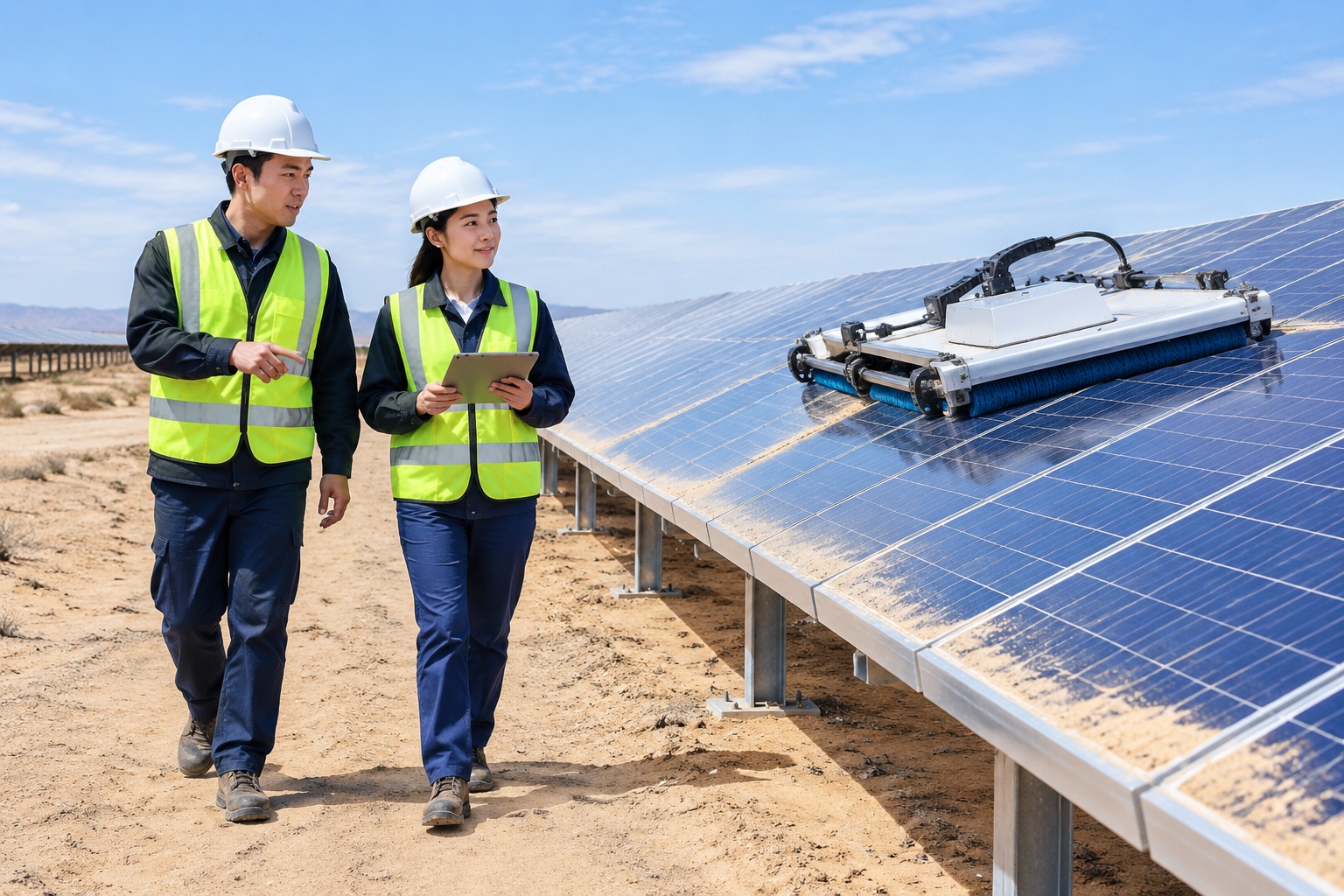
Water. Solar panels get dusty, and dust cuts output. Cleaning them with water in a place that receives about 200 millimeters of rain a year is a real cost. Some bases now use dry-cleaning robots and water-free brushes; others still use water, and how much they use is a live question for local governments.
Ecology. Large panel arrays change how the ground reflects sunlight and how wind moves across it. Grass appearing under panels sounds like an unambiguous win, but it also changes which species thrive. Ecologists who study desert ecosystems warn that greener is not automatically better in a landscape with its own fragile logic.
Curtailment. Nationally, more than 95% of wind and solar output was used in 2024. In a few northwestern provinces the share of wasted power is higher, because the grid and the storage have not kept up with the pace of installation.
Money. In February 2025, China’s main planning agencies moved new wind and solar projects onto market-based pricing, ending the era when a fixed tariff guaranteed the return. Projects now sell into a market where midday solar prices in some provinces fall close to zero. Cheap electricity is good news for factories; it is harder on the balance sheet of a project that cost billions.
How it compares with desert solar elsewhere
Desert solar is not a Chinese invention. Morocco’s Noor Ouarzazate complex, at about 580 megawatts, was a pioneer. India’s Bhadla Solar Park reaches roughly 2.2 gigawatts. Dubai’s Mohammed bin Rashid Al Maktoum Solar Park is planned for 5 gigawatts. Australia’s Sun Cable project, which proposed exporting solar power from the Northern Territory to Singapore, collapsed in 2023 under financing pressure.
What is different about the Chinese version is the bundling and the volume. The first batch of desert bases alone — 97 gigawatts — is larger than the entire solar capacity installed in the United States as of the mid-2020s, and it comes with transmission lines, storage and a domestic supply chain that produces the overwhelming majority of the world’s solar modules. At the end of 2024, China’s combined wind and solar capacity passed 1,400 gigawatts, roughly equal to the whole generating fleet of the United States.
What to watch next
The building part is, in a sense, the easy part. China has shown it can put 10-gigawatt power plants in places where almost nobody lives. The harder questions are the ones that surface later: whether the electrons reach a factory in Shandong at a price that keeps coal switched off, whether the grass under the panels is still there in 25 years, and whether the transmission lines get built fast enough to keep pace with the panels.
If you want to see the future of China’s energy system, you do not need a government white paper. Stand on a dune in Kubuqi, watch the sheep walk between the panel rows, and listen for the hum.
Start the discussion at forum.chinacomes.com