

A Particle That Passes Through You Right Now
Every second, hundreds of trillions of neutrinos from the Sun pass through your body. They do not bump into you. They do not warm your skin. Most will cross the entire Earth without leaving a trace. Physicists call them “ghost particles”—not because they are spooky, but because they are almost impossible to stop.
Neutrinos carry information from the Sun’s core, from collapsing stars, from nuclear reactors. Catch a few, and you can ask how the universe works. The trick is catching them.
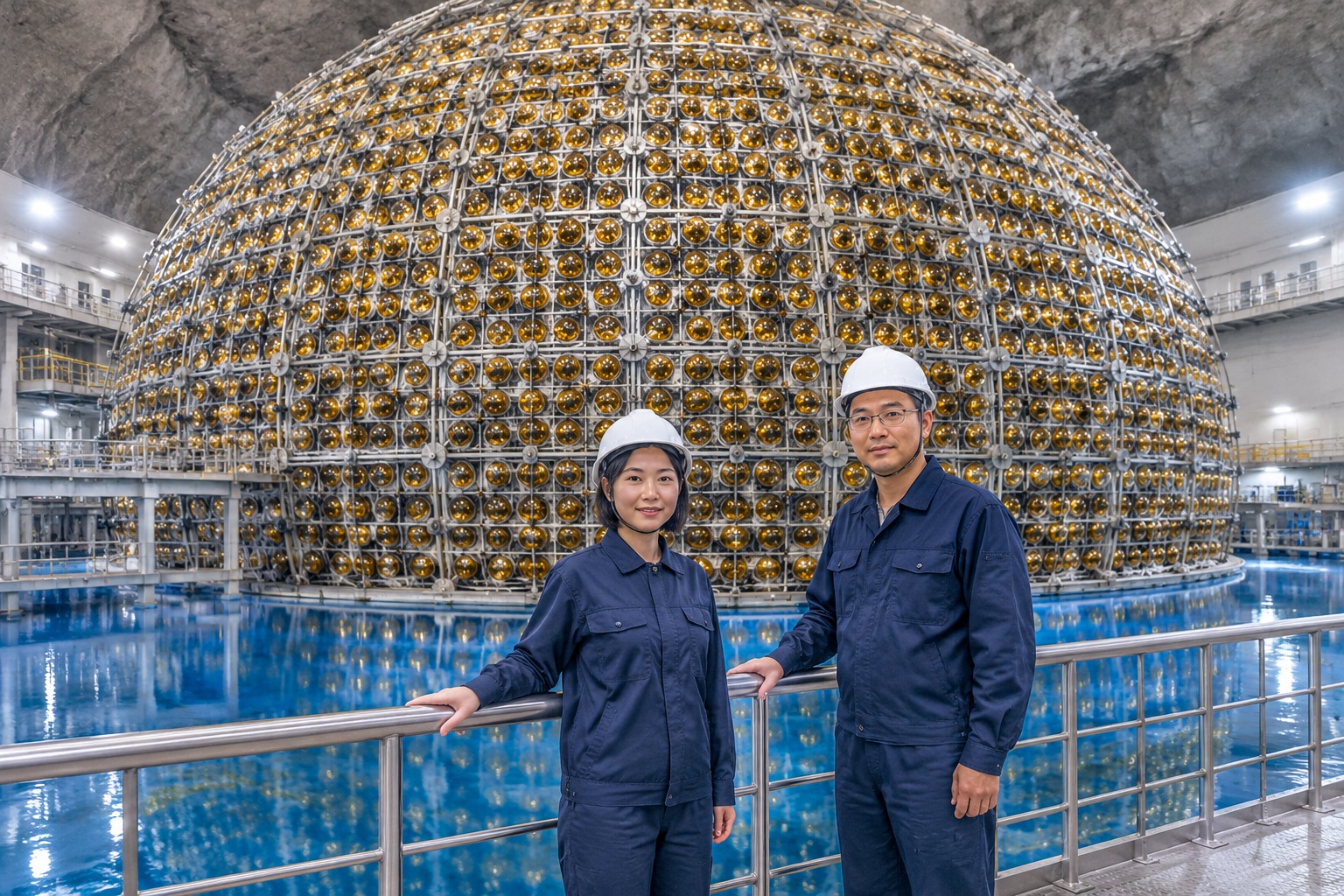
In Kaiping, a small city in Guangdong Province, southern China, a very large machine has been built to do that. It is JUNO—the Jiangmen Underground Neutrino Observatory. In 2025, after years of construction, it moved from building site to operating experiment.
Why JUNO Sits 700 Meters Underground
The first thing visitors notice is the quiet. JUNO sits about 700 meters underground, beneath a hill in Kaiping. You go down by tunnel or lift. The rock above is not a bunker aesthetic. It is a shield.
Cosmic rays hit Earth constantly. At the surface, they create a noisy background. A neutrino detector needs silence. Rock filters out most cosmic-ray muons—particles that would otherwise fake the tiny signals. Underground is a filter.
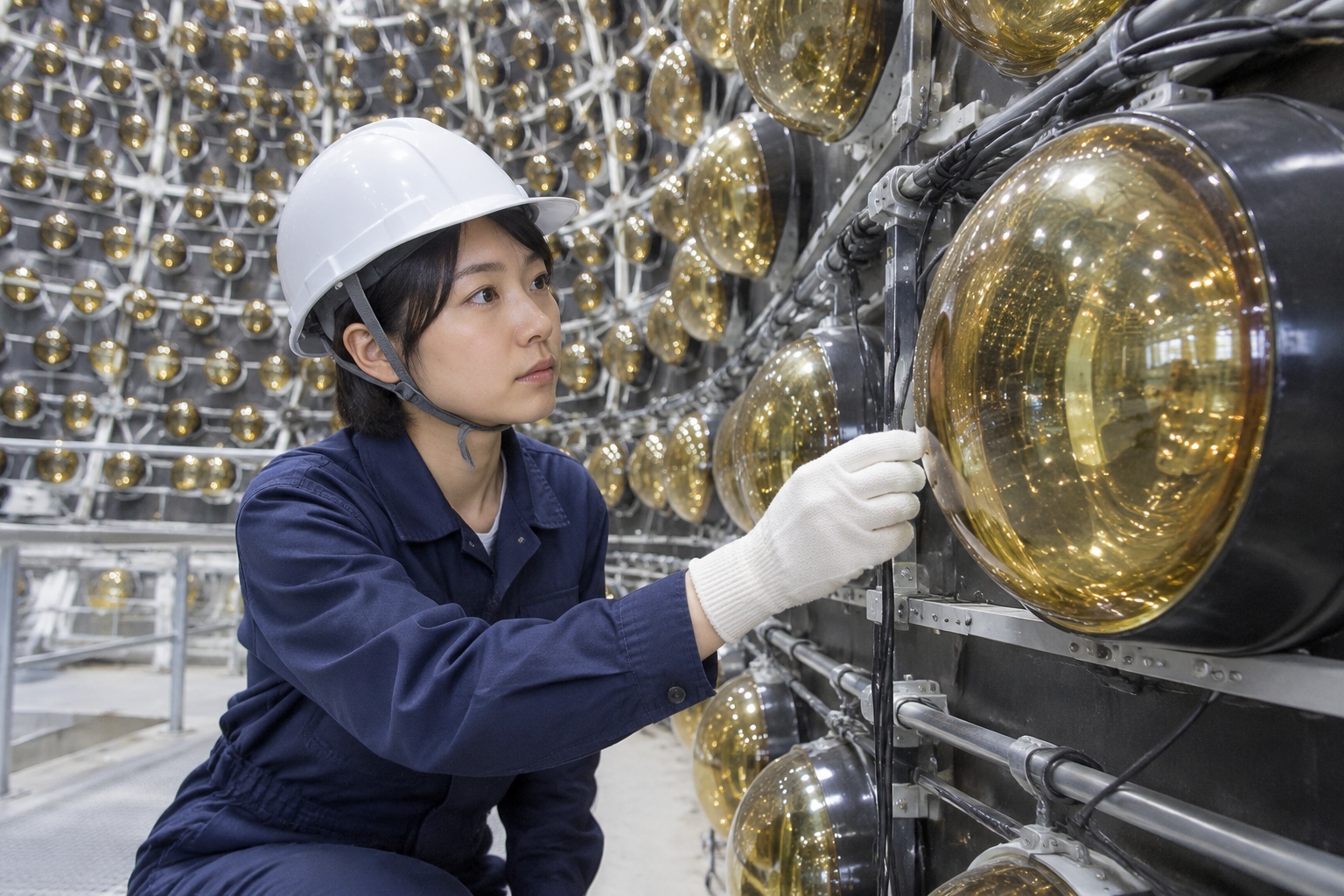
At the center is a sphere 35.4 meters across. It holds 20,000 tons of liquid scintillator, a clear liquid that gives off a faint flash when a particle passes through. The sphere sits in a water pool lined with photomultiplier tubes—very sensitive light sensors. JUNO has 43,212 of them.
When a neutrino interacts, the flash is incredibly weak. The sensors turn light into electrical signals. Researchers reconstruct when the neutrino arrived, from which direction, and with how much energy. It is like hearing one raindrop in a thunderstorm and working out where it fell.
What JUNO Is Designed to Measure
JUNO has several jobs. One is to study antineutrinos from two nearby nuclear plants—Yangjiang and Taishan—about 53 kilometers away. Those reactor antineutrinos help physicists attack a major question: what is the ordering of the three neutrino masses? That touches how neutrinos got mass and how the universe evolved.
Another job is solar neutrinos. The Sun produces them in the nuclear reactions that make sunlight. By the time they reach Earth, many have changed flavor—a quantum mixing called oscillation. JUNO will measure the rate and energy spectrum of solar neutrinos with a very large detector. That lets it pin down two key oscillation parameters: the mixing angle θ12 and the mass-squared difference Δm²21.
Those names look technical. The idea is simple. Neutrinos oscillate in a pattern set by a few numbers. Measure those numbers more precisely, and you test the standard three-neutrino picture more sharply. You also narrow the space where unknown particles or forces could hide.
What “1.5 to 1.8 Times Better” Actually Means
JUNO is designed to improve the precision on those solar neutrino oscillation parameters by a factor of about 1.5 to 1.8 compared with current best measurements. In plain language: the error bars get smaller.
This is worth pausing on. A smaller error bar is not a new particle. It is not a new force of nature. It is a sharper ruler. If two theories predict slightly different values, a sharper ruler can tell them apart. If the Standard Model is right, JUNO will make the agreement tighter. If something is off, the mismatch may become visible.
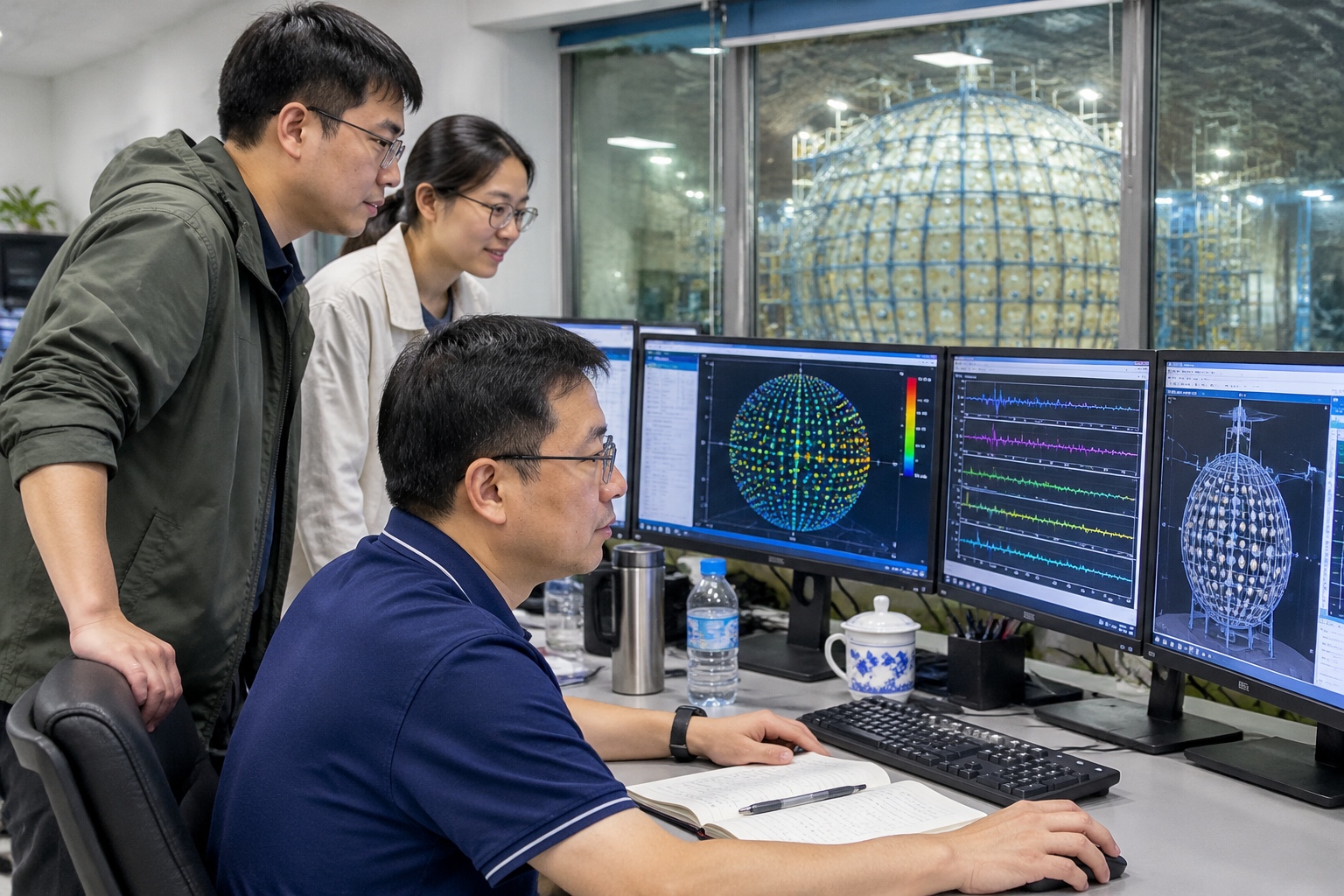
Discoveries in particle physics often come from a measurement slightly too high or too low. The Higgs boson was not found because someone saw a strange flash; it was found because thousands of events piled up at one mass. Neutrino physics works in a similar way. You count events, compare with predictions, and look for a pattern that does not fit.
So JUNO’s solar program is not a claim that new physics has been found. It is a high-stakes calibration of known physics—and a search for cracks in it.
The View from the Sun
Solar neutrinos are a direct line to the Sun’s core. Light takes tens of thousands of years to escape the Sun’s interior; neutrinos leave immediately. When JUNO detects one, it is looking at a reaction that happened about eight minutes earlier.
The practical challenge is separation. Solar neutrinos are less energetic than reactor antineutrinos, and their signals are harder to distinguish from background. JUNO’s size helps: more liquid, more sensors, more events. The collaboration is also building calibration systems and analysis methods to understand the detector’s response. This is not glamorous work. It is cables, purity checks, temperature stability, software, and shifts. It is also where the measurement lives or dies.
For readers used to telescopes, this may sound strange. Astronomy usually means looking up. Neutrino astronomy means looking down, into a tank, and reconstructing the Sun from flashes. Both are ways of seeing.
An International Lab in a Guangdong Town
JUNO is Chinese-led, but not solitary. The collaboration includes about 700 researchers from 17 countries and regions. Institutions contribute hardware, simulation, calibration, and analysis. A detector this scale is too big for one country alone—not just because of money, but because of expertise.
The local side matters too. The site is in Kaiping, a place better known to tourists for its diaolou—fortified towers built by overseas Chinese families. JUNO adds a different landmark: a laboratory under a hill, a surface campus, a control room, and a stream of visiting scientists. For local students, frontier physics is not only in Beijing or Geneva. It can be a bus ride from home.
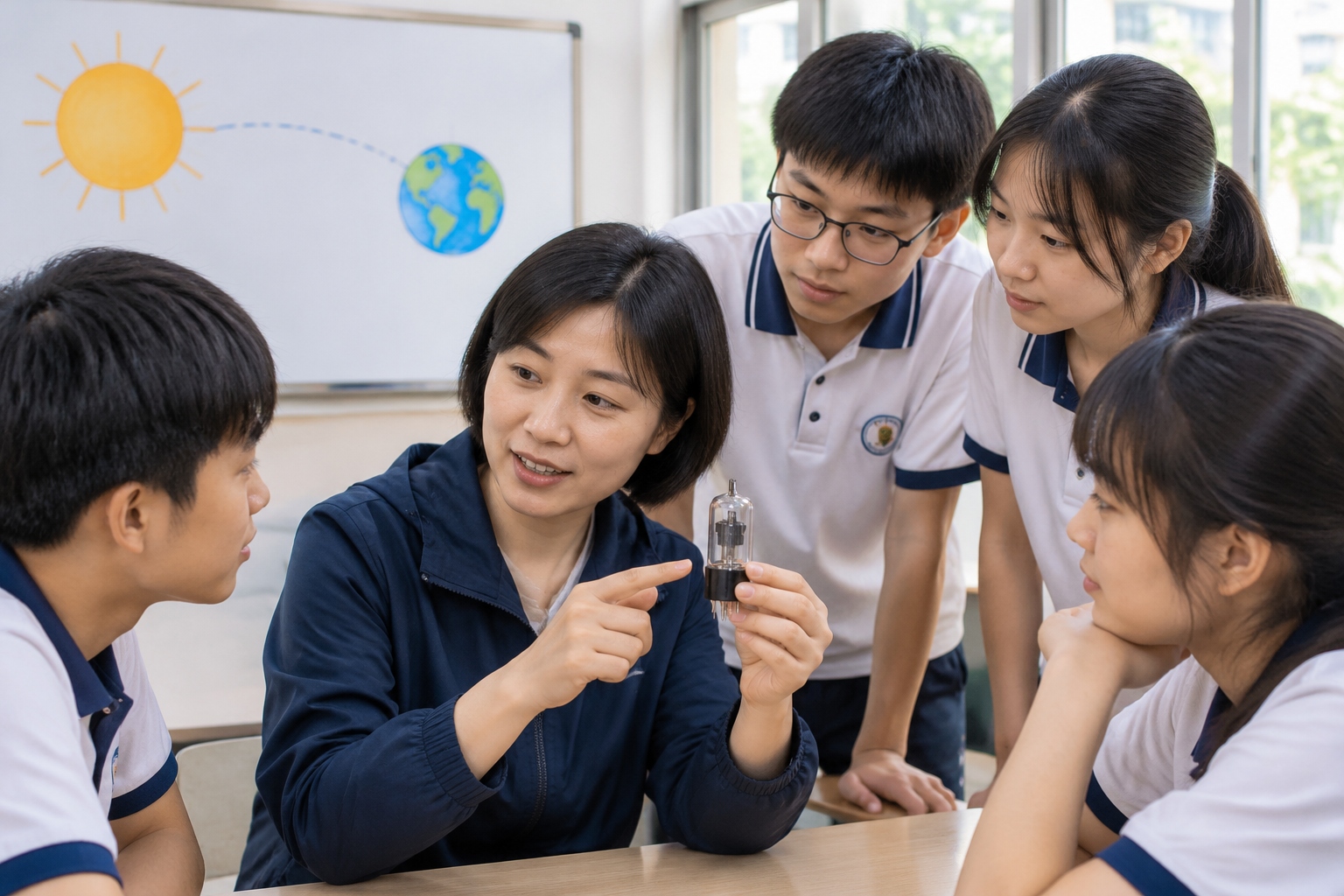
That is one of the quieter changes in Chinese science. Big facilities are no longer only in a few coastal metropolises. They are in smaller cities, in tunnels, in rural counties. They bring jobs, roads, and a new local identity. They also bring school groups who come to ask what a neutrino is.
What JUNO Will Not Do
It is easy to oversell a big machine. JUNO will not instantly explain dark matter. It will not tell us why the universe has more matter than antimatter. It will not make neutrino communication practical. Those are not its job.
What it will do is more modest and more useful. It will collect a huge, clean dataset. It will measure oscillation parameters with unprecedented precision. It will watch the Sun, reactors, and—if we are lucky—a supernova. It will train a generation of physicists and engineers. And it will test the standard picture of neutrinos at a level that matters.
That is how fundamental physics usually advances: not with one dramatic flash, but with a better ruler, a cleaner signal, and a stubborn insistence on checking the numbers.
Why This Matters Beyond the Lab
Most people will never visit an underground neutrino detector. But the skills travel. Liquid scintillator purity, low-noise electronics, large-scale data processing, precise calibration—these show up later in medical imaging, radiation monitoring, and industrial sensing. Frontier instruments create frontier skills.
There is a simpler reason to pay attention. The universe is mostly not made of the stuff we touch. Neutrinos are a reminder that the visible world is a thin layer. A country that builds a 20,000-ton detector under a hill is saying something about its ambitions: it wants to be part of the generation that measures what is almost invisible.
In 2025, JUNO began that work. The first results will take time. The error bars will shrink slowly. But somewhere under Kaiping, in a dark tank filled with clear liquid, the Sun is already sending messages. The machine is finally listening.