
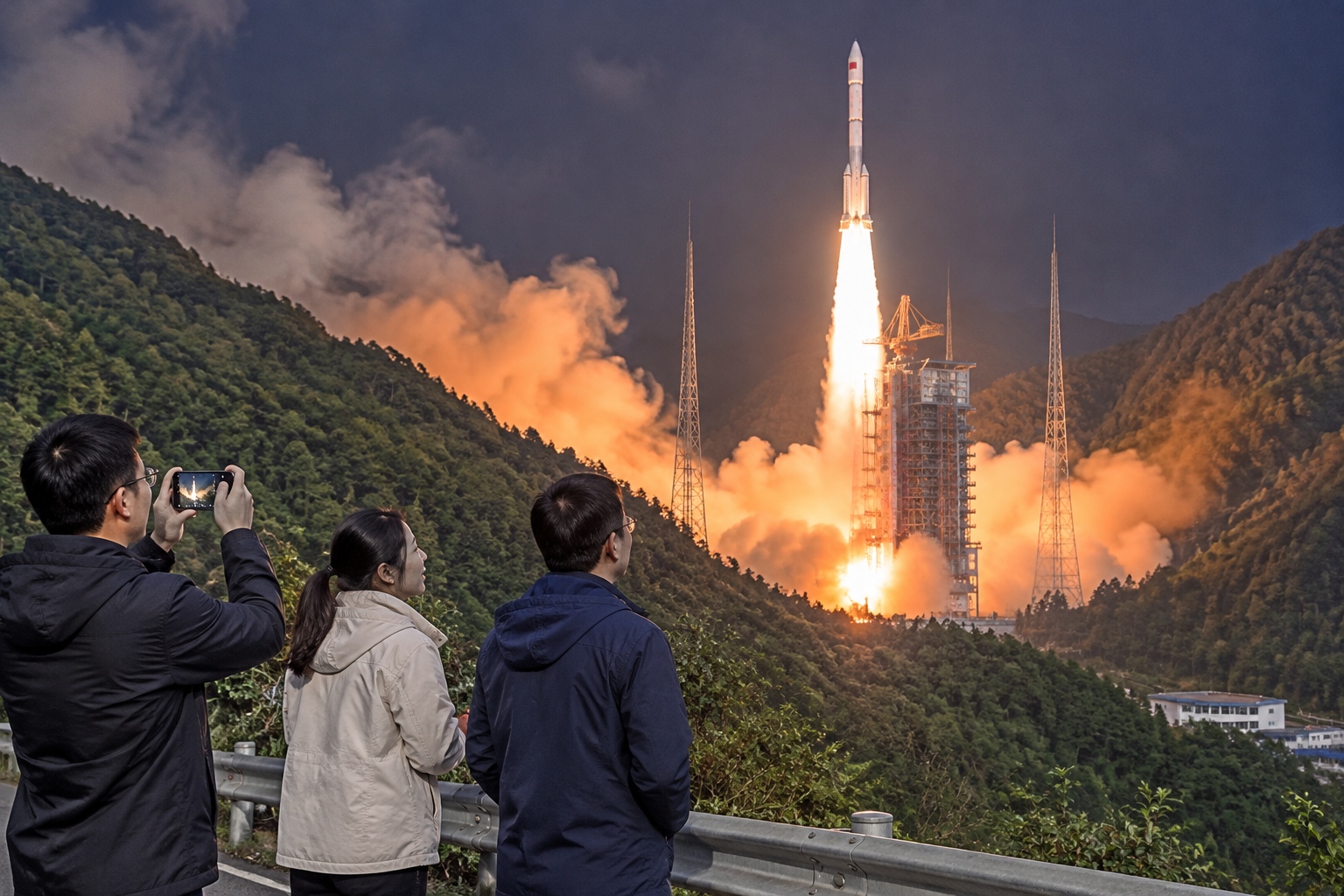

Just after 1:30 in the morning, a rocket leaves the valley
On 29 May 2025, a Long March 3B climbed out of the mountains at Xichang, in southwest Sichuan. A night launch from that site lights up the ridge lines on both sides of the valley and rattles windows in towns several kilometres away. Most rockets from Xichang carry communications satellites up to geostationary orbit. This one carried a spacecraft called Tianwen-2, and it was leaving on a ten-year trip.
Sample return is the part of space exploration that changes what scientists can actually do. A camera in orbit tells you what a surface looks like; a hundred grams of rock in a laboratory tells you what it is made of, how old it is, and what happened to it 4.5 billion years ago. Only four countries have brought material back from another world — the United States, the Soviet Union, Japan and, since 2020, China. Only Japan and the United States have done it from an asteroid.
Tianwen-2 is the first Chinese spacecraft designed from the start for that job. It is not a lunar mission with a new destination bolted on: the sampling mechanism, the navigation software, the return capsule and the ten-year flight plan were all built around a specific pair of objects. The first is a small near-Earth asteroid called 2016 HO3. The second, reached years later, is a comet sitting in the middle of the asteroid belt.
An asteroid that has been trailing Earth for a century
2016 HO3 was found in April 2016 by the Pan-STARRS survey telescope on Haleakalā, Hawaii. The name is just the year and half-month of discovery plus a sequence number; it also carries a Hawaiian name, Kamo‘oalewa, referring to a celestial object that oscillates back and forth.
It is small — estimates put its longest dimension somewhere between 40 and 100 metres, roughly the length of a Boeing 737 or, at the top end, a football pitch. It circles the Sun once every 365.9 days, on an orbit tilted only slightly relative to Earth’s. Because the two periods almost match, the asteroid appears from here to loop around our planet, drifting ahead of us for decades, then falling behind, then catching up again. Astronomers call that a quasi-satellite. It never comes closer than about 38 times the Earth–Moon distance — some 14.6 million kilometres — and never strays beyond about 100 lunar distances. It has kept this arrangement for around a century and will keep it for centuries more. You cannot see it without a serious telescope.
The reason to chase it is simple: it is a piece of the early solar system on an orbit almost identical to Earth’s, and at a few dozen metres across it has no atmosphere, no water and no geology to reprocess its surface since the day it formed. Nothing has disturbed it in 4.5 billion years.
One hypothesis makes it more interesting still. Its reflected light, measured from the ground, looks a lot like weathered lunar material, which has led some researchers to argue it could be debris blasted off the Moon by an ancient impact. That is unproven. A returned sample would settle it in a way no telescope can.
What the spacecraft will actually do
2026: arrive and map
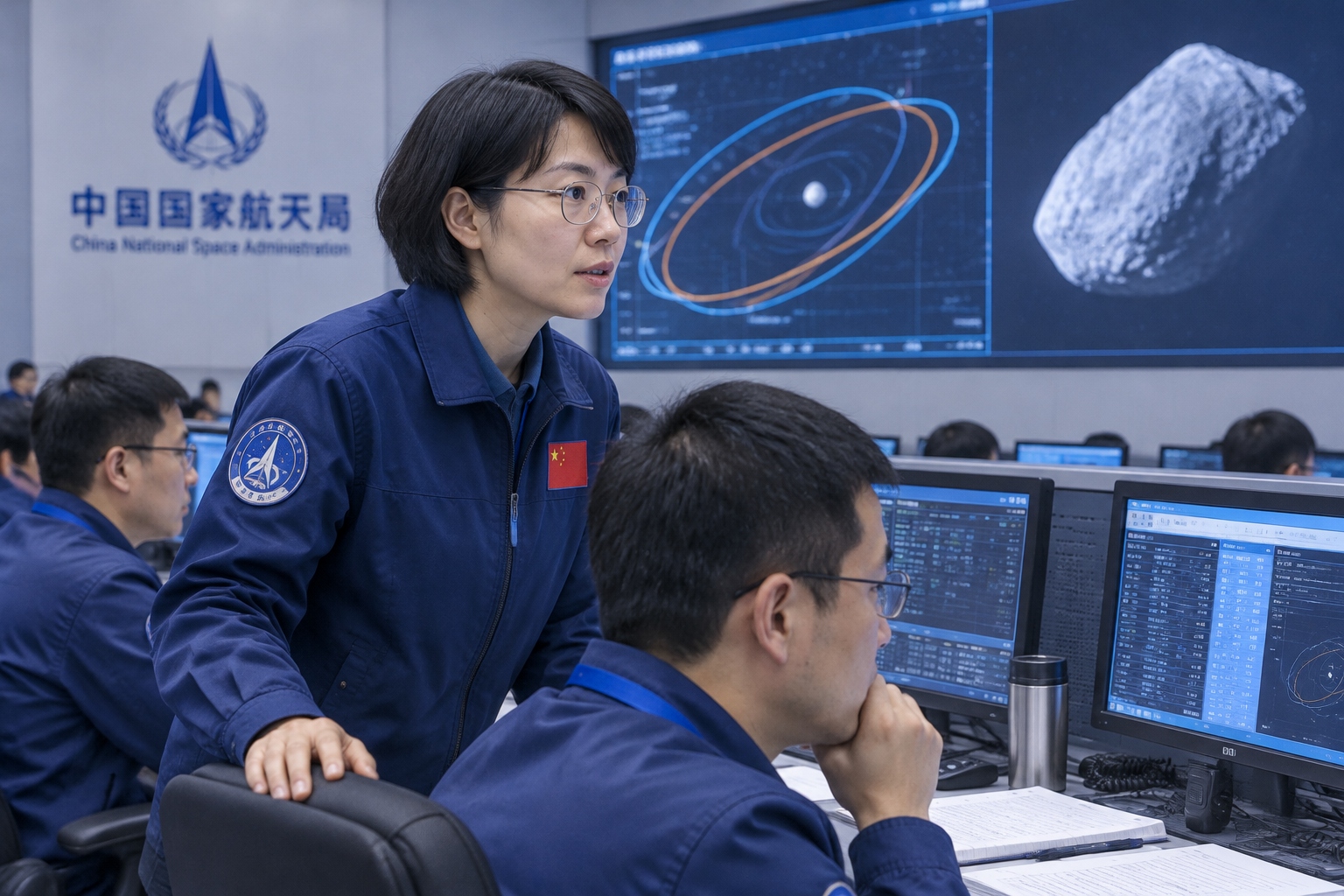
After roughly a year of cruise, Tianwen-2 will ease up to 2016 HO3 and begin a slow, close survey. Cameras and spectrometers will read the shape, the spin rate, the surface texture and the mineral signature; a radar will probe whether the interior is solid rock or a loose pile of rubble; a magnetometer and dust detectors will run in the background. This phase matters more than it sounds. Nobody knows what the surface of a 50-metre asteroid looks like from two metres away, and the survey decides where — and whether — to touch down at all.
2026: touch, collect, leave
Chinese mission planners have described two sampling methods. In the first, the spacecraft descends slowly, its collector head touches the surface for a few seconds, and it backs away — a touch-and-go. In the second, it hovers a couple of metres above the ground and gathers loose material without landing. The design target is at least 100 grams. For scale, Japan’s Hayabusa2 brought back 5.4 grams from Ryugu in 2020, and NASA’s OSIRIS-REx returned about 122 grams from Bennu in 2023.
Late 2027: a fast re-entry
The sample comes home in a small capsule, scheduled to land in Inner Mongolia in late 2027, on the same steppe where China’s lunar sample capsules have come down. It will hit the atmosphere faster than a capsule returning from the Moon, because it is arriving from a heliocentric orbit rather than from Earth’s own neighbourhood. That means a heat shield problem measured in thousands of degrees, and a landing ellipse that has to be right the first time.
2028 to 2034: the second act
The main spacecraft does not come home. After releasing the capsule it swings past Earth, uses the planet’s gravity to bend its path, and heads out to the asteroid belt. It is due to reach comet 311P around 2034.
Why touching a 50-metre rock is harder than landing on the Moon
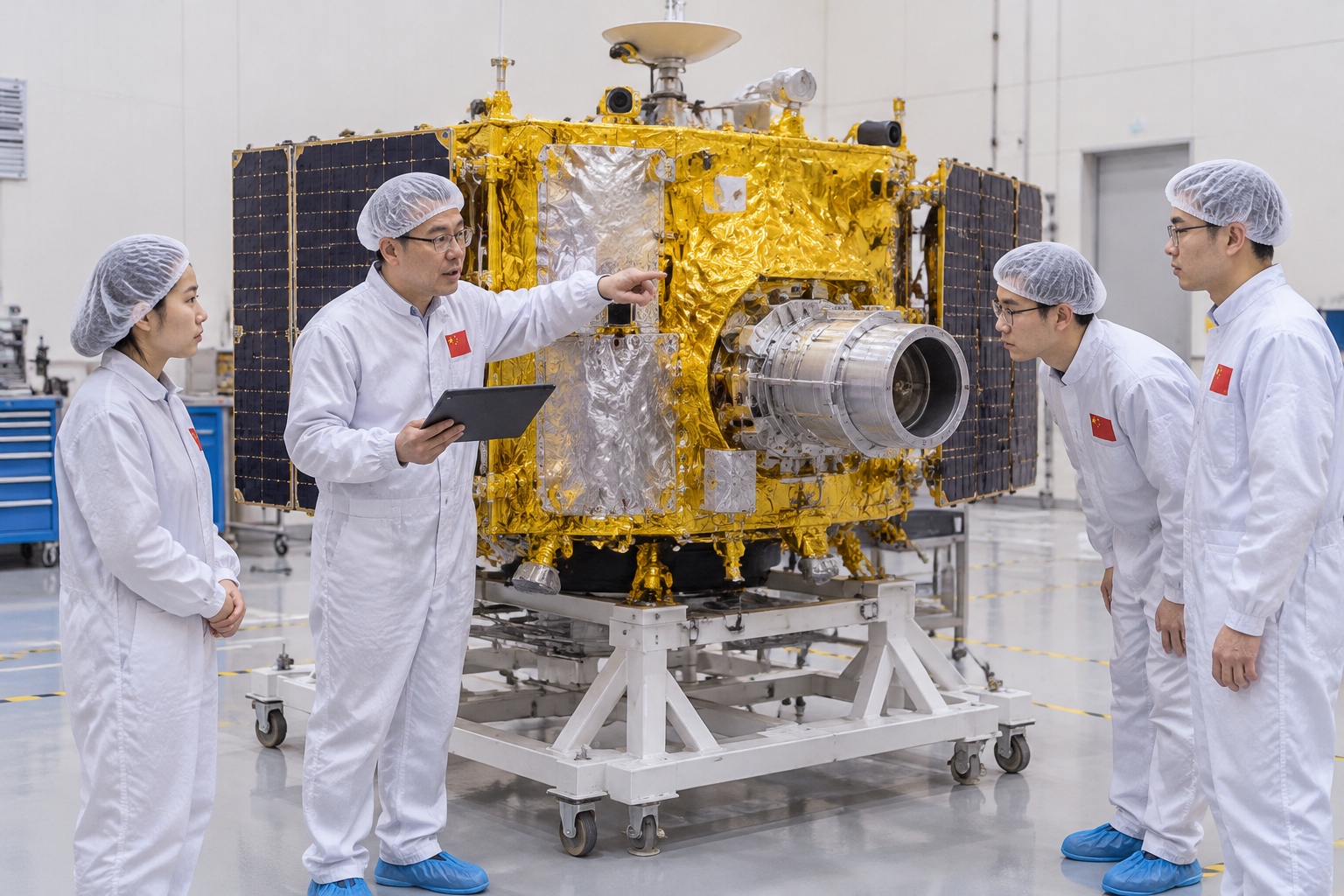
On the Moon, gravity does most of the work. A lander fires an engine, settles, and stays put. On 2016 HO3 the gravity is barely measurable. A body 50 metres across with the density of ordinary rock has an escape velocity of a few centimetres per second — push off it gently and you never come back. Anything the spacecraft disturbs, from dust to pebbles to the sampler itself, can drift for hours before settling, or never settle, and can fog a lens or jam a mechanism at exactly the wrong moment. Engineers cannot test that environment on Earth for more than a few seconds at a time.
The second difficulty is distance. At 2016 HO3, a radio signal takes between about 50 seconds and two minutes to reach Earth, depending on where the two objects sit in their orbits. At 311P, roughly 300 million kilometres away, it is closer to 15 or 20 minutes each way. Nobody flies a spacecraft in real time at those distances. The final approach has to be handled by the spacecraft’s own cameras and software, which must recognise a boulder field it has never seen and decide, in seconds, to abort.
Then there is power. At the comet, sunlight is a quarter as intense as it is at Earth, and the panels and thermal design have to work across the whole range, from a warm near-Earth orbit out to a cold one past the inner belt. Every subsystem is a compromise between those two ends of the mission.
A comet inside the asteroid belt
311P/PANSTARRS was discovered in 2013 in the main belt between Mars and Jupiter, a region that should be far too warm and far too dry for a comet to behave like a comet. Yet it has thrown off dust tails, repeatedly, in the way comets do. The leading explanations are that it is spinning fast enough to shed material from its equator, or that it holds ice beneath the surface that occasionally vents — possibly both.
Either way, it muddies a distinction that textbooks have used for two centuries. If main-belt objects can carry water ice, they become part of the argument about how water reached the early Earth. Tianwen-2 will spend years at 311P, and it will be the first spacecraft to do so.
Why this matters to people who never look up
Three threads run from a mission like this back into ordinary life. The first is planetary defence. Working out the mass, the spin and the surface mechanics of a small asteroid is exactly the homework a deflection mission would need if something bigger were ever headed our way. 2016 HO3 is not a threat; the techniques are transferable.
The second is the sample itself. Bennu and Ryugu material is already in laboratories in Houston, Japan and elsewhere. A third asteroid, from a different part of the solar system and with a different history, turns three data points into a comparison — and comparison is where the science happens.
The third is the toolkit: autonomous navigation around an unknown object, systems that survive a decade in deep space, sampling hardware that works in near-zero gravity. Those capabilities do not stay inside the space programme any more than radar or satellite imaging did.
What to watch, and what could go wrong
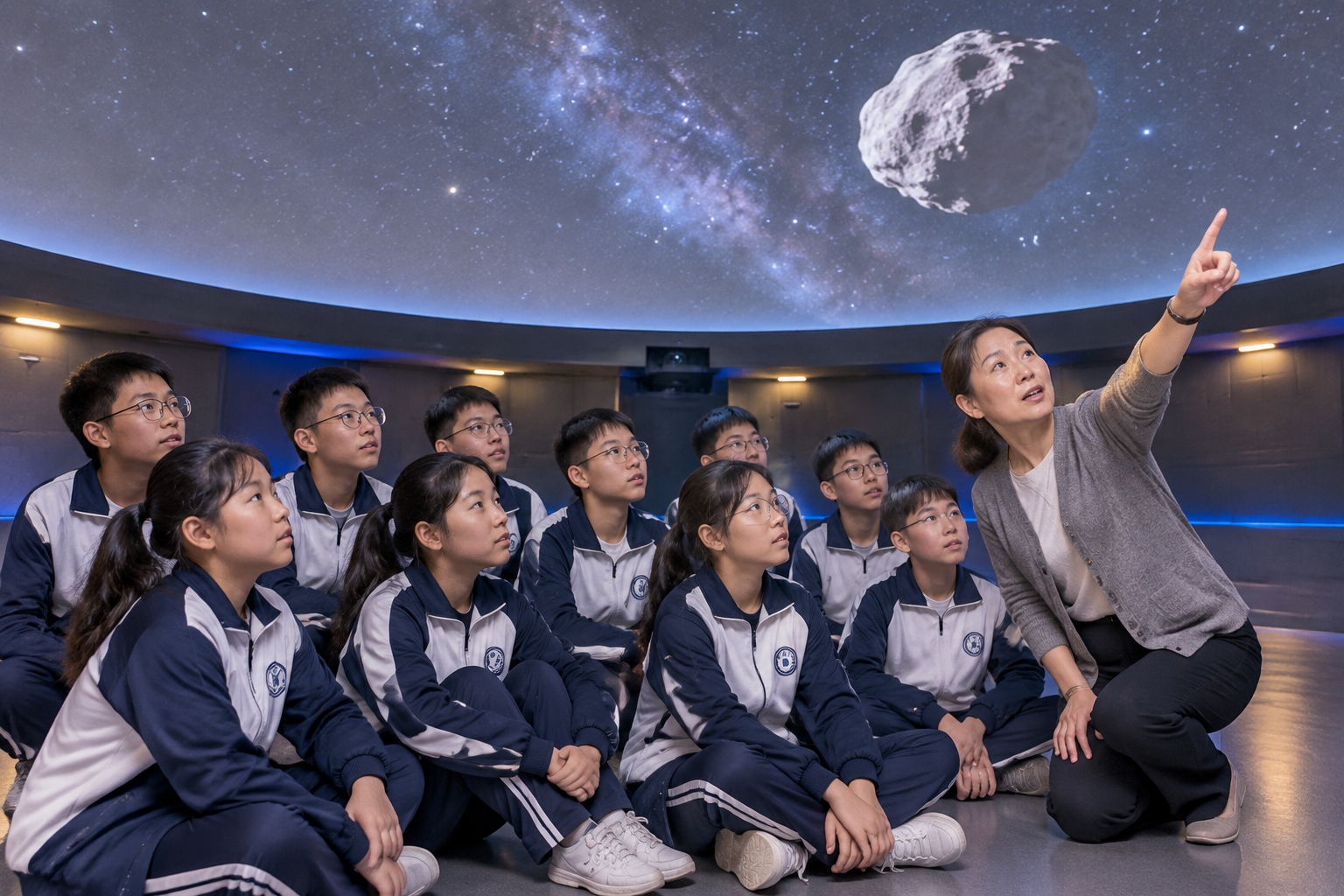
Deep space missions slip. Sampling hardware can return less than planned, or nothing. The capsule’s re-entry is a one-shot event, and the spacecraft still has to be healthy enough afterwards for seven more years of flight. Anyone who followed Hayabusa’s stuck sampler or OSIRIS-REx’s overflowing collection head knows how much of this comes down to improvisation on the day.
China’s deep-space record so far is short and unusually clean: a far-side lunar landing in 2019, 1,731 grams of lunar sample returned in 2020, 1,935.3 grams from the far side in 2024, an orbiter and rover at Mars in 2021. Tianwen-2 is the first of those missions where the target is essentially unknown up close.
The part worth noticing may be the quietest. After the capsule lands in 2027, the spacecraft will fly for seven years with almost no public attention — a decade-long plan that outlives news cycles and budget arguments, treated inside the programme as a schedule item rather than an adventure.
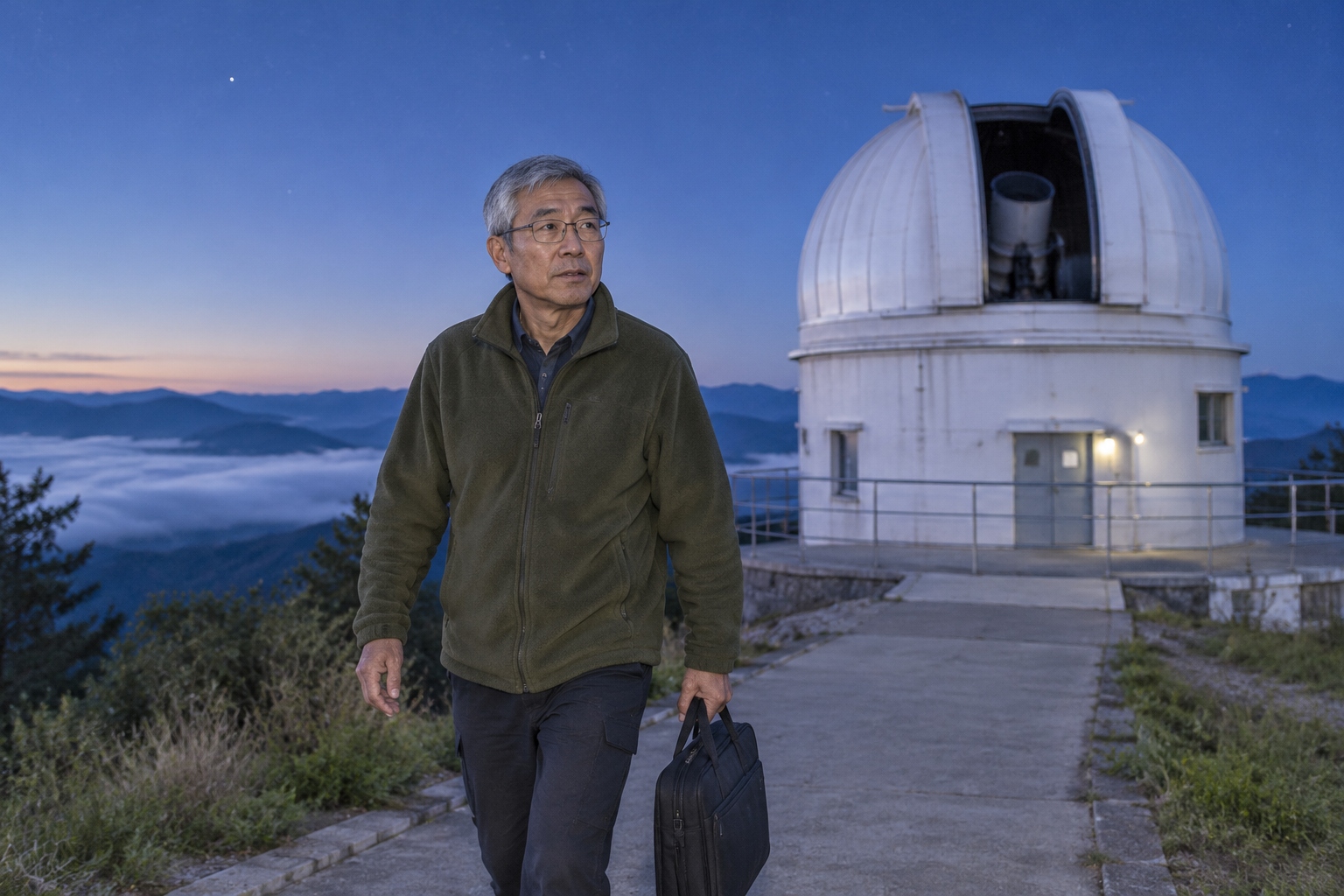
If the capsule does come down on the Inner Mongolia steppe with a few ounces of a 4.5-billion-year-old rock inside, the headlines will last a week. The catalogues, the comparison papers and the follow-on missions will last decades.