


The Meeting That Went Well—But Made No Decision
Last year, a friend of mine from Singapore flew to Shenzhen to pitch a new component to a Chinese electronics company. The meeting lasted three hours. The commercial director asked precise questions about lead times, the purchasing manager took notes, and the general manager ended the session by saying, “We welcome this opportunity.” My friend flew home feeling the contract was almost in his pocket.
A month later, no order arrived. A local contact explained that the deputy general manager had wanted to proceed, but the company’s founder and chairman had not been in the room that day. And he had not yet made up his mind.
If you have done business with Chinese suppliers, distributors, or state-owned groups, you probably have a similar story. On the surface, a Chinese meeting can look like a Western one: same tables, same charts, same polite questions. But authority often flows through a different circuit, and it is not always visible on the official agenda.
Chinese Company Hierarchy: Stronger Than the Org Chart Suggests
Chinese companies use many familiar titles: board of directors, chairman, CEO or general manager, vice-presidents, department directors, team leaders. In a mid-sized private firm, the chairman is often the founder and majority shareholder. Strategic decisions—entering a new market, replacing a core supplier, setting a floor price, approving a joint venture—are usually shaped by him or her after hearing advice, not by a general vote of senior management.
Not every company is a one-person show. Major listed groups and internet firms like Alibaba, Tencent or Huawei have professional governance and independent boards. Yet even in those companies, senior executives tend to centralise power when a decision is strategic or expensive. The flatter world of product teams and rapid iteration lives inside the company, usually a safe distance away from the chairman’s risk horizon.

The “One-Head” Principle: Decision-Making Still Has a Single Owner
Chinese organisations use a useful phrase: 一把手 (yī bǎ shǒu), literally “one hand.” It means the top person in a unit—the person who finally answers for results. In a private business that person is usually the founder. In a university, hospital or state-owned enterprise, the “number one” can be the director or the party secretary, depending on the issue and the organisation’s rules.
This reality produces a communication culture that foreign managers often underestimate. Few employees will openly challenge the boss’s direction in a large meeting. Opinions are expressed more carefully, usually after speakers have read the boss’s mood or the political mood of the room. At the same time, the top leader rarely decides without consulting anyone. Instead, the boss treats discussion as a way to test risk, gather missing data and prepare the group to execute.
Collective Discussion Is Not a Vote
In China, a CEO might say, “大家怎么看?” (“What do you all think?”) and then spend twenty minutes listening to every department head. To a Western visitor, this looks like collective decision-making. In practice, it is more like an intelligence-collection session. Managers present their perspectives, fight for their departmental interests, and reveal what could go wrong if the proposal goes ahead.
The real decision-maker often does not “decide” in that room. The boss may wait until the evening, call the finance director, then ring the sales vice-president, and finally use a short phrase such as “就这样吧”—“let’s make it this way.” Chinese business language calls this final act 拍板 (pāi bǎn), literally “slap the board,” the moment a leader takes ownership of a decision.
Therefore, if you plan a partnership with a Chinese company, do not confuse a lively workshop or a consensus-like meeting with a green light. The green light appears only after the “top hand” has found a way to say yes.
Middle Managers: The Bridge and the Filter
Middle managers in Chinese companies are the true connectors between strategy and daily work. They receive instructions from above and pressure from below. In Chinese workplace language, they 汇报 (huìbào, report to a superior) daily or weekly. Their survival depends on understanding what the boss values and which messages should be presented carefully.
For an external partner, this has an obvious consequence: the friendly manager who promises to “take it back to the team” may be doing exactly that, but he or she probably does not carry the same authority as a Western project manager. A Chinese middle manager can be a valuable sponsor, but you still need to find the person whose approval actually moves money and resources.
Be aware, too, that saying “no” directly is uncomfortable in Chinese workplace culture. When a counterpart says, “it will be difficult,” “we need to discuss,” or “this is the first time we have done this,” do not interpret it as a final answer. These phrases usually mean: I can see a problem, or I cannot approve it myself.
How to Identify the Real Decision-Maker
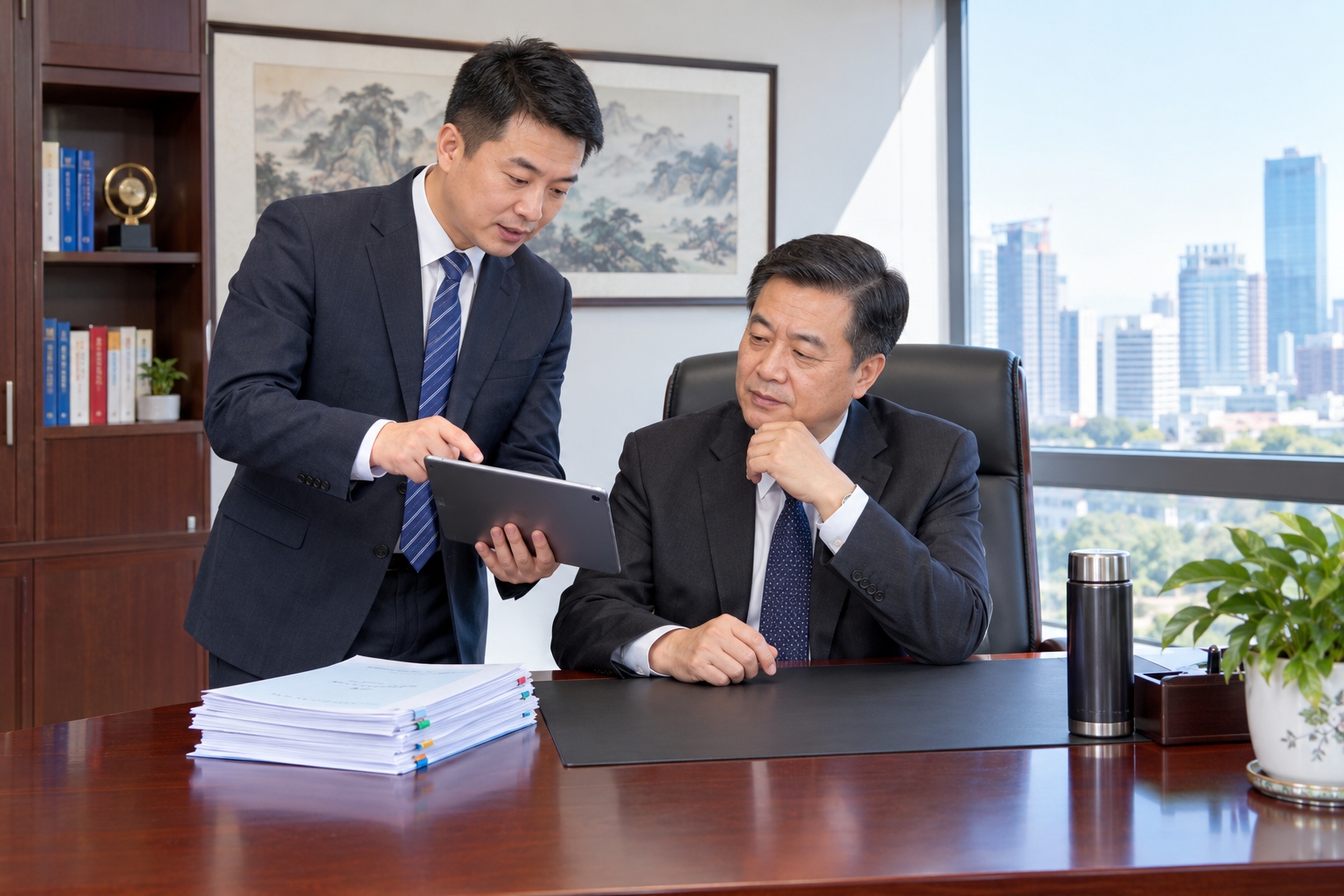
Start with basic questions. In the company you are dealing with, who signed the last major contract? Who negotiated the current raw-material price? Who chose the present supplier? The answers can tell you more than any org chart. People in the company usually know immediately; if your direct contact sounds vague, that in itself tells you that they are not in the inner loop.
Watch the meeting dynamics. Before a department manager answers a question about pricing or delivery, does he glance at a more senior person? Does the general manager rephrase an offer after everyone has spoken? Do employees call the founder “老板” while calling the CEO by his title? These small clues reveal where real authority lives.
In state-owned enterprises, the pattern is more formal. The general manager or chairman usually has broad operational authority, but major decisions often follow internal procedural rules. Collective deliberation may require a leadership team meeting and formal minutes. The result: a decision can take longer and more people must be convinced, but there is still an identifiable senior leader and a clear approval sequence.
A useful practical trick is to ask about approval limits. In many Chinese companies, a department head can spend a small amount without asking, but a contract above a certain threshold—say 200,000 or 500,000 yuan—must be signed at a higher level. Ask a local colleague: “What is the maximum amount you can approve?” If they do not know, the hierarchy has told you the answer.
Communication Strategies That Fit the Hierarchy
Do not bypass the middle manager. In Chinese teamwork, respect for the chain matters. But you can involve your middle-level contact in a way that makes both of you successful: ask them to help arrange a short meeting with “the leader,” explaining that you want to avoid misunderstanding and confirm a few details. Most Chinese managers will accept this if it is framed as protecting them from being embarrassed later.
Prepare your material for the top leader’s concerns, not just the end user’s benefits. A Chinese founder will think about risk, cash flow, stability and personal reputation. Include answers on how the project affects existing relationships, what could go wrong, and how problems will be handled. These are not defensive questions; they are the real decision criteria.
Do your quiet deal-making before the formal meeting. In Chinese business culture, “先沟通,再上会” (“communicate first, then bring it to the meeting”) is common practice. The formal meeting often confirms a decision already shaped in phone calls, meals or informal visits. If the senior leader sees a proposal for the first time in a packed meeting, do not expect an immediate yes.
Finally, practise patience and avoid putting the boss on the spot in public. If he says “I will think about it,” he means it. Allow a few days, send a calm WeChat follow-up, and keep the message short. In a hierarchy, pressure works best if it feels like support, not challenge.
Why This Culture Feels Top-Heavy to Outsiders
China’s modern corporate hierarchy has multiple roots. Traditional Confucian values taught respect for age, rank and the harmony of the group. Later, the centrally planned economy taught organisations to run as vertical command systems. More recently, China’s private economy grew so fast that many companies still carry the management style of their founder, who built the business from zero and often still owns the majority of shares.
When banks and major customers ask “who is in charge?” the answer is simple. Centralised authority lowers transaction costs in an environment where personal relationships remain important. This does not mean that Chinese managers are all obedient or that Chinese companies cannot innovate. In many factories and offices, young employees question routines, create new products and handle digital tools with confidence. But the formal decision layer remains more vertical and less team-based than in many parts of Europe or North America.
Final Advice: Work with the Structure, Not Against It
If you are used to flat management, Chinese hierarchy can feel slow or unclear. But once you identify the real decision-maker, and once that person decides in your favour, execution can be surprisingly fast. A short boss phone call, and the sales director changes priorities before lunch.
The key is not to demand that foreign logic apply. Instead, treat Chinese hierarchy as a professional map: locate the centre of gravity, communicate with it, support the people around it, and wait for the right moment. That is how countless foreign companies have turned “we welcome this opportunity” into a signed contract.
Start the discussion at forum.chinacomes.com