

Introduction: A Green Ribbon in the Gobi
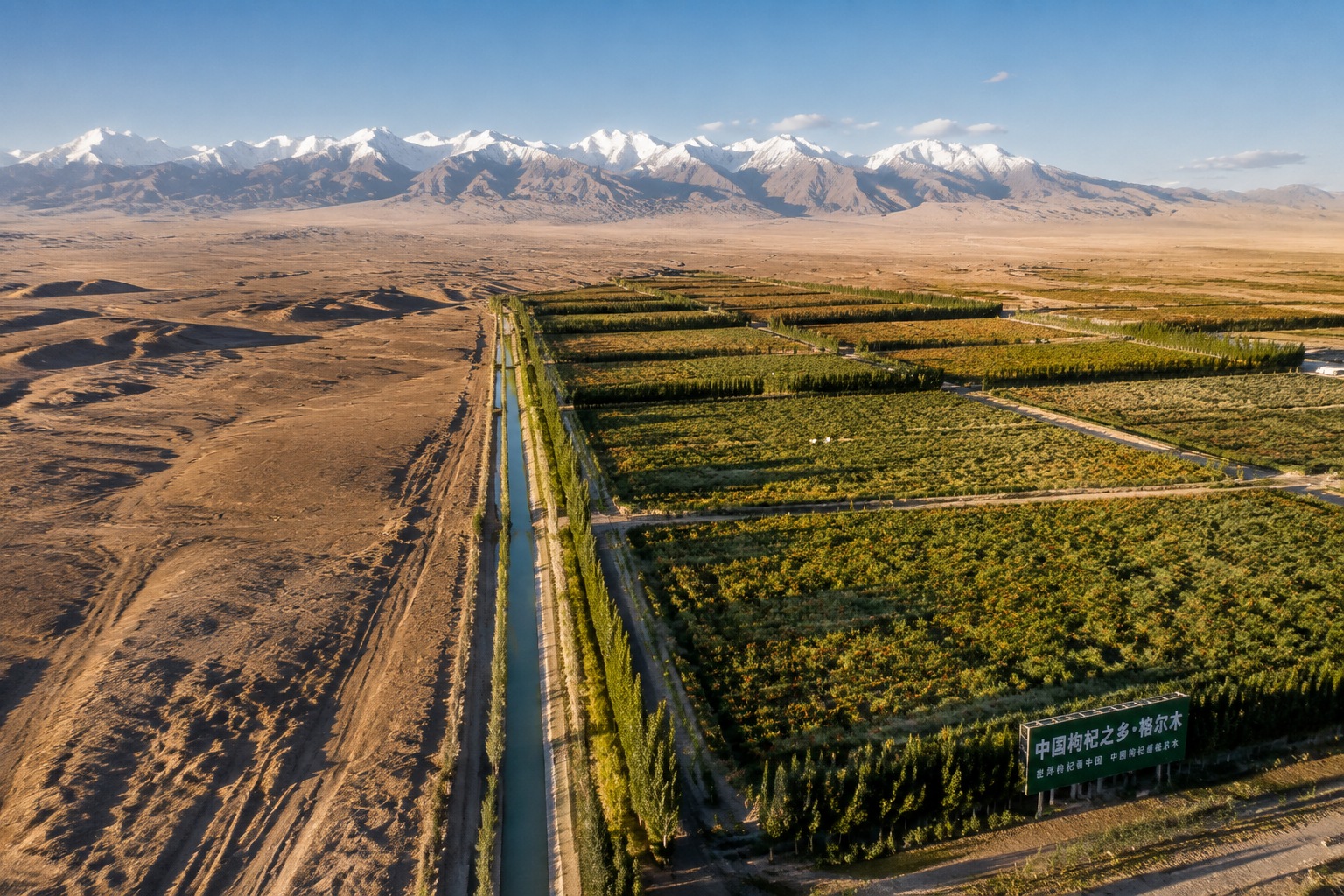
Maybe you’ve heard of the Qaidam Basin as one of the most desolate places in China — a vast, windswept expanse of salt flats and gravel. But on a late spring morning, if you drive along the G315 highway from Golmud toward Nomhon, you’ll see something that looks like a mirage: row after row of low green shrubs, so neat they seem drawn with a ruler. Beneath each shrub, a thin black drip line weeps small droplets of water onto the roots. This isn’t a scene from some futuristic farm in California or Israel. It’s the edge of a desert that now calls itself China’s ‘Qaidam Granary.’
The phrase might sound like a stretch. The basin sits in the northeastern corner of the Tibetan Plateau, with an average altitude of more than 2,800 meters. It receives less rain each year than the Sahara does. Yet today it produces hundreds of thousands of tons of goji berries, quinoa, and other high-value crops. How did a landscape so barren become a food-producing region? The answer involves geology, engineering, and a group of farmers who refused to see gravel as a dead end.
The Qaidam Basin: A Land of Light and Limitations
To understand the transformation, you need to know the raw ingredients. The Qaidam Basin is a closed basin, surrounded by the Kunlun Mountains in the south and the Altun and Qilian ranges in the north. Water that flows in has no outlet, so over millions of years, minerals and salts have concentrated in the soil. Large areas are covered by salt lakes, salt crusts, and moving dunes. If you simply poked a hole in the ground and planted a seed, almost nothing would grow.
But there’s one hidden treasure that balances the harshness: light. The basin boasts over 3,000 hours of sunshine a year, one of the highest in China. At the same time, the drop between day and night temperatures can reach 15 to 20 degrees Celsius. This combination slows plant respiration and pushes sugars and natural pigments into the fruits and seeds. That’s why goji berries from this region are considered premium quality, and why experiments with quinoa have been so successful.
Where Does the Water Come From? Tapping Snowmelt and Aquifers
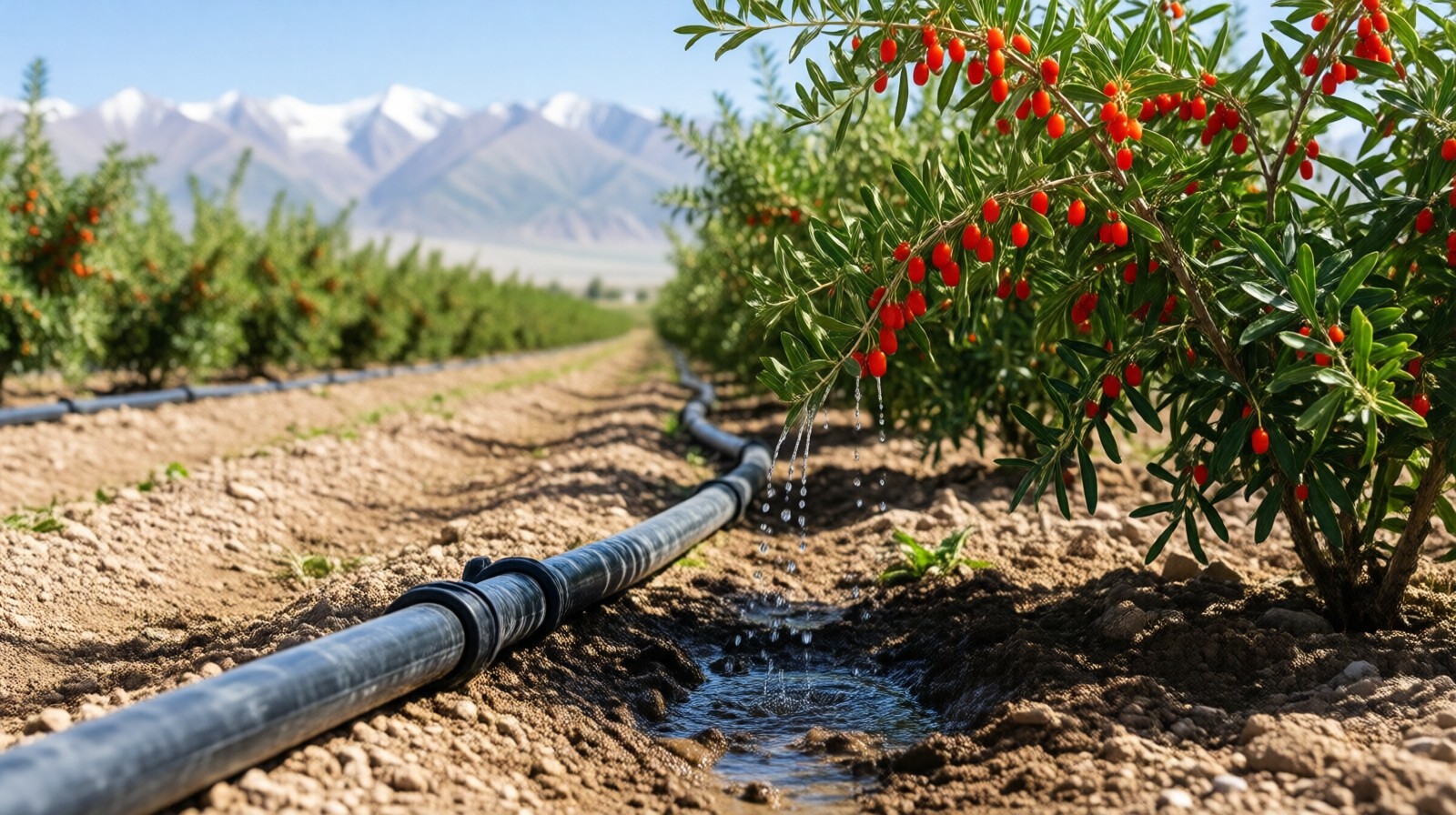
The first question everyone asks is: how can a desert grow crops without rivers? In Qaidam, there are actually several underground aquifers, fed by snowmelt from the surrounding mountains. For decades, engineers have built long concrete channels that deliver this water from the foothills to the fields. In more recent years, they’ve installed pressurized drip irrigation systems that send water directly to each plant’s root zone, saving as much as 40 percent of the water that older methods would have wasted.
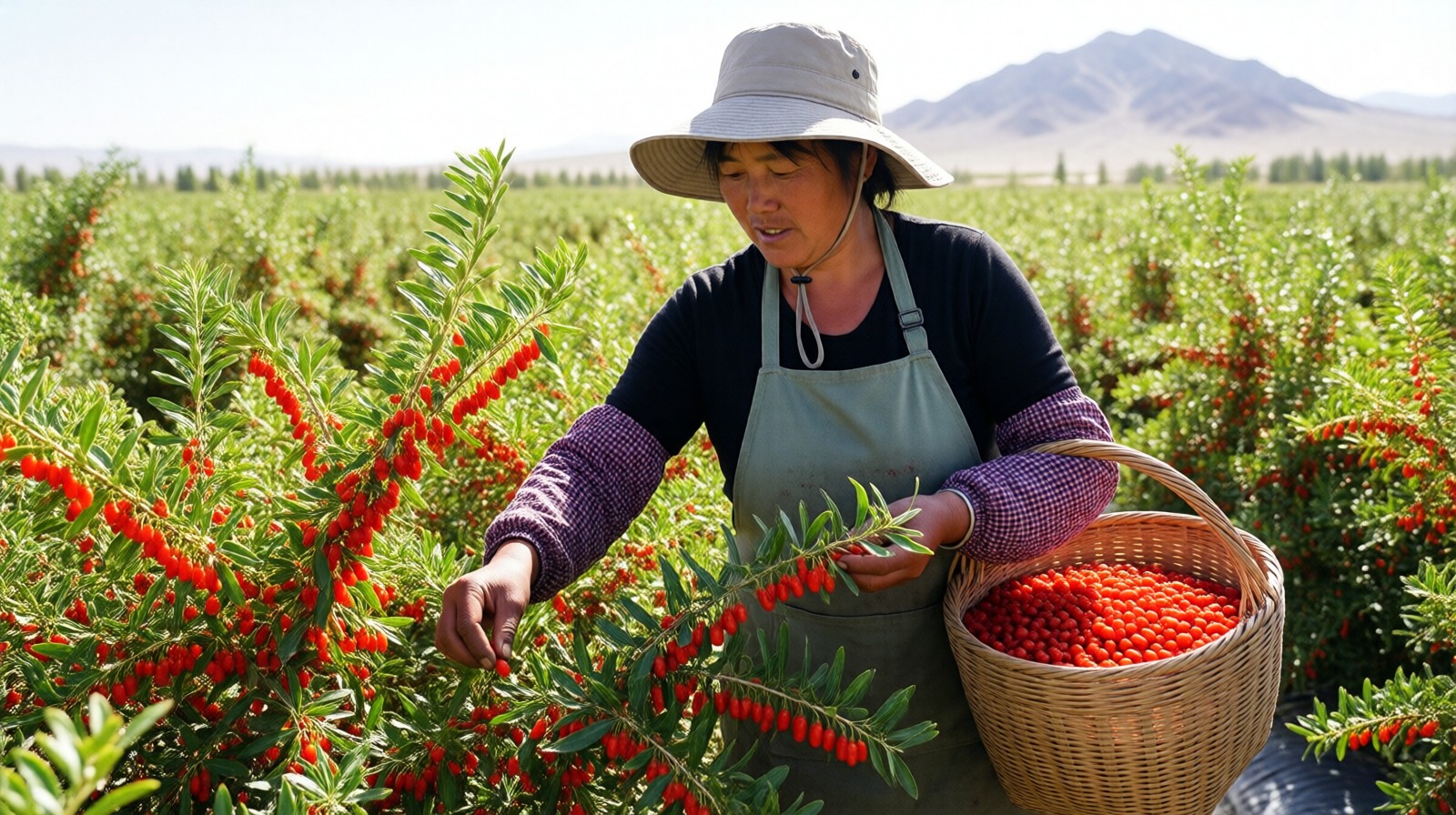
I met a farmer, 47-year-old Liu Zhiqiang, in a goji field near the village of Dalangtan. His family has lived here for three generations. ‘When my grandfather came, this was just stones,’ he told me. ‘We dug the first irrigation channel by hand.’ Now Liu manages a 60-mu (about 4 hectares) plot. He pointed to a small monitoring device half-buried in the soil. ‘This tells us the soil moisture, the salt level, even the weather up there. We water only when the plants need it.’ A strict local water authority enforces quotas; each farm’s water use is metered and monitored. ‘Nobody fights over water like they did in the old days,’ Liu laughed. ‘The system keeps everyone honest.’
From Gravel to Fields: The Long Work of Building Soil
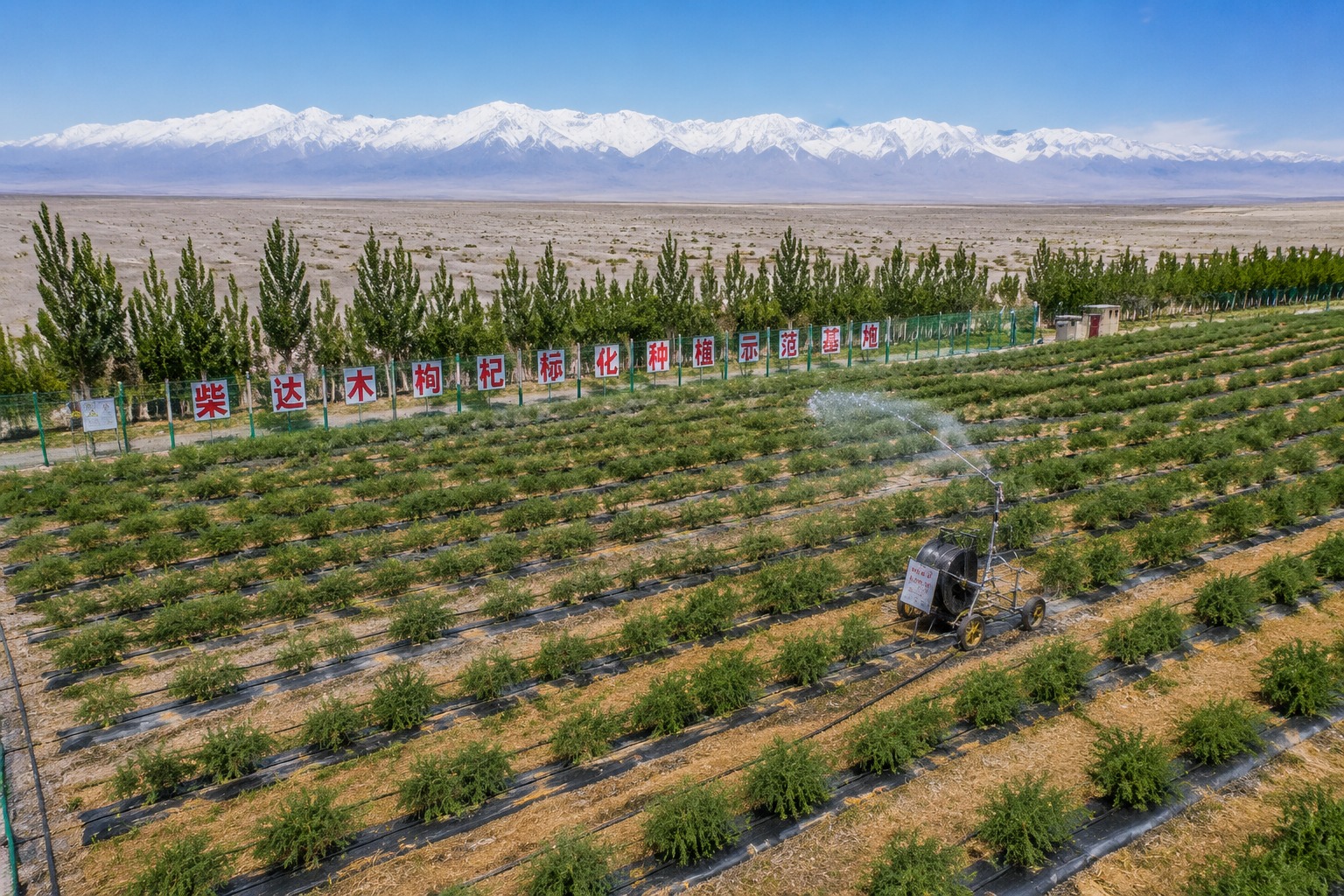
Turning gravel into arable dirt is not a one-year project. In the early days, farmers had to pick out stones, lay down sand, and mix in organic matter such as sheep manure or composted crop waste. They also planted windbreak forests of poplar and willow around each field to blunt the wind, which in spring can carry enough dust to turn the sky a grayish brown.
In the Nomhon area, the approach was more industrial. Huge tractors with laser-guided leveling scraped the ground flat. Workers then laid a mesh of plastic pipes to supply water and covered the soil in plastic film to keep moisture in and weeds down. The result looks more like a semiconductor fabrication plant than a traditional farm. And it works: goji yields have doubled over the past decade, while the sharp, chemical taste you sometimes get in cheap goji berries has been replaced by a sweet, full flavor.
Goji, a fruit long used in traditional Chinese cooking and medicine, has become a major economic engine. Local farmers say a grower can earn three to four times more from high-quality goji than from wheat or barley. That’s why the region’s goji fields have expanded rapidly. By 2023, Haixi Prefecture had more than 30,000 hectares of goji fields, producing over 150,000 tons of fresh berries, according to local officials. Most are dried and sold across China, while a growing share is exported to countries like Germany, the Netherlands, and Japan. Some goji is even sold as fresh fruit in the summer, although the delicate berries need fast logistics. One organic-certified cooperative sells small boxes of fresh goji through e-commerce, shipping them overnight to Beijing and Shanghai.
Quinoa: A New Crop From the Andes Finds a New Home
If goji is the old success story, quinoa is the new kid on the block. Native to the highlands of Peru and Bolivia, quinoa is prized for its protein and gluten-free grains. It also happens to be one of the most salt- and drought-tolerant crops in the world. When Chinese researchers began testing it in the Qaidam around 2015, they found the environment ideal: the cool nights, intense sunlight, and bare, well-drained soil mimic the Andean highlands.
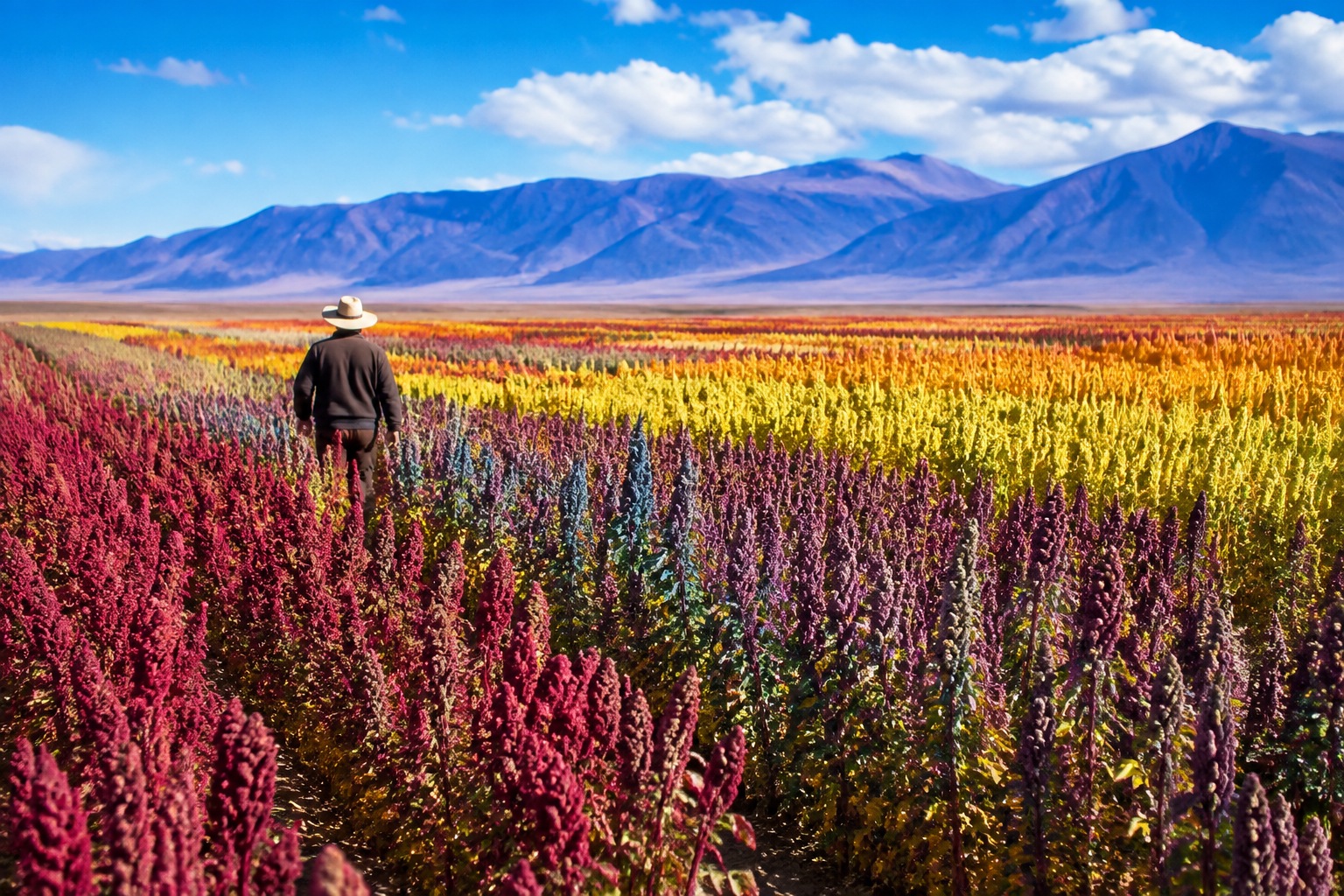
Fields of quinoa here are now a common sight in the summer. Instead of the golden beige you might expect, the crop grows in a spectacular palette of red, purple, orange, and gold. Farmers say the colors are natural genetic variations. The grain is harvested in September and processed locally into seeds for cooking, hot breakfast porridge, and even noodles.
In the village of Xiangride, a young agronomist named Wang Lu returned after finishing her degree in the provincial capital, Xining. She runs a greenhouse test site that develops quinoa varieties with an even shorter growth cycle to cope with the short summer. ‘People think this is the middle of nowhere,’ she said, laughing. ‘But we’re actually on the front line of climate-adaptive agriculture. What we learn here could help other dry regions around the world.’
A Greener Life for Desert Communities
Agriculture has brought more than just crops to the Qaidam. It has created jobs and given people a reason to stay. In some townships, farming cooperatives hire teams of workers, many of them women, to plant and harvest goji and quinoa. Ma Guilan, a 45-year-old mother of two, has worked in the goji fields for a decade. Her husband drives a truck, but her salary pays for her daughter’s university tuition. ‘I only went to middle school,’ she said, ‘but my daughter will have a degree. That’s more than I ever dreamed of.’
The new economy has also brought investment in infrastructure. A few years ago, many roads in the basin were unpaved tracks; today, paved highways connect once-isolated villages to the regional center of Golmud. Cold-chain logistics warehouses have been built so that fresh produce can reach distant markets without spoilage. And there’s even a growing agro-tourism scene. Visitors come to see the colorful quinoa fields, pick goji berries, and take photos of the strange contrast between snowcapped peaks and purple farmland.
The Hidden Costs: Salt, Plastic, and Groundwater
But there’s a darker side to this success story, and the people here know it. The Qaidam is a closed basin, so dissolved salts have nowhere to go. Over-irrigation can push groundwater upward, dragging salts to the surface and turning once-productive fields into white-crusted wastelands. Some earlier projects were abandoned for exactly that reason. Even today, farmers carefully monitor soil salinity and sometimes flush their fields with fresh water to move salts deeper down — a costly practice that requires even more water.
Plastic film, used to suppress weeds and hold moisture, is another headache. The thin sheets are practical but difficult to remove from the soil on a large scale. A 2022 report from the Chinese Academy of Sciences noted that the water table in parts of the basin is falling by about half a meter each year, raising concerns about the long-term sustainability of groundwater extraction.
Local leaders say they are grappling with these trade-offs. New policies encourage more efficient drip irrigation, water recycling, and the use of biodegradable mulch film. Some farms are experimenting with remote sensing and drones to detect salinity stress early. The goal is to keep the granary lively without turning the desert into a swamp of salt and plastic.
What the Future Holds
As you stand in the middle of a goji field, listening to the wind hiss through the leaves, it’s easy to be impressed by what humanity can do. The Qaidam’s farmers have turned a landscape that seemed to reject life into one that feeds people and helps local livelihoods. But this is not a final victory. Deserts strike back when they are exhausted. The water will always be scarce, and the soil will always be vulnerable.
The people of the Qaidam are learning to live with that tension. They are using technology to make every drop count, and they are developing crops that can weather drought and salt. They may not have ‘conquered’ the desert, but they have found a way to grow food in some of the harshest conditions on Earth. In a world that is heating up and drying out, that’s a lesson worth paying attention to.
That’s the real miracle of the ‘Qaidam Granary’ — not that the desert has been tamed, but that humans are learning how to grow food with the desert, not just against it.
Start the discussion at forum.chinacomes.com