

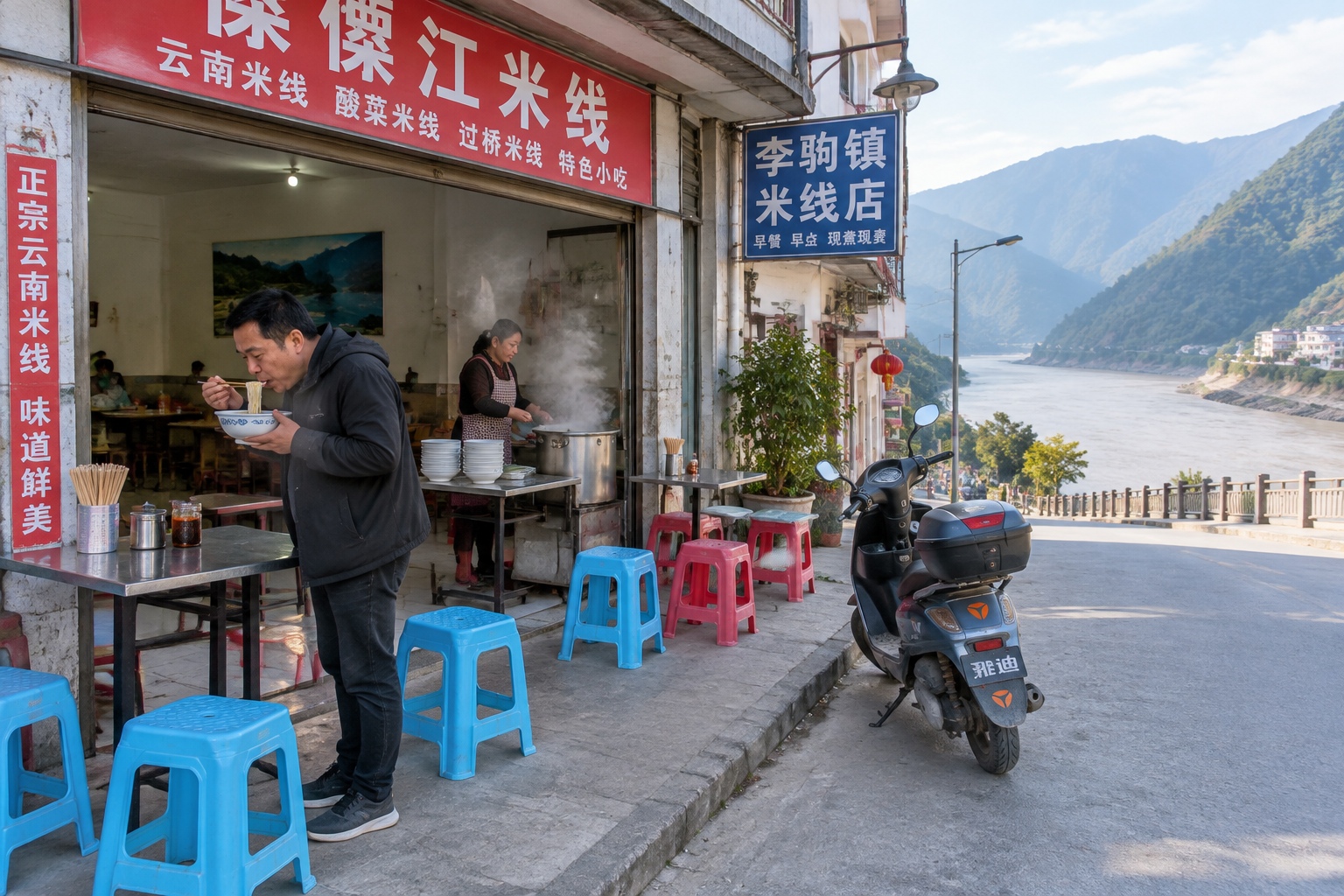
Liuku, 7 A.M.
At seven in the morning in Liuku, the Nujiang River is the loudest thing in town. It runs gray-green between concrete embankments, maybe eighty meters wide, and the sound carries up to the street where I was eating breakfast. A man in a reflective vest parked his electric scooter, ordered rice noodles, and ate standing up. Two women in Lisu headscarves walked past with baskets of greens. Nobody was in a hurry.
Liuku is the seat of Nujiang Prefecture, in the far northwest of Yunnan, a province most foreign visitors know for Dali, Lijiang, and Shangri-La. I was there to drive the long way around the top of the province, along three rivers that run almost parallel to each other for 170 kilometers, separated by mountain ridges that reach 4,000 meters and more.
Why the Three Parallel Rivers
The Nujiang (which becomes the Salween in Myanmar), the Lancang (the Mekong), and the Jinsha (the upper Yangtze) all rise on the Tibetan Plateau and push south through deep gorges. UNESCO listed the Three Parallel Rivers region as a World Heritage Site in 2003. It covers roughly 17,000 square kilometers. There is no gate, no ticket, no single viewpoint. It is a region about the size of a small country, and more than a dozen ethnic groups live in it: Lisu, Nu, Dulong, Tibetan, Naxi, Bai, Pumi, Yi, and others.
The reason to drive here is not the scenery, though the scenery is enormous. It is to see how people live in places that were, until recently, difficult to reach—and what changed when the roads arrived.
The Road: Getting to Yunnan’s Remote Corners
The route
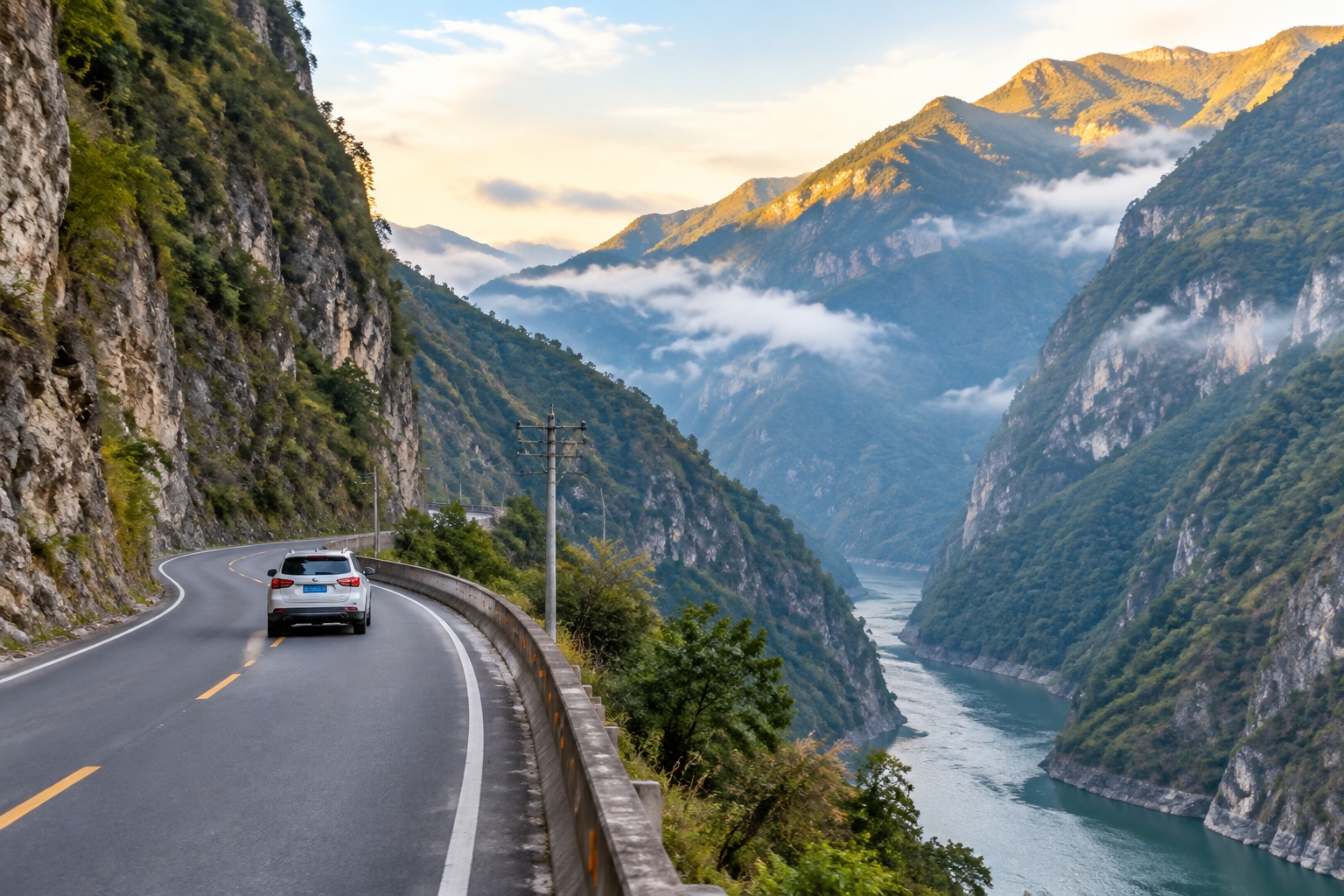
A common loop starts in Dali or Lijiang, goes north to Shangri-La and then Deqin, drops south along the Lancang through Weixi and Lanping to Liuku, and then follows the Nujiang north again through Fugong and Gongshan to Bingzhongluo. It can be done in a week if you drive hard. Ten days is better.
What the roads are like
Most of it is paved. The Nujiang section is on the G219, rebuilt as the so-called Beautiful Highway and opened in 2019: about 288 kilometers from Liuku to Bingzhongluo, with tunnels and bridges replacing the worst of the old cliff road. It is still mountain driving. Blind curves, rockfall, and landslide closures are normal, especially from June to September, the rainy season. The Deqin-to-Weixi road along the Lancang is narrower and slower than the map suggests.
Fuel up whenever you see a station. 92-octane is easy to find; 95 is not. Phone signal is strong in towns and gone in the deep parts of the gorge. Mobile payment works almost everywhere, but keep some cash.
Checkpoints and permits
This is a border area. Expect police checkpoints where you show your passport and visa. Foreign travelers may need an additional permit for certain townships, including Bingzhongluo and Dulongjiang. Rules change; ask a licensed agency or the local police before you plan around it.
The Nujiang Valley: Lisu, Nu, and Dulong
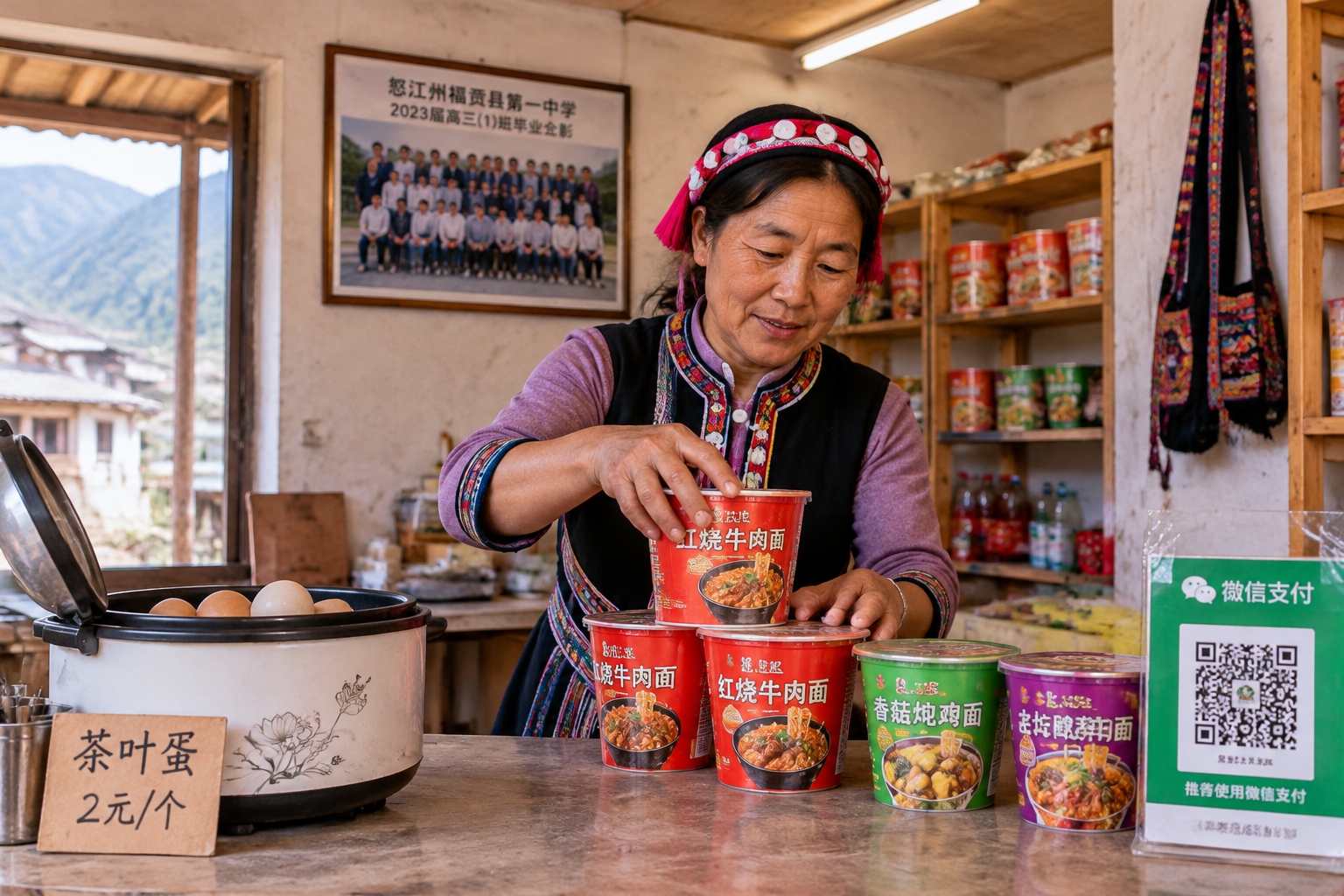
South of Fugong I stopped at a small shop for water. The owner, a Nu woman in her fifties, was boiling eggs in a rice cooker and stacking instant noodles on a shelf. Her son works in Kunming and sends money home. Her daughter was in a school photo taped to the wall, wearing a red scarf. On the counter, a QR code for WeChat Pay.
The Nu are one of the smaller groups here, around 30,000 people. The Lisu are more numerous. The Dulong, in the next valley east, number about 7,000—one of China’s smallest recognized ethnic groups. Many languages are spoken in this one river valley, and most people under forty move between two or three of them, plus Mandarin.
Crossing the river used to be a serious business. Steel cables stretched across the gorge, with a pulley and a rope. You hung on and went. Between 2011 and 2016, the province replaced dozens of these ziplines—liusuo—with proper bridges. Older people remember the crossing. Their grandchildren ride scooters across the bridge without thinking about it.
East of Gongshan, a 6.7-kilometer tunnel opened in 2014 through the mountain to Dulongjiang. Before that, the road was blocked by snow for up to half the year, and the valley was effectively cut off. Now there are guesthouses, a market, and new apartment blocks where families have moved from landslide-prone slopes. The trade-off is real: closer to clinics and schools, farther from fields.
Along the Lancang: Salt, Tea, and New Income
The Lancang River valley, running through Weixi and Lanping, was part of the old tea-horse trade route that linked Yunnan to Tibet. Salt was harvested here for centuries; the town of Lajing in Lanping grew up around its wells.
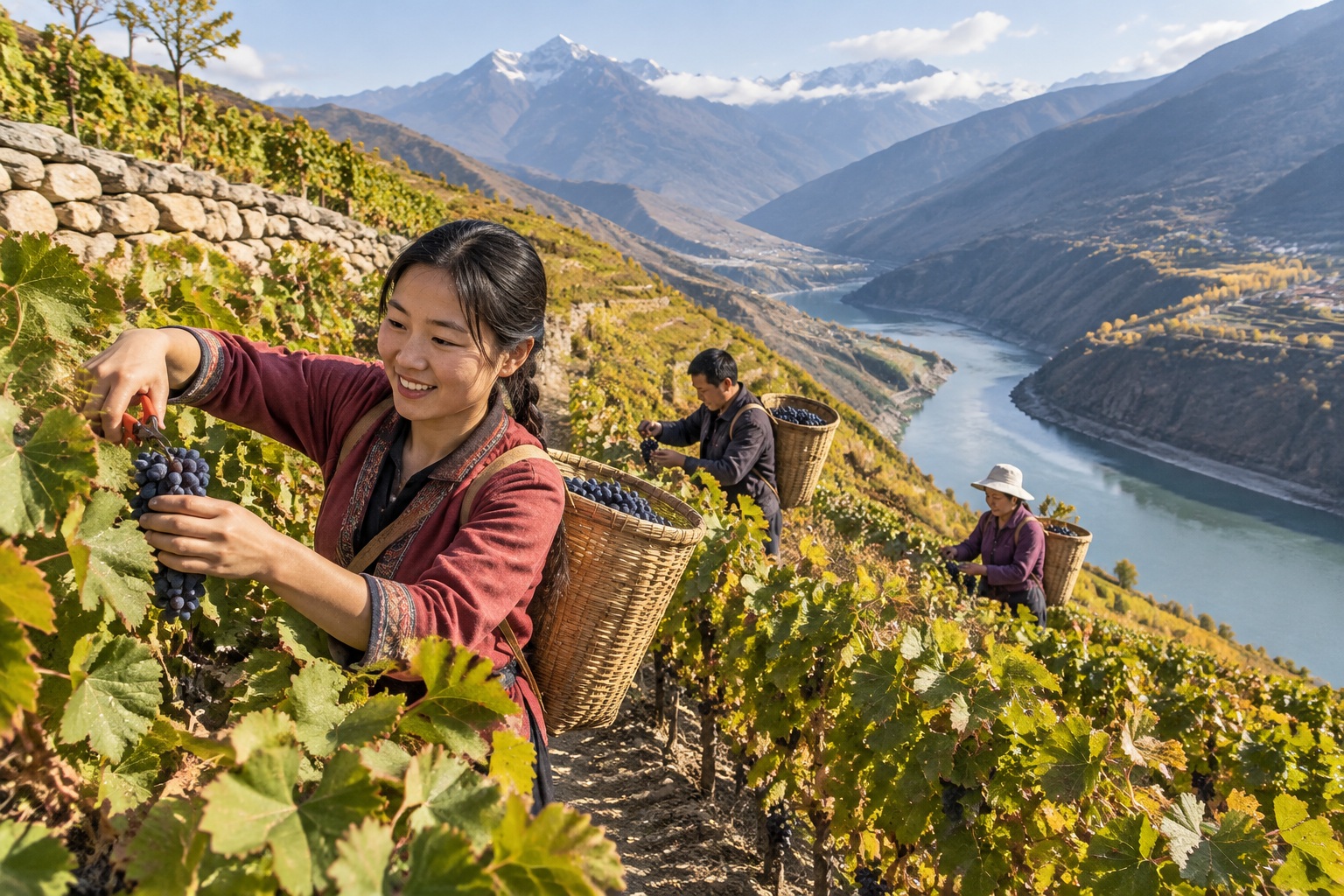
What is new is wine. Since around 2013, high-altitude vineyards have spread across slopes in Deqin County, in the Shangri-La region, producing Cabernet Sauvignon for a luxury label. Local families work the harvest and rent land. On the same hillsides, solar water heaters sit on the roofs of farmhouses, and small hydropower stations feed the grid.
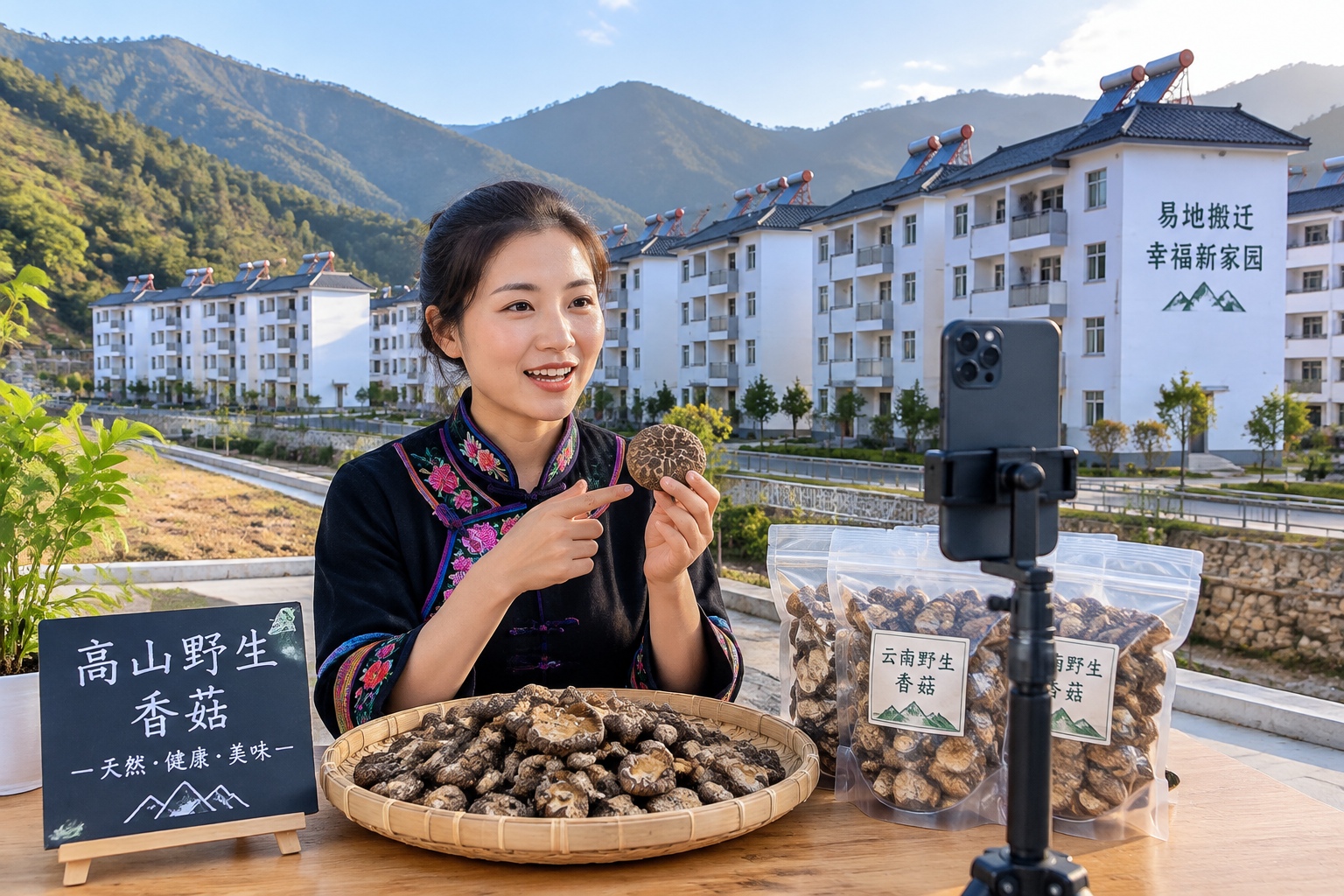
In Weixi, a Tibetan family I stayed with runs a small guesthouse. The mother cooks; the father drives a truck part-time; the daughter, who is twenty-three, sells dried mushrooms and honey through her phone. She has more orders from Shanghai and Guangdong than from Yunnan.
The Jinsha River: Beyond Shangri-La and Lijiang
The Jinsha forms the third line of the region, and it is the one most travelers skip. Away from Shangri-La’s old town and Lijiang’s crowds, the river cuts through counties where Yi, Pumi, Naxi, and Tibetan villages sit on both banks.
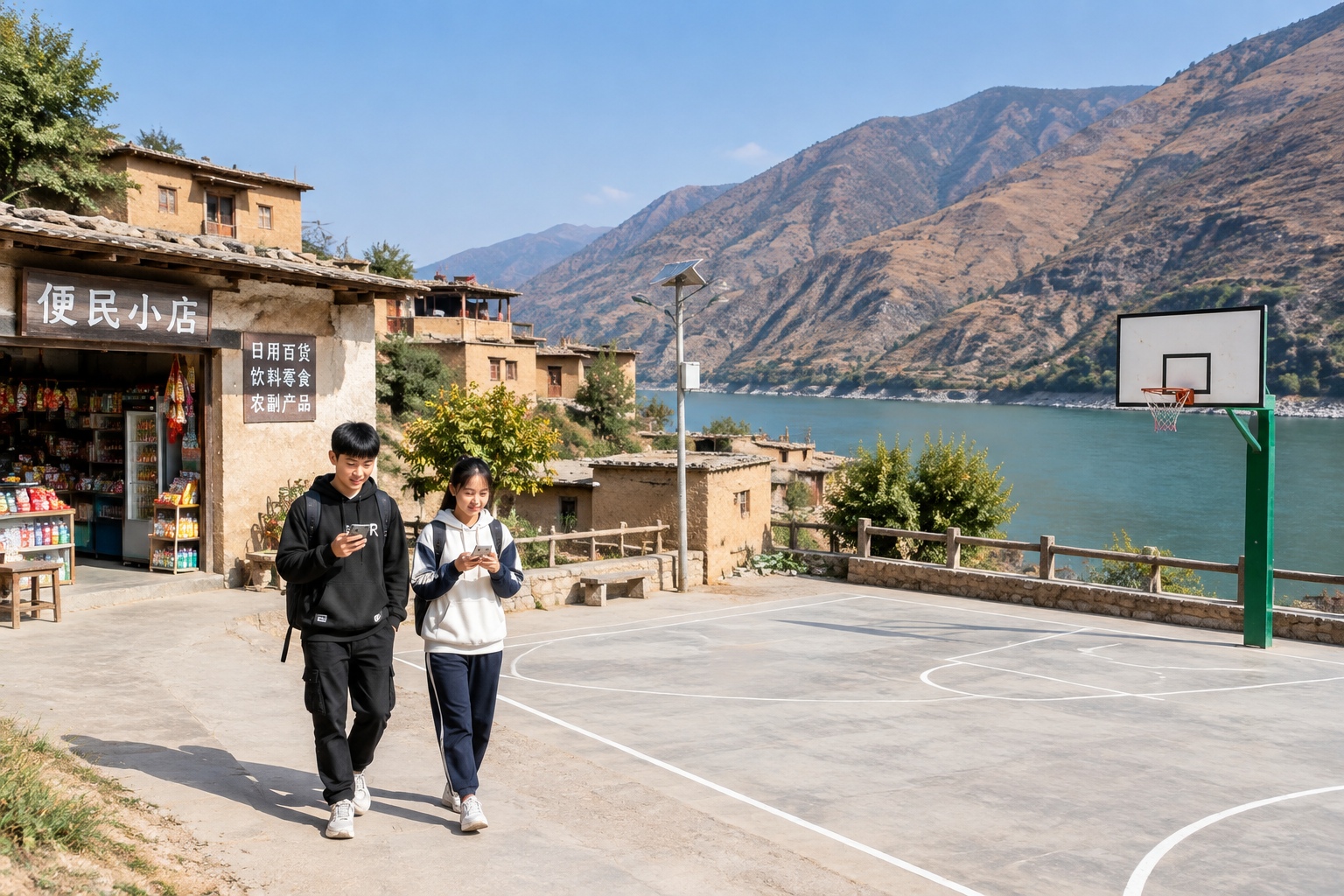
The pattern here is familiar across rural China. Young people leave for factory jobs in Guangdong or construction in Kunming. Some come back. A former migrant worker in his early thirties opened a six-room guesthouse; his wife livestreams matsutake mushrooms in autumn. Others stay away, and the villages grow quiet, with grandparents raising children.
Public services have changed the arithmetic. Boarding schools concentrate teachers in places where villages are too small for their own schools; children go home on weekends, sometimes a two-hour drive. Township clinics handle basic care and refer serious cases to Shangri-La or Kunming. In one village, the new basketball court and the small square in front of the shop are where people meet after dinner.
Meeting People, Not Performances
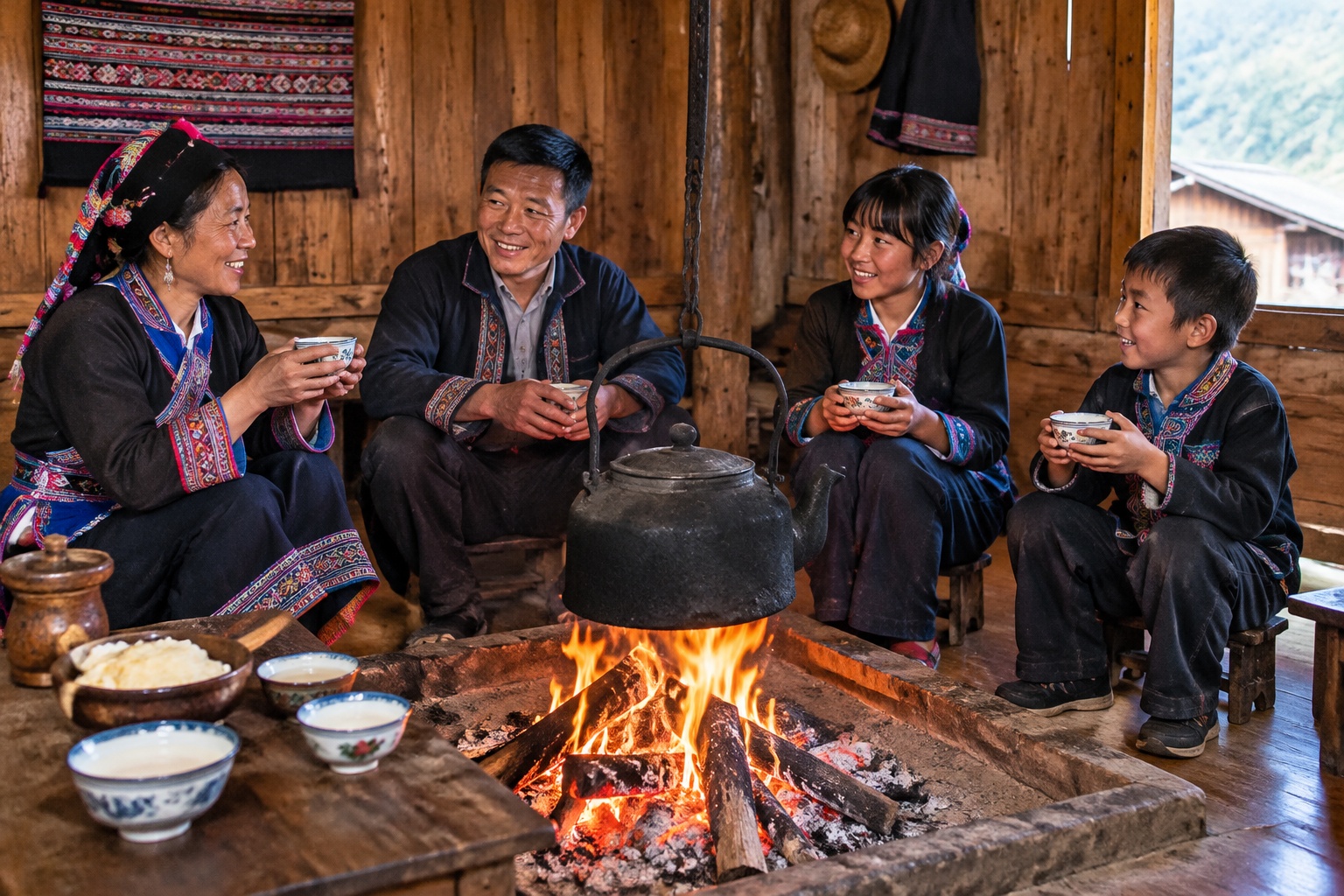
There are tourist performances in Yunnan, and this is not that. The encounters that stay with you are smaller: a fire pit in the middle of a wooden house; butter tea poured from a thermos; corn liquor passed around at a meal; a market that rotates between villages on a five-day cycle, so that on any given morning one town is full and the next is empty.
Religion is layered. In Bingzhongluo, a Catholic church, a Tibetan Buddhist temple, and small Protestant meeting halls sit within a few kilometers of one another. On a Sunday morning I heard hymns sung in Tibetan, with a guitar. A few streets away, an old woman was turning a prayer wheel.
Etiquette matters more than most guidebooks admit. Ask before photographing people, especially elders. Do not treat facial tattoos or festival dress as props. Take your shoes off when you enter a home if others do. If you are invited to eat, accept at least a little.
What Roads and Networks Change
The gains are easy to list. A pregnant woman in a remote valley can reach a hospital in a few hours instead of a day. A farmer can sell mushrooms to a buyer in Shanghai without a middleman. A student can take online classes when the local school lacks a subject teacher. Electricity, 4G, and paved roads have arrived in most of the region within one generation.
The pressures are just as real. Tourism money can turn a festival into a show for outsiders. Young people still leave, and villages age. Dams and roadbuilding alter rivers and slopes. There is no clean answer. People here want hospitals, Wi-Fi, and cash income—and also want their language, their land, and their own way of doing things. Pretending those goals never conflict would be dishonest.
Practical Notes for Self-Drive Travelers
Best season: October to May, the dry season. June to September brings rain, landslides, and road closures.
Vehicle: An ordinary car handles the main paved roads. An SUV is better for side valleys. Bring a spare tire and check it.
Fuel: Fill up in towns. 92-octane is widely available; 95 is not.
Money: WeChat Pay and Alipay work nearly everywhere. Carry 300–500 yuan in cash anyway.
Permits: Foreign travelers should confirm border-area permit rules for Bingzhongluo, Dulongjiang, and other townships before departure.
Altitude: Deqin sits around 3,400 meters. The old Baima Snow Mountain pass is above 4,200 meters, though tunnels now bypass most of it. Give yourself a day to adjust.
Etiquette and environment: Ask before photos. Pack out your trash. Do not buy wildlife products. Dress modestly at religious sites.
Not an Exotic Spectacle
The road ends; the river keeps going. What I remember most is not the scale of the gorges, though they are enormous. It is the ordinariness: a shopkeeper checking her phone between customers, a boy doing homework under a fluorescent tube, a truck driver waiting for a landslide to be cleared, drinking tea from a thermos.
The Three Parallel Rivers is not a place frozen in time, waiting to be discovered. It is home. The people who live there are making practical choices about schools, work, and the future, the same way people do anywhere. Driving through it slowly, and paying attention, is the least and best thing a visitor can do.
Start the discussion at forum.chinacomes.com