
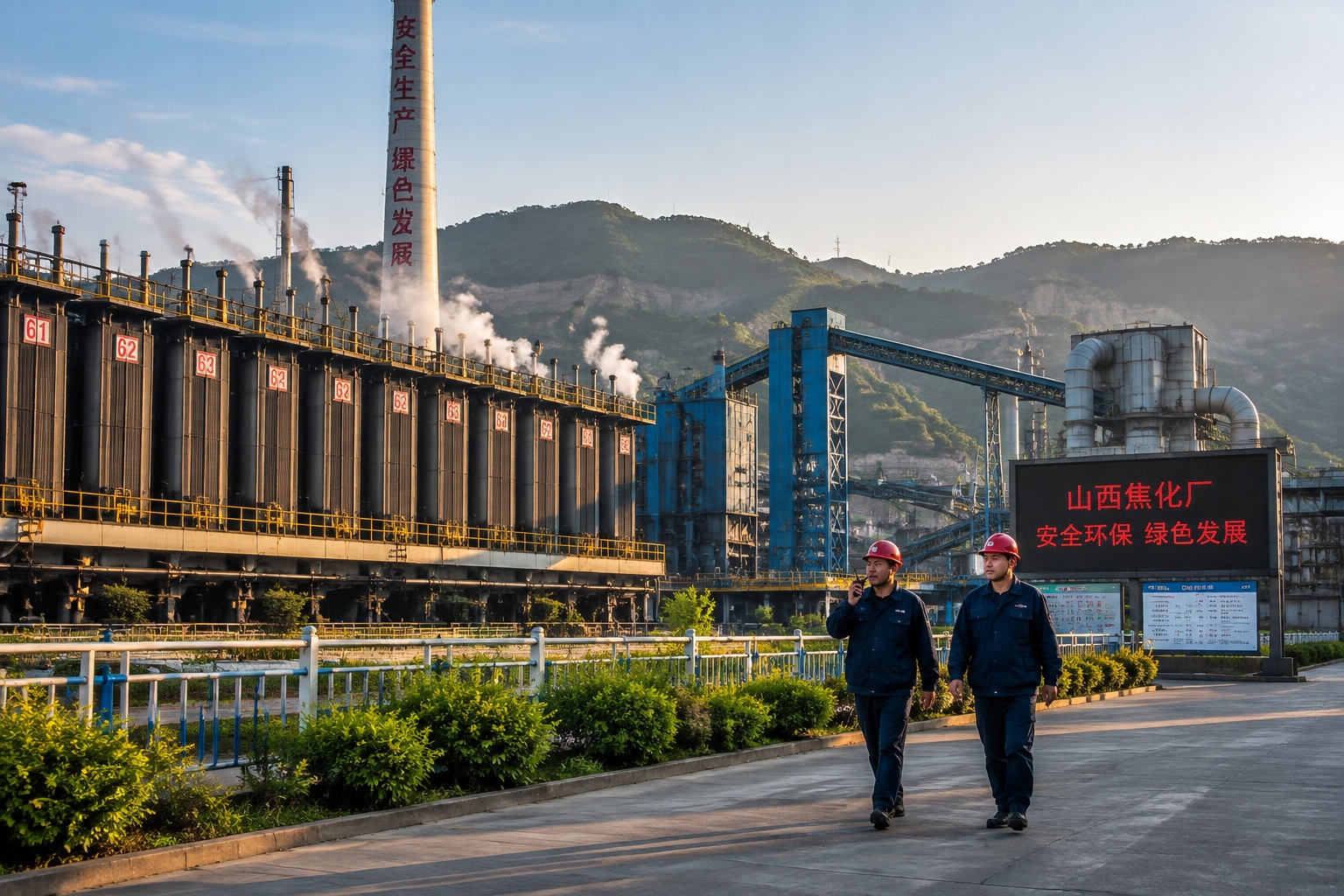

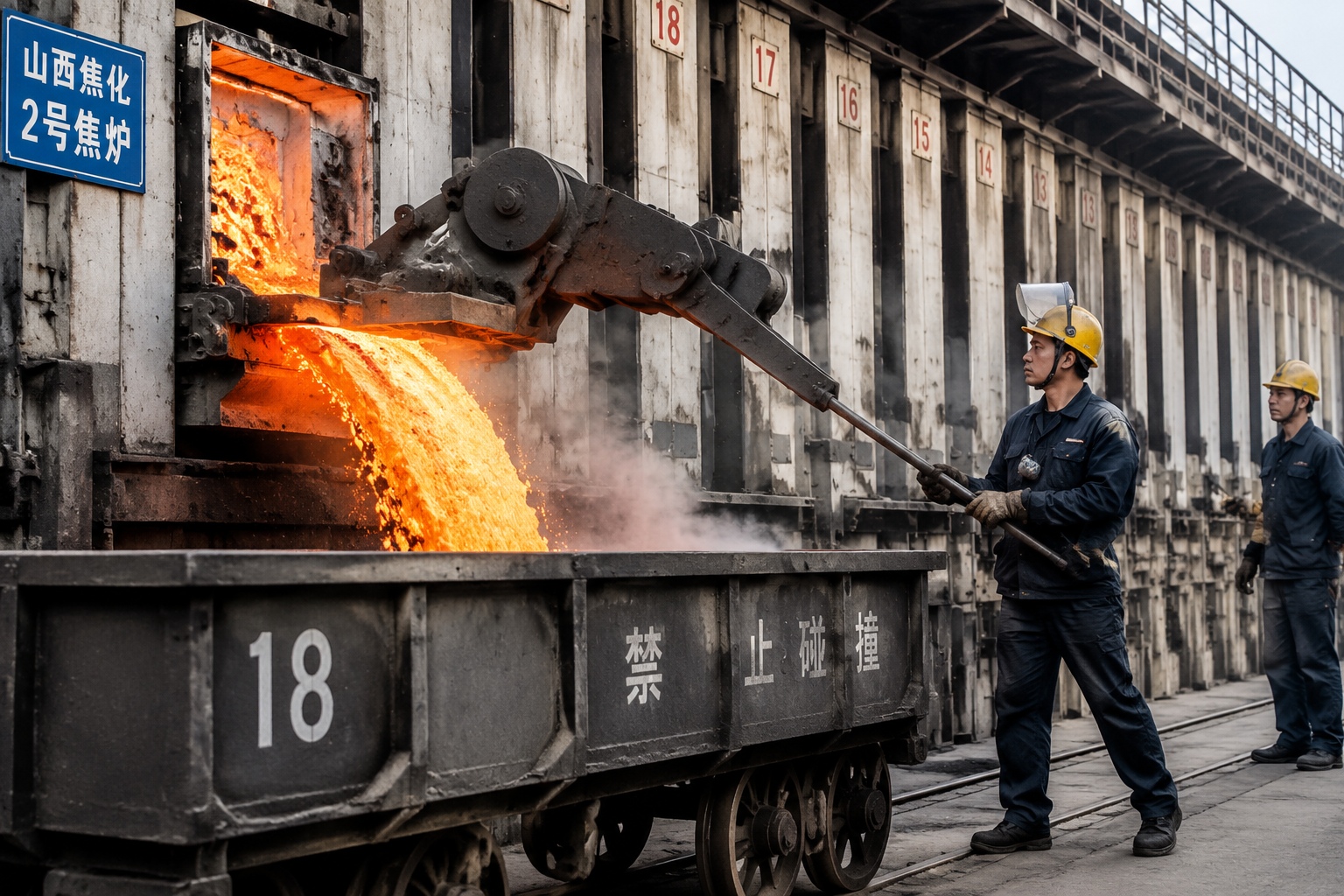
At dawn on the Loess Plateau, the air above Shanxi’s coking towns smells of sulfur and coal dust. In a modern coking plant outside Taiyuan, the provincial capital, workers in heat-resistant suits stand on a platform twenty meters from a row of coke ovens. With a deep rumble, one oven door swings open, and a glowing orange slab of coke slides out into the guide car. The heat is so intense that it blurs the air around it. Within minutes, the red-hot coke is pushed into a quenching tower, doused with water, and turns into the gray, porous lumps that the world’s steel industry cannot function without.
Shanxi, a landlocked province in northern China roughly the size of Nevada, produces about one-fifth of China’s coke and about one-seventh of the world’s supply. This makes it one of the most important sources of the fuel and reducing agent that every blast furnace needs to turn iron ore into steel. For most foreigners, Shanxi is just an abstract space on a map, but its coke has quietly shaped global steel prices, infrastructure projects, and the fortunes of steelmakers from South Korea to India.
What Is Coke and Why Does Steel Need It?
Let’s start with some basic chemistry. Coke is made from coking coal, a specific grade of coal that, when heated without oxygen, melts and fuses into a hard, porous carbon block. That block has two essential jobs in a blast furnace. First, it burns at extremely high temperatures to provide the heat needed to melt iron ore. Second, and more importantly, it releases carbon monoxide, which strips oxygen from the iron ore and leaves behind molten iron. There is no practical substitute for coke in modern blast furnaces. Some steelmakers inject pulverized coal or natural gas to replace part of the coke, but the bed of coke still has to physically support the iron ore and allow gas to flow through the burden. That’s why roughly 70 percent of global steel is still made using the blast furnace-basic oxygen furnace route, which requires coke.
To make coke, coking coal is first crushed and blended to create a consistent recipe. The blend is loaded into a coke oven — a narrow, firebrick-lined chamber about as long as a shipping container. The oven is sealed and heated to over 1,000 degrees Celsius for roughly 18 to 24 hours. During this process, the coal softens, melts, and re-solidifies into coke, while volatile compounds escape as gas. The gas, called coke oven gas, is rich in hydrogen, methane, and carbon monoxide, and is itself a valuable fuel. After the oven is opened, the hot coke is pushed out and quenched, or cooled rapidly, to prevent it from burning.
In short: no coke, no steel.
The Hard Numbers: Shanxi’s Outsize Role
China is the world’s largest steel producer, making more than one billion tons of steel a year — over half of global output. To feed those blast furnaces, China also produces more than 500 million tons of coke annually, and Shanxi alone accounts for about 100 million tons, roughly one-fifth of the national total. This single Chinese province produces more coke than the entire European Union, Russia, and India combined.
Why Shanxi? The province sits on some of China’s richest deposits of coking coal. Commercial coal mining began there in the late 19th century, and in the first decades of China’s reform era, Shanxi’s coal and coke became the crude backbone of the country’s industrialization. The province’s location also helps: it sits close to the steel-heavy region of Hebei and the Bohai Bay ports, making it easy to ship coke east by rail or truck.
Shanxi’s role as a coke center dates back to the 1970s, when China’s state planners decided that the province’s abundant coal resources should be processed locally rather than shipped as raw coal. By the 1990s, hundreds of simple coke ovens had been built, many with no emission controls. It was not uncommon to see rivers running gray from coal wash water. That legacy is now being slowly cleaned up.
Shanxi’s share matters because the global seaborne market for coke is surprisingly thin. Only about five percent of worldwide coke production is traded across borders, and China is the largest exporter. When Shanxi’s coke production dips or its prices rise, the effect ripples through the international steel market quickly.
How Shanxi’s Coke Reaches the World
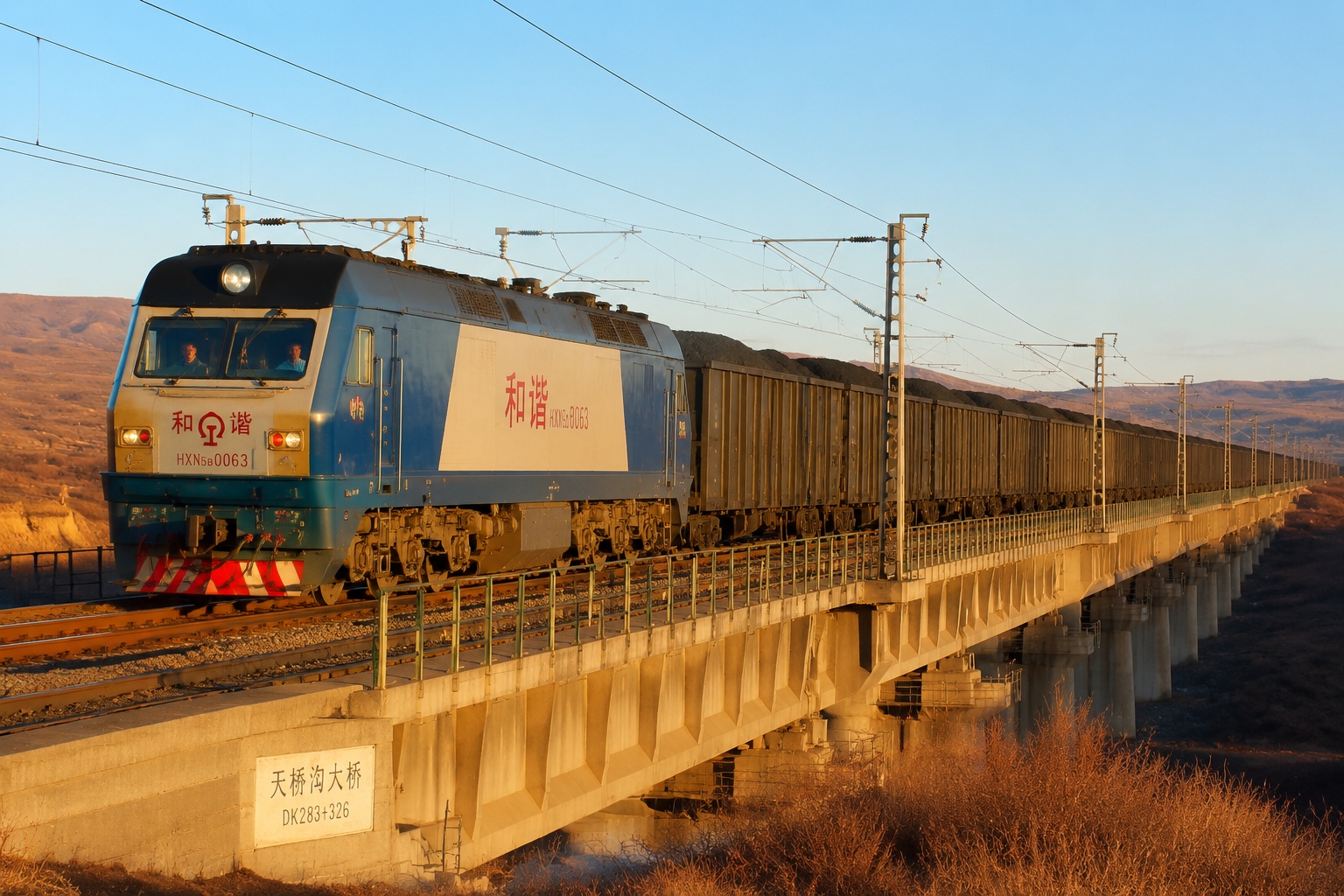
The journey from a Shanxi coke plant to a foreign steel mill usually starts with trucks climbing over mountain passes to one of the many rail loading stations along the Datong–Qinhuangdao railway, one of the heaviest freight lines on the planet. Trains of two hundred cars or more carry coke and coal eastward across 400 kilometers of northern China. At the ports of Qinhuangdao, Tianjin, or Tangshan, the coke is transferred into bulk carriers, then crosses the sea to buyers in Japan, South Korea, India, Malaysia, Indonesia, and increasingly the Middle East. India, which is rapidly expanding its steelmaking capacity but lacks high-quality coking coal and domestic coke production, has become a major buyer of Chinese coke. In recent years, China’s total coke exports reached roughly 8 million tons annually, with the bulk coming from Shanxi.
Shipping coke by sea from China to India or Japan is relatively cheap, but the cost still matters. For a typical 50,000-ton cargo, freight costs can add $20 to $30 per ton, which is significant in a market where coke futures often trade around $300 per ton. That is why Shanxi’s coke is not as competitive in Europe as it is in Asia — the distance simply adds too much to the final bill.
But the international connection isn’t only about finished coke. Shanxi also sends huge volumes of coking coal abroad, which overseas steelmakers use to make their own coke. So even if a country doesn’t import a single lump of Chinese coke, it may still depend on Shanxi’s raw material for its blast furnaces.
The Greening of a Polluting Industry
It would be dishonest to present Shanxi’s coke industry without talking about its dirty past. Traditional coking plants in the province were major sources of air and water pollution. In the 2000s, dozens of small, inefficient ovens operated near villages, releasing clouds of smoke, benzopyrene, and other toxins. Some areas became notorious for respiratory disease and contaminated groundwater. For people living in those valleys, “prosperity” and “pollution” were two sides of the same coin.
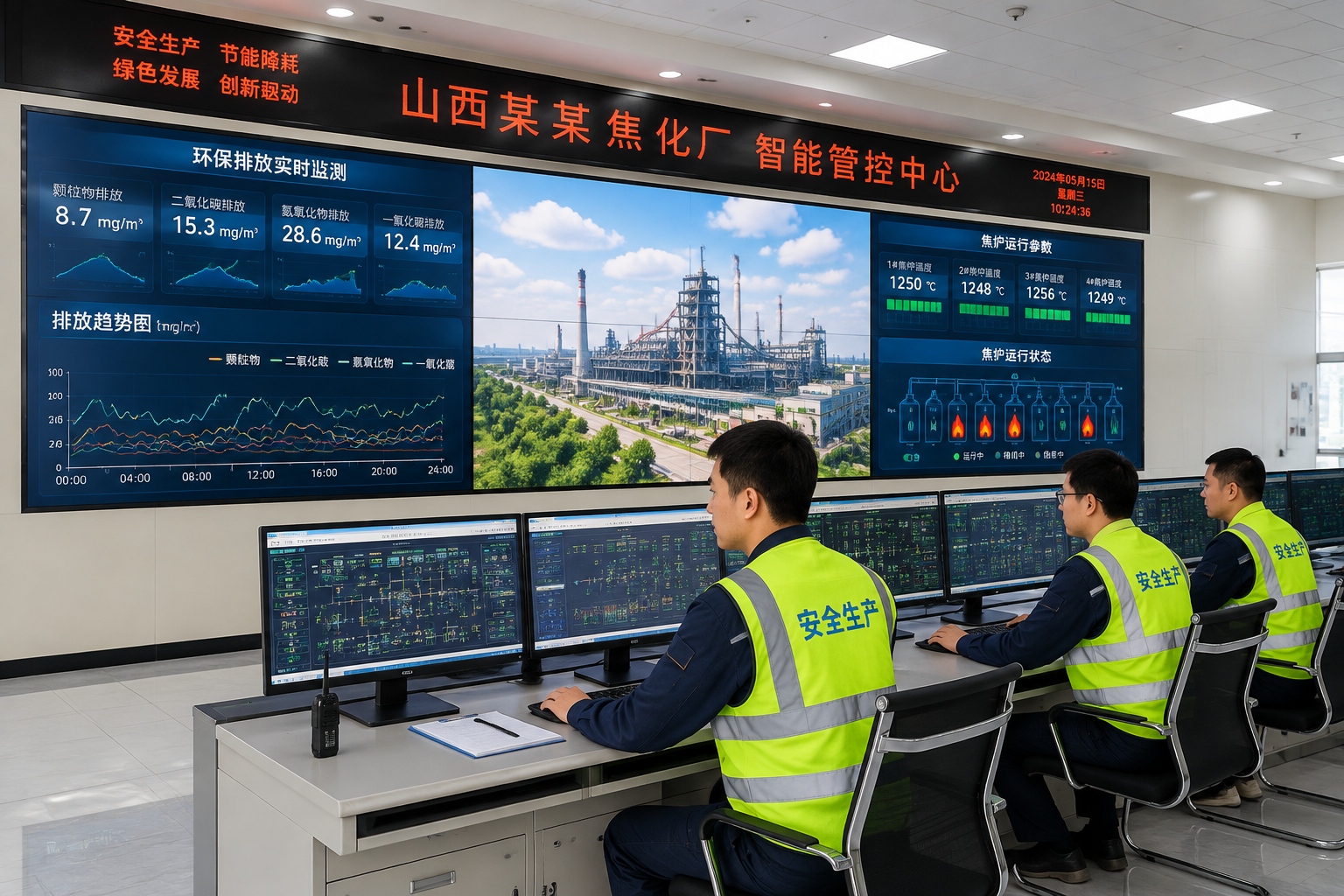
That started to change, slowly and with difficulty. Since 2018, China’s central government has pushed coking plants to meet “ultra-low emission” standards for sulfur dioxide, nitrogen oxides, and dust. Shanxi has shut down hundreds of old vertical ovens with 4.3-meter chambers and replaced them with modern horizontal ovens in the 5.5-to-6.25-meter class. These larger ovens burn more efficiently, and are fitted with sealed charging cars, bag filters, desulfurization scrubbers, and continuous dust monitoring. In 2020, the provincial government also forced many plants to relocate from urban areas to industrial parks, where waste heat can be recovered for power generation and water can be reused.
A walk through a qualified modern coking plant in Shanxi today is not clean, but it is dramatically different from the old image. The conveyor belts run under sealed sheds. The pushing operation is automated. Data from continuous emission monitors is streamed in real time to environmental authorities. The retrofit costs are staggering — a single large plant can spend up to 3 billion yuan, or more than $400 million, on pollution control. Some small producers simply closed. But the long-term logic is that Shanxi’s coke will only remain relevant on the global market if it can be made with a manageable environmental footprint.
One sign of change: in Linfen, a city in southern Shanxi that once often topped China’s “most polluted cities” list, the local government has closed dozens of outdated plants and moved the remaining coking industry into a modern industrial park. The skyline is visible again on many days, though the air is still far from pristine. The cleanup is a work in progress.
What Lies Ahead for Shanxi’s Coke?
The industry now faces an even bigger challenge: global steel demand may have peaked. China’s own steel output has plateaued since 2020, and the country has pledged to reach peak carbon emissions by 2030 and carbon neutrality by 2060. Since blast furnace steelmaking using coke is heavily carbon-intensive, any serious climate policy will put downward pressure on coking coal demand. Chinese steel production is expected to decline slowly as property construction weakens and the stock of buildings matures.
Shanxi has begun to prepare for this. The provincial government has set a cap on total coke production at around 130 million tons per year, with a plan to lower that ceiling as obsolete capacity is closed. Some coking plants are diversifying into the chemical industry. Coke oven gas, a byproduct of the coking process, is rich in hydrogen. In a handful of Shanxi projects, it is already being converted into liquefied natural gas, methanol, or compressed hydrogen for fuel-cell trucks and buses. Some large steel companies in China are experimenting with hydrogen-based ironmaking, which would eliminate the need for coke altogether. But such processes remain in pilot stages and require enormous amounts of green hydrogen that the country cannot yet produce cheaply. For at least another generation, blast furnaces will dominate.
No one expects Shanxi’s coke industry to disappear soon. Even in a low-carbon scenario, the world will still need a large stock of blast furnaces for another two or three decades. But the province’s leadership knows that it is not riding a boom anymore — it is managing the gradual transition of a century-old industry. The goal is to keep the coke business profitable long enough for the steel transition to develop, and to leave behind a cleaner landscape and a more skilled workforce.
Why It Matters to Anyone Who Uses Steel
Every car, building, bridge, ship, and washing machine is made from steel, and steel begins with iron ore and coke. A change in Shanxi’s coke output can shift steel prices in Dubai, São Paulo, or Lagos. Today, Shanxi is not just a remote Chinese province; it is a node in a global chain that touches almost every physical object around you.
The next time you walk over a steel bridge or ride in a subway train, consider that the steel above you was probably produced with coke pushed out of a red-hot oven at dawn in a northern Chinese province you hadn’t thought about until now.
Start the discussion at forum.chinacomes.com