

It Starts with the Rain
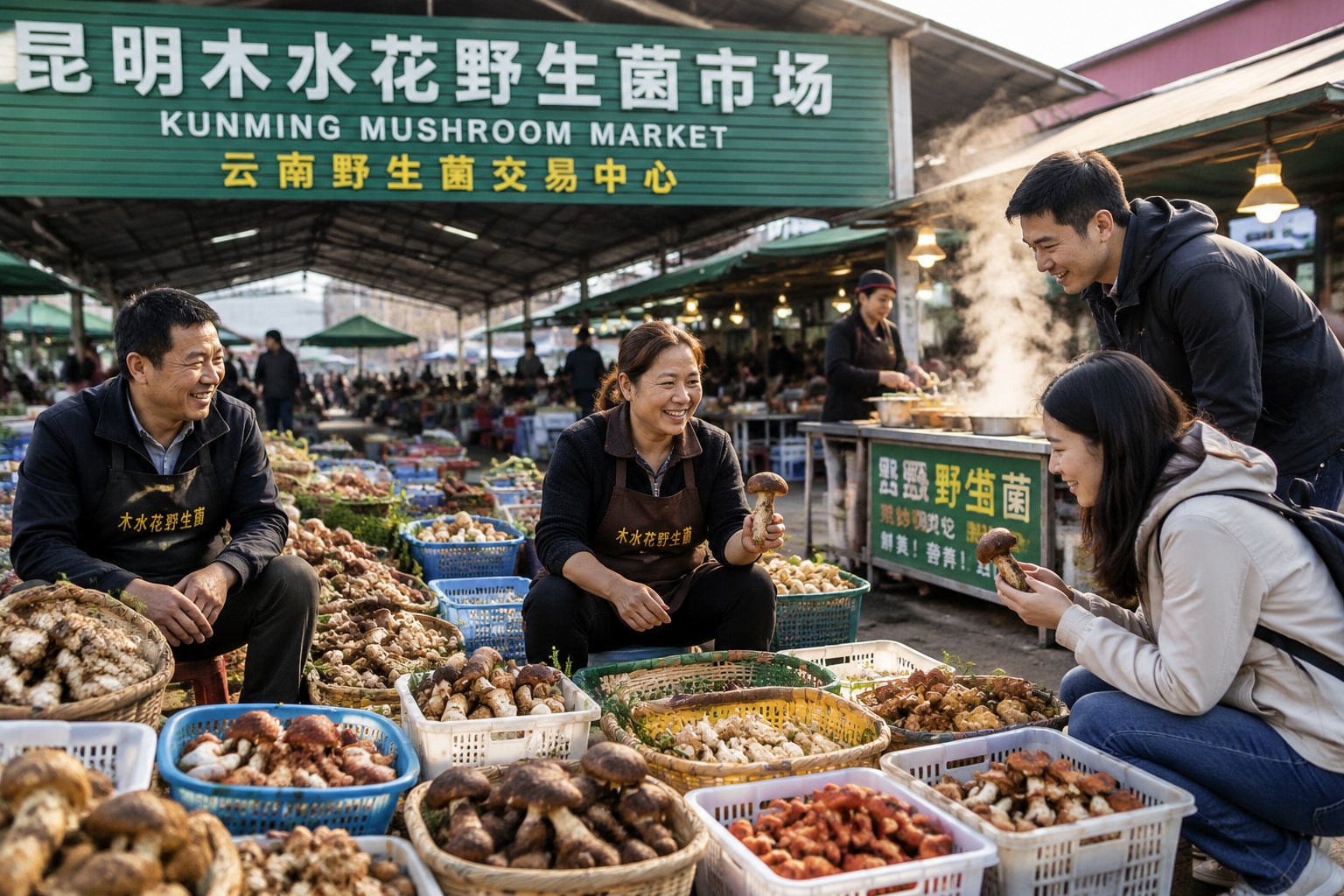
In late June, the monsoon breaks over the mountains of Yunnan. Within days, the red soil of the province’s forests begins to push out something that triggers a collective frenzy: wild mushrooms—or, as locals call them, junzi.
For the next three months, Yunnan’s capital Kunming smells like damp earth and frying garlic. Side streets turn into spontaneous markets. Farmers arrive at 3 a.m. with baskets full of prize fungi. And every family WhatsApp group is flooded with photos of the day’s haul, followed by warnings: “Don’t eat the little red ones.”
Why Would Anyone Risk It?
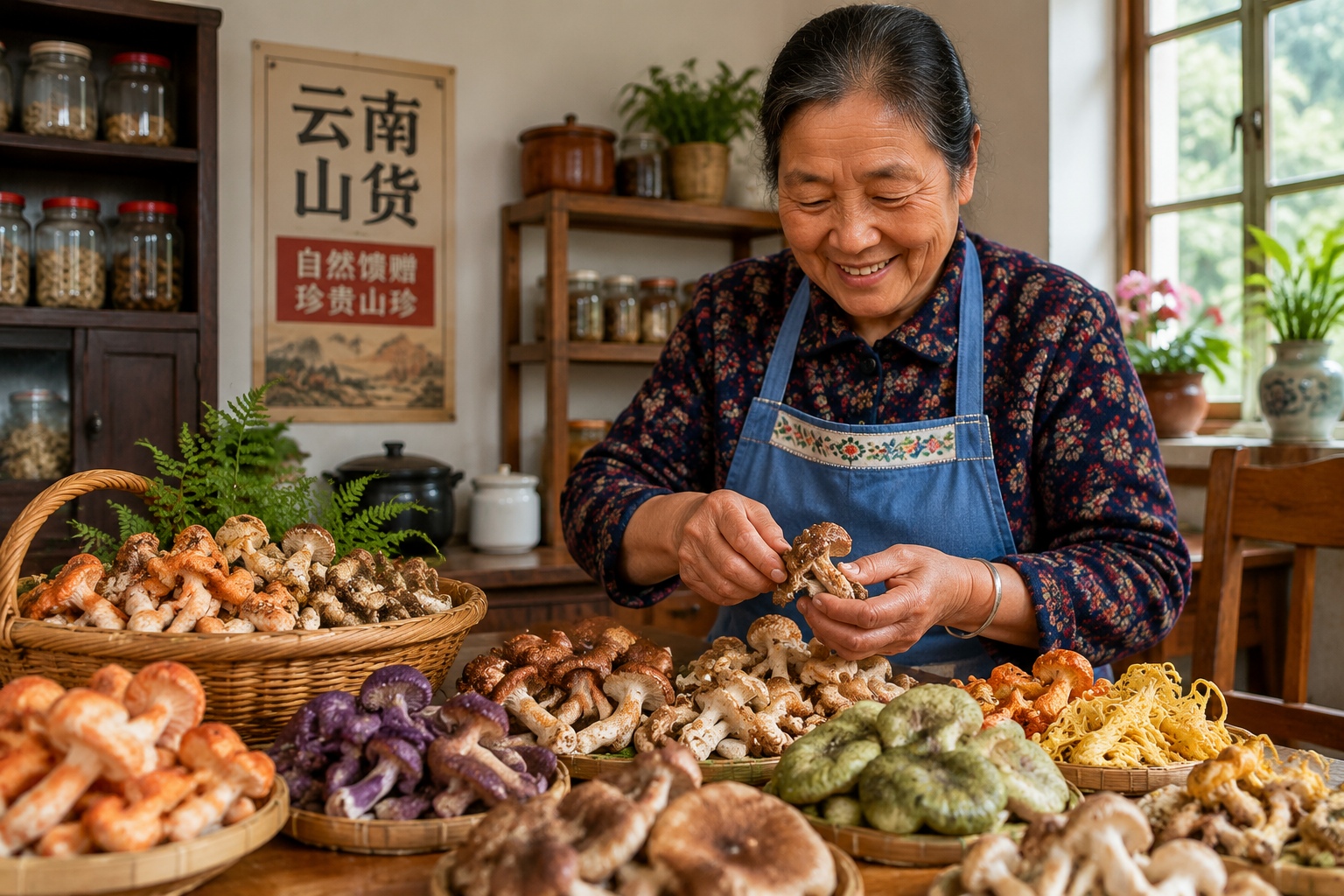
To understand the appeal, you need to meet Li Wei, a 34-year-old graphic designer in Kunming. Every summer, he drives two hours into the countryside to buy porcini-like jian shou qing (牛肝菌) from a farmer he trusts. “My grandmother taught me to pick them when I was six,” he says. “The taste is like… the forest, the rain, and my childhood, all in one soup.”
Li Wei’s story is common. For many Yunnanese, wild mushrooms are not just a seasonal ingredient—they are a cultural anchor. The province’s diverse ethnic groups have foraged and cooked these fungi for centuries. The Dai people grill them with chili. The Yi boil them in herbal broths. In Kunming’s upscale restaurants, a single plate of song rong (松茸, matsutake) can cost $50, yet it always sells out.
The flavor is unlike anything farmed. A bite of wild jian shou qing starts nutty, then earthy, then finishes with a hint of pine. Locals describe it as xian (鲜)—a savory umami that hits deep in the throat. No supermarket button mushroom can replicate that.
The Risk Is Real, But So Is the Know-How
Every year, China’s CDC reports around 800 mushroom poisoning incidents, mostly in Yunnan. The headlines are scary: “Family of Four Hospitalized After Wild Mushroom Dinner.” But here’s the nuance: almost all severe cases involve amateurs who pick mushrooms they shouldn’t, or tourists who eat at unlicensed roadside stalls.
Experienced foragers follow ironclad rules. Never eat a mushroom you can’t identify with 100% certainty. Always cook mushrooms thoroughly—never raw. Never mix different species in one dish. And never, ever drink alcohol with wild mushrooms, because alcohol can accelerate toxins.
Li Wei’s family has a ritual: when they return from foraging, they lay out all the mushrooms on the kitchen table and go through each one, discarding any that look suspicious. Then they boil them for at least 20 minutes before stir-frying. “The poison is in the small ones with white gills,” Li Wei explains. “We know which ones to avoid.”
Still, accidents happen. The most common hallucinogenic reaction—seeing tiny dancing figures, or “little people” (jian xiao ren, 见小人)—has become a dark meme on Chinese social media. Videos of people laughing at invisible friends or trying to catch imaginary creatures go viral every summer. Yunnanese joke about it: “You haven’t truly lived until you’ve seen the little people.” Behind the humor is a serious risk—some mushrooms cause liver failure. But the joke also shows how locals have normalized the danger through generations of trial and error.
A Market That Never Sleeps
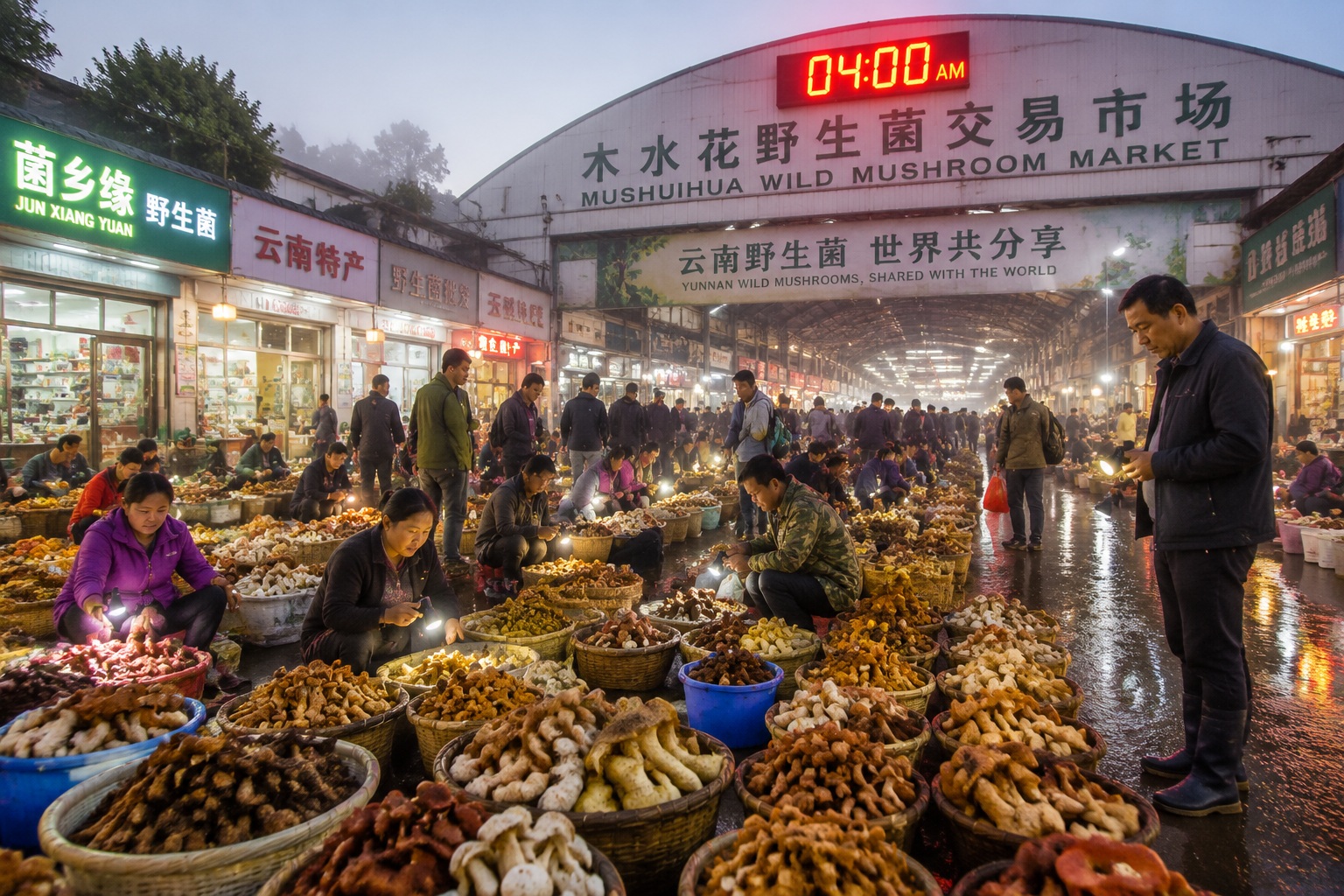
To see the scale of this obsession, visit Kunming’s Muying Wild Mushroom Market (木水花野生菌市场) at 4 a.m. The air is thick with the smell of wet moss and chlorophyll. Hundreds of vendors squat on plastic stools, their baskets glowing with orange, purple, and brown fungi. The prices are displayed on handwritten signs: jian shou qing at $8 per pound, song rong at $30, and the rare hu mo gu (虎磨菇, tiger mushroom) at $60.
Deals are made in a rapid-fire local dialect. Buyers sniff the mushrooms, pinch the stems, and haggle for seconds. One vendor, 52-year-old Yang Fang, sells only qing tou jun (青头菌, green-capped mushrooms). “I’ve been selling here for 20 years,” she says. “My customers come from all over China. Last week, a man from Beijing ordered 50 pounds to ship to his restaurant.”
Social media has turned the market into a spectacle. Live-streamers walk through the aisles, narrating the varieties and occasionally biting into raw mushrooms for dramatic effect. “Don’t try this at home,” they warn, while millions of viewers comment: “The government should ban these!” and “I’d still eat it.”
How the Government and Science Step In
Yunnan’s local government doesn’t try to ban wild mushroom consumption—that would be political suicide. Instead, it focuses on harm reduction. Since 2018, the province has run an annual “Wild Mushroom Safety Campaign” that includes:
- Posters in every village and urban community showing the top 10 poisonous mushrooms with clear photos.
- Text message alerts sent to all mobile phones during peak season, reminding people to cook thoroughly and not to forage alone.
- Training sessions for restaurant chefs and market vendors on identification and proper handling.
Hospitals in Yunnan are also well-prepared. The Kunming No. 1 People’s Hospital has a dedicated mushroom poisoning ward with a stock of antidotes like silibinin. Every emergency room in the province keeps a reference chart of local toxic species. The death rate from mushroom poisoning in Yunnan has dropped by 40% in the past decade, according to the provincial health commission.
Science is also helping. Researchers at Yunnan University are developing a portable DNA barcoding device that can identify a mushroom’s species within 30 minutes—a tool that could soon be used by market inspectors and even consumers. Meanwhile, the provincial agricultural department has certified over 200 wild mushroom collection bases, where trained foragers harvest under strict protocols.
More Than a Food: A Window into Local Life
If you only know China through news headlines, Yunnan’s wild mushroom culture might seem absurd—strange, dangerous, and irrational. But spend a summer in Kunming and you’ll see something different: a society that has learned to live with risk through knowledge, community, and a deep love for the land.
When Li Wei serves his family a mushroom hotpot on a rainy evening, nobody is scared. His grandmother stirs the pot, his kids fight over the biggest slice, and the steam carries the scent of the forest into the room. This is not a dare. This is dinner.
And that, perhaps, is the best way to understand China today: not through abstract debates, but through the everyday choices people make—choices shaped by history, family, and the simple pleasure of a good meal.
Start the discussion at forum.chinacomes.com