
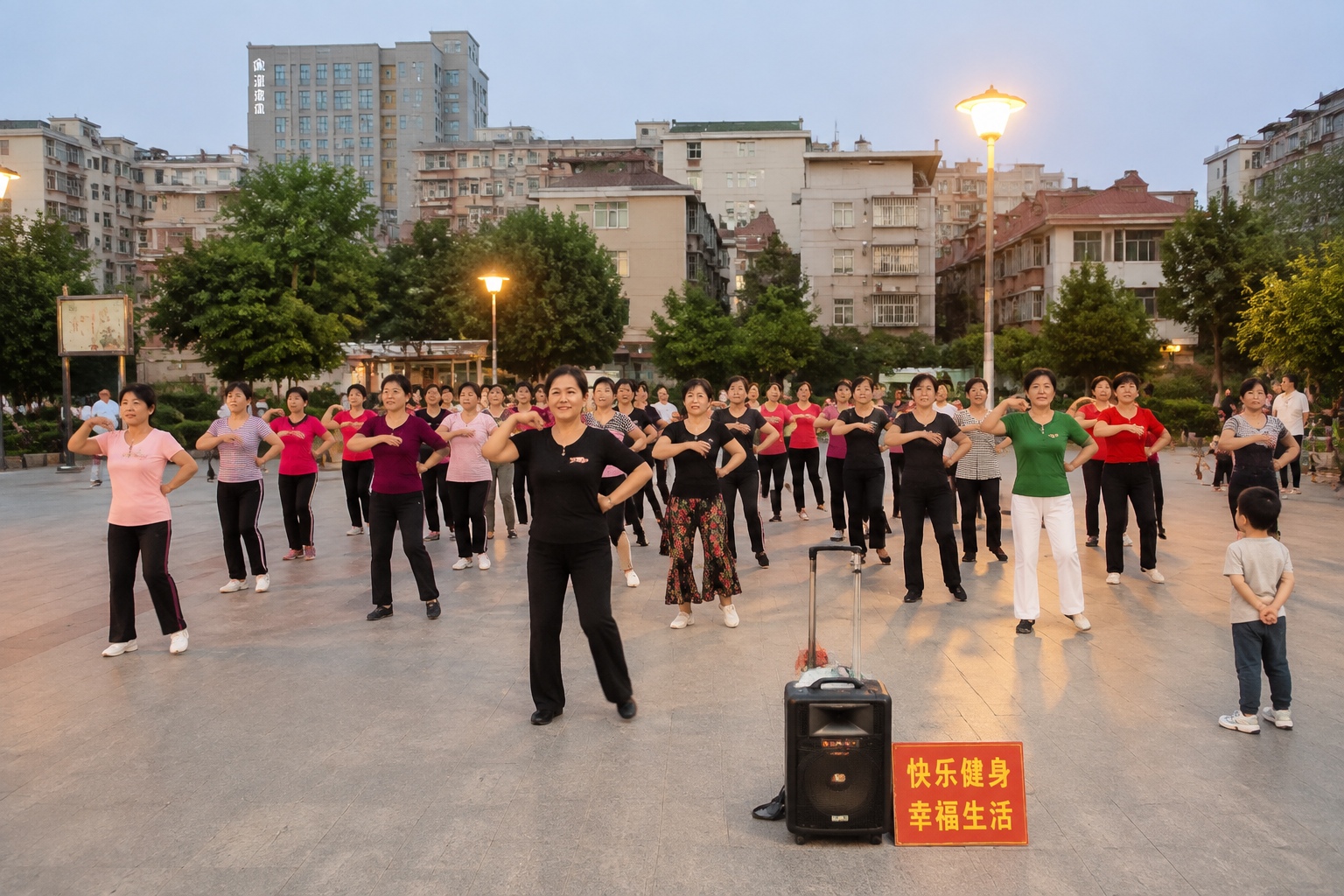

The Plaza Fills Up at 7:30
Zhang Guifang gets to the plaza twenty minutes early. She is 61, retired from a textile plant on the edge of Chengdu, and she wants the spot under the second streetlight, where the paving is flat and there is enough light for her phone camera to catch the routine.
By 7:30 there are around forty people behind her. Most are women in their fifties and sixties. There are four men. There is a girl of about fourteen who comes with her grandmother and already knows all the steps better than anyone. A speaker the size of a carry-on suitcase sits on a wheeled trolley; someone plugs in a USB stick; the first song is a Mongolian folk tune with a bass line borrowed from a nightclub. Forty people who a minute ago were chatting in small clusters turn to face the same direction.
Nobody signed up. Nobody paid. There is no class card, no monthly membership, no app to open, no group chat where you ask “is anyone going tonight?” and then wait.
That last part is usually what stops American visitors first.
What “Square Dancing” Actually Means
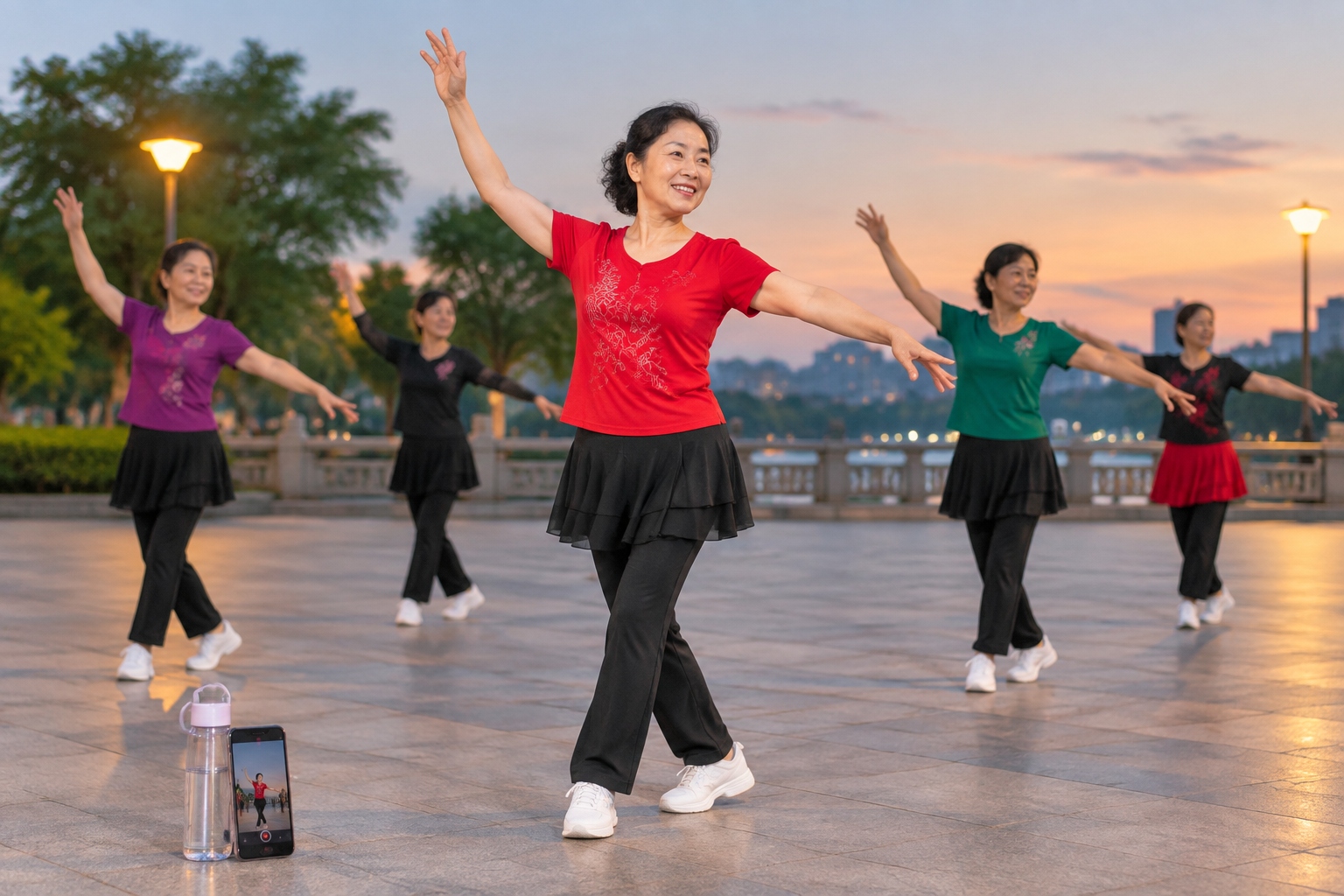
The Chinese term is 广场舞, guangchang wu — literally “plaza dance.” It is not one organization or one style. It is a habit that spread across the country in the 2000s and 2010s and never went away: a group of neighbors, usually twenty to eighty of them, meeting in whatever flat open space is free.
That space might be a city park, the forecourt of a shopping mall, the courtyard of a residential compound, a riverside promenade, or the concrete underneath a highway overpass. The only requirements are level ground and somewhere to put a speaker. Most groups dance from about 7 to 9 in the evening, an hour or two after dinner. Some prefer 6 to 7 in the morning, before the heat.
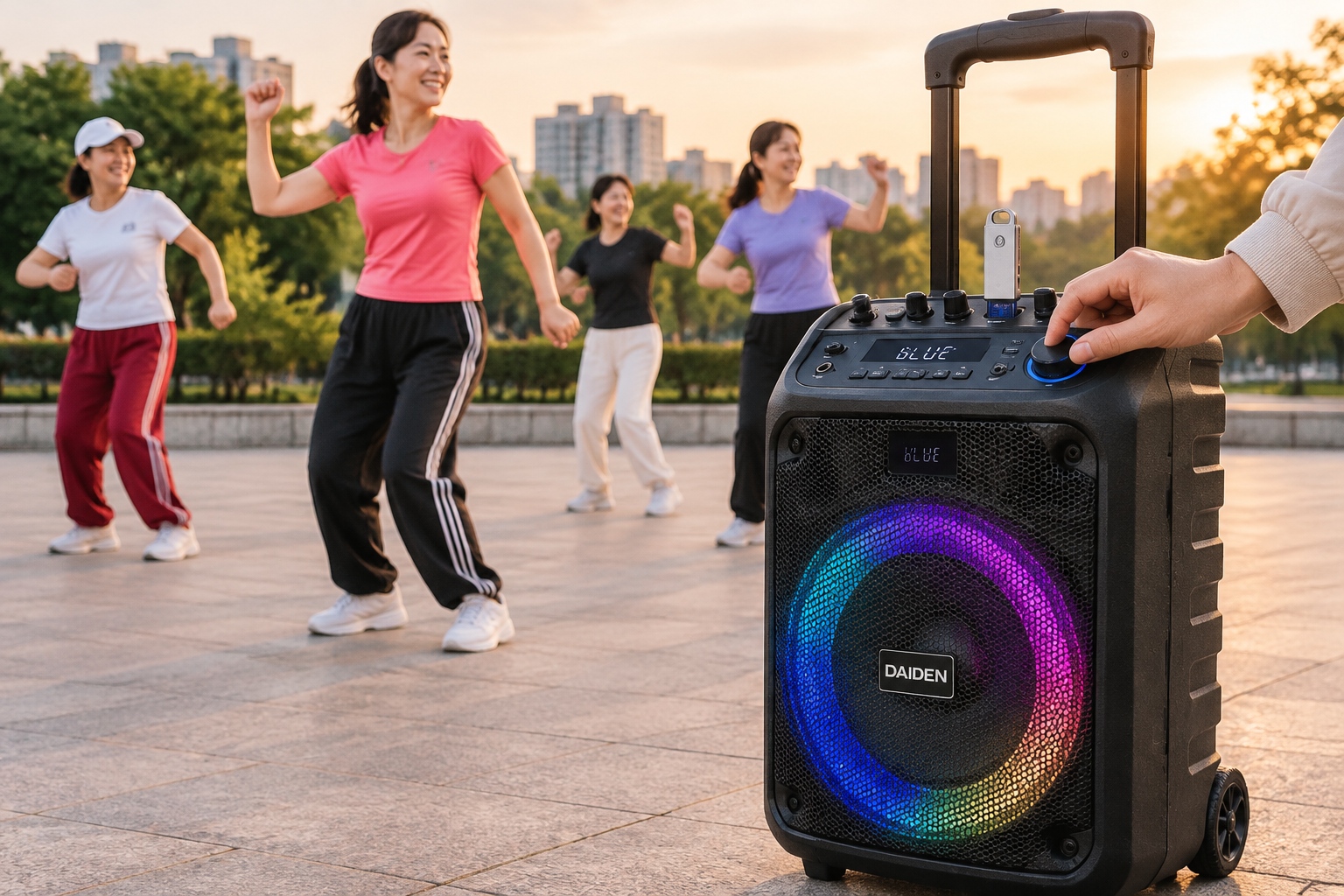
The economics are almost embarrassing in their simplicity. A wheeled speaker costs a few hundred yuan, roughly fifty to a hundred US dollars. Some teams chip in for matching T-shirts, maybe twenty dollars each. The person who leads is usually just the one who learned the choreography first on Douyin and then taught everyone else. She is not paid. She is, in the most literal sense, the reason the group exists.
Why American Visitors Notice It So Fast
Americans arrive with a specific set of assumptions about how adults make friends after fifty. You join something. You pay for it. You drive to it. You schedule it three weeks out and half the people cancel.
The sociologist Ray Oldenburg called the informal gathering places of a community “third places” — neither home nor work. The American version has been thinning for decades. Robert Putnam wrote about it in Bowling Alone back in 2000. In 2023, the US Surgeon General issued an advisory calling loneliness and isolation an epidemic, noting that roughly half of American adults report measurable loneliness. Pew Research found that about 27 percent of Americans aged 60 and older live alone.
So when an American visitor stands at the edge of a Chinese plaza at 7:40 in the evening and sees forty people who are not lonely, not paying, not scheduled, and not going home to an empty apartment, the reaction is rarely “how charming.” It is closer to envy.
The scale on the Chinese side is worth stating plainly too. At the end of 2023, China had about 297 million people aged 60 and over, roughly 21 percent of the population. Retirement for blue-collar women has historically started at 50 to 55, and a 2024 decision by the National People’s Congress is now raising those ages gradually, beginning in 2025. That means an enormous number of people in their fifties and sixties have both the time and the physical mobility to spend two hours a night outdoors with neighbors. Square dancing is what a lot of them do with it.
It Rarely Stops at the Dancing
Ask anyone who has a mother or an aunt in a dance team and you hear the same thing: the dancing is maybe a third of it.
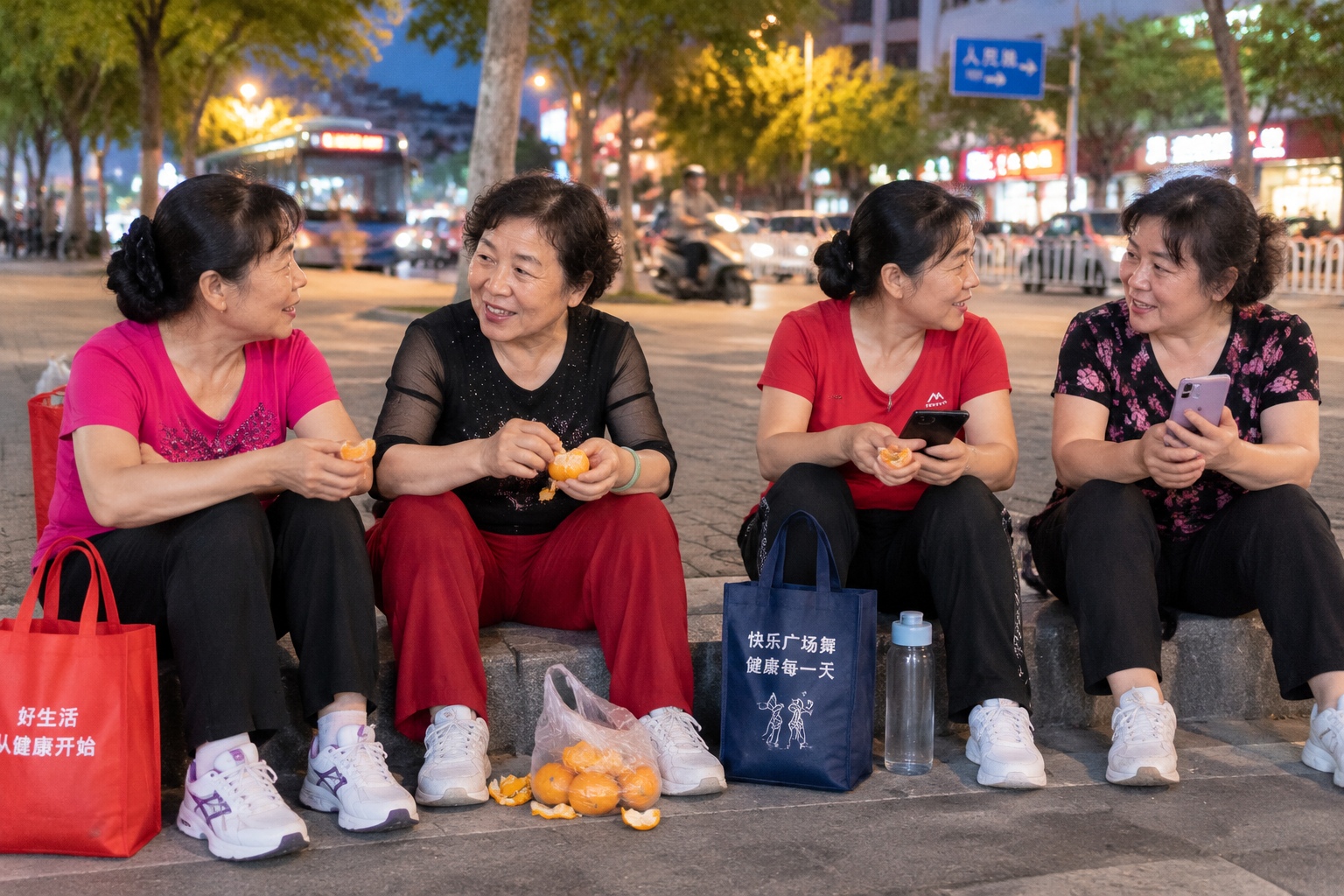
There is a WeChat group. In the group, someone asks who needs a ride to the hospital on Thursday. Someone posts a video of a new routine. Someone’s husband, who does not dance, drives four women to a hot spring two hours away. Someone brings a bag of oranges and passes them around after the last song while everyone sits on the curb. When a member’s son gets married, the team shows up. When a member dies, the team shows up for that too.
Sociologists call this social capital. On the ground it looks like knowing eleven people’s phone numbers and being expected somewhere at 7:30.
The Safety Question Nobody Asks Out Loud
One reason this works is easy to overlook: the women walking home at 9:15 at night, alone, through a residential neighborhood, generally are not afraid. Violent street crime in Chinese cities is low, and public space at night is busy — people eating, walking dogs, buying fruit, sitting on steps. That baseline of physical safety is what makes an unsupervised, unpaid, open-air social life possible in the first place. Take it away and the whole thing collapses.
The Friction Is Real, Too
It would be dishonest to describe square dancing as frictionless. In many Chinese cities, noise complaints about evening dance groups are among the most common calls to local complaint hotlines. The tension is genuine and it is not always polite: in 2013, a dispute in Beijing between dancers and a resident who objected to the sound made national news.
Cities have mostly responded with rules rather than bans. Shanghai and Beijing limit hours and volume in many districts. Some cities designate specific plazas and specific time windows. Occasionally the argument runs the other way — a group is told to move, and neighbors petition to let them stay.
The most interesting fix came from the dancers themselves: silent square dancing. Groups in several cities now wear wireless receivers — each dancer has a small earpiece, the leader carries a transmitter, and the plaza stays completely quiet for everyone else. From a distance it looks like forty people exercising in total silence, which is both eerie and rather beautiful.
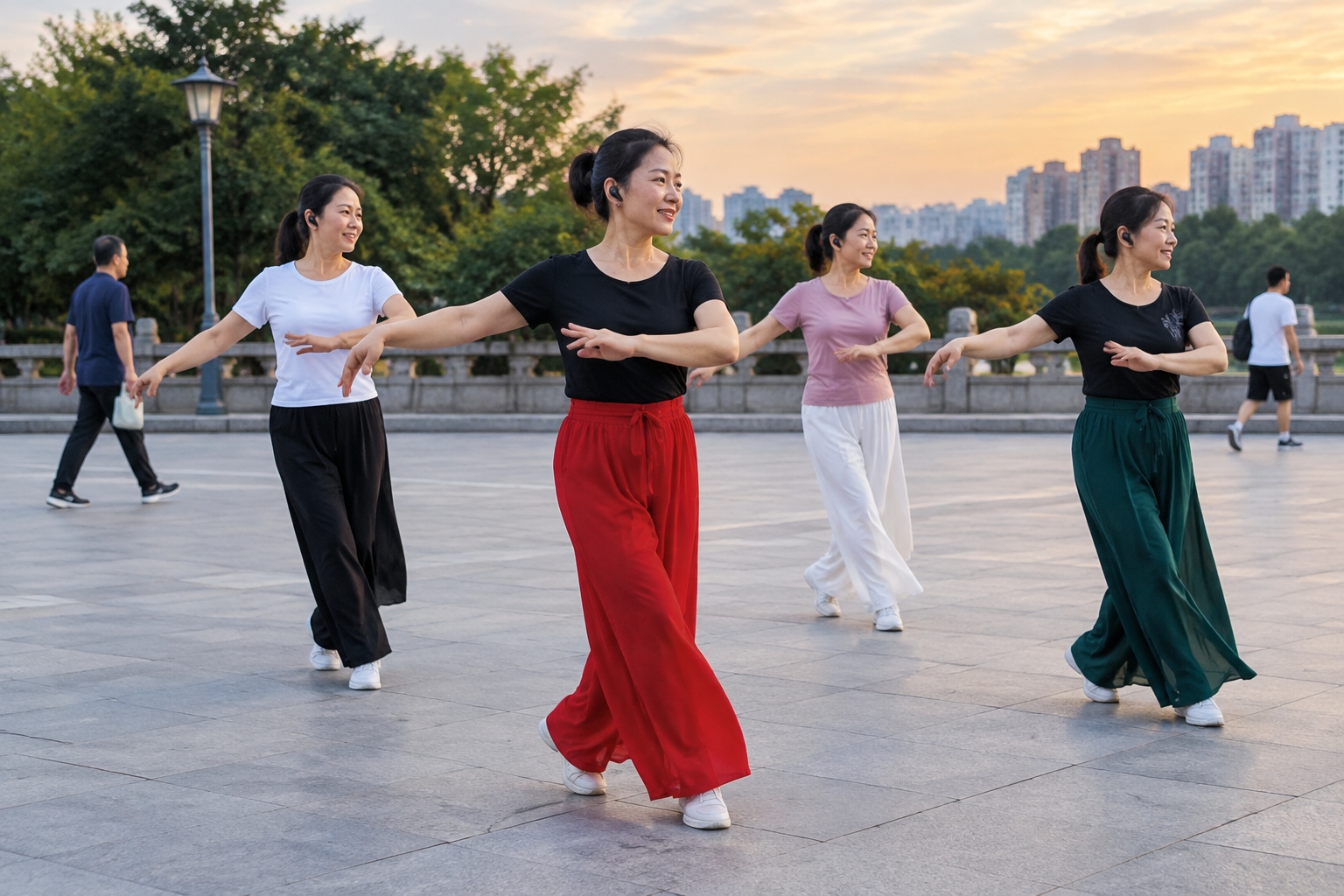
What They’re Actually Doing Out There
There is a temptation to read square dancing as nostalgia, or as a holdover from a more collective era. The people doing it usually describe it much more simply.
Zhang Guifang spent thirty-one years on a factory floor. Her husband watches television. Her son lives in Shenzhen and calls on Sundays. Without the plaza, her evenings would be a long, quiet stretch between dinner and sleep. With it, she has a reason to leave the apartment, a reason to learn something new at 61, and about forty people who would notice if she stopped coming.
That is not nostalgia. That is a schedule, a body in motion, and a place where your absence registers.
Why It’s Hard to Copy
Americans who see this often ask why it doesn’t happen at home. The honest answer is that it depends on conditions that are not purely cultural. It needs density — enough people within a five-minute walk. It needs flat, open, ground-level public space that isn’t a parking lot. It needs a street life that feels safe after dark. It needs a large population of relatively healthy retirees with time on their hands. And it needs a habit of simply showing up without a reservation.
Some of those things can be built. Some are harder than they look. The reason it works in Chengdu is not that Chinese people are naturally more social. It is that the physical and social infrastructure happens to line up.
9:10 p.m.
The last song ends. Someone unplugs the USB stick and coils the cable. The speaker gets wheeled back toward a ground-floor apartment. People drift off in twos and threes, still talking, past the fruit stand that is still open and the noodle shop with the plastic stools.
Zhang Guifang walks home in about eight minutes. Tomorrow she’ll be there at 7:20, holding the spot under the second streetlight, and nobody will have had to invite her.
Start the discussion at forum.chinacomes.com