


5:40 a.m.: The field is still black
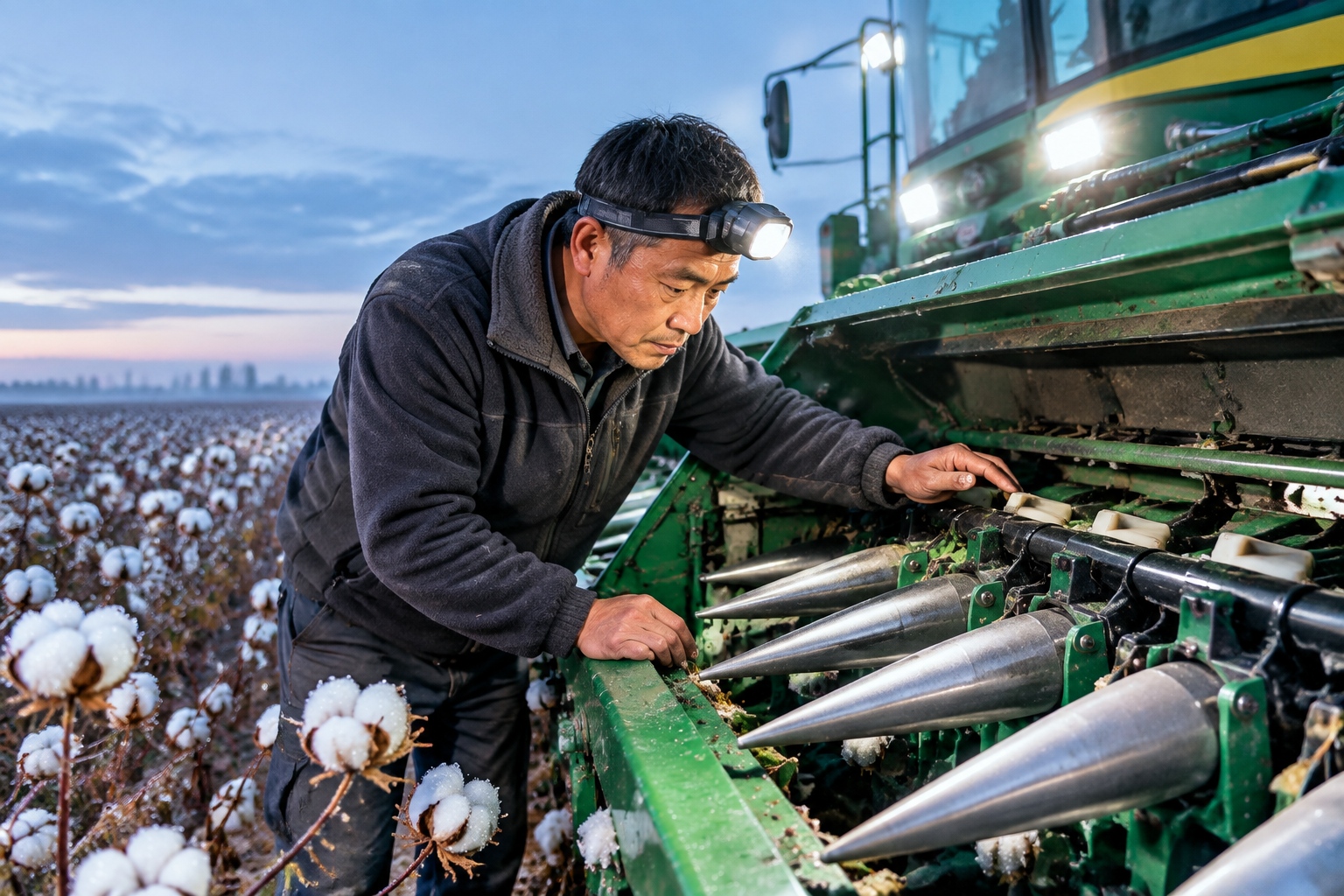
At 5:40 in the morning, the cotton fields outside Shihezi, in northern Xinjiang, are still black. For a kilometre in any direction, the only light comes from the LED work lamps of a six-row cotton harvester and the small screen inside its cab.
Wang Jun, 42, walks along the left side of the machine with a torch, opening the panels above the picking heads one by one. It is 6°C and his breath shows. “Every morning I check the spindles first,” he says. “One bent spindle can wrap cotton around itself for half a hectare before anyone notices.”
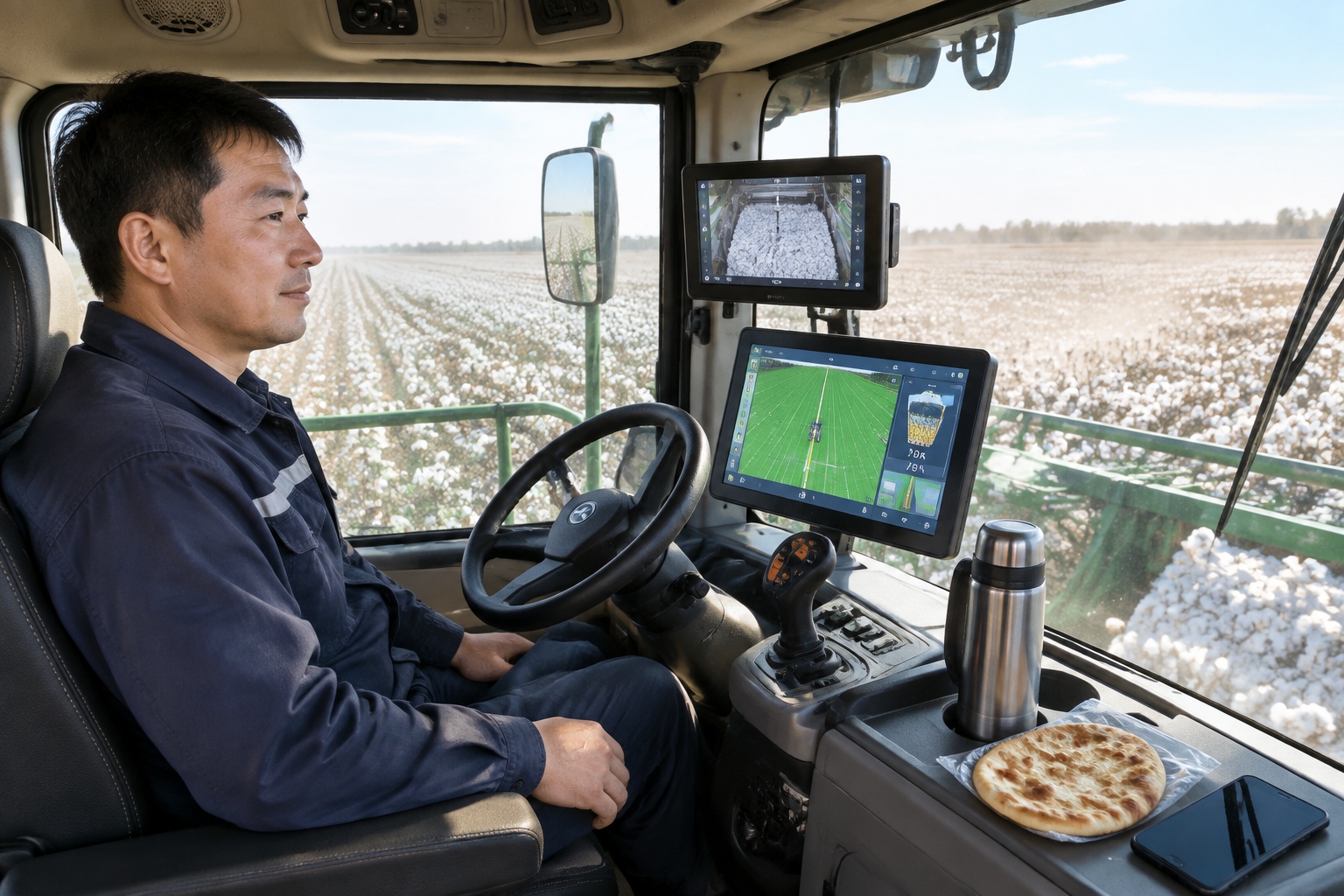
He has run this machine for six years. It is about five metres wide, close to five metres tall, and cost the equivalent of a comfortable apartment in a provincial city. Inside the cab: air conditioning, a GPS screen, a live camera feed of the packing chamber, a phone charger, a thermos, two rounds of naan and a bag of apples.
Why the day starts before sunrise
Cotton bolls open through late September and October. By the first week of harvest the plants are dry, the leaves have mostly fallen, and each boll holds a fist of white lint wrapped around its seeds.
Wang starts early for two reasons. Cool, damp early-morning air makes the lint more pliable, so it comes away from the boll cleanly and less leaf trash ends up in the basket. The second reason is the calendar. This field is 1,200 mu — about 80 hectares, or 200 acres — and the machine covers roughly 30 mu an hour. After 20 October, the weather in northern Xinjiang can turn fast.
At 6:10 the engine starts, the lights swing across the rows, and the machine rolls into the first strip.
What a cotton picker actually does
Mechanical picking is stranger to watch than most people expect. Nothing is cut. Each of the six rows runs its own drum holding hundreds of tapered, barbed spindles spinning at high speed. The spindles reach into the open boll, hook the lint, and carry it past a rubber doffer that strips it off. A fan then blows the seed cotton — lint and seed together, exactly as it grew — through ducts into the basket above.
Inside the cab the noise is a low, constant roar. Outside, it sounds like a vacuum cleaner the size of a train.
Wang keeps his hands on the wheel, but over long stretches the machine drives itself. GPS steering holds it within a few centimetres of the previous pass. He watches three things instead: the basket-fill meter, the camera view of the packing chamber, and the ground ahead for soft spots or an irrigation pipe left in the wrong place.
Mid-morning: the arithmetic behind the white
Around ten, a pickup stops at the headland and a farmer named Zhou gets out. He stands on the field edge with his phone in his hand, watching the machine finish two passes before he speaks.
He has grown cotton here for twenty years. One mu yields around 350 kilograms of seed cotton, he says. Hand-picking is paid by weight; a fast picker gathers 70 to 100 kilograms a day, and the labour alone runs to 700–900 yuan per mu. Machine harvesting is billed by area instead — this year, 150 to 220 yuan per mu.
“Nobody hand-picks any more,” Zhou says. “Maybe the corners the machine can’t reach, or where the plants have fallen over. Then we call people back for a second pass.”
The change behind that sentence is large. Around 2010, several hundred thousand pickers from Henan, Sichuan and Gansu took trains into Xinjiang every autumn and stayed for two months. That migration has almost vanished. In 2023, more than 85% of Xinjiang’s cotton was harvested mechanically, and in many counties in the north the figure was above 95%. It is not universal: small plots, older orchards and awkward terrain in parts of southern Xinjiang are still picked by hand, and machine-picked cotton carries slightly more trash, which gins have to clean out.
11:20 a.m.: the moment cotton becomes a bale
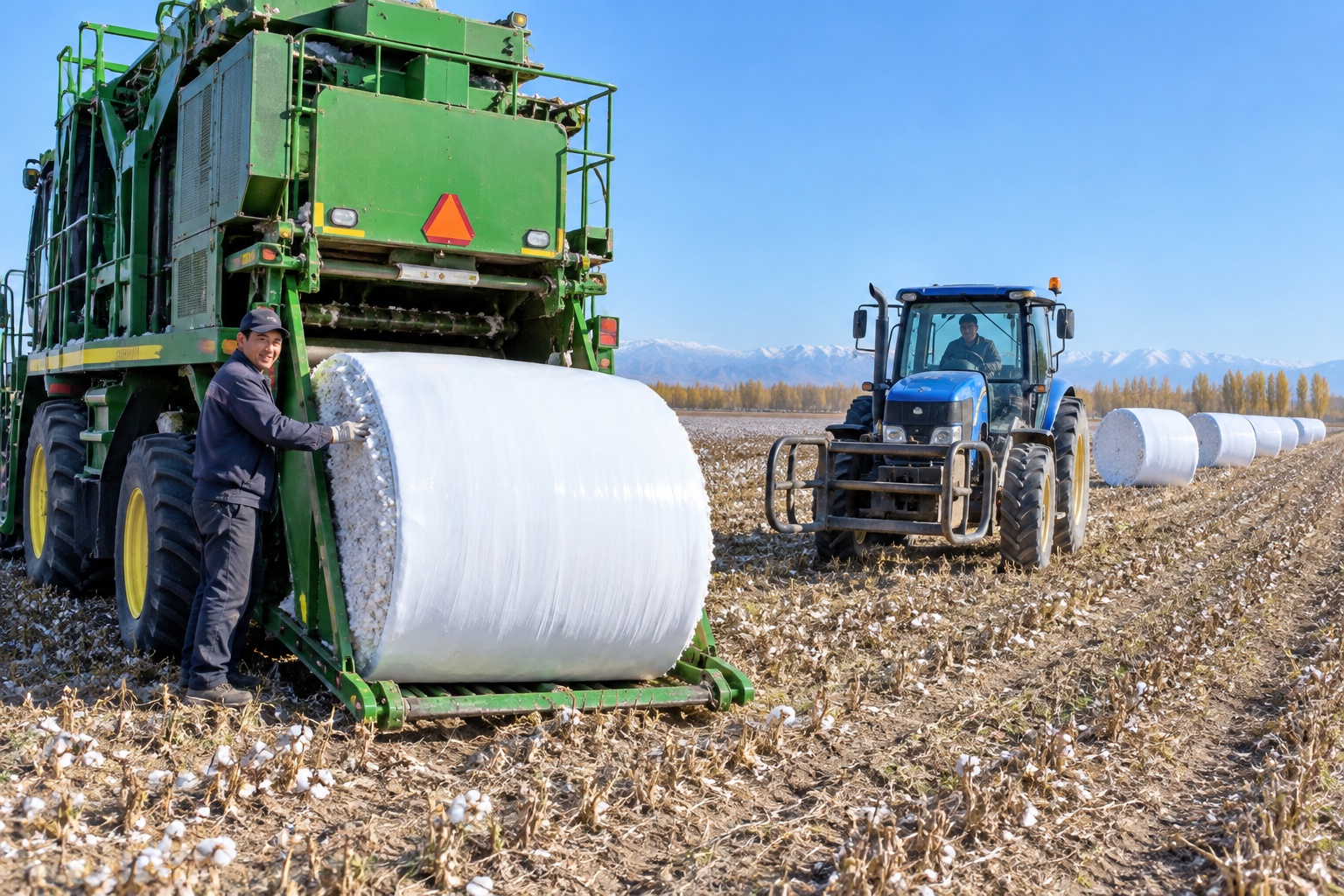
A red light on the dash: basket full. Wang stops in the middle of the strip and the packing cycle takes over. The seed cotton drops into a chamber behind the cab, where a roller compresses it into a cylinder about 2.4 metres across and 2.2 tonnes heavy. An arm wraps the cylinder in white plastic film, and the finished module rolls out the back onto the stubble.
Ten minutes later a tractor with a bale carrier lifts it and stacks it at the headland, where a row of identical white cylinders is already waiting. Each one carries a number and a GPS location. By the time it reaches the gin, the buyer knows which field, which day and which machine it came from.
Lunch: fifteen minutes, engine idling
Wang eats in the cab — naan, a boiled egg, hot water from the thermos, half an apple. The engine stays on.
He works 40 to 60 days a year like this. Most days run from eight in the morning to midnight, and when rain is in the forecast he keeps going through the night. “Open bolls are what we’re afraid of,” he says. “One rain and the grade drops.”
He is paid by area, at 170–190 yuan per mu this season. Ask him what he clears and he shrugs it off: fuel, a helper’s wage, replacement spindles, the machine loan. “People think we’re printing money. We’re not.”
The cabin is the only clean place in the job. By evening the air filter has gone black with leaf dust.
11 p.m.: trucks, headlights, and the gin
By eleven at night the headland looks like a small construction site: two trucks, a loader, and the harvester’s lights sweeping back and forth across the rows. The temperature has dropped to 4°C. Wang has pulled a hoodie on under his jacket.
At 12:20 a.m. the basket empties, the counter stops at 312 mu, and he shuts down. He sits in the dark cab for a minute before opening the door.
From the field, the modules go to a gin about 40 kilometres away that runs around the clock during the season. There, seed cotton is dried, cleaned and ginned — the lint separated from the seed. The lint is pressed into standard 227-kilogram bales that will end up as yarn, denim, towels and T-shirts. The seed goes to oil presses and dairy feed. Every bale is sampled, and a lab measures fibre length, strength and micronaire before it is sold.
What the day adds up to
Wang drives back to Shihezi and is home just before two. A shower, five hours of sleep. At seven the next morning he is expected back in the field — 900 mu still standing.
What has changed in Xinjiang’s cotton harvest is not really visible at the level of headlines. It is a screen in a cab, a 2.2-tonne module rolling onto the stubble every twenty minutes, far fewer people bent over the rows than fifteen years ago, and a farmer at the headland running numbers on his phone while a machine worth more than his house does the work of fifteen hundred pairs of hands.
Start the discussion at forum.chinacomes.com