

A Classroom of Red Paper and Scissors
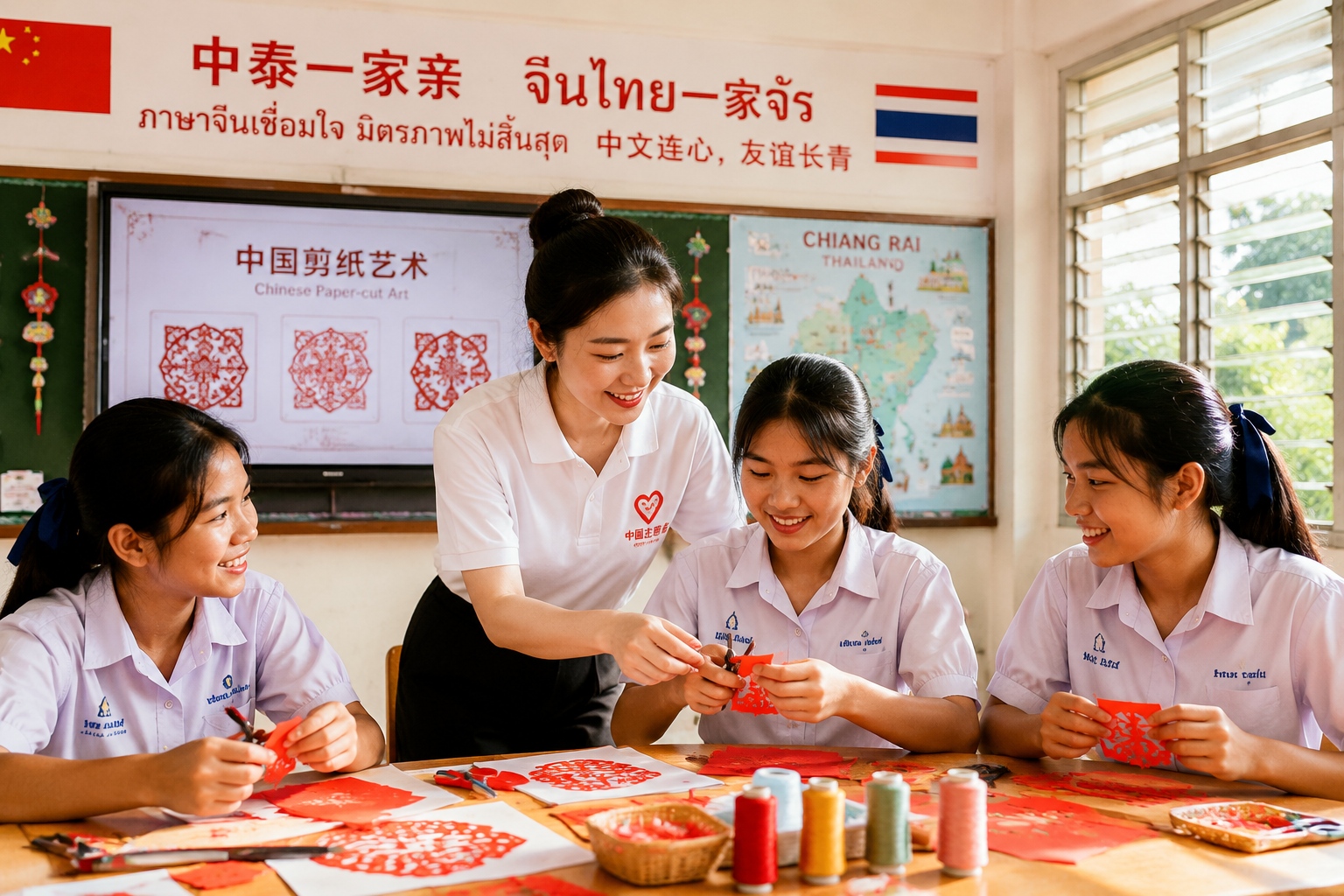
The afternoon sun filters through the louvred windows of a small classroom in Chiang Rai, northern Thailand. I’m standing at a long wooden table covered with sheets of bright red paper, a box of scissors, and bundles of silk thread. It’s my third month as a volunteer Chinese teacher at a Confucius Classroom, and today is the first handicraft session of the term. Outside, the familiar hum of a tropical town drifts in – a motorbike sputtering by, the distant call of a vendor selling mango sticky rice. Inside, eleven Thai high school students are watching me with a mixture of curiosity and hesitation. They know me as the Chinese teacher who makes them repeat tones and write characters, but today the lesson looks different. There are no textbooks on the table, no whiteboard full of pinyin. Instead, there are materials that feel more like play than study.
Why a Confucius Classroom Teaches Handicrafts
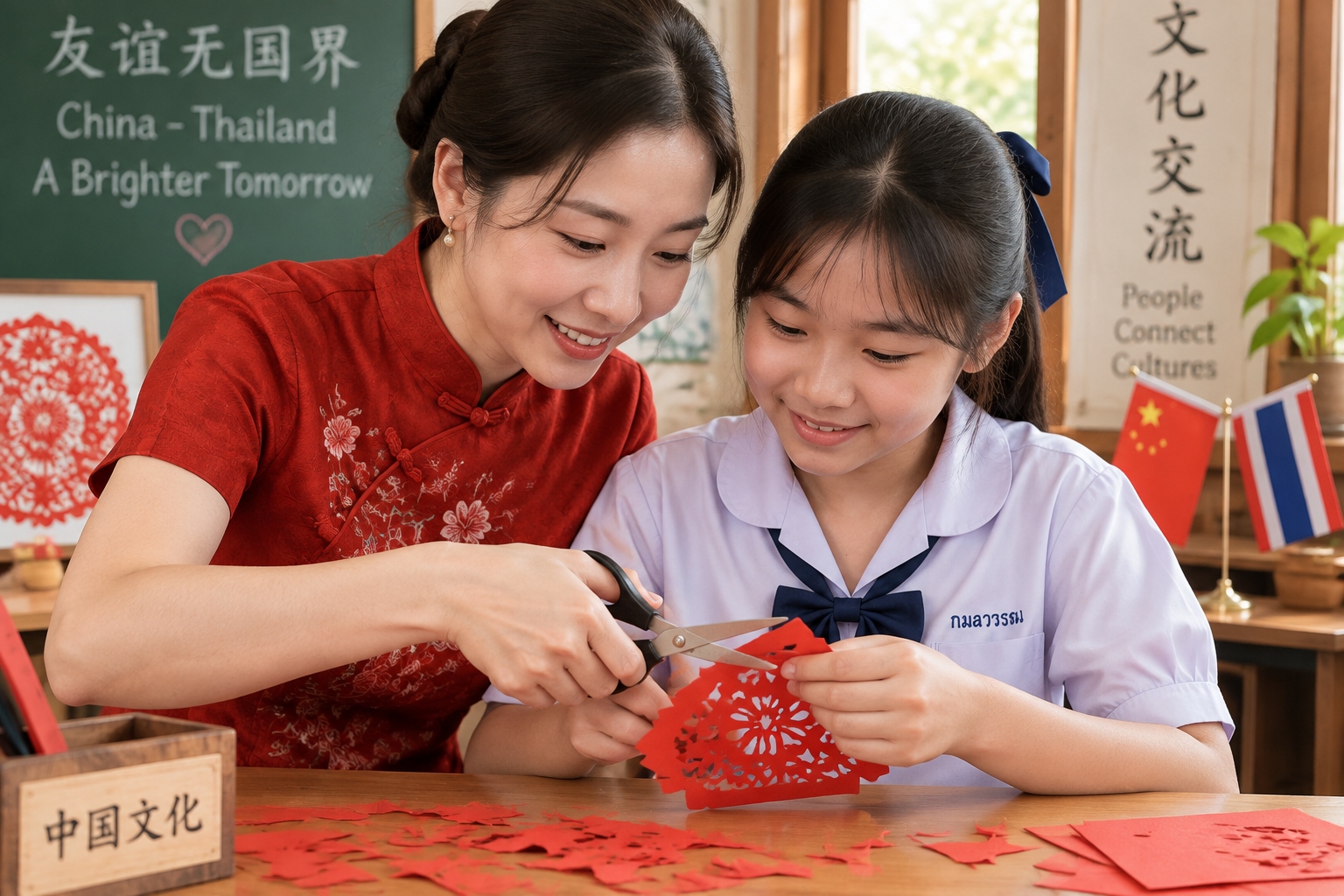
When people hear “Confucius Classroom” or “Confucius Institute,” they often think of language drills or solemn lectures about the Analects. But in this part of Thailand, the classroom is a warm, slightly messy space where language and culture blend in simple, tangible ways. The Confucius Classroom here is attached to a local secondary school. It receives teaching materials and volunteer teachers from China’s Hanban and partner universities, and its mission is broader than just vocabulary exercises – it also offers a taste of Chinese traditions through festivals, food, music, and handicrafts. For many students, this is the first time they’ve touched Chinese paper or held a pair of scissors with a specific cultural purpose. The teacher, me, is not a professional artisan. I studied Chinese literature, and back home in Yunnan I used to fold paper cranes with my grandmother. That’s enough. The goal is not to produce perfect crafts, but to create a moment where students forget they are “learning a foreign language” and just do something with their hands.
Cutting, Folding, and Tying Together
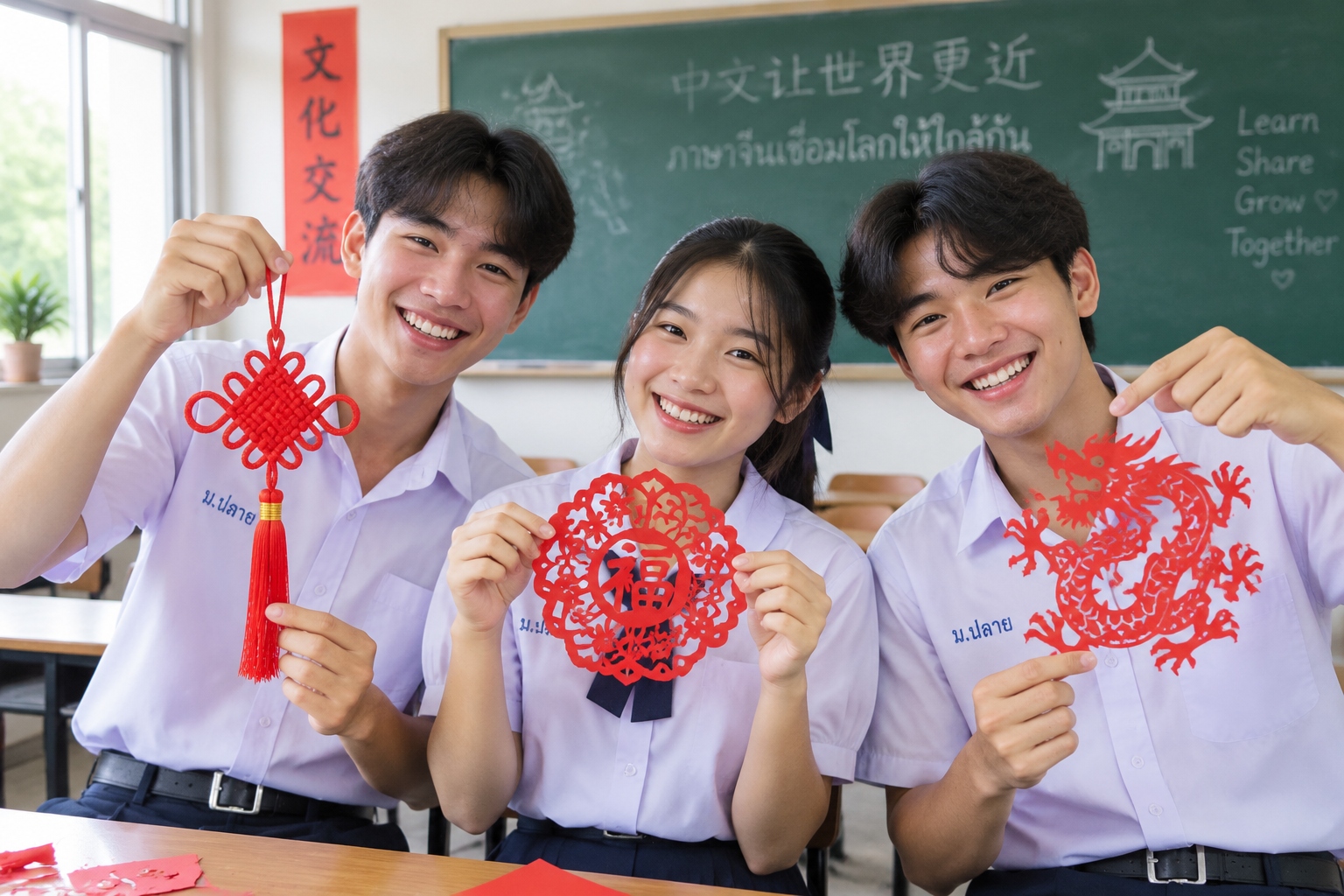
I begin by showing them a simple paper cutting – a double “Happy” character, or shuāngxǐ, which is often used at weddings. The students lean forward, intrigued. I fold the paper in half, sketch a few lines with a pencil, and snip carefully. When I unfold it, a small pattern of two interlocked rectangles emerges. There’s a collective “wow.” Then it’s their turn.
A girl named Aom, who sits at the front, stares at the paper as if it might bite her. She’s usually confident in class, but this is new territory. Her hands tremble slightly as she tries to follow the lines. I walk over and kneel beside her. “Let’s try together,” I say in the broken Thai I’ve picked up. I gently guide her hand through the first few cuts. When she finally opens the folded paper and sees a small, imperfect but recognizable star, her face lights up. She says, “Repetition practice, teacher.” I laugh and nod. That’s exactly it.
Next, we move to Chinese knots. I teach them the “button knot” and the “double connection.” This is trickier than scissors. The silk thread seems to have a life of its own. Some students pair up, one holding the loop while the other passes the thread through. A boy named Krit, who spends most of his time drawing cartoons, produces an unexpectedly neat knot on his first confident attempt. He grins and holds it up like a trophy. His friend teases him, but now everyone wants to try. The room fills with the rustle of paper and the quiet hurry of fingers threading silk.
More Than Just Craft
As the hour passes, something quiet happens. The craft becomes a bridge. Aom asks if red is always the lucky color. I explain that in Chinese culture, red represents happiness and good fortune, which is why it appears in festivals and weddings. She nods and then shares that in Thailand, monks wear orange and people use phuang malai – flower garlands – as a way to show respect. The conversation moves naturally from scissors to symbols, from symbols to daily life. Another student, a boy named Somchai, asks if Chinese people also make flower garlands. I tell him that in the south of China, people sometimes string jasmine flowers for the Dragon Boat Festival. He looks pleased, as if he’s found a connection.
The students also teach me a few words of Thai I don’t know. When I mispronounce “orchid” and they all giggle, I realize this exchange isn’t one-directional. It’s a two-way street, not a lecture. They are learning about China, but they are also giving me a glimpse of their own world. The paper and silk are just starting points; the real lesson is about noticing that we all make things to express hopes and memories.
The Evening After Class
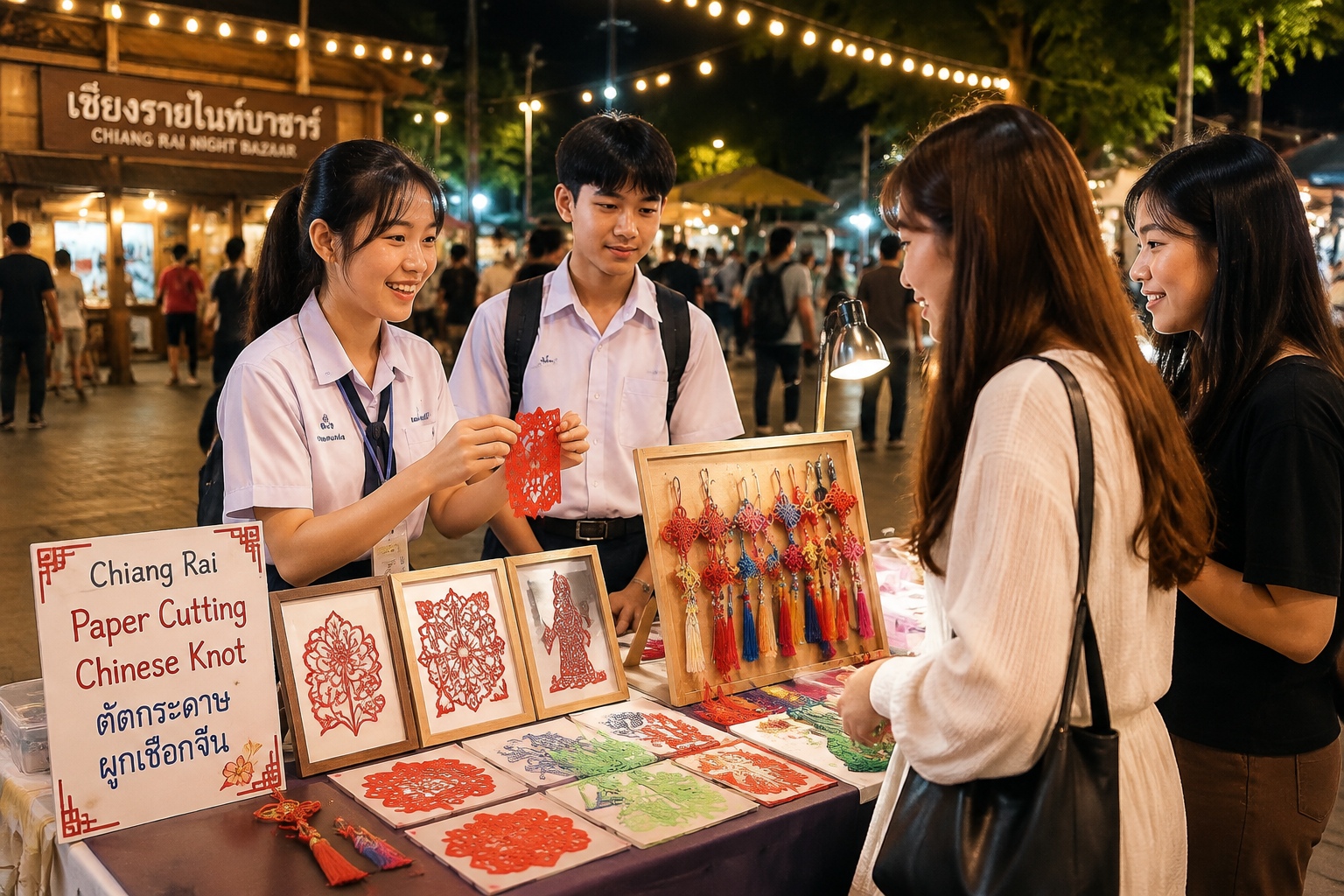
A few hours later, I walk through the night market in the center of town. The air smells of grilled meat and jasmine. Near a stall selling cheap phone cases, I spot a familiar face – Aom. She’s sitting at a small table with two other students from the afternoon class. They’ve set out a miniature display of their new crafts: a few paper cuttings in plastic sleeves and some brightly colored Chinese knots hanging from a small rack. They’re not selling much, but they’re showing their work to friends and passersby, explaining what the symbols mean in Thai. Aom sees me and waves excitedly. “Teacher! Look, we made an exhibition!” she calls out. I smile and walk over. For a moment, I feel that this small, quiet effort has taken root in the world.
A Lasting Thread
Later, as I ride a songthaew back to my rented room, I think about the usual debates about cultural influence. Maybe they’re too big and abstract to matter on the ground. What matters, I think, is that a girl in Chiang Rai can now fold a piece of red paper into a star and say “shuāngxǐ” with a smile. That seems more real than any headline. The classroom is gone now, but the thread continues – in a knot kept on a backpack, in a paper star pasted on a bedroom mirror. That is how culture travels, not through grand gestures, but through one small act of attention at a time.
Start the discussion at forum.chinacomes.com