


I Saw Myself Selling a Lipstick I Never Tried
A few months ago, a 26-year-old office worker in Chengdu, let’s call her Xiao Liu, was scrolling through a short-video app when the screen froze.
A lipstick ad was playing. The model’s eyes, eyebrows and the slightly uneven line of her smile felt almost uncomfortably familiar. The handle was not hers, the body on screen was different, and the voice had never been recorded in a studio. But the details around the nose and mouth looked like the selfies she had posted on WeChat the previous spring.
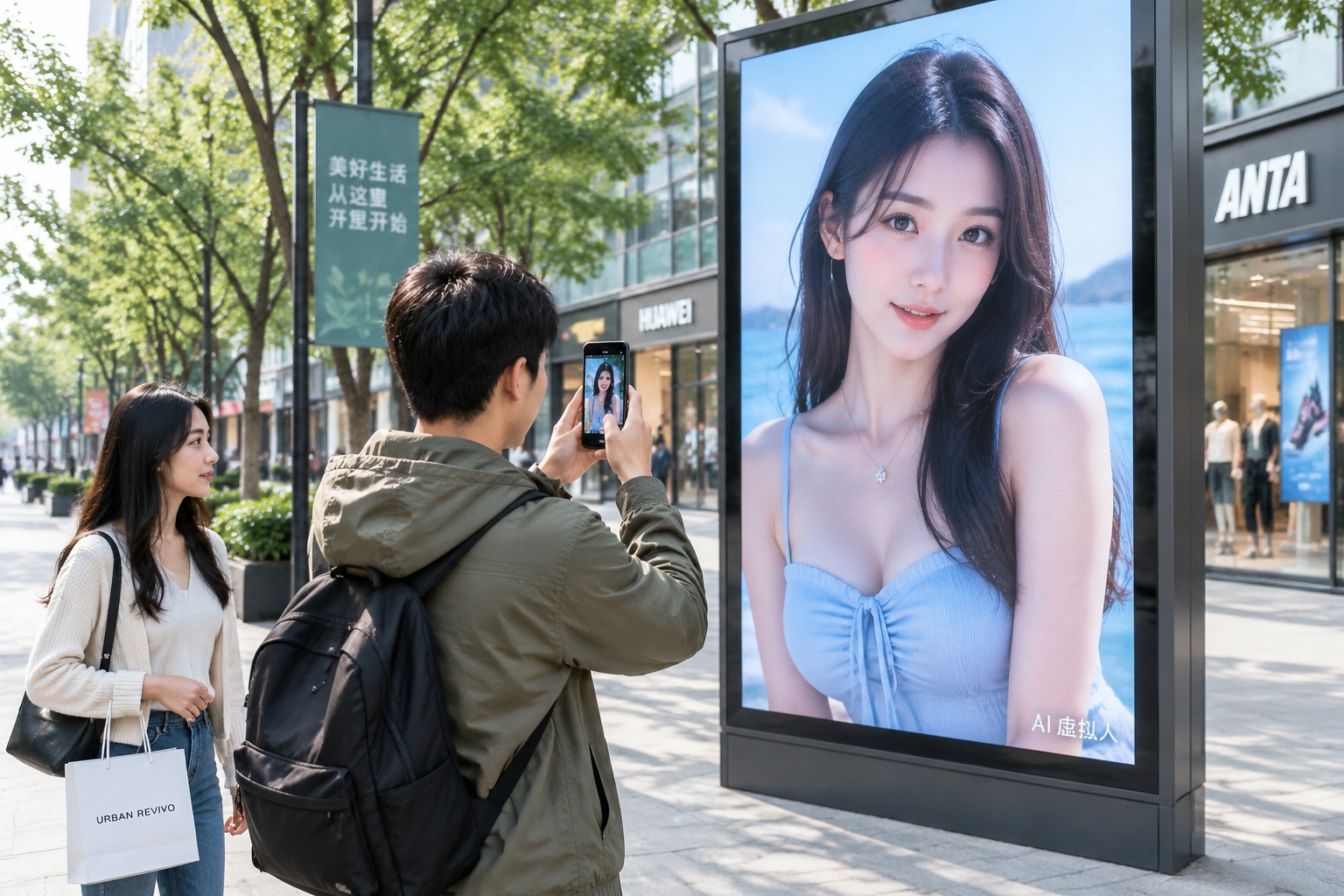
She had never bought that lipstick. She had never signed an endorsement. Someone had simply collected a few of her public photos and used AI face-swapping software to turn her into a virtual saleswoman.

Stories like this rarely make national headlines. Yet they are part of a quiet wave of portrait-rights disputes unfolding across China. For each famous face that goes through a deepfake fight, there are countless unknown people who discover one day that their own smile is showing up in an online ad, a fake product review, or a live-stream room without their permission. This is the more ordinary side of deepfake technology: someone has made you into content, and the content is you.
How Face-Swapping Left the Far-Future
In 2019, a Chinese app called ZAO became a short-lived sensation. It let users put their own faces into famous movie clips in seconds. That was followed by privacy worries and regulator attention, but not by the end of face-swapping tools. Today similar functions are built directly into mainstream short-video platforms, photo editors and camera apps. After a 30-second tutorial, almost anyone can make a reasonably convincing swap.
That convenience has given rise to an odd shadow market. Some e-commerce sellers use harvested selfies to make “real customer” show images. Some live-stream operators generate low-budget virtual hosts with stolen faces, saving the cost of a real presenter. The result often travels through heavy compression, so the face can look a little blurred or too polished — and the real person may not even notice until a friend sends them a “have you seen this?” link.
Internet-rights lawyers in China note that ordinary people are often less protected than celebrities in this new landscape. A star’s face has a management team and a market value. Normal citizens usually have no watchers, no evidence budget, and little experience when they first find a wrong face.
What Chinese Law Says Now
China’s civil law has moved quickly to define what can and cannot be done to an image. The Civil Code went into force in 2021. Today, article 1019 states that nobody may make, use or publicly display another person’s portrait without permission, and it specifically mentions “forging by information technology” as a form of violation. In short, it does not matter whether the face is a normal photo or a deepfake: a face belongs to its owner.
Special rules for “deep synthesis” add practical details. They require that someone who wants to edit or swap a real person’s face, or use other biometric data, must first inform the person and get separate consent. Service providers also need to label synthetic output with clear identifiers. So under the written rules, Xiao Liu’s case is not actually a grey area. The person who made the ad, and the platform that broadcast it, can be held responsible.
The harder part is enforcement. The anonymous account behind the ad can vanish overnight. Platform moderation can be slow. Evidence often sits behind login walls. And when people do go to court, the damages in published decisions are still often modest — sometimes a few thousand renminbi, which may be less than the cost of one lawyer meeting. A clear law does not instantly produce cheap justice.
Four Ways Ordinary People Can Fight Back
How should a person react when the same discovery comes to them? Based on guidance shared by Chinese rights lawyers and consumer advocates, here is a practical path.
1. Freeze the evidence first. Take a full-page screenshot, record a short video of the ad playing, and save the URL or account link. If you can afford a notary service or an e-evidence tool, use it to lock the timestamp and content.
2. Report inside the platform. Every large Chinese video or e-commerce platform has a built-in reporting channel. The complaint should include your ID, a comparison image, and a brief quote of the Civil Code’s article 1019. Ask for immediate removal, and keep the case number.
3. Go to the national reporting centre. China’s official online-abuse hotline site, 12377.cn, receives reports on harmful online information. Local cyberspace regulator offices can also press platforms when they are slow to handle a civil dispute.
4. Send a legal letter or start an online lawsuit. Chinese courts have developed online filing, so distance is less of a barrier than before. If the platform or advertiser ignores you, a lawyer can send a formal demand letter. Many small companies prefer to settle quietly after receiving one, and even without a large payout, a court ruling can set an important public trace.

People Need Better Tools, Not Just Laws
Legal pathways are necessary, but they will never be enough on their own. The current internet culture treats personal data as free raw material. A law creates a boundary, but deepfake tools regenerate faster than law updates, and a face can be generated in one place, uploaded to another, and viewed in a third.
There are small signs of progress. Some platforms are requiring advertisers to prove that every face in their content belongs to a paid actor or to a person with signed permission. A few virtual influencers are now sold with a warning label saying they are “digital humans.” Reverse-image search has become cheaper and more convenient for ordinary people who want to check where their own image is being shown.
Ordinary habits matter, too. If you are concerned about photo theft, you can set profile photos to be hidden from search engines, add visible watermarks to high-definition selfies, and occasionally upload a screenshot into a reverse-image search to see the trail. These steps do not make you invisible. Once a photo is on the open web, anyone can copy it. But they raise the friction for someone who wants to mine your face without your knowledge.
No One Should Rent Your Smile Without Asking You
In the end, Xiao Liu did not go to court. She used the in-app reporting button, the ad disappeared after two days, and the creator was never identified. But the experience changed some of her digital habits. She switched off location tags when posting travel photos, and she paused before uploading another high-resolution self-portrait.
This is the face of many digital-rights battles in China today: messy, tiring, and not always heroic. But it is moving forward. The law gives a firmer basis than it did five years ago. Platform rules are slowly becoming more transparent. And an increasing number of people understand that if an artificial intelligence can create a fake you, the right to prove “that is not me” is a real form of power.
Behind each deepfake avatar is a human being. Most of them simply prefer not to be rented as a smile in a stranger’s ad. Protecting that preference — with better legal checks, transparent labels and everyday digital caution — is the task that will define the ordinary experience of the AI age. Because your smile is one of the few things left that should still be yours to point in a direction you choose.
Start the discussion at forum.chinacomes.com