

A Night Near the Twilight
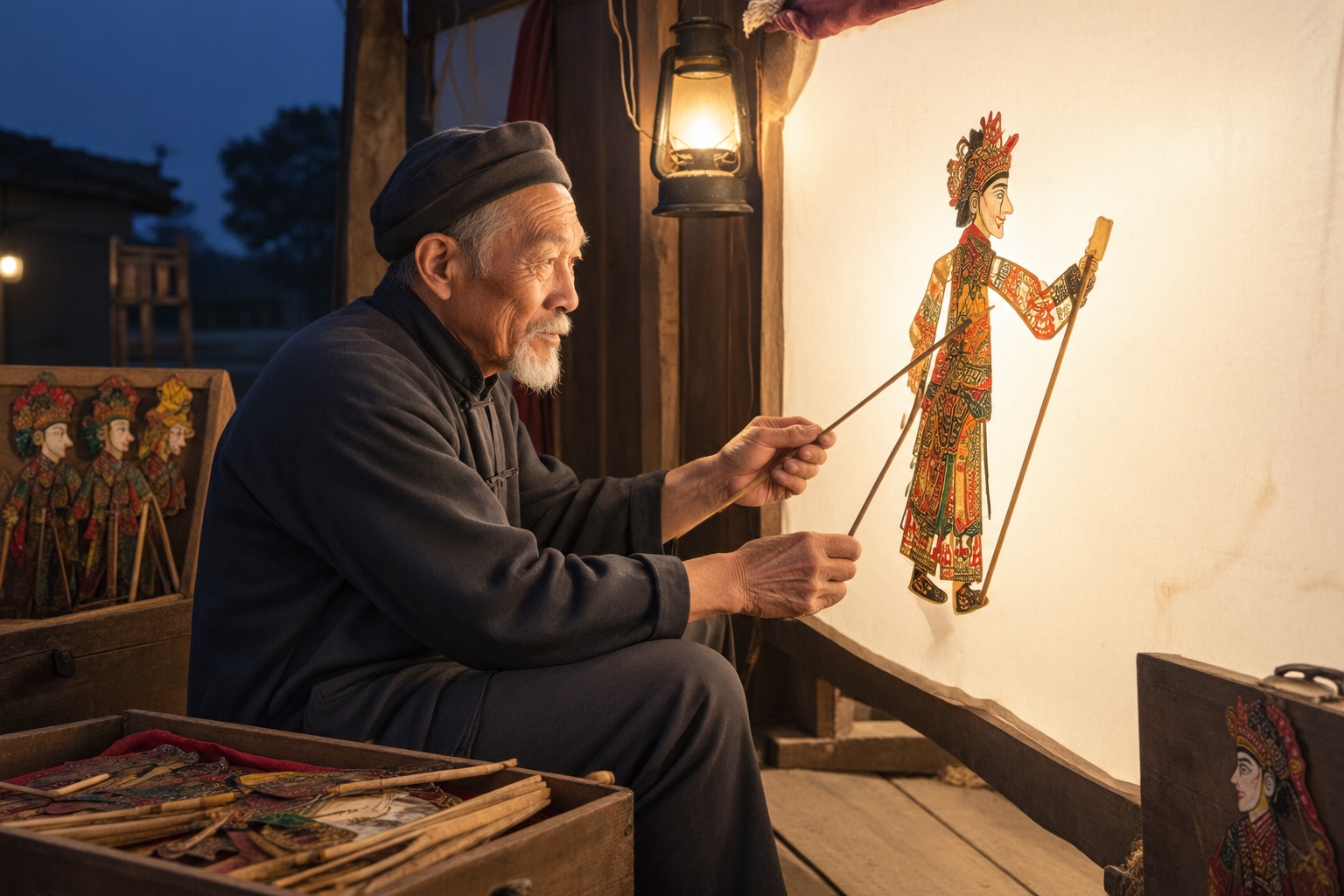
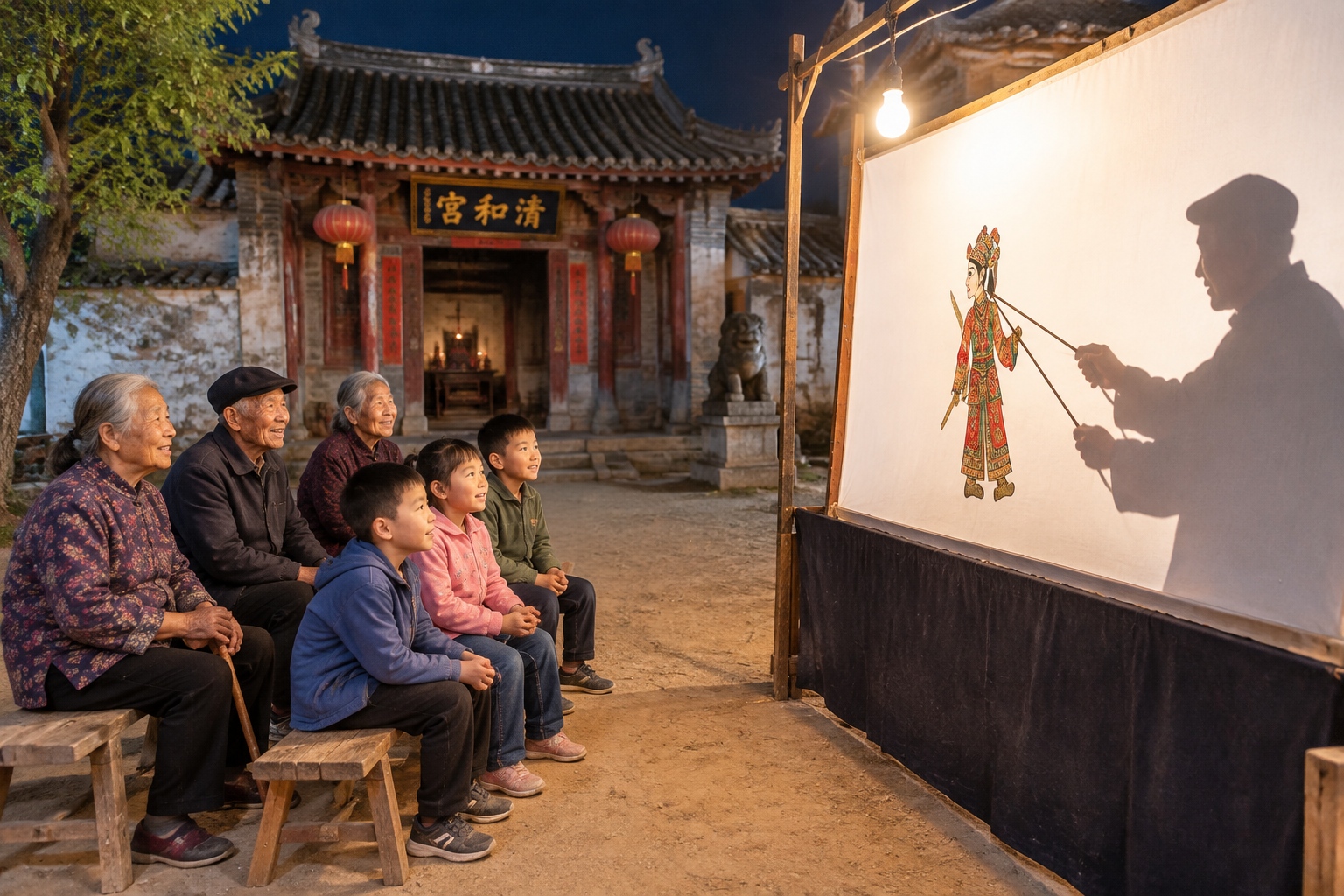
The village of Zhangqiao is not on any tourist map. At nine o’clock on a July night, the air still carries the day’s heat. In a small clearing in front of an old temple, a white cloth sheet is stretched between two bamboo poles. Behind it, a single electric bulb throws a circle of warm light.
An elderly man crouches behind the sheet, holding two thin sticks. On top of them is a leather puppet of a general, its face fierce, its robe painted in deep red and gold. When the man moves his wrists, the general strides across the fabric, and the audience – maybe fifteen old villagers and three restless children – falls silent. The screen glows. The general’s shadow becomes alive.
The man is Wei Jingsheng, 72. For forty years he has been a shadow puppeteer, one of the last in Huaxian, the district in Shaanxi Province once famous across China for its shadow play. His story is not a triumphant one. It is a story about what people hold on to when the world around them has let go.
Years ago, these performances would fill a square with hundreds of people. They would stay until midnight, wrapped in blankets, feeding the fire, passing jars of liquor. Now Zhangqiao has fewer than two hundred residents, most over sixty. The younger generations work in cities. The lantern still burns, but the square around it has grown older and quieter.
The Art That Once Ruled the Dark
Shadow puppetry in China is thousands of years old. Historians say it is one of the earliest forms of moving images, a direct ancestor of cinema. In the countryside of the northern plains, before television and smartphones arrived, the shadow altar was the only window to stories: tales of warriors, love, monsters, and gods.
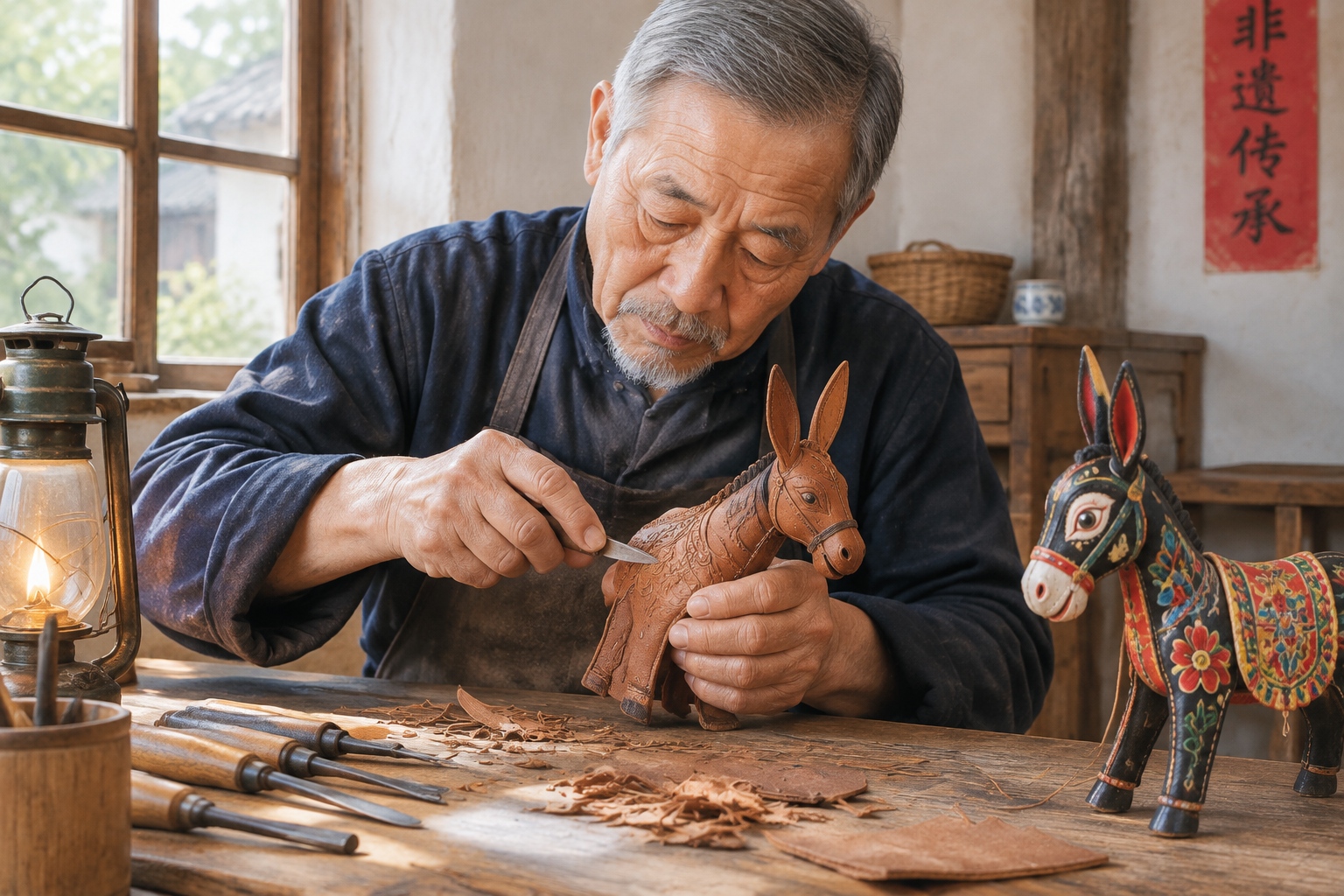
Huaxian was a proud center. Its puppets were carved from donkey leather, tanned thin as paper. A single puppet could take a week to shape: cutting the outline with a knife, piercing hundreds of tiny holes to let the light through, filling color, fitting the rods. The result, held against a lamp, looks like a stained-glass window from a chapel, but stranger and more alive.
The performers were not just entertainers. They were respected as people who could speak to the world of spirits. Invited to weddings, temple festivals, funerals, and ancestor ceremonies, they were expected to keep the dead company, to bring rain in a drought, to scare off illness. The stage was not a stage. It was a portal.
The decline began with loudly spoken electricity. When television entered the villages in the 1980s, the shadow play lost its role as the only moving image in the dark. People could see generals and monsters on a screen at home, without having to walk to a temple square. The old players found fewer invitations. Some retired. Some died. By the time UNESCO added Chinese shadow puppetry to its list of intangible cultural heritage in 2011, most old troupes had already packed their trunks.
The Master’s Hands
Wei Jingsheng’s hands are rough and scarred. The middle finger of his left hand bends at an angle – an injury from a year of carving leather in his twenties. But when he picks up a puppet, the hands stop being hands. They become a machine with no wasted movement.
He started as an apprentice at age fifteen, sent to the county town to study under a master named Sun. He slept on the floor behind the stage, learned the dozens of scripts by heart, practiced the footwork, the drum beats, the flutter of a cloak. At night he trained himself to hold a puppet arm perfectly still for ten minutes, so that only the intended part moved.
“This kind of work,” he told me, “does not let you run. You must sit, and wait, and listen.” He picked up a puppet of a young lady, put her rods in his right hand, made her tilt her head just slightly. The gesture was almost human.
He also makes his own puppets. In a wooden chest under the stage, he keeps thirty-five characters: generals, emperors, demons, a white-bearded magistrate. Some were made by his teacher’s teacher. The leather is old and dark, but the colors still bloom when the light is on.
The carving is a ritual of patience. He traces the character’s face onto the leather with a bamboo pen, then cuts along the outline with a chisel-like knife. The eyes, the eyebrows, the beard – every detail demands a separate piercing tool. He spends an hour on a single sleeve. “The light will not forgive mistakes,” he says. “If a hole is too big, the face will have a white dot forever.”
Why They Won’t Stop
The economics of shadow puppetry are brutal. Wei Jingsheng charges about 800 yuan for a full night show, but with the cart, the costume, and four days of preparation, he often earns less than 200 yuan. That is about 28 US dollars. He does not do it for the money.
“When I take the puppet out, I become someone else,” he said. “The men in the audience are not just villagers. They are the soldiers who never went home. The women I put on the screen are the daughters every family lost. The lantern is a kind of bridge. If I don’t cross it, they are on the other side alone.”
The local government gives him a small annual subsidy as a “representative inheritor” of intangible cultural heritage – about 10,000 yuan a year. It covers his medicines and his phone bill. It does not cover the cost of performing. He uses the subsidy to buy donkeys when he needs new leather.
Other old masters have died with their scripts unrecorded. The cultural center has tried to archive them, but the last living memories are fragile. When a village asks Wei to play for a festival, he almost always says yes, even at a loss.
He shows me a small notebook with names of ancestors written in pencil. “These are the families who paid for the show tonight. The show is for their ancestors. They may be gone, but they still expect the general to ride once a year.”
The New Audience
For the first time in decades, Wei Jingsheng has begun to see unfamiliar faces at his performances. A young man from a city film institute came with a camera and sat motionless for four hours. A television crew staged a “revival” of shadow puppetry in a studio. A short video on Douyin, the Chinese version of TikTok, brought 20,000 clicks to a clip of Wei’s hands manipulating the puppet.
The attention is real, but it is not enough to make a living. Wei’s own son works in Xi’an as a construction worker. He knows the puppets are beautiful, but he cannot spend his life scraping leather in a village when a monthly wage is three times more reliable. “I don’t blame him,” Wei says. “The lantern is warm, but it has never heated a house.”
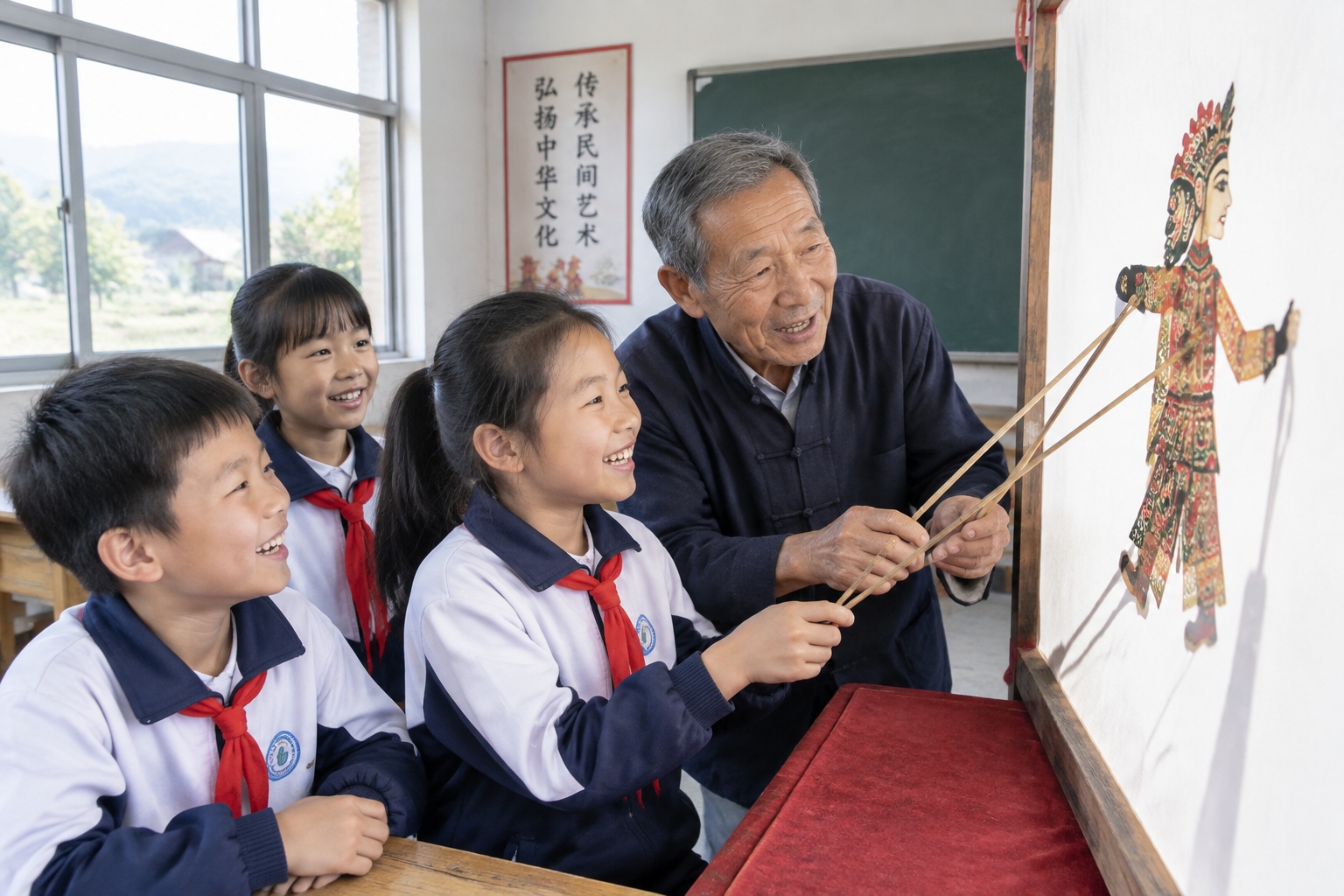
There are some younger people trying. A school in the county now has a shadow-puppet workshop for children. Wei goes there twice a month. He teaches them a few simple movements, and sometimes the kids laugh when the puppet’s head falls off. But he sees one or two pairs of eyes that stay serious.
Researchers are also experimenting with digitization. A university team came with a 3D scanner and recorded his every movement. They asked him to speak every line of a play called “The Palace of Eighteen Beats.” He spent three days repeating the old verses. At the end, the team thanked him and said the files would be saved forever. “That data will not get tired,” Wei said. “But it will not drink tea with the ancestors either.”
Before the Lights Go Out
At the end of a performance, Wei Jingsheng does not take a bow. He unclips the white screen, folds it carefully like a flag. He removes each puppet from its rod and lays it back in the chest, wrapped in silk. The last puppet is the general. He wipes dust from the general’s face and mutters something under his breath.
The electric bulb is snapped off. The temple courtyard falls into thick darkness. The other actor, a younger man in his sixties, packs the drum and the horn. They share a cigarette in silence.
I ask Wei what he hopes for. He laughs. “I hope the taxi leaves enough room for my chest.” Then he grows serious. “Maybe someone, one day, will turn on a light in a city apartment and want to see what this old ghost does. I will not be there. But the general will.”
He has already arranged for most of his collection to go to the Huaxian Museum after his death. But he has kept one puppet for his grandson – a young warrior, freshly carved, not yet painted. “This one is for my grandson,” he said, lifting it to the evening light. “Whether he wants it or not, someone in this family will know how to hold a rod.”
His shadow stretches long on the ground as he walks toward a new LED streetlamp at the edge of the village. Behind him, the stage is dark. For now.
What Comes After
China’s shadow puppetry is not completely dead. There are troupes in museums, in tourist towns, on digital archives. A few young masters have emerged through cultural programs. The Huaxian Shadow Puppet Museum keeps thousands of pieces. But the old ritual – the one-night-a-year connection to ancestors, the smell of leather and dust, the raw voice cracking with age – has crossed into a zone where it cannot return.
That does not mean the practice is useless. It means that what Wei Jingsheng does is no longer performance. It is an act of memory kept alive by a stubborn man and a small lamp, for an audience of ghosts and a few people who remember.
The blank leather face of the grandson’s puppet, still empty, showed everything. The light was going down, but someone was still carving in the dark.
Start the discussion at forum.chinacomes.com