
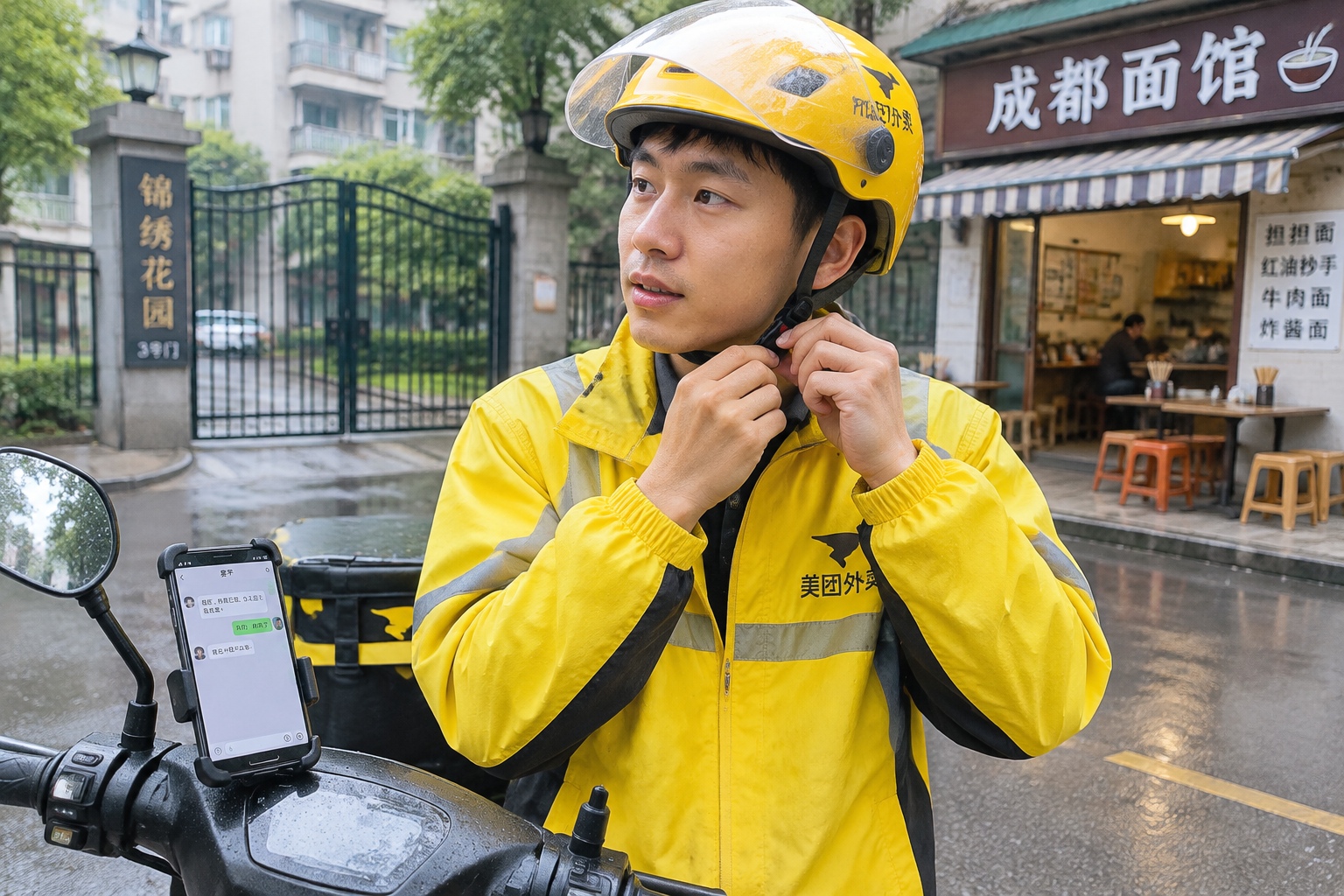

At 11:40 on a wet Tuesday morning in Chengdu, Li Wei’s phone starts buzzing against his chest. Not ringing — buzzing. A short-short-long pattern he feels through his jacket. He is 28, deaf since birth, and he has three orders to move across a neighbourhood of gated apartment blocks before the countdown on his screen turns red.
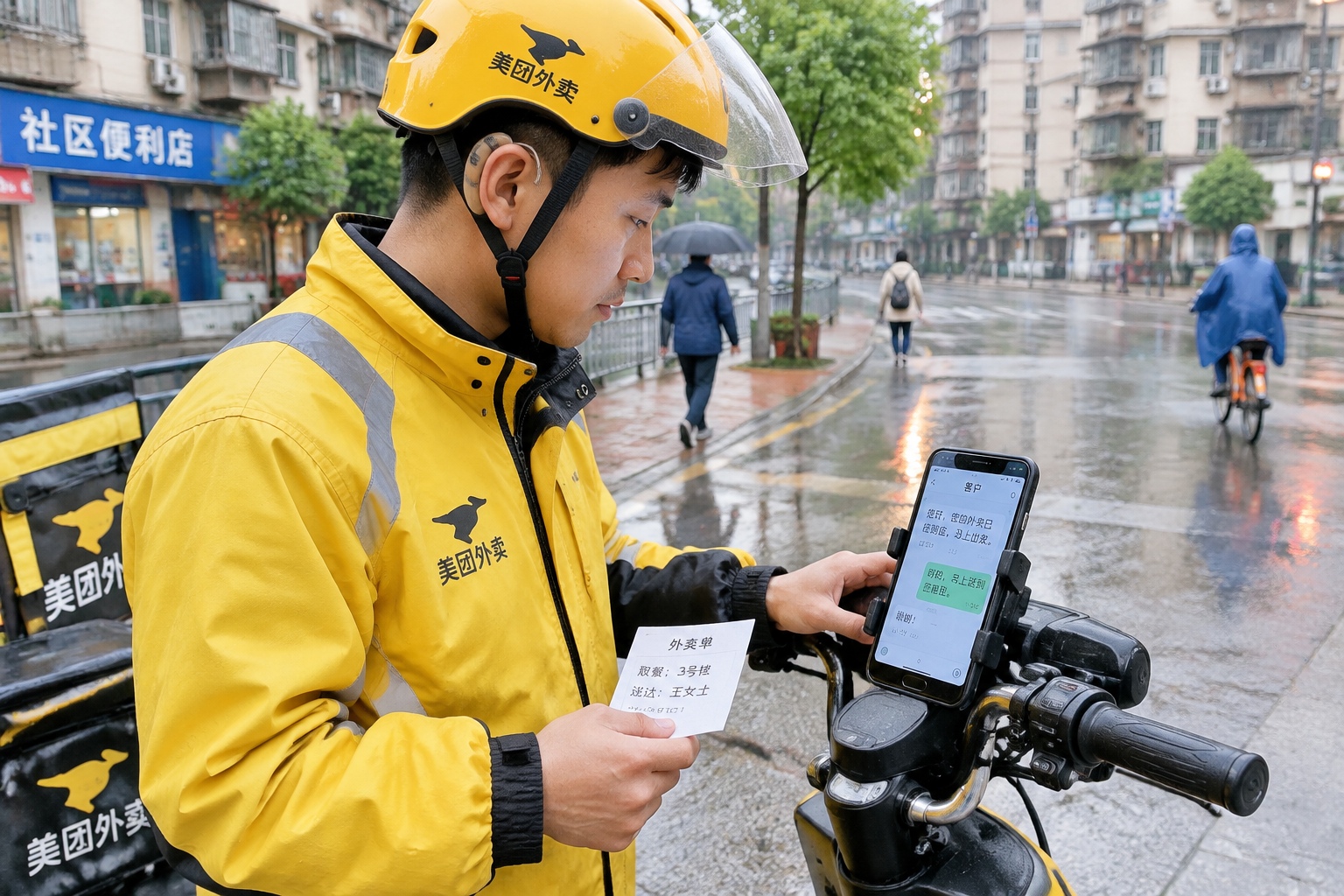
The screen tells him what a phone call tells other riders: restaurant, address, deadline, notes. He taps a message that now travels with every order he accepts — “I’m a hearing-impaired rider, please contact me by text” — and clips the helmet strap under his chin. Then he rides.
Why Delivery Work Fits Deaf Riders
China’s official statistics count roughly 85 million people with disabilities, and hearing and speech disabilities are among the largest groups. For decades, the jobs available to deaf workers clustered in a few places: printing plants, garment factories, assembly lines. Steady, quiet, and usually poorly paid.
Food delivery looks like an odd upgrade. It is outdoors, weather-beaten, physically punishing, and paid by the order rather than by the hour. But it has one feature that matters enormously if you cannot hear: almost the entire job happens in text. The order arrives in the app. The address arrives in the app. When something goes wrong, the customer usually types first. A rider who cannot hear a phone is not automatically a rider who cannot do the job.
Riders I met in Chengdu say a normal day brings in 150 to 300 yuan before battery swaps, meals and scooter costs; a slow, rainy day can drop below 100. That is not a fortune. For many deaf workers, though, it is more than they earned before, and it comes with something harder to measure: they are out on the street, working alongside everyone else, instead of behind a factory wall.
What the Technology Actually Does
Orders you can feel
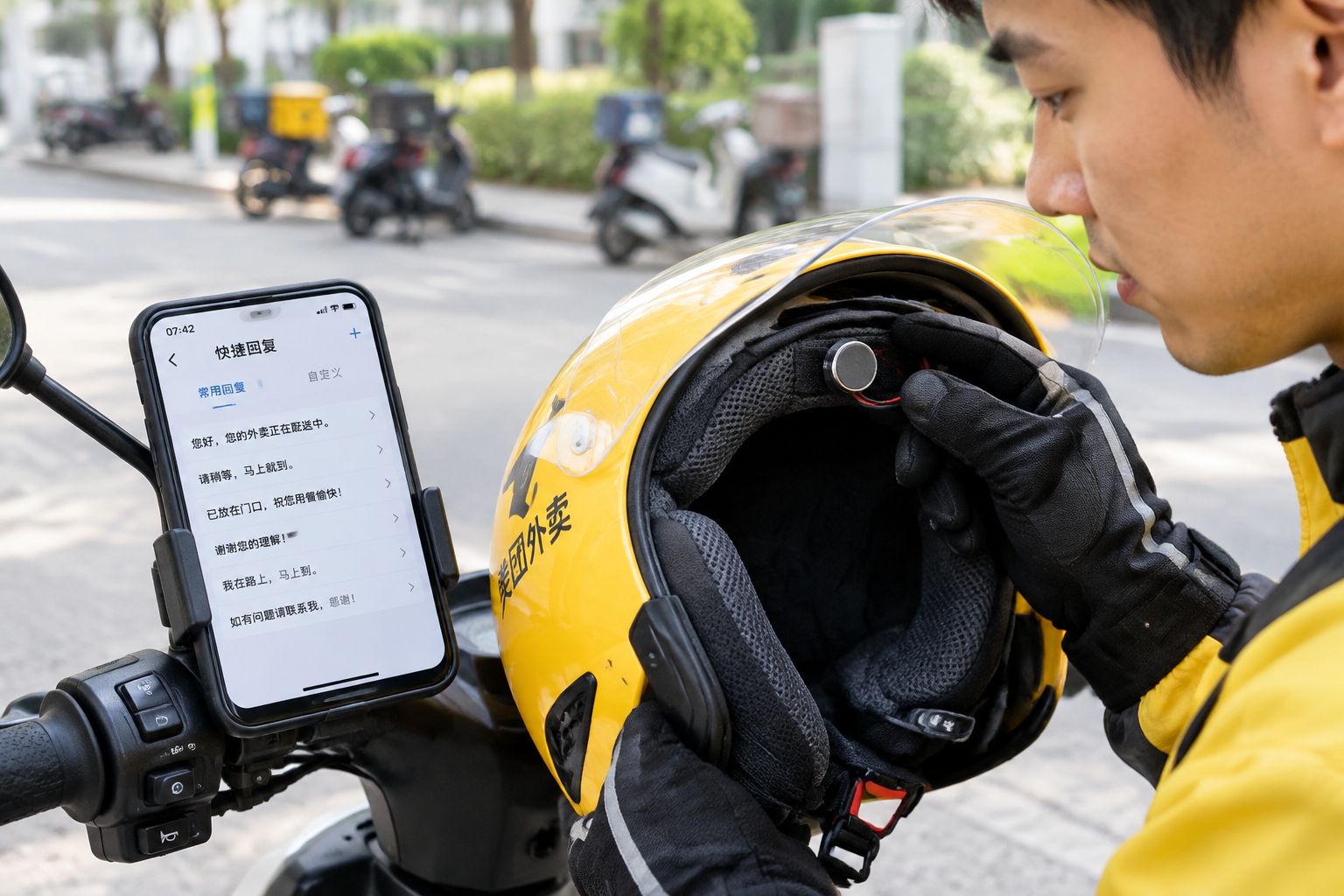
Li Wei’s phone never makes a sound. Instead it produces vibration patterns: two short pulses for a new order, a long buzz when a delivery window is closing, a steady rhythm for an incoming message. Inexpensive smart helmets sold for riders add a second channel — a small motor on the left or right side of the headband taps the temple when it is time to turn, so he does not have to look down at a screen in traffic.
Speech-to-text, and text-to-speech
Chinese apps such as iFlytek’s Tingjian convert speech into text in real time, and the main delivery platforms now build live captions and “text call” modes into their rider apps. In theory the rider types, the system reads it aloud to the customer in a synthetic voice, and whatever the customer says comes back as captions on screen.
In practice, many riders skip the voice part entirely. Zhou Lan, 34, who works the northern half of the city, keeps a set of saved replies: “I’ve arrived,” “Please come down to the gate,” “The lift needs a key card,” “I’m sorry, I can’t hear you.” Four taps, and the conversation is over before it becomes an argument.
The low-tech parts that still matter
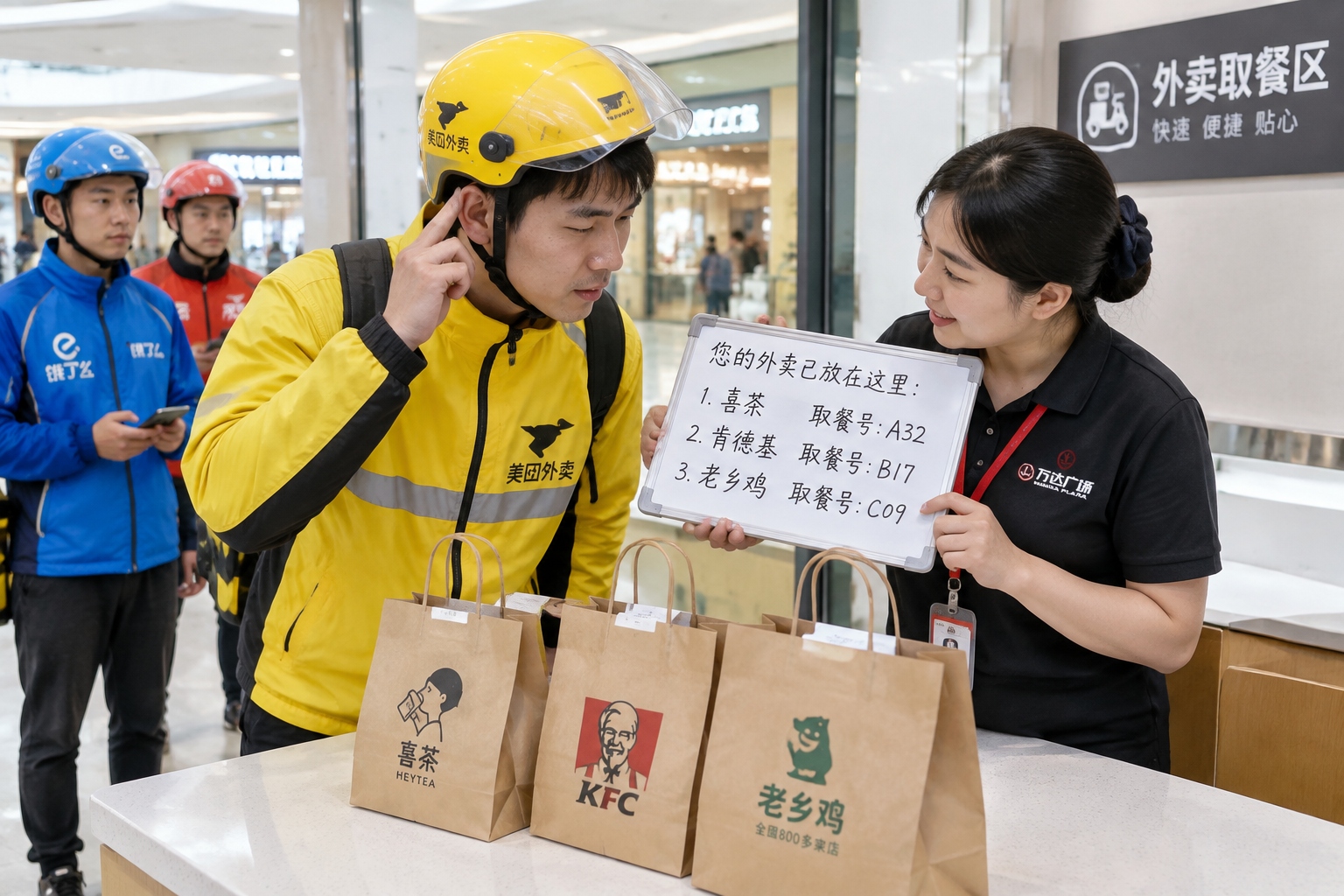
Not everything is software. Most riders carry a stack of pre-printed slips and a marker. Zhou Lan writes the order number and a short note on every bag, and she keeps a whiteboard pen in her scooter box for the buildings that have a board at the security desk. In one residential compound I visited, the guard now recognises her scooter and writes the visitor code on a scrap of paper without being asked. That took two months of showing up, and no technology at all.
Inside the “Barrier-Free Delivery” Pilots
Since around 2021, several Chinese cities and delivery platforms have tested what they call barrier-free delivery (无障碍配送). Chengdu is one of the places where the idea has been tried, alongside Hangzhou and Shenzhen. The programmes differ, but the components repeat: a designated pickup counter at busy shopping malls, staff trained to communicate in writing instead of shouting an order number across a crowd, community notice boards telling residents that some riders cannot hear, and app settings that make text the default channel for a given account.
Platforms have also been competing on accessibility features. Ele.me has publicly discussed its “silent riders” since 2018 and built captioned calling into its courier app; Meituan has added hearing-impaired rider modes with visual and vibration-based alerts, plus reminder messages that nudge customers to reply in text. Company statements have put the number of hearing-impaired riders on the major platforms in the thousands — a small share of a workforce of several million, but a visible one in a city like Chengdu, where you will occasionally see two deaf riders signing to each other while they wait for the same order.
Where It Still Falls Short
This is the point where the story usually gets told as a clean tech success. It is not one.
The most common failure is human, not technical. A customer who insists on calling. A building intercom that only produces sound. An elevator that requires a phone call to the management office. Any of these can turn a competent rider into an “unreachable” one. Some customers never read the note. Ratings drop. Pay gets docked.
Speech-to-text is better than it used to be, but it stumbles on regional dialects, street names and fast, irritated speech. Older deaf riders, or those who left school early and read slowly, find text-heavy apps exhausting rather than freeing. Accessible settings are often buried three menus deep, and a rider only benefits from a feature he knows exists. Technology that nobody is taught to use is not really accessibility; it is a hidden switch.
Then there is the structure of the work itself. Gig delivery has no fixed wage, no paid sick leave and, until recently, thin injury protection. Deaf riders are safer than the stereotype suggests — most are careful and unusually alert to traffic — but they cannot hear a horn or a shouted warning, and the road does not care about fairness. And a job that happens in fifty-second exchanges at doorways is not the same thing as being included in a workplace. The contact is warm, but brief. Full inclusion is not a feature a platform can ship.
What Riders Ask For Next
Ask riders what would help and you get practical answers, not slogans. Make the “text only” flag visible to customers from the moment they order, instead of buried in a note nobody reads. Fix captioning for phone calls. Put accessible pickup points in more malls, and train the staff who work at them. Give new riders a human being to ask questions on day one. And, over and over: slow the clock down a little. A two-minute buffer on orders going to buildings with no lift would cost almost nothing and remove a real source of daily pressure.
Li Wei finishes his shift at 9:20 that night, 38 orders, jacket soaked through. He eats at a noodle shop near the compound where he parks his scooter. The owner has stopped asking what he wants and writes it on the order pad instead. It is a small thing — a pen and a habit — and it does more for him than any app update this year.
That is the honest version of the story. Technology did not solve disability, and it never will. But a job built out of text, vibration and a screen turned out to be one place where being deaf is not an automatic disadvantage. In a labour market where that is rare, it is worth noticing — and worth pushing further.
Start the discussion at forum.chinacomes.com