

A Morning That Takes Planning
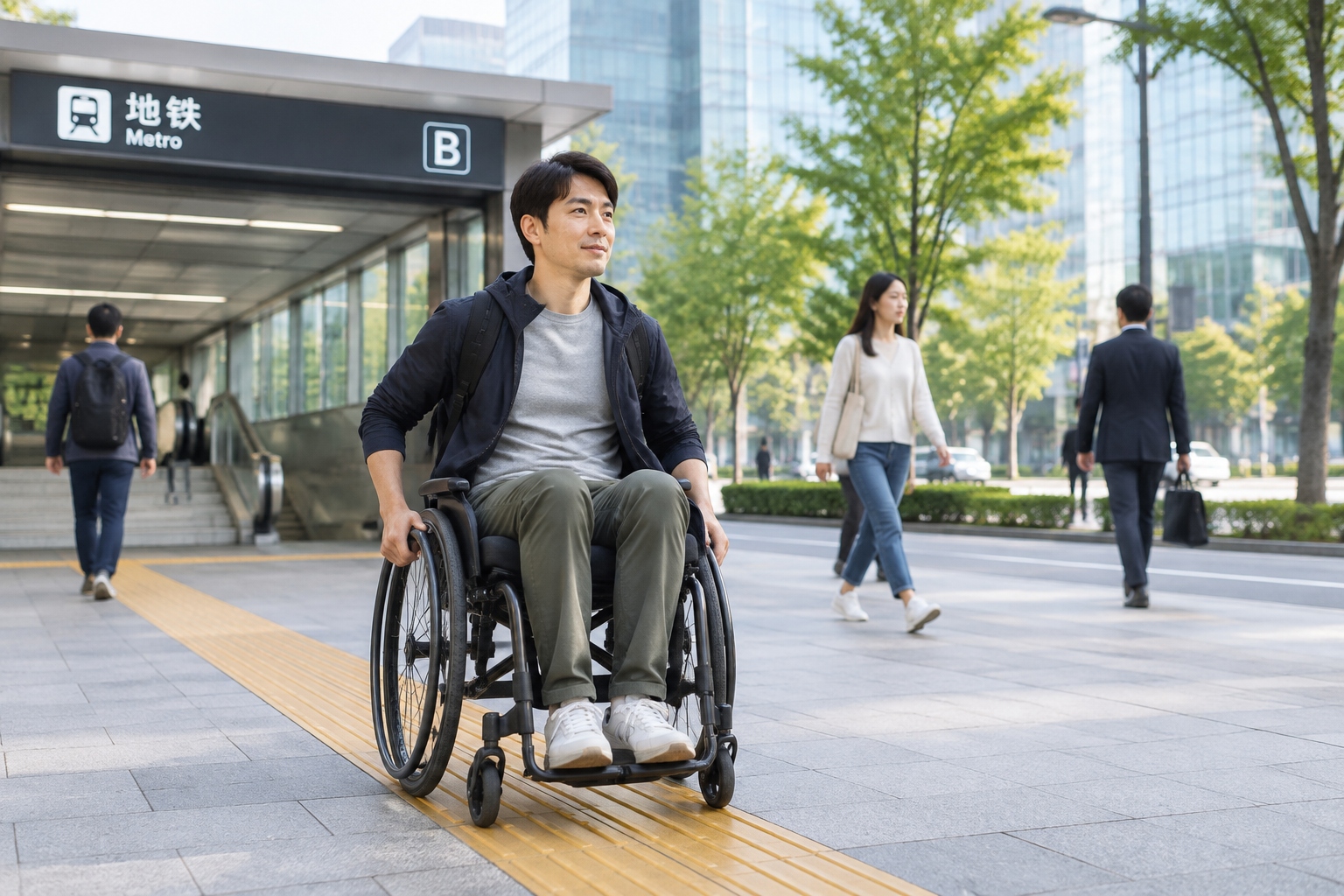
On a Tuesday morning in Shanghai, Chen Wei leaves his apartment at 7:40. The ramp at the building entrance is new—poured last year when the compound was renovated. It is about 1.2 metres wide, with a handrail on one side. He rolls down it without pausing.
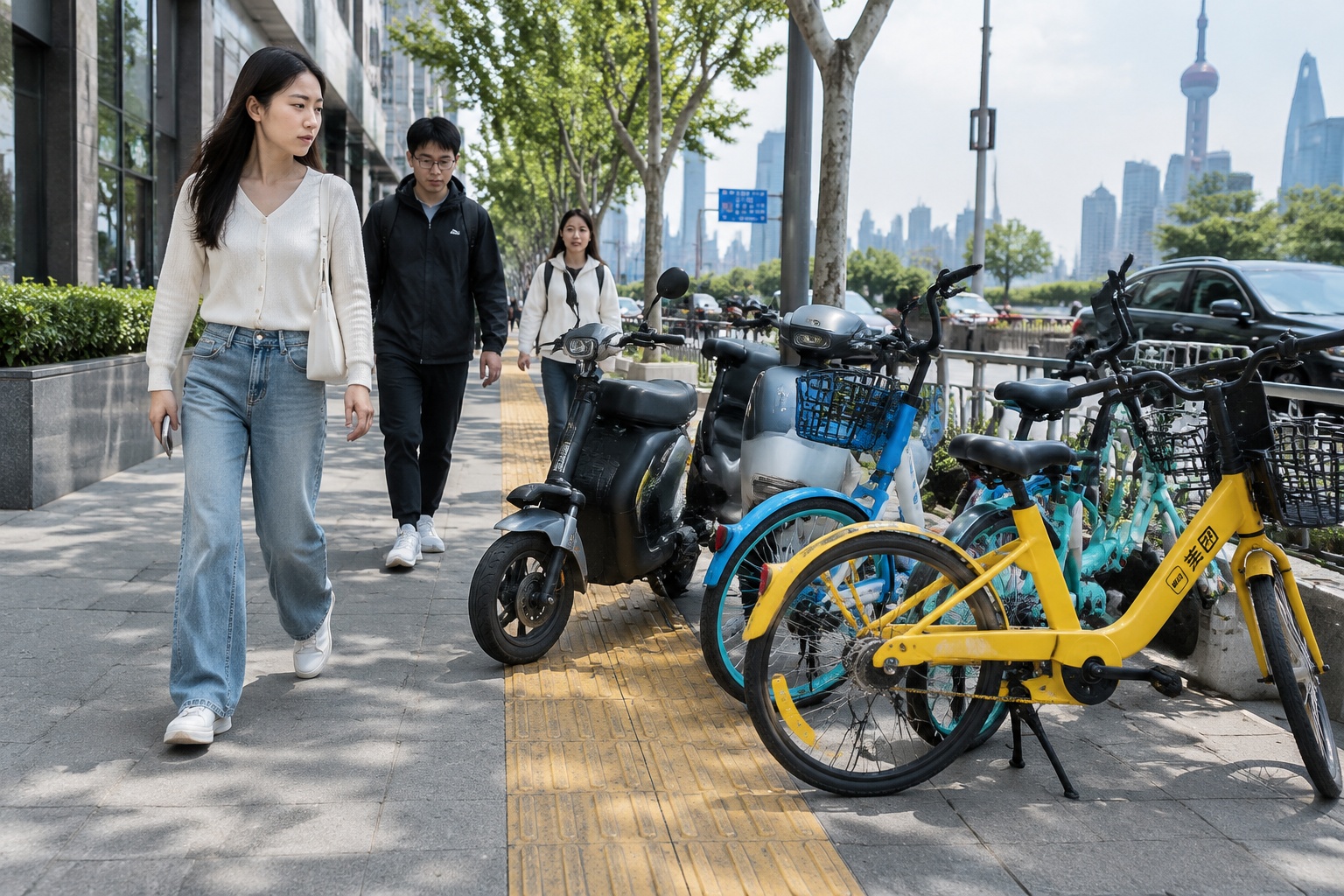
Two hundred metres later, he stops. The tactile paving—the yellow strip with raised bars and dots that runs along the pavement—disappears under a row of shared bikes. He swings onto the road, waits for a gap in the electric scooters, and rejoins the strip after the intersection.
His commute to the metro station takes twelve minutes on a good day. On a bad day it takes twenty-five, because he has to ask someone to move a bike or find another way around a delivery van parked over the kerb ramp.
Chen, 38, works as a data analyst in Jing’an district. He has used a wheelchair since a spinal injury eight years ago. His route is not unusual. It is the ordinary arithmetic of accessibility in a Chinese city: some parts work, some don’t, and the difference decides whether he arrives at the office calm or exhausted.
What Is Actually on the Ground
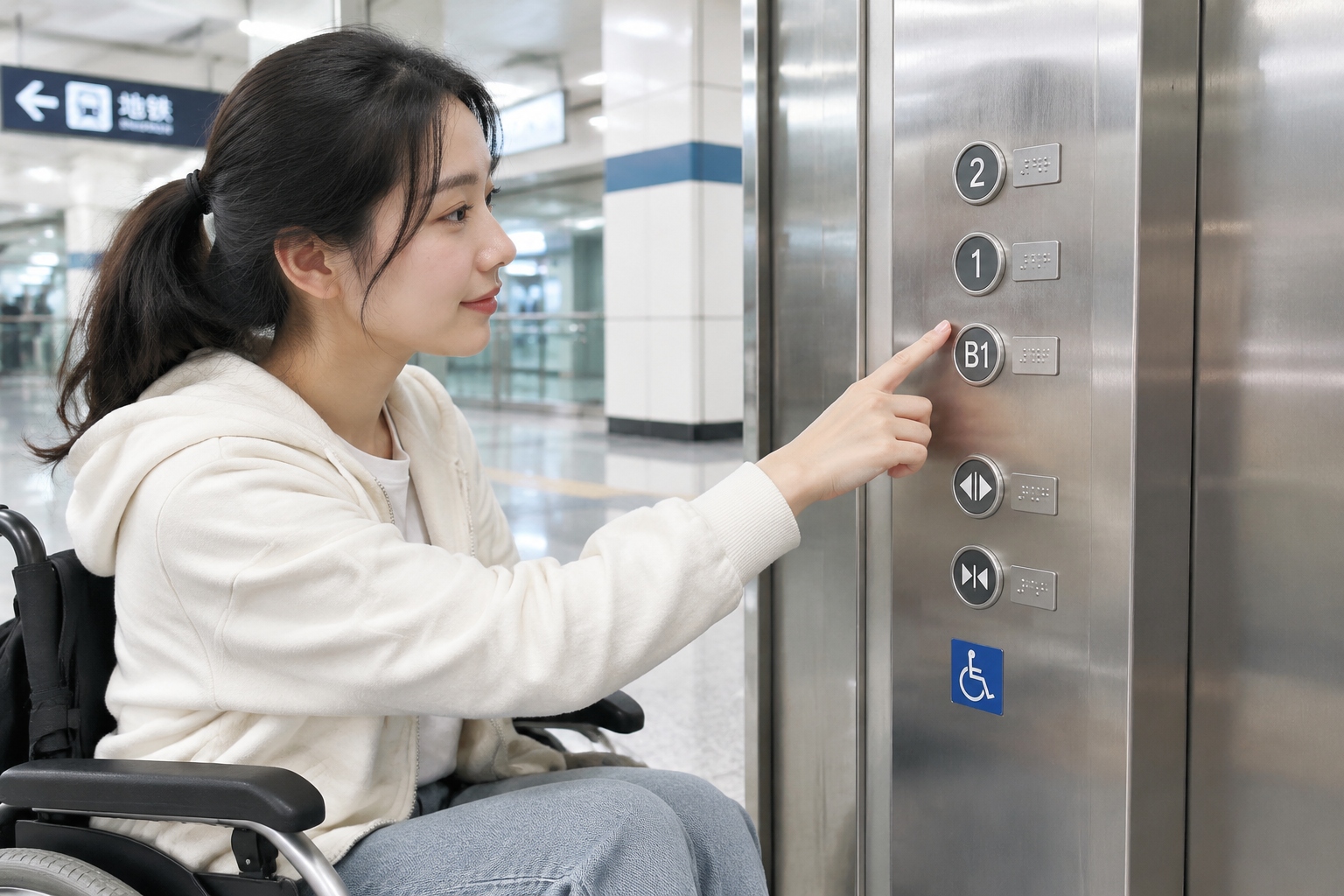
Walk down almost any main street in a Chinese city and you will see the hardware of accessibility. Tactile paving (盲道, mángdào) lines the pavements—yellow strips with raised bars that mean go and dots that mean turn or stop. Kerbs have ramps at crossings. Traffic lights at busy intersections chirp when the pedestrian signal turns green. Metro stations built in the past fifteen years usually have lifts, not only escalators. Lift buttons in public buildings are increasingly placed at wheelchair height, with Braille beside them. Accessible toilets and lower service counters have become standard in newer stations, airports and government buildings.
This did not appear overnight. Tactile paving reached Beijing in the 1990s, and the 2008 Paralympics pushed cities to build more. A 2012 regulation set national rules. The bigger shift came on 1 September 2023, when the Barrier-Free Environment Construction Law took effect—China’s first law devoted specifically to accessibility.
The law covers more than ramps. It requires new and renovated residential buildings, public buildings, transport hubs and roads to meet accessibility standards, and says they should be planned, designed, built and accepted together. If a project fails the accessibility standard, it should not pass final inspection. The law also addresses information access: government websites and apps are expected to become usable for people with visual or hearing impairments.
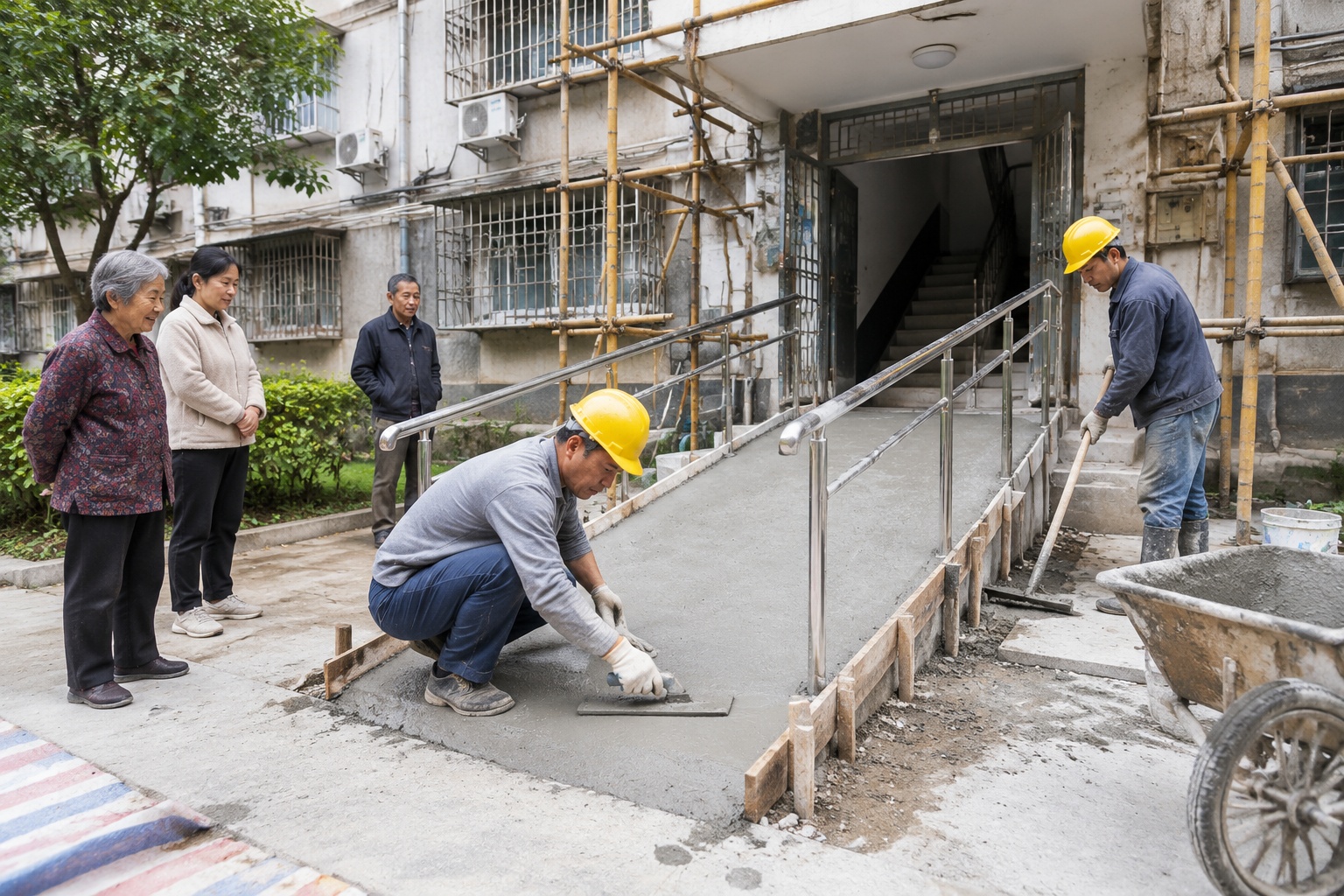
Standards are set nationally but implemented locally. Cities and counties have been assessed under a barrier-free environment programme since 2016, with a second round running through 2025. In older neighbourhoods, renovation projects have added ramps and, in some cases, lifts to walk-up buildings.
Where It Still Breaks Down
The gap between the rulebook and the pavement is where most daily experience lives. A few things go wrong again and again.
Tactile paving is blocked. Shared bikes, delivery scooters, shop displays and parked cars are common culprits. Some strips end abruptly at a wall or lead into a pole. Blind users describe routes that require memorisation and, often, a sighted companion the first few times.
Ramps are built at the wrong angle. A standard kerb ramp should be gentle enough for a wheelchair user to climb without help; in practice, some are steep, narrow, or blocked at the top by a gate or a parked vehicle. A ramp that exists but cannot be used is not much better than no ramp.
Lift buttons are sometimes too high, or the Braille is worn away, or the lift itself is out of service for weeks. In older metro stations, the accessible route may exist but be long and indirect—one line in central Shanghai requires a wheelchair user to leave the station and re-enter through a different entrance to change platforms.
Information is fragmented. A station may have a lift, but no map shows where it is. A bus may be low-floor, but the driver may not know how to operate the ramp. Connections between metro, bus and taxi are often the weakest link.
Not Every City Moves at the Same Speed
Accessibility in China looks very different depending on where you are. Central districts of Beijing, Shanghai, Guangzhou and Shenzhen have the most complete networks—lifts, audible signals, accessible toilets and staff training. Newer developments, built after the 2012 standards, tend to be better than older ones because accessibility was part of the original design.
Old urban neighbourhoods are the hardest. Narrow lanes, historic buildings and tight budgets make retrofitting slow. In smaller cities and county towns, tactile paving and ramps are increasingly common on main roads, but maintenance and consistency lag. A 2021 survey by a disability network found that while most large cities had accessible facilities on paper, the share that worked without assistance was much lower.
Who Is Pushing the Change
The pressure comes from several directions. Disabled people’s organisations, including local branches of the China Disabled Persons’ Federation, run surveys and file complaints. Community workers in older neighbourhoods mediate between residents who want lifts and those who do not want to pay for them. Designers and architects have begun to treat accessibility as a professional standard rather than an add-on. Volunteers audit routes and post photos of blocked tactile paving online.
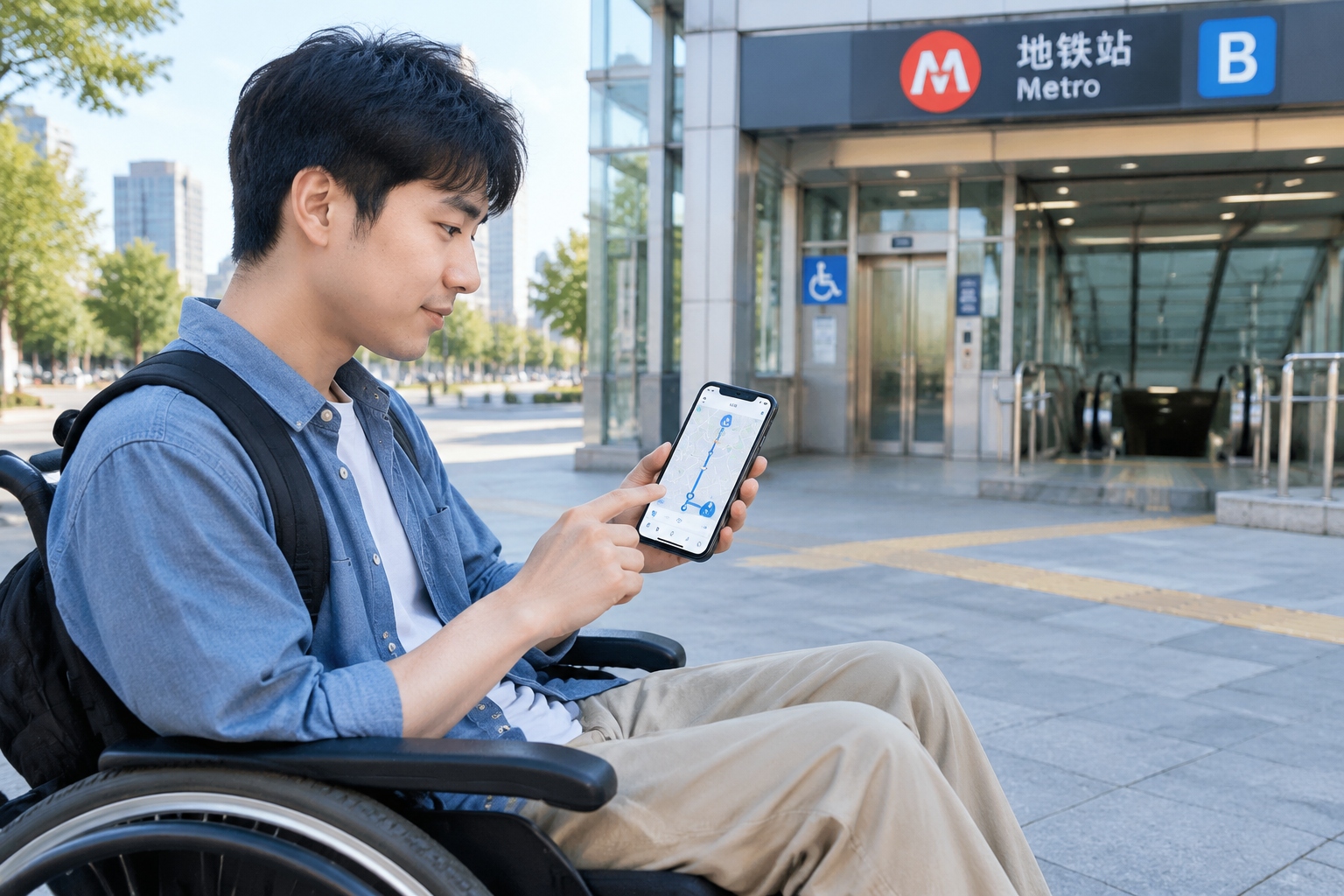
Companies are part of it too. Amap, the mapping app owned by Alibaba, launched a wheelchair navigation mode in 2022 that routes users around stairs and steep slopes and flags accessible metro entrances. Ride-hailing platforms have added accessible vehicles in some cities, though supply is small. Public feedback channels, including the 12345 hotline, are used to report broken facilities.
What Technology Can and Cannot Fix
Technology has made some things easier. Voice prompts on phones read out bus arrivals. Sign-language translation apps help at service counters. Remote assistance connects a blind user to a sighted volunteer through a phone camera. Accessible ride-hailing reduces the need to flag down a taxi.
But none of it replaces a working lift. An app can tell you a station has an accessible exit; it cannot clear the bike blocking the tactile paving. The most useful technology tends to be the kind that connects people to physical infrastructure that already exists—and the most common frustration is infrastructure that exists but does not work.
Why This Matters Beyond Disability
For readers outside China, accessibility can look like a niche concern. In practice, it is a preview of a much wider problem. China had 297 million people aged 60 or over at the end of 2023—about 21 per cent of the population. That number is rising. A city that works for a wheelchair user also works for an 80-year-old with a shopping trolley, a parent pushing a pram, a traveller dragging a suitcase, and anyone recovering from a leg injury.
The same kerb ramp that helps Chen also helps the delivery worker with a handcart. The same lift that gets him onto a metro platform helps the grandmother with a foldable cart of vegetables. Accessibility, in this sense, is not a special service. It is the baseline of a public space that expects people to move independently.
Back to the Morning
Chen reaches his office at 8:35. The route worked, but it required attention: watching for bikes, choosing the wider crossing, remembering which metro entrance has the lift. He did not need help. That is his measure of a good system.
China’s accessibility law has given cities a clearer standard and a legal duty. The facilities are visibly multiplying. The harder work is maintenance, consistency and the small daily details that decide whether a person can leave home without planning every metre. The test is not how many ramps a city builds. It is whether someone can go out, alone, and expect to arrive.
Start the discussion at forum.chinacomes.com