

A gate on a mountain, and a family that ruled for 725 years
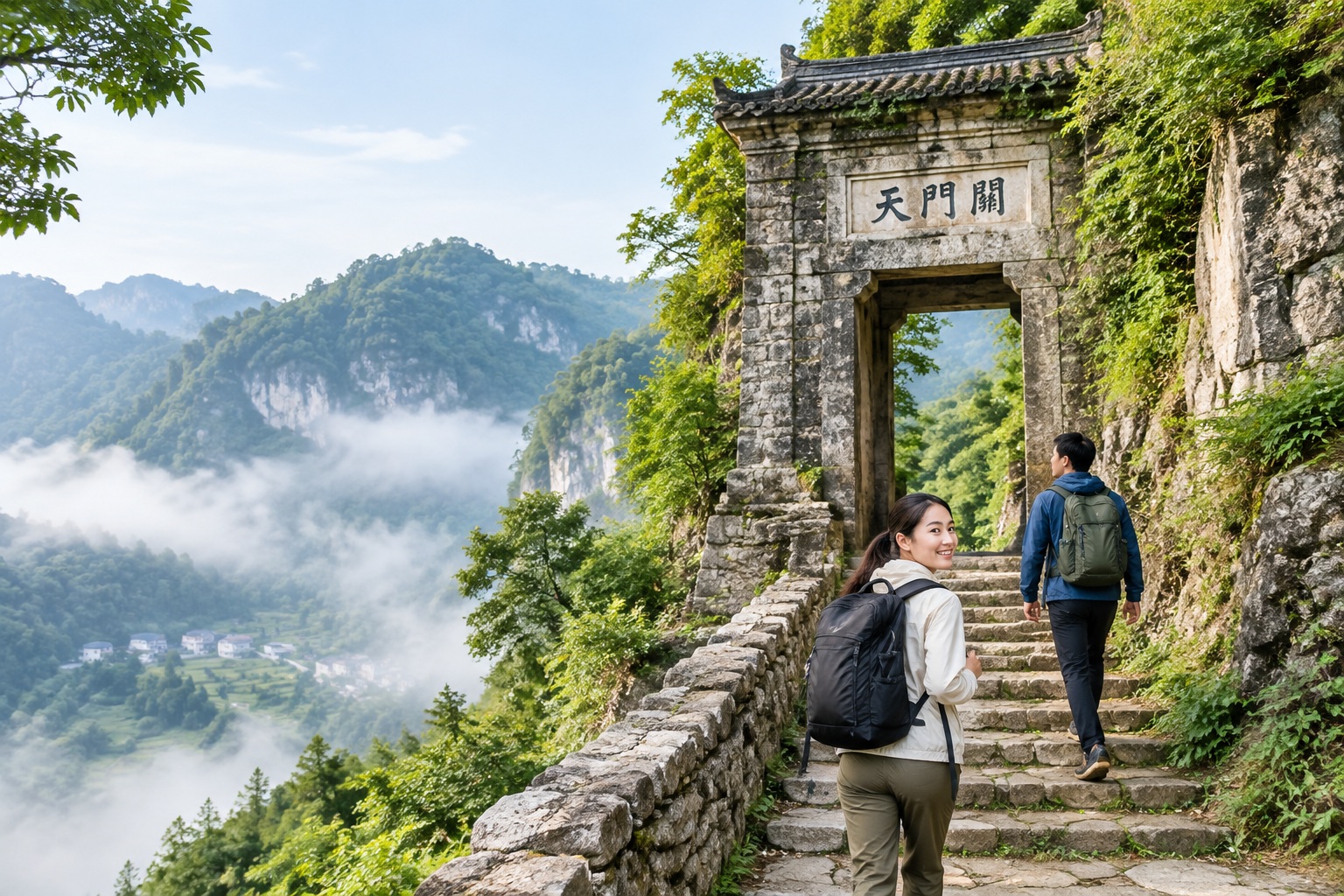
From the cable car, the ridge above Zunyi looks like any other green hill in Guizhou. Then the trees open, and there is a stone gate set into the rock, with a view straight down a valley that has been farmed for a thousand years. Visitors climb the last stretch on foot, past walls that follow the cliff line.
The place is Hailongtun, “Hailong Fort,” one of three sites in southwest China added to the UNESCO World Heritage List in 2015 under the name Tusi Sites. Local guides say the same thing at the top, because it is the number that stops people: “The Yang family ruled this valley for 725 years. When the Ming army came in 1600, it took them 114 days to take this one mountain.”
Twenty-nine generations. The Yang family held the valley from the late Tang dynasty, through the Song, the Yuan and most of the Ming — longer than most European dynasties kept a crown. They were not kings, and they were not quite officials either. They were tusi (土司).

What a tusi actually was
Tusi is usually translated as “native official” or “hereditary chieftain.” The system took shape under the Yuan dynasty in the 13th century, matured under the Ming (1368–1644), and continued into the Qing. It covered the mountainous southwest: today’s Yunnan, Guizhou, Guangxi, Sichuan, and parts of Hunan and Hubei — the least flat, least connected, most ethnically mixed corner of the country.
The court’s problem was practical. Sending a magistrate from the capital into a valley several weeks’ travel away, where people spoke another language and the roads washed out every summer, was expensive and often fatal. So the empire did something pragmatic: it recognised whoever already held local power and gave him a title, a rank, a bronze seal and a document. He kept his soldiers, his courts, his land and his tax income — and passed them to his son.
In everyday life, that meant two systems running inside one empire. A farmer in Yongshun, in what is now Hunan, paid grain to the Peng family, not to a magistrate sent from Nanjing. Disputes went to the tusi’s court. The tusi decided who paid how much, who could move, and who could marry whom.
It is easy to read that as independence. It was not. It was a contract, and the terms were specific.
Tribute, soldiers, and a son in the capital
What did a tusi owe? Tribute, regularly: horses, tea, timber, medicinal herbs, sometimes silver. Soldiers, when the court called. Open roads and working post stations. A personal appearance at court when required.
What did he get? Confirmation of his title, the right of hereditary succession, and fairly often imperial troops when a neighbour or a relative moved against him.
The Ming added a detail that shows how the relationship really worked. Tusi heirs were required to study at the Imperial College, first in Nanjing and later in Beijing. They learned the Confucian classics, court etiquette and the capital’s Mandarin. On one level this was education. On another it was insurance — a son who speaks the court’s language and reads its books is a son less likely to raise a banner against it.
The court also kept its options open. Recognition could be withdrawn. A domain could be split in two, or a rival branch of the family promoted over the sitting tusi. Chieftains fought each other constantly, and Beijing’s seal often decided who won the argument.
Three sites, three families
The three World Heritage sites were chosen to show three stages of the same system.
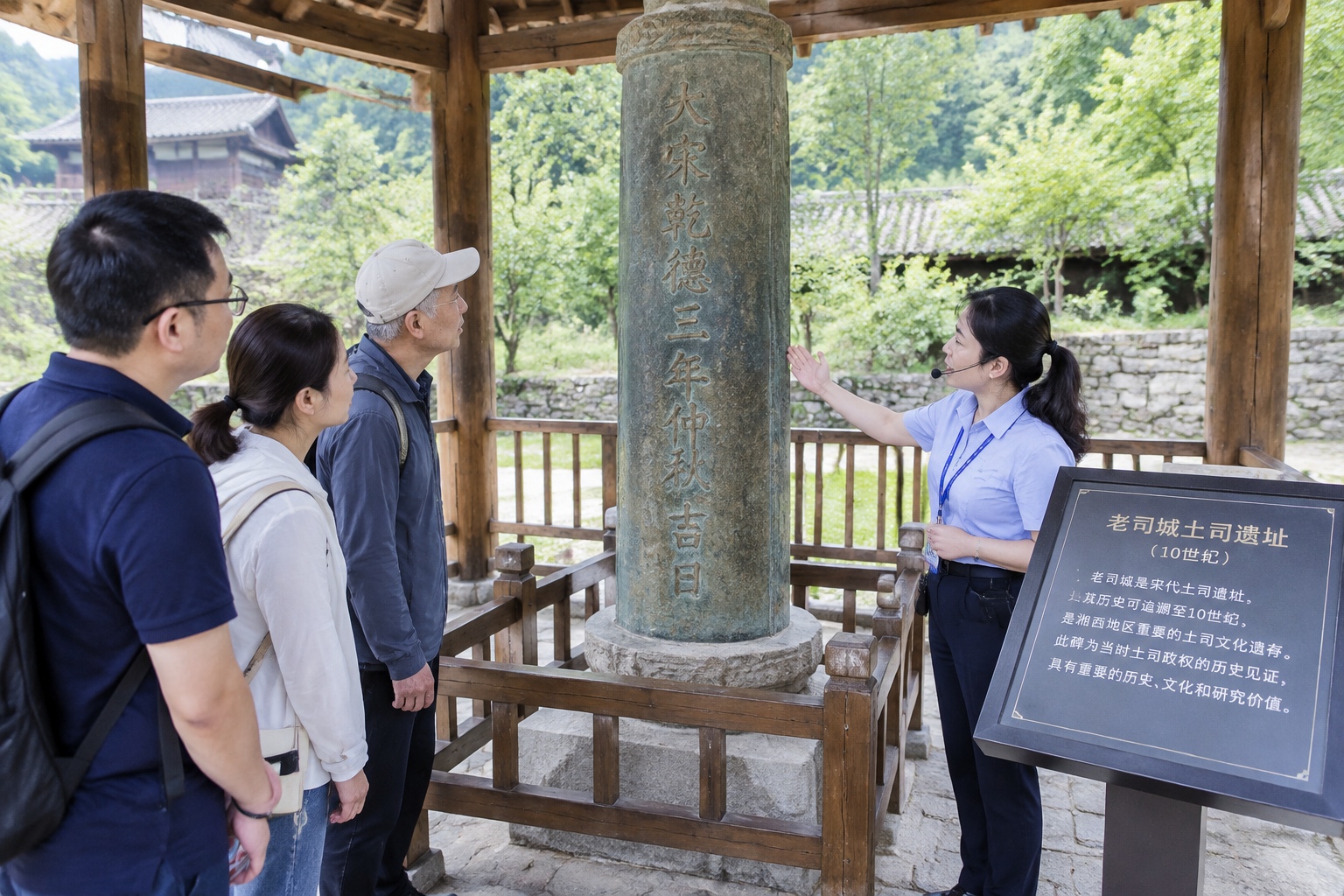
Laosicheng, in Yongshun county, Hunan, was the seat of the Peng family, who ruled the Xizhou area for roughly eight hundred years, until 1727. In a pavilion on the site stands one of the most striking objects in this part of China: a bronze pillar cast in 940 AD, inscribed with the terms of a peace agreement between a Peng ruler and the neighbouring Chu kingdom. Nearly a thousand years before the system formally ended, local power was already being negotiated in writing with a larger state.
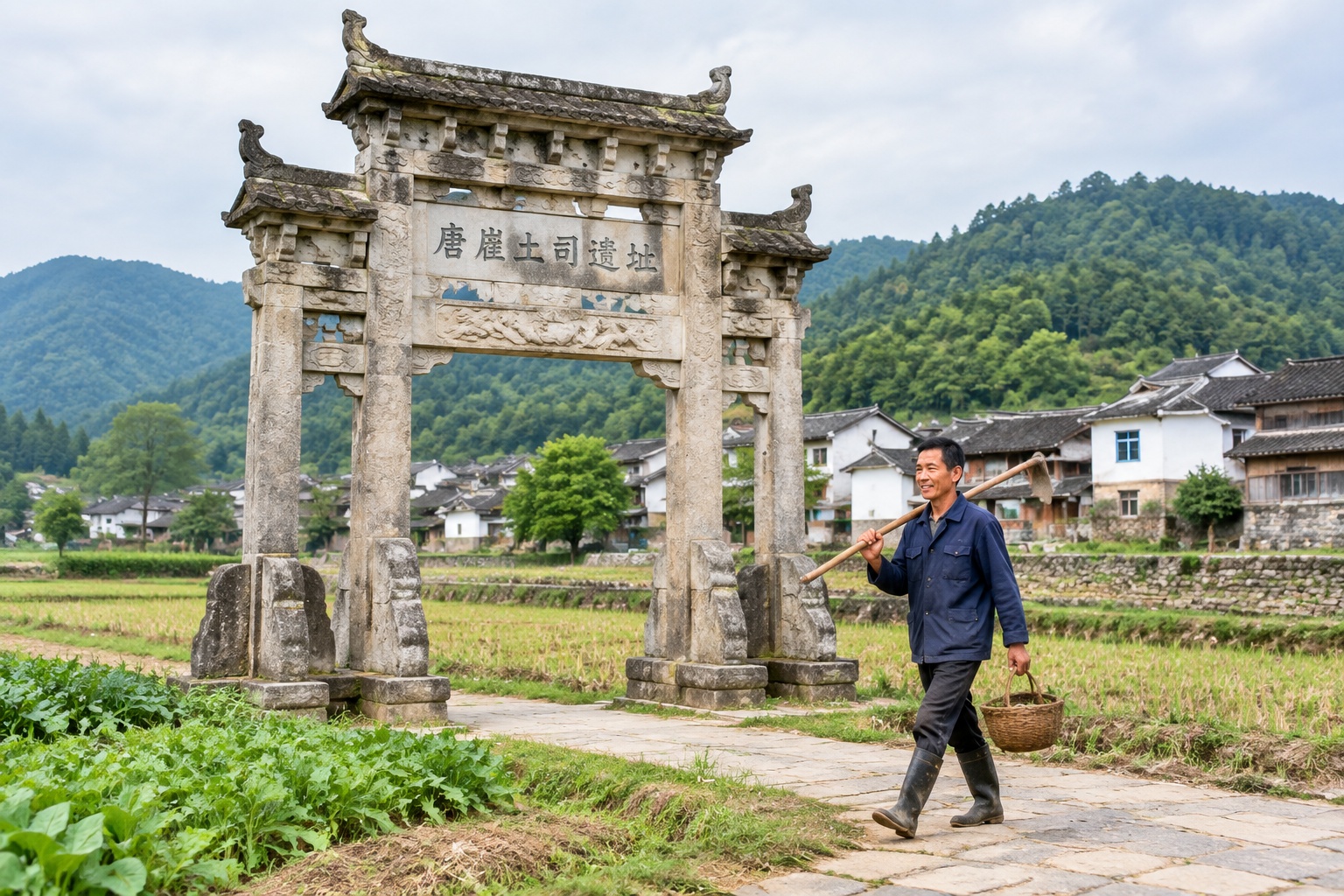
Tangya, in Xianfeng county, Hubei, belonged to the Qin family for about 460 years. Its signature is a carved stone archway standing in farmland, along with a tomb complex whose stone horses, officials and gates are still legible. This is the quietest of the three, and the one where you are most likely to be the only visitor on the path.
Hailongtun, near Zunyi in Guizhou, is where the system failed. The Yang family had held Bozhou for twenty-nine generations. In 1600, Yang Yinglong rose against the Ming. The Wanli emperor sent a large army; the fortress fell after a siege of about 114 days. Bozhou was broken into two units and placed under centrally appointed officials — an early version of a reform the Qing would apply wholesale more than a century later.
Why the empire ended the bargain
Three pressures built up. Wars between tusi destabilised whole regions. The court wanted tax revenue and a reliable chain of command. And as migration into the southwest increased and the land became more valuable, leaving it to hereditary lords looked less like a bargain and more like a loss.
The decisive move came in the 1720s, under the Yongzheng emperor. His governor-general in the southwest, Ortai, pushed a policy with a very Chinese name: gaitu guiliu — “change the native officials, restore the flowing officials.” The word “flowing” is the key. In the imperial bureaucracy, officials rotated: they arrived, served about three years, and moved on. A tusi’s power stayed in one family forever. The reform replaced the second arrangement with the first.
Between 1726 and the 1730s, a large number of tusi titles were abolished. Some chieftains handed over their seals voluntarily, after negotiating a pension and a noble rank. Others fought, and lost. But the system did not end on a single date. In remote corners, especially in Yunnan, tusi offices continued into the twentieth century, and the hereditary line that governed Xishuangbanna in the far south kept its title into the 1950s. It was a three-hundred-year retreat, not a switch.
For ordinary people, the change was mixed. Local courts and customary law gave way to the Qing legal code, which was more predictable in some ways and more intrusive in others. Taxes became more regular — and more thoroughly collected.
What a visitor actually sees
All three sites are reachable by high-speed rail plus a road transfer, and all three are far less crowded than Zhangjiajie or Fenghuang.
Hailongtun is about half an hour by road from Zunyi, itself roughly 45 minutes by high-speed train from Guiyang. Most visitors ride up to the ridge, then walk: stone stairs, gates, wall foundations and cliff-edge lookouts, a couple of hours in total. It is a genuine ruin. There is no rebuilt palace, just stone lines and the valley below.
Laosicheng sits near Yongshun town in Hunan and is usually combined with a trip to Zhangjiajie. Tangya is in Xianfeng county, Hubei, about two hours by road from Enshi, which now has its own high-speed rail station.
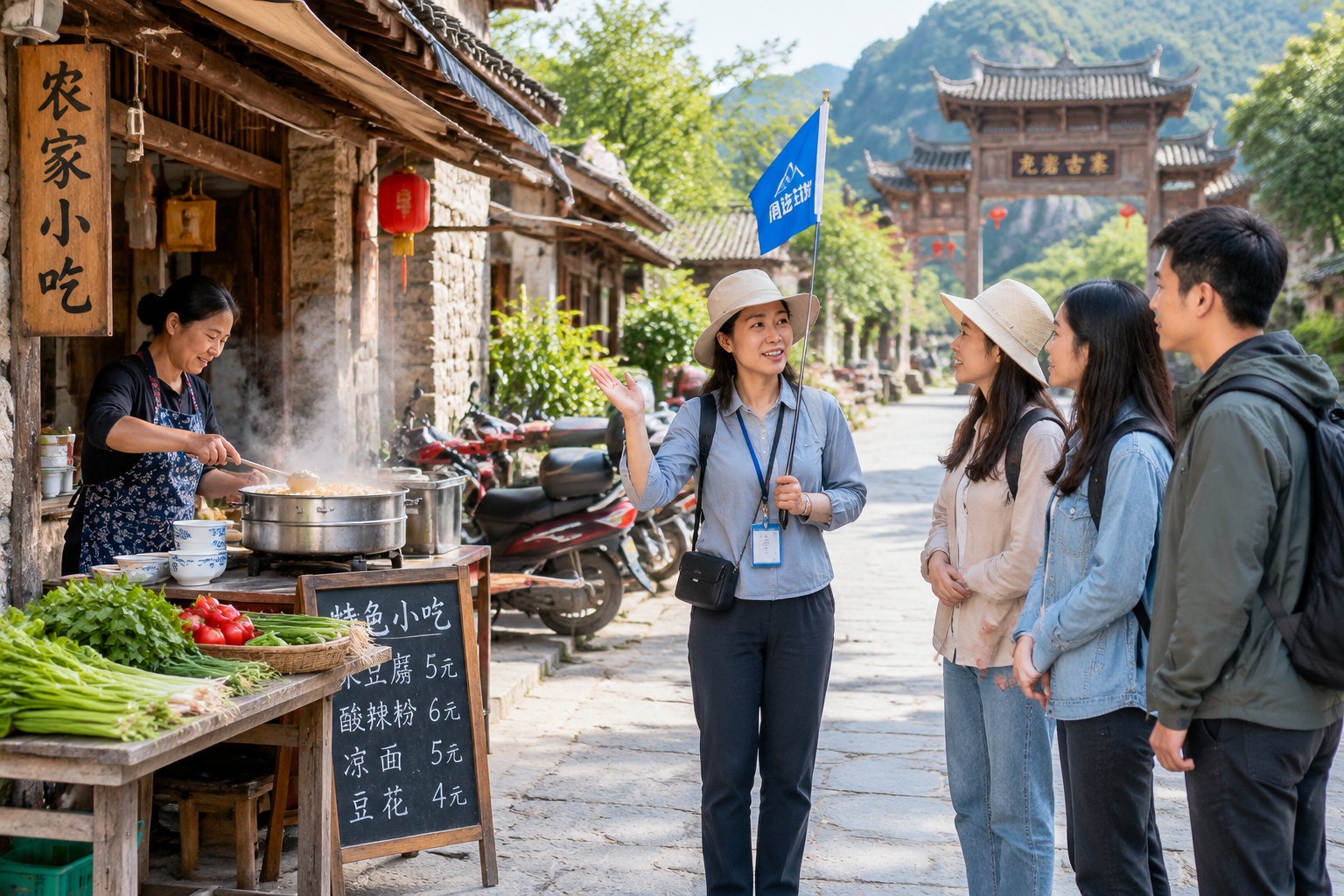
Around all three, tourism has become the local economy. Villagers sell snacks and run small guesthouses, and government money has gone into roads, car parks and visitor centres. Many of the people working at the ticket gates and in the shops are Tujia, Miao or other ethnic groups whose ancestors were the tusi’s subjects — not their equals.
Who decides now
The tusi story is a history lesson, but it is also about a question that has not gone away: how does a large state govern places that are very different from one another? The imperial answer was layered — direct rule on the plains, bargains in the mountains, and a slow, uneven push toward uniformity.
The present arrangement is different in kind. Officials rotate. Counties, prefectures and autonomous regions are administrative units with budgets and boundaries, not family property. Yunnan alone has eight autonomous prefectures and nearly thirty autonomous counties, where local languages appear in schools, signage and festivals, and where the head of the local government is, by law, a member of the relevant ethnic group.
What survived from the tusi era is more personal than political. Many families in these valleys keep genealogy books that name the chieftain line, and some villages still trace land use and marriage customs back to the old domains. Ask a shopkeeper near Hailongtun about his family, and he may tell you, without much drama, that his ancestors farmed land belonging to the Yang family — and that his children now work in tourism or in Zunyi city.
That is probably the most honest way to describe what changed: not one dramatic break, but a long shift in who gets to decide, and how far away that person lives.
Start the discussion at forum.chinacomes.com