
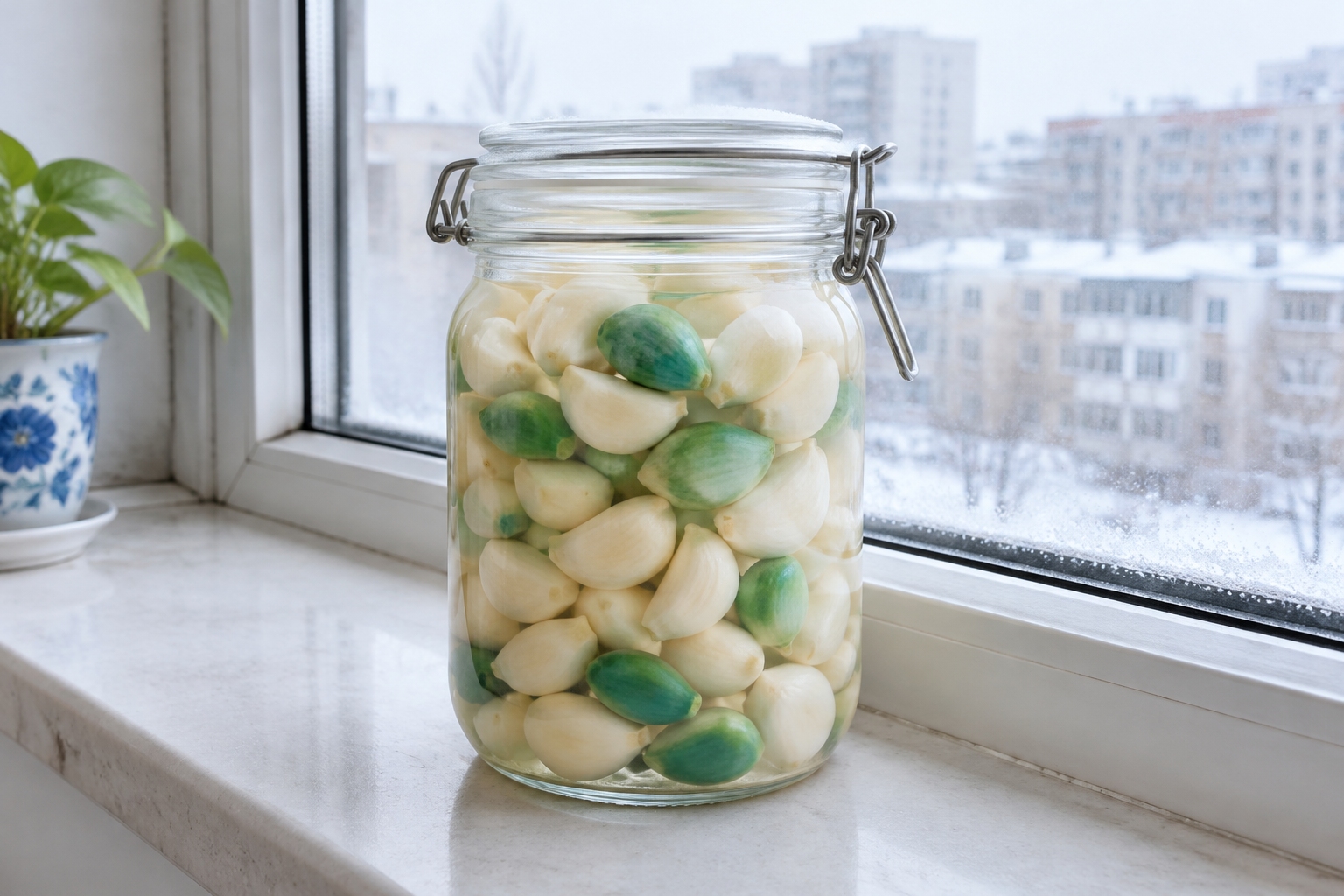

A jar on the windowsill in Beijing
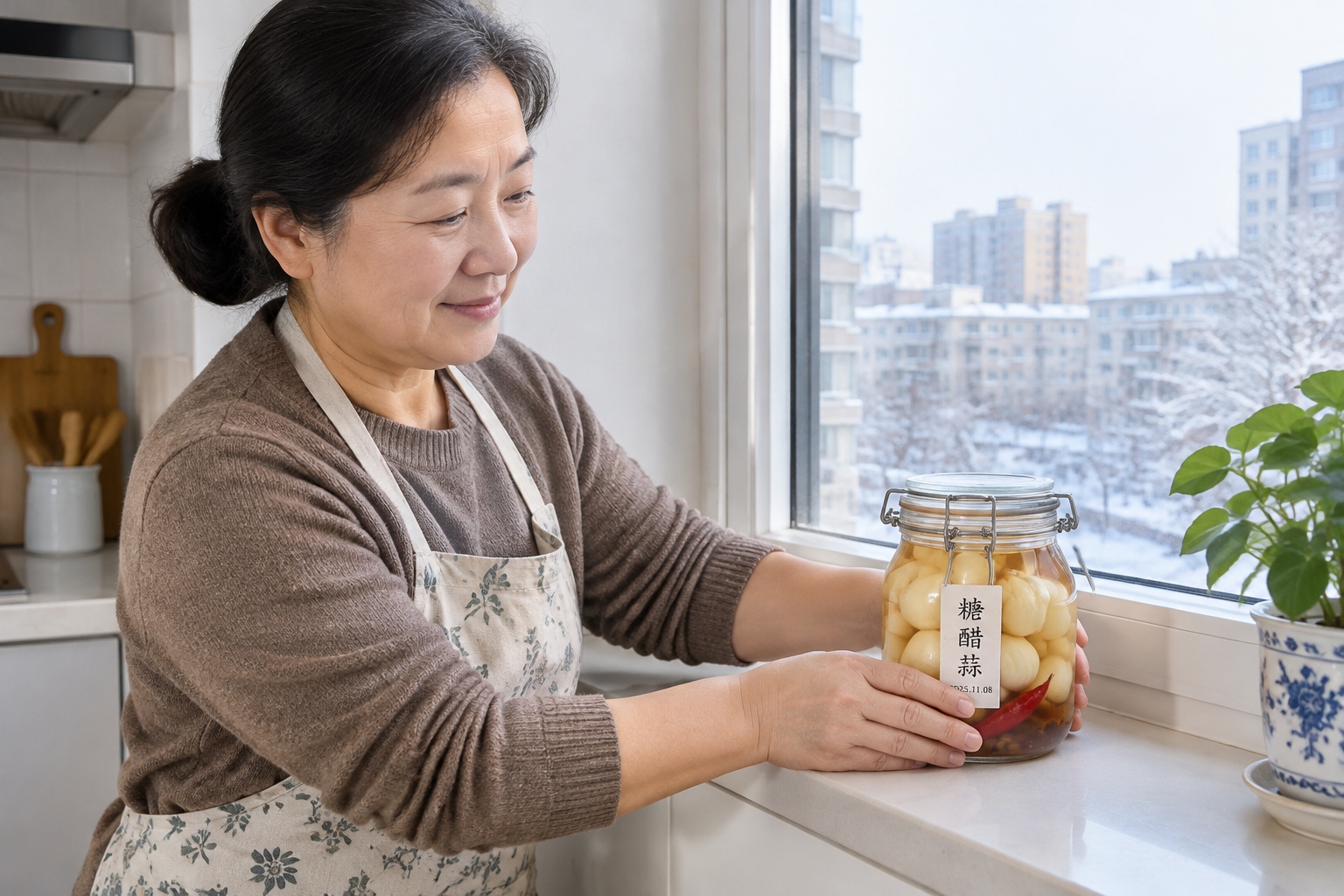
On a cold morning in early January, in a sixth-floor apartment in Beijing’s Chaoyang district, Mrs. Zhao sets a glass jar on the kitchen windowsill. Inside are maybe thirty peeled garlic cloves, pale and glossy, floating in rice vinegar that catches the gray winter light. The window is single-paned and leaks cold air, which is exactly the point. She wipes her hands on her apron and says, almost to herself, “Three weeks. Then we eat it with dumplings.”
This is laba garlic, or labasuan. For millions of households across northern China, making it is one of the first signs that the New Year is coming. The garlic will slowly shed its white color and turn a vivid, almost unreal emerald green, like something out of a chemistry set rather than a kitchen. People wait for that color the way others wait for the first snow.
What Laba actually is
The name comes from a date on the lunar calendar: the eighth day of the twelfth lunar month, known as Laba (literally “the eighth of La,” the twelfth month). It usually falls in January, roughly three weeks before Chinese New Year. In old Beijing, Laba was the unofficial starting gun for the holiday season. People cooked a thick porridge of rice, beans, nuts, and dried fruit called laba zhou, and in the north they also started a jar of garlic that would be ready right around New Year’s Eve.
The timing isn’t romantic nonsense. It’s practical. The green color only develops reliably in the cold, and January in Beijing delivers plenty of that. Start the garlic on Laba, and it finishes just in time for the dumplings.
How to make it, and why the cold matters
The recipe is almost comically simple. Peel garlic. Put it in a clean, dry jar. Cover it with vinegar, usually a sharp, clear rice vinegar in the north rather than the dark, mellow Shanxi aged vinegar. Seal it. Leave it somewhere cold but not freezing, ideally between about 0 and 10 degrees Celsius. Then wait.
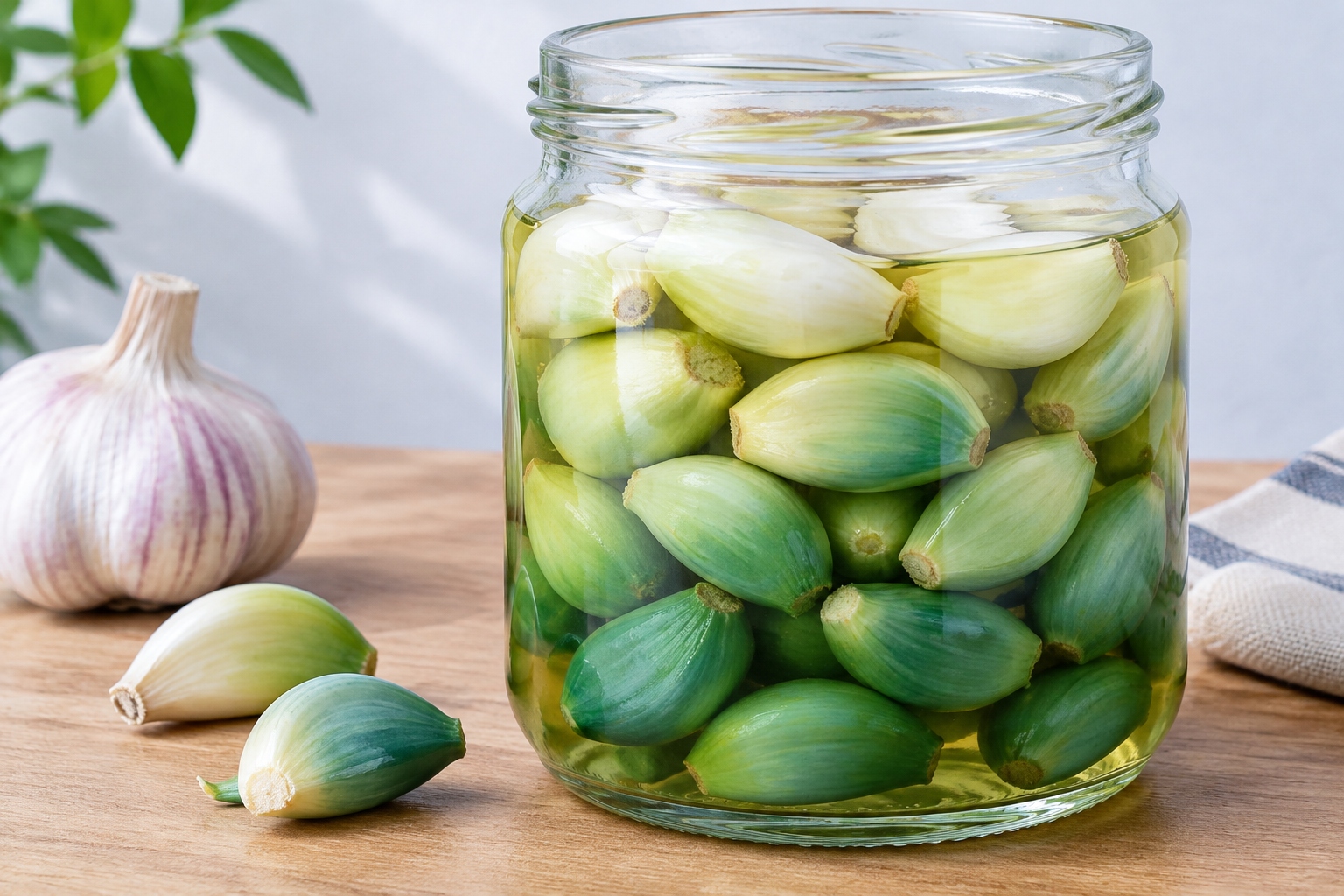
Over the first week, not much seems to happen. Then the cloves start to tint, first a faint blue-green at the edges, then deeper, until after two to three weeks the whole jar glows green. The vinegar itself turns slightly green-gold and takes on a mellow, garlicky sweetness.
Temperature is the hidden ingredient. Make the same jar in a warm kitchen in summer and the garlic mostly refuses to turn green, or does so weakly and unevenly. The cold is what unlocks the color. This is why laba garlic is, by its nature, a winter food, tied to a specific season in a way that few dishes are anymore.
The science behind the green
For a long time the color was treated as half magic, half folklore. Only in recent decades did food scientists pin down what’s going on, and the explanation is genuinely interesting.
Garlic contains sulfur compounds and an enzyme called alliinase. When you break the cloves, or expose them to the acidic environment of vinegar, that enzyme gets to work. The cold temperature keeps the enzyme active over a slow, steady period while suppressing other reactions that would otherwise dominate. The result is the formation of two pigments: a blue one and a yellow one. Layered together inside the clove, they read to the eye as green.
So the color isn’t a dye or a trick. It’s the garlic reacting with the acid, at the right temperature, over the right amount of time. Warm it up and the pigment pathway shifts and the green fails to form. That’s the whole “magic”: enzymes, acid, and patience in the cold.
Older generations didn’t know the chemistry, but they knew the rules by heart. Use good vinegar. Keep the jar cold. Don’t let water get in. Be patient. They were running a controlled reaction without ever calling it one.
At the table: garlic and dumplings
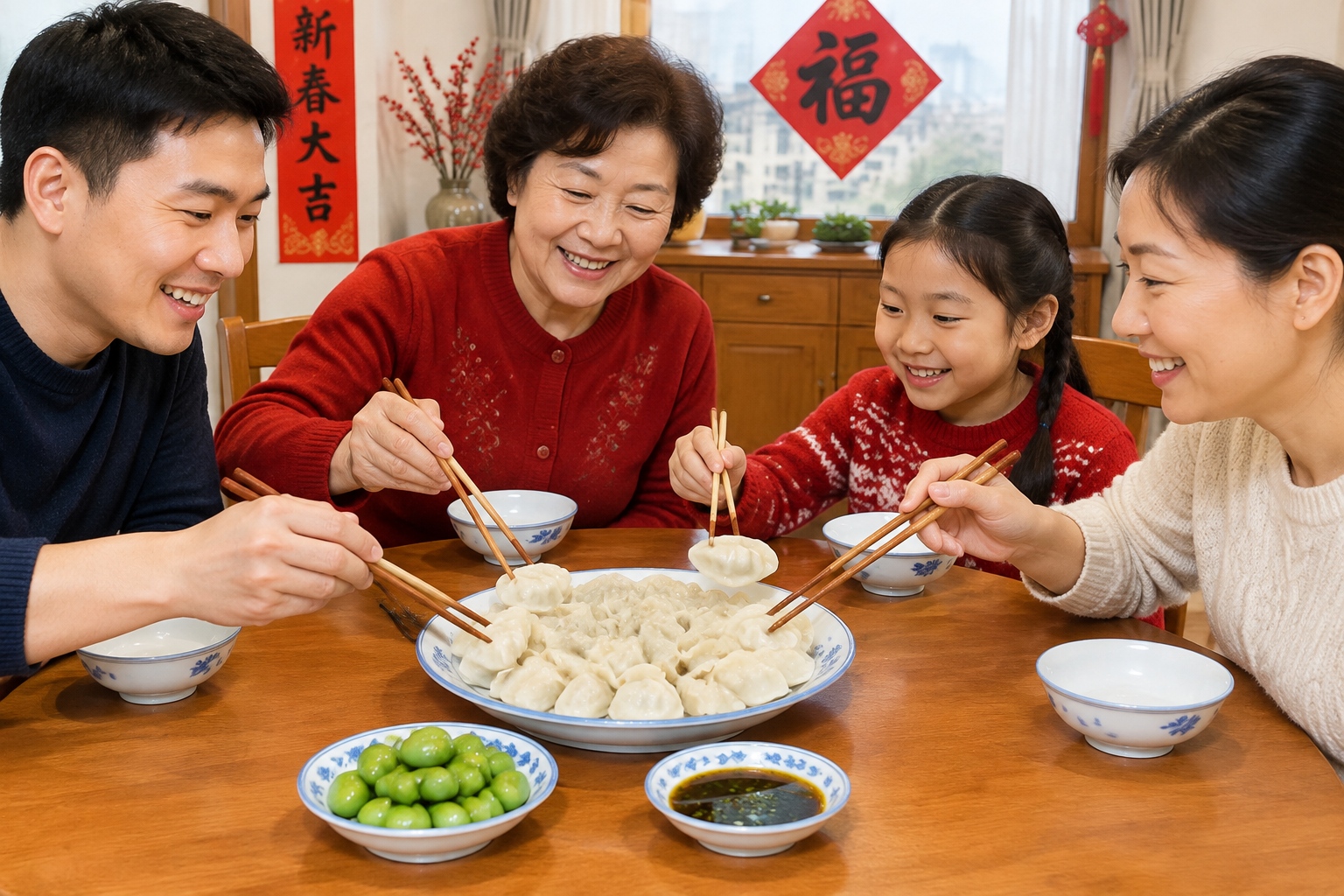
Laba garlic isn’t eaten alone. Its home is next to a plate of boiled dumplings, especially on New Year’s Eve, when families across northern China sit down to eat jiaozi together.
Here’s the contrast that makes it work. A boiled dumpling is soft, hot, and mild: a thin wheat wrapper around pork and cabbage or lamb and scallion. Laba garlic cuts straight through that softness. By the time it’s ready, the garlic has lost most of its raw, aggressive burn. What’s left is crisp, tangy, faintly sweet, with just a gentle garlic warmth. You bite a dumpling, then a clove, and the sour-sweet crunch resets your mouth for the next one.
The vinegar from the jar doesn’t go to waste either. People spoon it into their dipping sauce, now green-tinged and softened by three weeks with the garlic. In many northern homes, a bowl of dumplings without laba garlic on the side feels incomplete, the way some tables feel wrong without salt.
A ritual of the season, not just a recipe
To understand why people bother, it helps to understand nianwei, literally “the flavor of the year.” It’s a hard phrase to translate. It means the whole sensory atmosphere of the New Year: the smell of frying, the sound of a knife on a cutting board, the particular foods that only appear once a year. Nianwei is nostalgia you can taste and smell.
Laba garlic belongs to that atmosphere. In a country that has modernized at breathtaking speed, where many people now order groceries by phone and heat up pre-made meals, a jar of garlic that takes three weeks to turn green is almost an act of resistance. You can’t rush it. You can’t buy the exact same thing from an app at midnight. You have to start it on time and let the cold do its work.
That slowness is part of the appeal. Older residents remember a childhood where the laba garlic jar on the windowsill was a countdown clock to the holiday. Younger people in cities like Beijing and Harbin still make it, sometimes posting photos of their jars turning green on social media, half proud of the color, half surprised it worked. Supermarkets now sell ready-made laba garlic in plastic tubs, and plenty of people buy it. But many insist the homemade kind, made in their own cold kitchen, simply tastes more like the New Year.
Why it travels well as a story
If you’ve never been to northern China in winter, laba garlic is an easy way in. It’s a dish anyone can picture: a jar on a cold windowsill, garlic turning an impossible green, a family folding dumplings. It needs no special equipment and no rare ingredients, just garlic, vinegar, cold air, and the discipline to wait.
It also quietly explains something about how tradition survives here. Nobody is forced to make laba garlic. It persists because the color is strange and satisfying, because it tastes right next to a dumpling, and because starting the jar means the New Year is really on its way. Three weeks later, when the green has fully arrived, so has the holiday.
Start the discussion at forum.chinacomes.com