
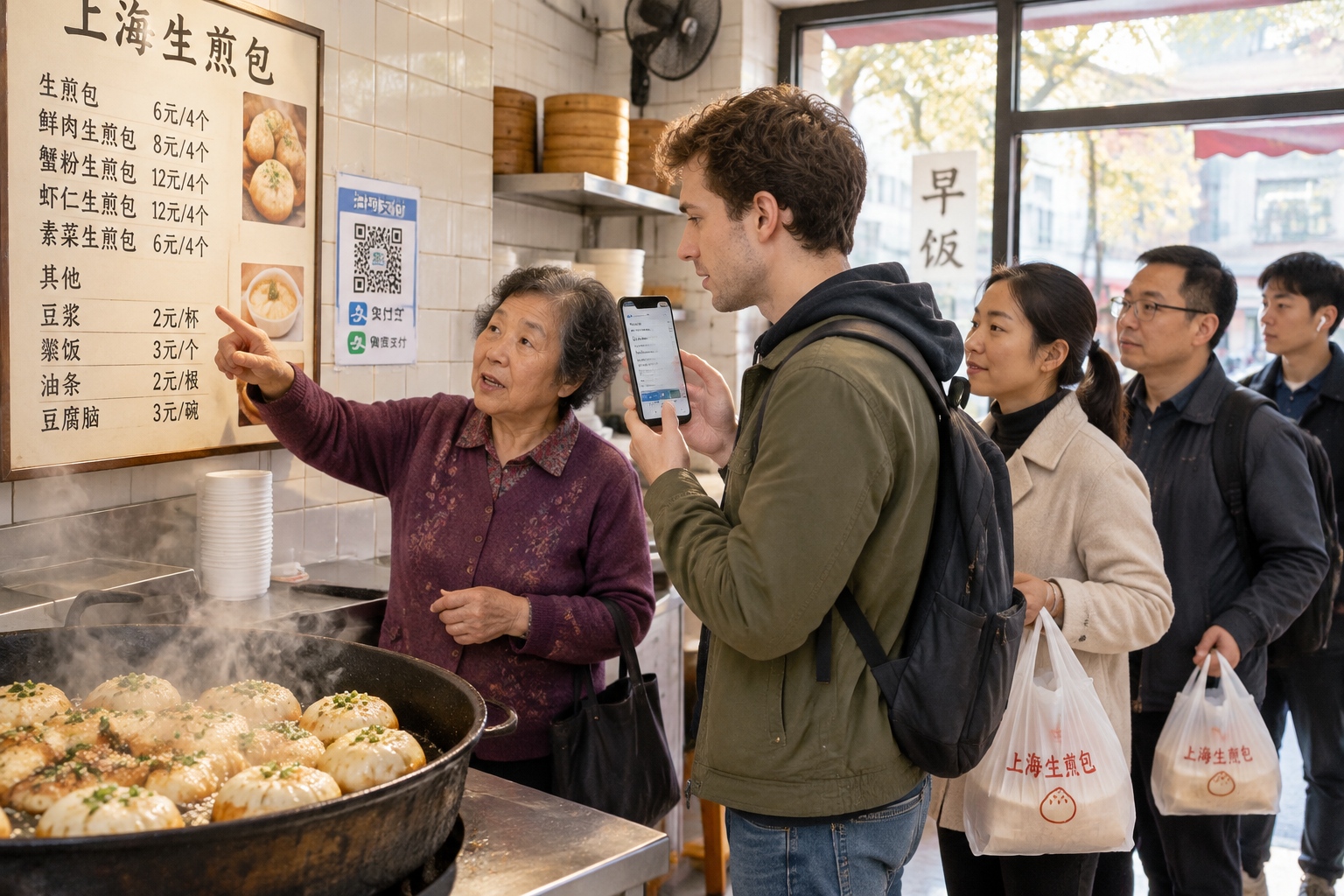

7:20 a.m., a side street off Huaihai Road
Steam first. Then the clang of a metal lid, then the beep of a payment confirmation, three phones in a row, four seconds apart.
Jonas, 29, from Leipzig, had been in Shanghai for eleven hours. He stood in front of a laminated menu board covered in Chinese characters, holding his phone at the angle of a man who was trying to translate and failing. Behind him: nine people in line, most of them on their way to work.
Then a woman in a purple cardigan tapped his elbow. “你要什么?” she said, slowly. Then, in English: “What you want?”
Her name is Wang Xiuzhen. She is 72, she has lived within two kilometers of this street her whole life, and she orders breakfast here four mornings a week. For the next six minutes she became Jonas’s translator, menu consultant and — briefly — his grandmother.
Why breakfast is the hardest meal to order in China
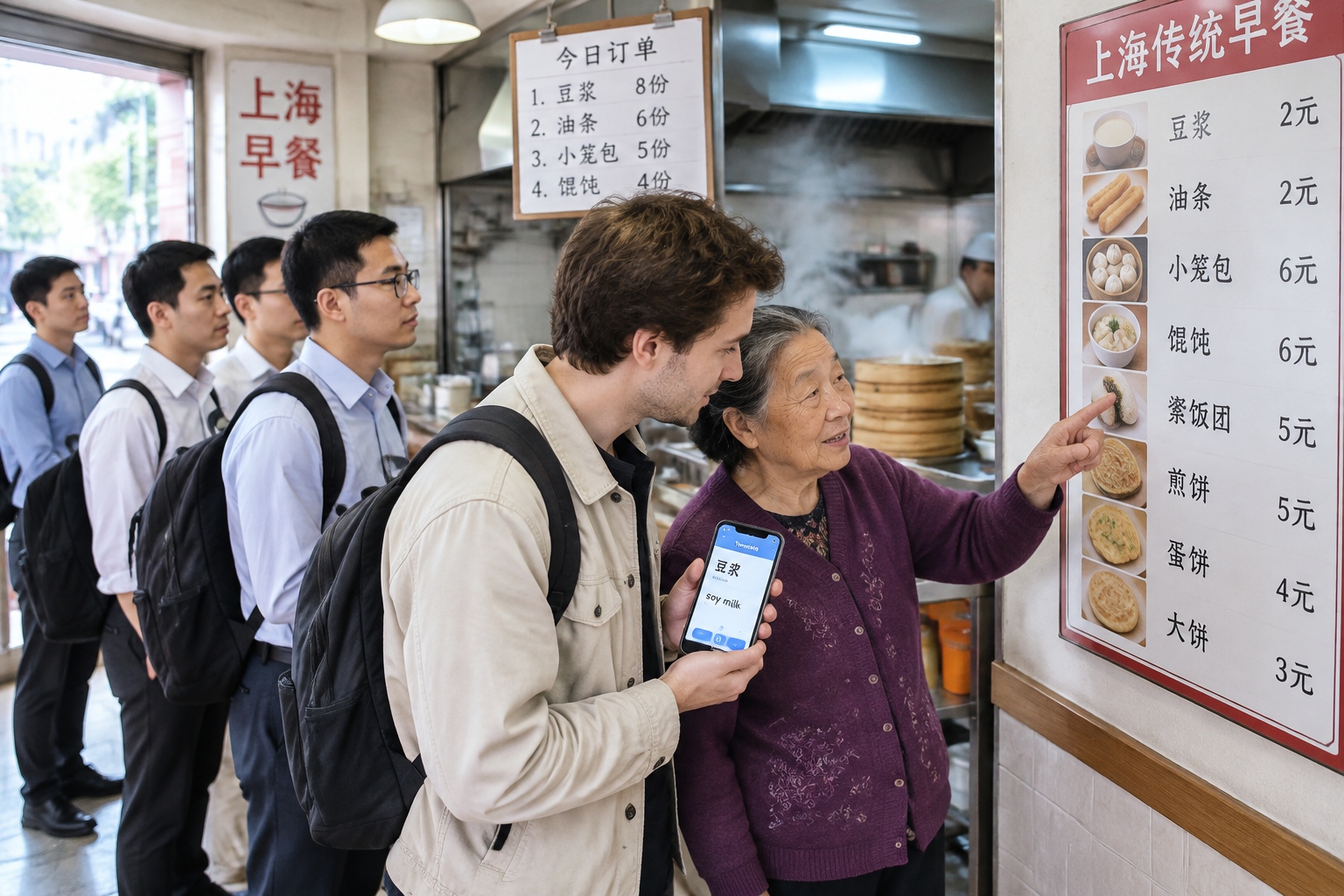
Dinner at a restaurant is easy. There are pictures, there’s an English menu, there’s a waiter whose job is to help you. Breakfast is a different sport. It happens fast, in small shops, at an hour when nobody has patience. The menu is a wall. The portions are cheap enough that nobody bothers explaining anything. Get it wrong and you eat a cold fried dough stick and move on with your day.
Breakfast is also where local rules are strongest — the combinations people actually eat, the sweet-or-savory choices, the order in which you bite something.
What Shanghai actually eats in the morning
Auntie Wang’s short version: “上海人早饭,四大金刚,还有生煎、小笼、粢饭团。”
The “four big kings” — 四大金刚 — are 大饼 (dàbǐng, a sesame or scallion flatbread), 油条 (yóutiáo, a long fried dough stick), 豆浆 (dòujiāng, soy milk) and 粢饭 (cīfàn, sticky rice, usually rolled into a 粢饭团, a rice roll). They’re often sold from the same counter, in the same paper bag.
Then come 生煎 (shēngjiān, pan-fried pork buns with a crisp bottom and soup inside), 小笼 (xiǎolóng, steamed soup dumplings), 锅贴, 葱油饼, tea eggs, and a wall of steamed buns.
Rough prices in central Shanghai in 2024–25: soy milk 3–5 yuan ($0.40–0.70); a fried dough stick 2–3 yuan; a cifantuan 6–10 yuan; four shengjian 8–14 yuan; eight xiaolongbao 15–30 yuan.
A full breakfast lands between 10 and 25 yuan — about $1.50 to $3.50. That number matters. This is a meal people eat out not because it’s a treat, but because it costs less than making it at home and takes six minutes.
Where Jonas got stuck
Three things stopped him.
First, the menu. No pictures on this board. Just characters and prices.
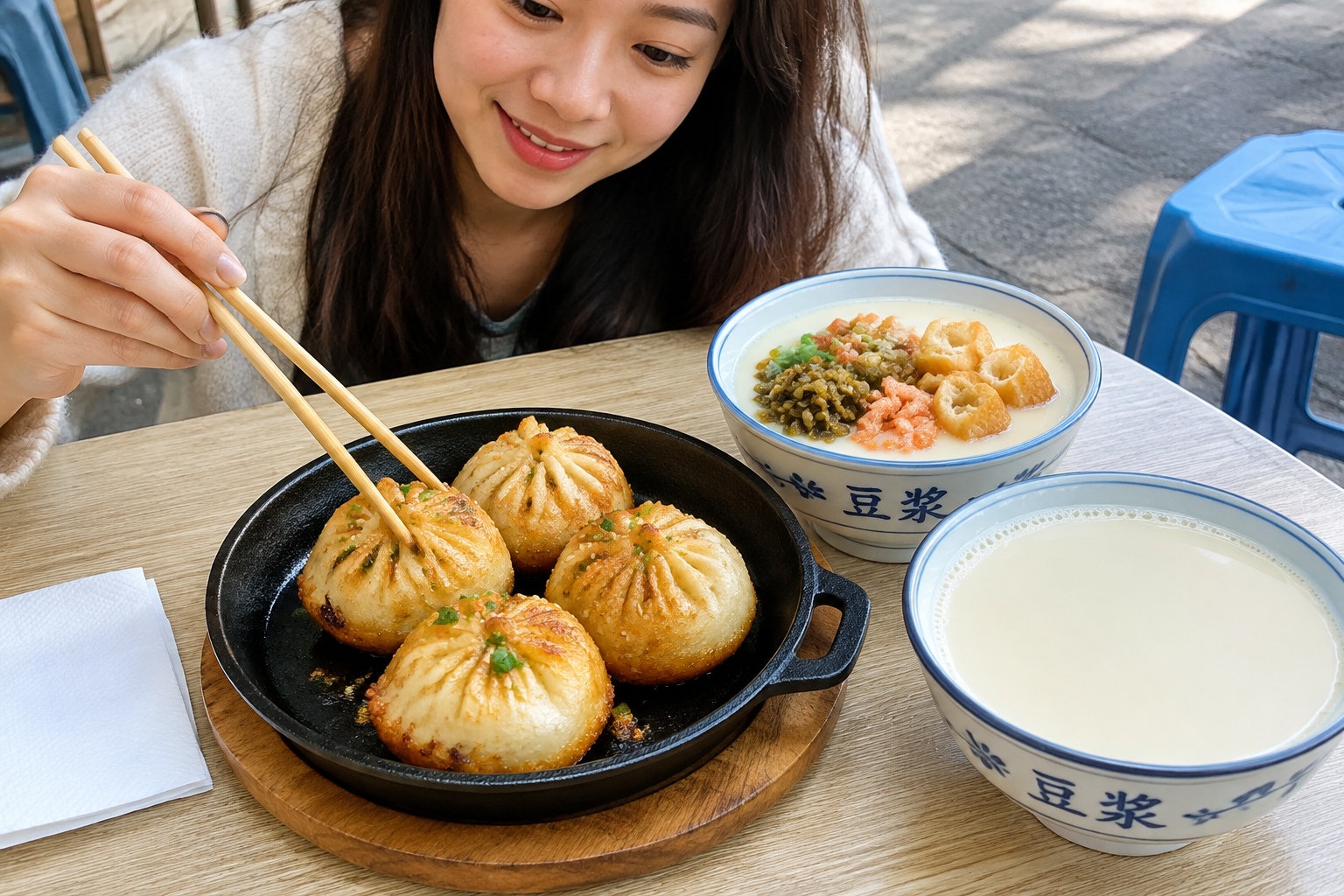
Second, the questions. “甜的还是咸的?” Sweet or savory? He hadn’t known soy milk came in two versions. In Shanghai, savory soy milk (咸豆浆) is curdled with vinegar and topped with dried shrimp, pickled vegetable and pieces of fried dough. Sweet soy milk (甜豆浆) is just sugar. Both are normal. Neither is the wrong one.
Third, the modifiers. 加蛋 (add an egg), 加辣 (add chili), 少糖 (less sugar), 再来一根油条 (one more dough stick). These are said fast, in Shanghainese-accented Mandarin, while the next person in line has already started talking.
Auntie Wang handled all three. She pointed at the board. She held up two fingers. She said “sweet,” then made a face that clearly meant “but you should try the salty one.” She opened the translation app on his phone, typed 咸豆浆, and showed him the screen. Then she added a cifantuan to his order without asking, because, in her words, “你光喝豆浆不饱的” — soy milk alone won’t fill you.
“Authentic” isn’t a secret recipe. It’s what the neighbors eat.
I asked Auntie Wang what makes breakfast “地道” — authentic. She found the question slightly silly.
“地道就是附近的人天天吃的,” she said. Authentic is just what the people nearby eat every day. “不是给游客吃的。游客吃的那个是拍照的。”
Her rules, translated:
A cifantuan without 油条 inside is just rice. “要加油条,还要榨菜、肉松。” You want the dough stick in there, plus pickled vegetable and pork floss.
If the soy milk is hot, don’t drink it in one go. Same logic applies to shengjian.
With shengjian: bite a small hole in the top first, let the steam out, sip the soup, then eat the rest. “不然烫嘴,我烫过。” Otherwise you burn your mouth. I’ve burned mine.
Order as much as you’ll finish. Nobody here is impressed by waste.
Eat it standing or sitting, but eat it now. Cold shengjian is a small tragedy.
The breakfast shop as a neighborhood living room
Between 7 and 8 a.m., this shop does more social work than most community centers.
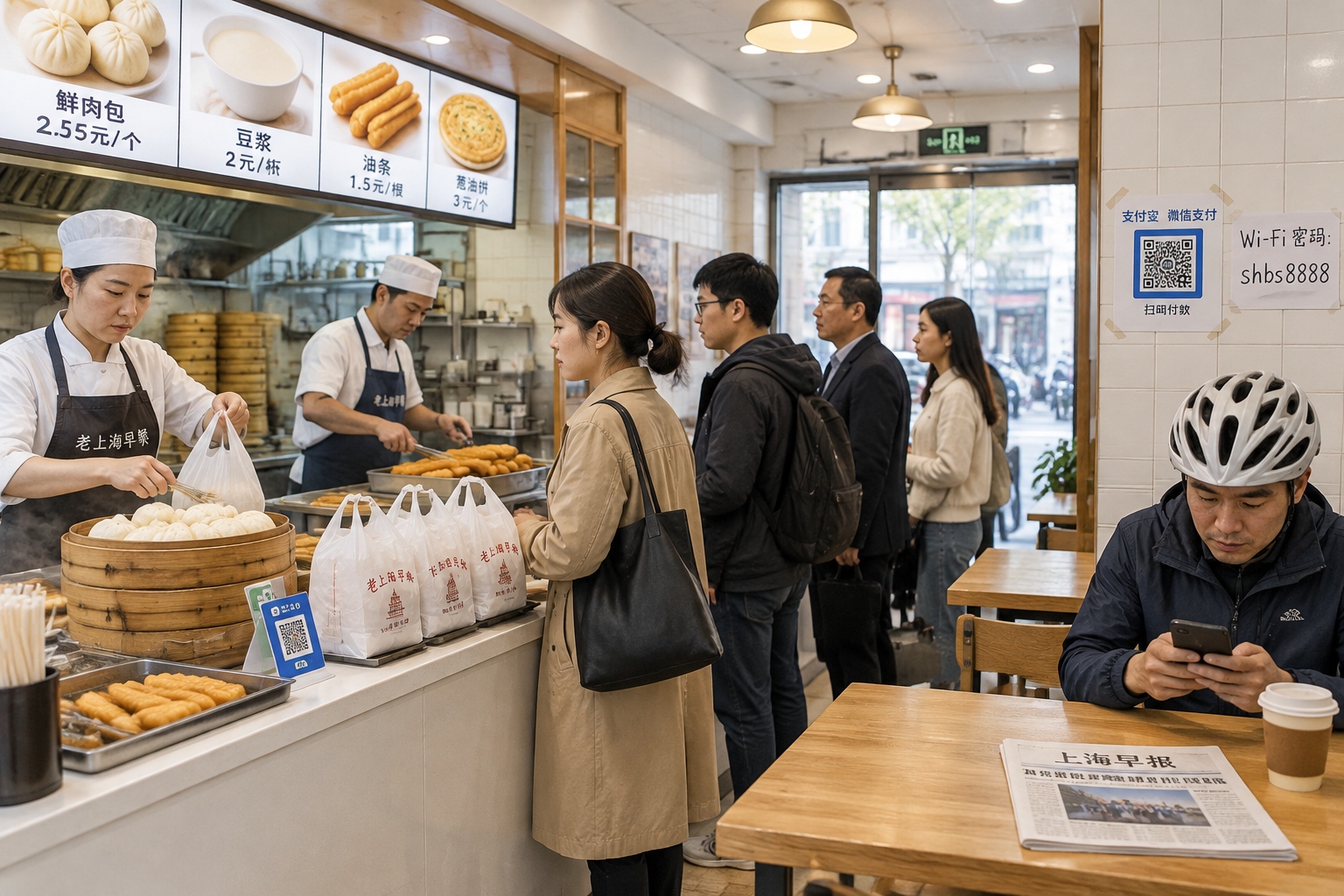
People queue in a loose, unspoken order that everyone understands and nobody enforces. You share tables — 拼桌 — without asking. Regulars get a nod from the woman at the griddle. Someone holds the door with a foot while carrying four takeaway bags. A retired man reads the news on his phone; the shop’s Wi-Fi password is taped to the wall next to the payment QR code.
Auntie Wang knows the owner’s daughter’s school year. She knows which neighbor’s mother is in the hospital. She learned most of it, she says, at this counter.
QR codes, cash, and the nod of a regular
Jonas paid with his phone. Foreign visitors can now link international Visa and Mastercard cards to Alipay and WeChat Pay, and it worked: the terminal beeped, the woman at the counter nodded, the queue moved.
Two other things happened in that same minute. An older man paid with a 10-yuan note, and the cashier took it without comment — refusing cash is against the rules in China, and shops know it. And another customer just said “老样子” — the usual — and was served before anyone mentioned money.
Delivery apps exist here too. During the 7:40 rush, three bagged Meituan orders sat waiting on the counter. But the physical line never disappeared, because the line is partly the point.
What city change looks like from inside a breakfast shop
Since 2011, Shanghai has run a “breakfast project” (早餐工程) meant to keep cheap, food-safety-inspected breakfast within reach in every neighborhood — chain outlets, mobile kiosks, convenience store counters.
Meanwhile the old street-side stalls are thinning out. Rents. Renovation. Rules on open-air cooking and grease. The shop Jonas walked into is a survivor: a family operation whose lease has been renewed, painfully, three times.
Auntie Wang’s summary is not sentimental. “以前摊子多,便宜,但脏一点,” she said. “现在干净,贵两块钱。都可以。” Before, more stalls, cheaper, a little dirtier. Now cleaner, two yuan more. Both are fine.
What has clearly changed for her is choice. She can get a decent breakfast at 6:40 a.m., at 9:30 a.m., or at her door through an app. What has changed less: the combinations. The four big kings are still the four big kings.
How it ended
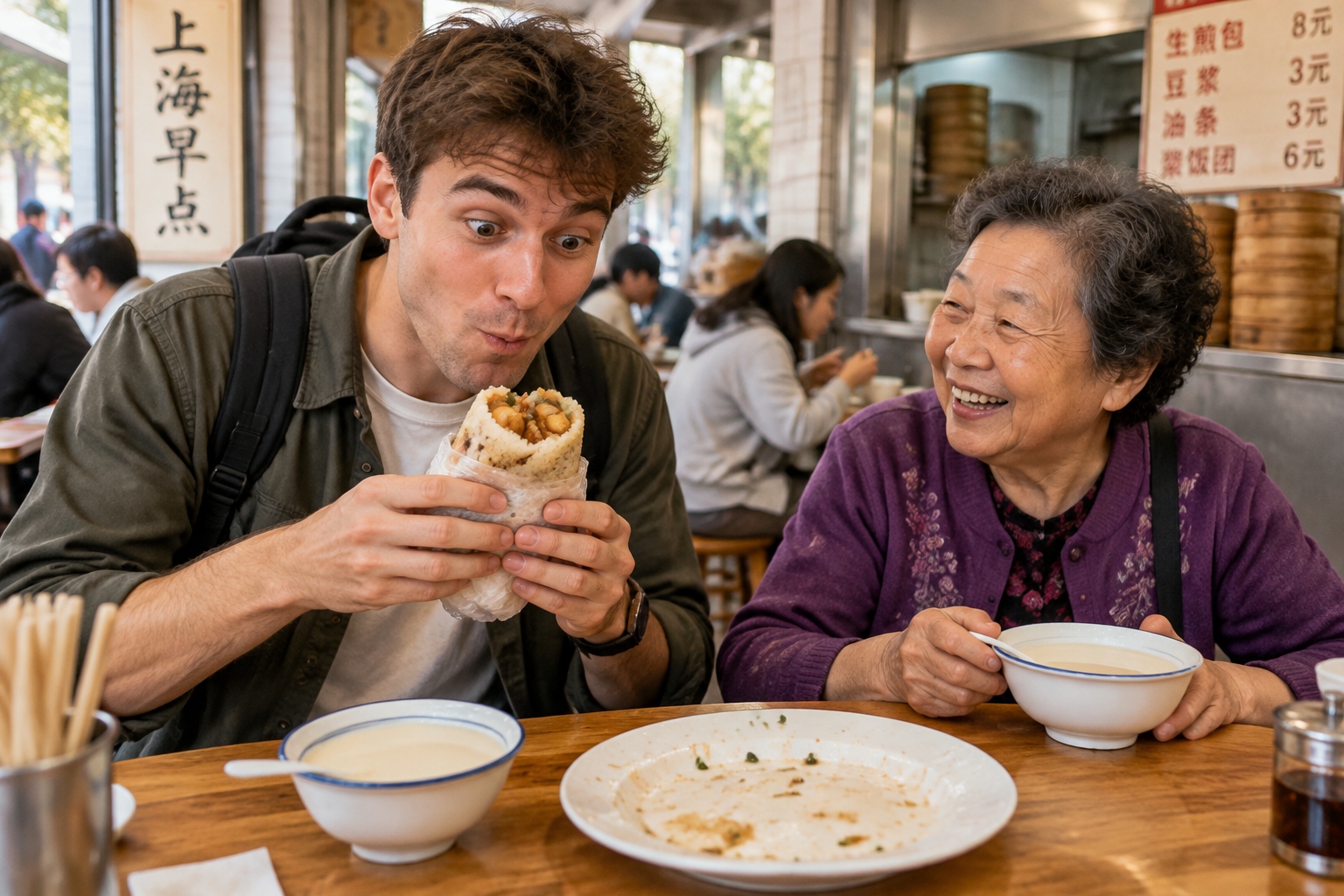
Jonas ate a savory soy milk, a cifantuan with fried dough stick and pork floss, and four shengjian. He burned his mouth on the first shengjian. Auntie Wang laughed at him, then demonstrated the technique on her own bun — slowly, twice.
His verdict on the cifantuan: “It’s like a burrito, but it’s breakfast, and it’s better.” On the savory soy milk: “I didn’t expect soup.” He asked for a second one.
There was one small misunderstanding. He tried to thank Auntie Wang by buying her breakfast. She refused, firmly, twice, then ordered another soy milk anyway — which he paid for, which she allowed, which she then complained about. It is, I think, the most Shanghai exchange possible.
If you’re visiting Shanghai, here’s how to order breakfast
Go between 6:30 and 7:15, or after 9:00. The 7:30–8:30 window belongs to commuters.
Learn five words: 豆浆 (soy milk), 油条 (fried dough stick), 粢饭团 (sticky rice roll), 生煎 (pan-fried buns), 小笼 (steamed soup dumplings).
Learn three modifiers: 甜 (sweet), 咸 (savory), 加 (add).
Point at what other people are eating. It works. Nobody minds.
Payment: Alipay or WeChat Pay with an international card linked, or cash. Bring small notes. ¥5 and ¥10 are the useful ones.
Budget ¥10–25. Come with a small appetite or a friend.
With shengjian: hole first, sip, then bite.
If it’s busy, share a table. Here that’s normal, not rude.
And then: “下次再来”
As Jonas left, Auntie Wang said the thing she says to everyone: “下次再来。” Come again next time.
Not “welcome to Shanghai.” Not “enjoy China.” Just: come back to this shop, on this street, and eat breakfast again. It’s a low-key invitation, and in a city of 25 million people it’s also a fairly accurate description of what breakfast is here — a short, repeatable, unremarkable experience that most people have, most mornings, with whoever happens to be standing next to them.
Start the discussion at forum.chinacomes.com