
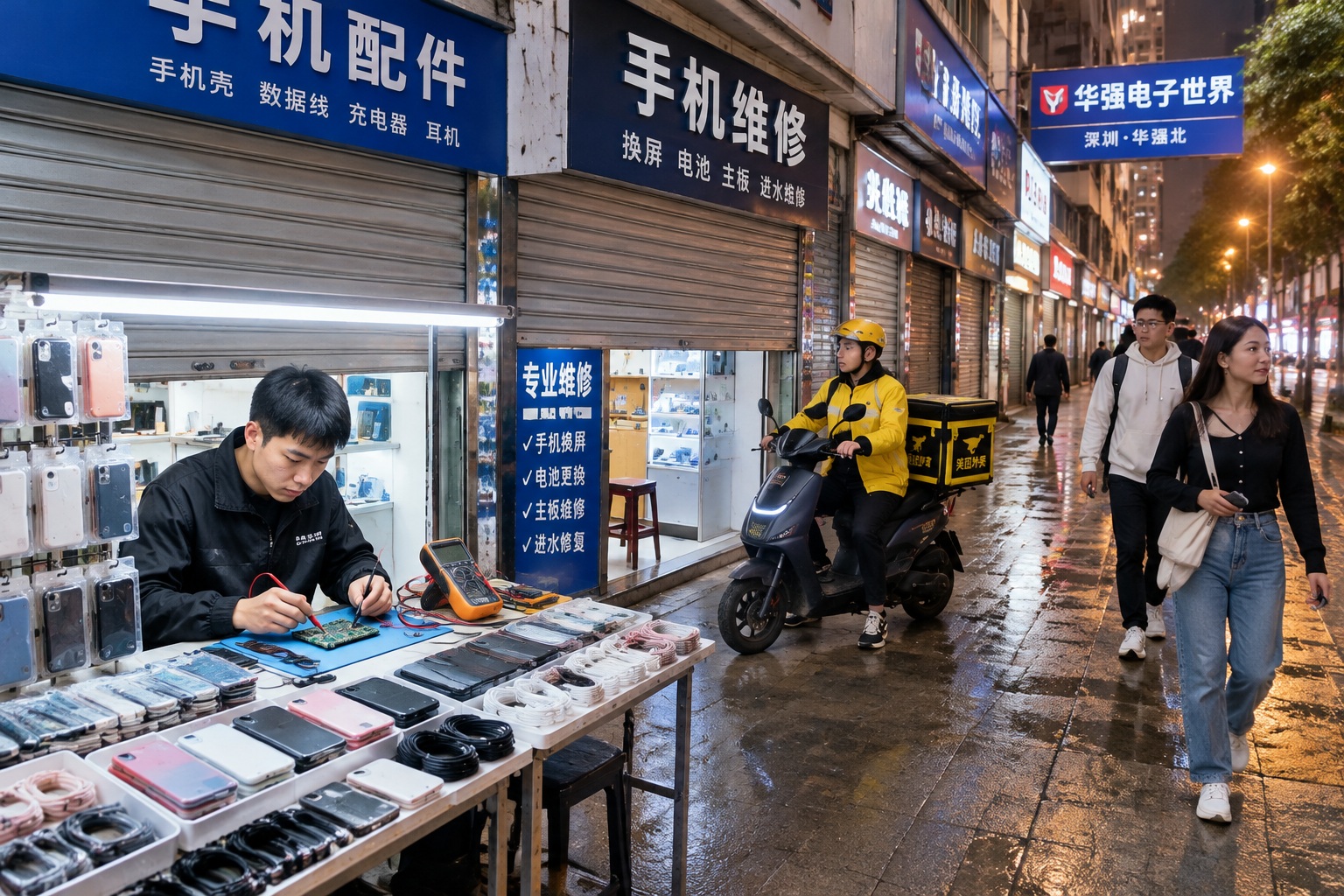

At 9 p.m., Huaqiangbei Starts Its Second Shift
I step out of Huaqiangbei Metro Station at 9:12 p.m. on a Tuesday. The daytime crowd is gone. So are most of the tourists posing beside the giant phone-shaped sign. The big malls—SEG, Huaqiang Electronics World, Mingtong Digital City—have lowered their metal shutters, and the air still smells faintly of solder, fried rice, and wet cardboard.
This is not the Huaqiangbei in the guidebooks. During the day, it is a compressed city of components: capacitors in tiny bags, iPhone screens on trays, drone motors, laptop fans, and cables coiled like rope. By night, the wholesale floors go quiet. But the district does not sleep. It changes jobs.
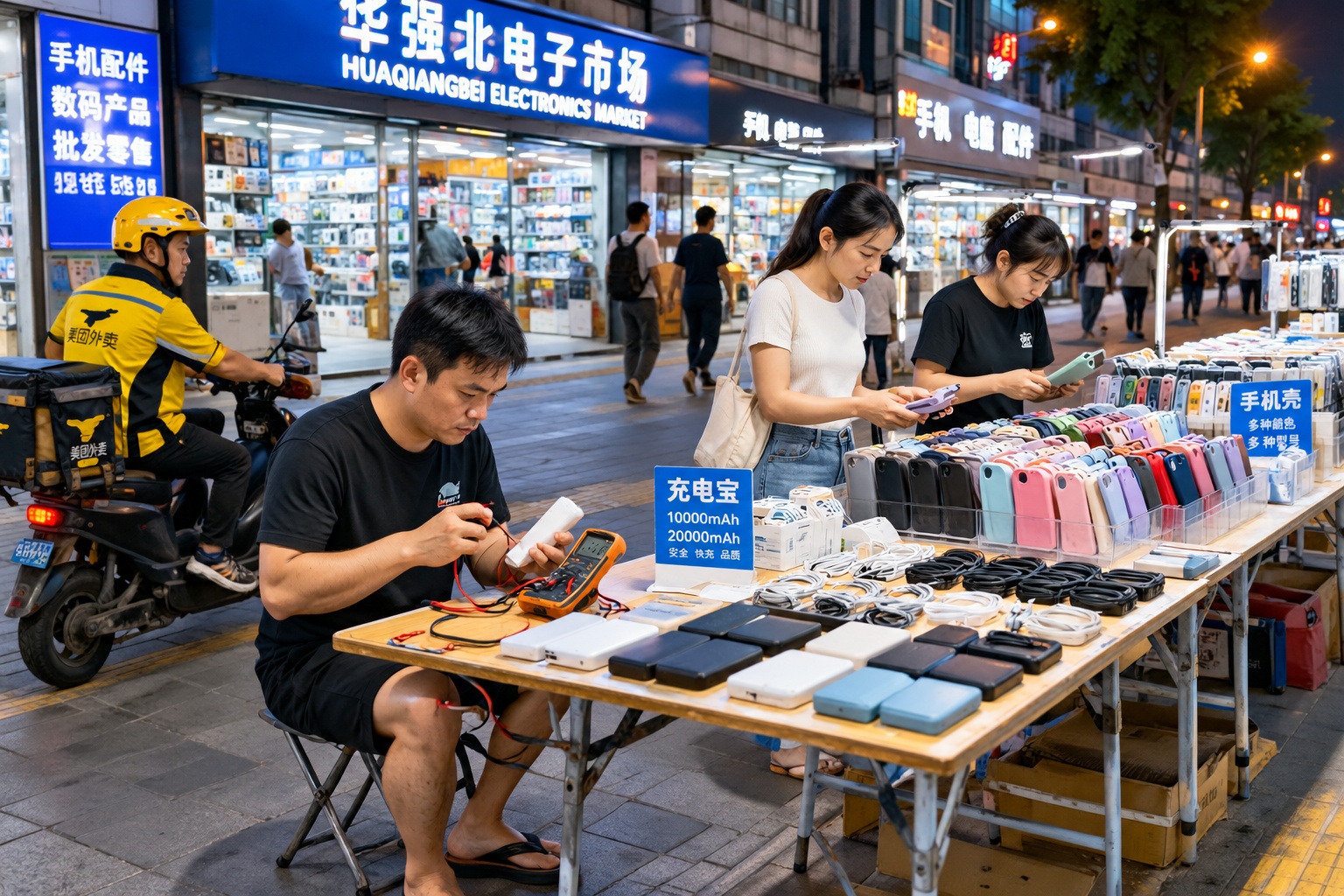
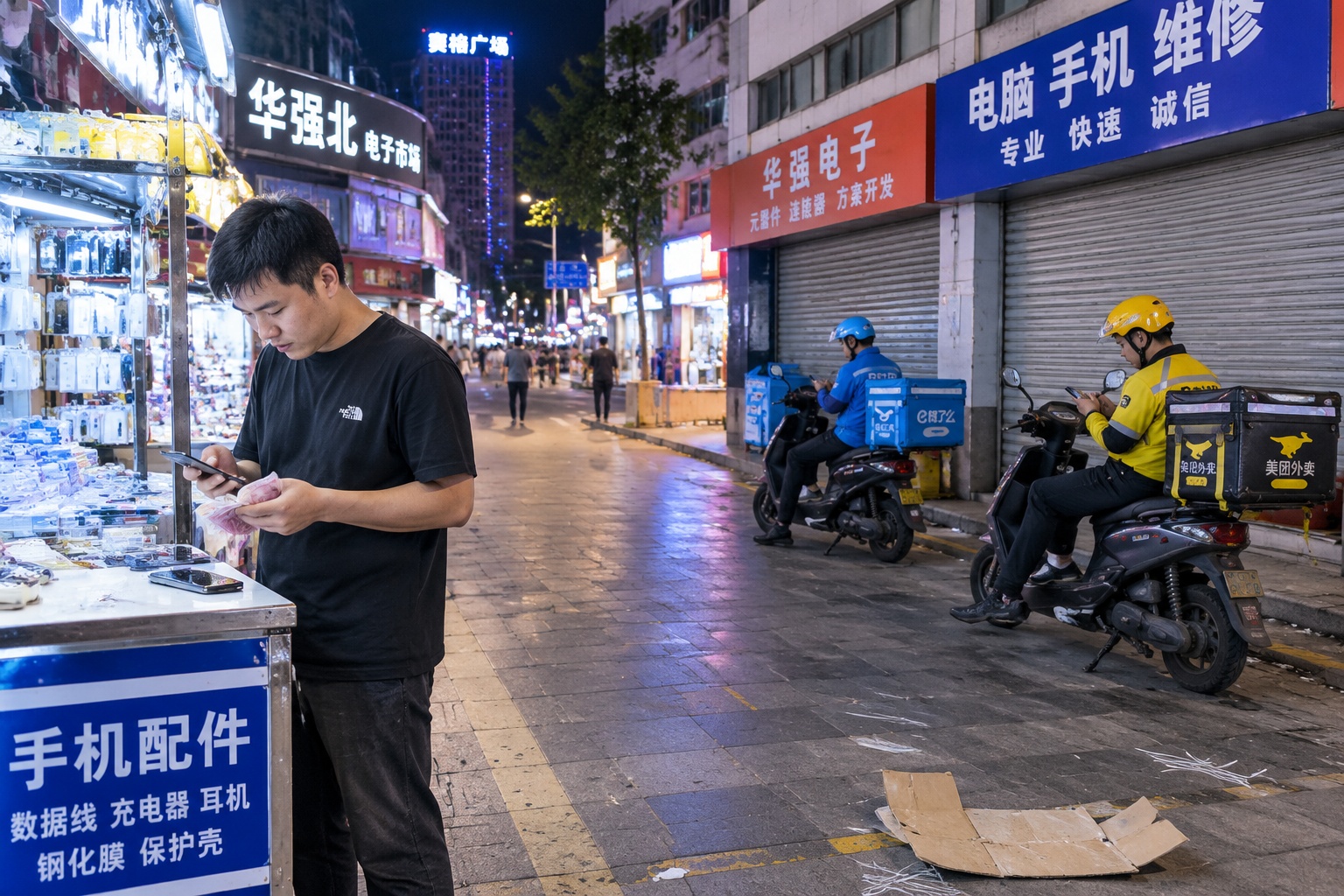
On the side streets, folding tables appear under white LED strips. A man in flip-flops tests a row of power banks with a multimeter. Two women sort phone cases by color. A delivery rider idles his electric scooter, waiting for a bag of parts that must reach a cross-border warehouse before midnight. The market has moved from retail to motion.
The Stall Owner Who Works When the Malls Close
Mr. Chen, as he introduces himself, sells small electronic parts from a table no wider than a yoga mat. He has been in Huaqiangbei for eleven years. For eight of those years, he had a counter inside a mall. Now he works nights.
He says the daytime market is for tourists and big orders. The night market is for people who are late, picky, or desperate. A repair shop in Futian needs a charging port for a discontinued phone. A student from a nearby startup needs ten sensors for a prototype. A buyer from Lagos needs to see a sample before placing a wholesale order. Chen keeps a plastic box of adapters, connectors, and tiny motors that do not appear on any major e-commerce site.
His philosophy is simple: the part is not valuable until someone needs it tonight. He prices by urgency, not by catalog. A USB-C cable might go for 10 yuan. A hard-to-find ribbon cable can go for 80. He accepts WeChat Pay, Alipay, and sometimes cash from older buyers. When I ask if he is tired, he laughs. Everyone here is tired, he says. The rent is not.
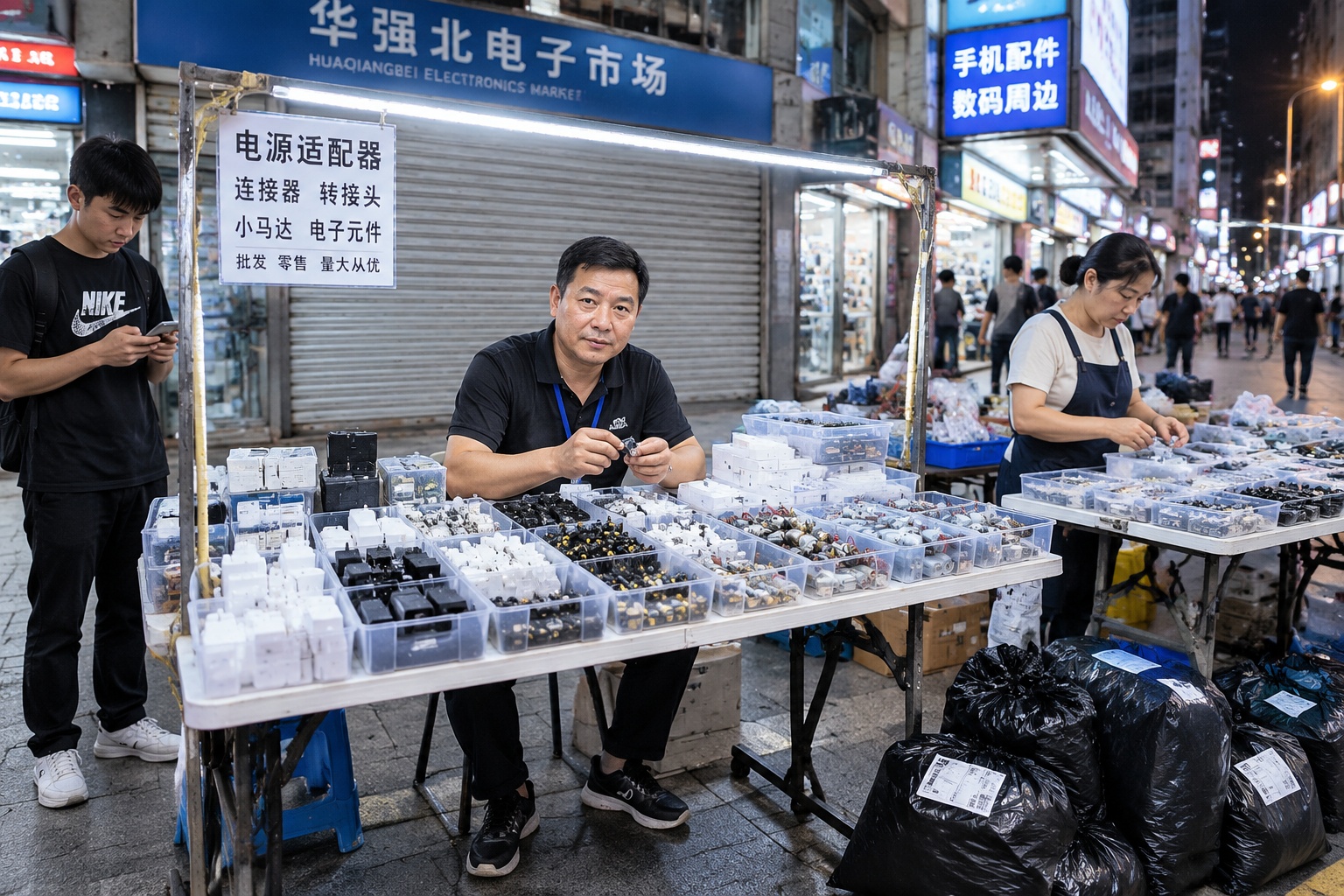
Around him, the night economy is a family business. His wife watches a second table. His nephew, a college student, handles online messages. They pack orders into black plastic bags and hand them to riders who will cross the city, and sometimes the border, before sunrise. On the ground, flattened cardboard boxes and cable ties show how quickly goods arrive and leave.
Global Buyers, Phone Flashlights, and the Art of the Deal
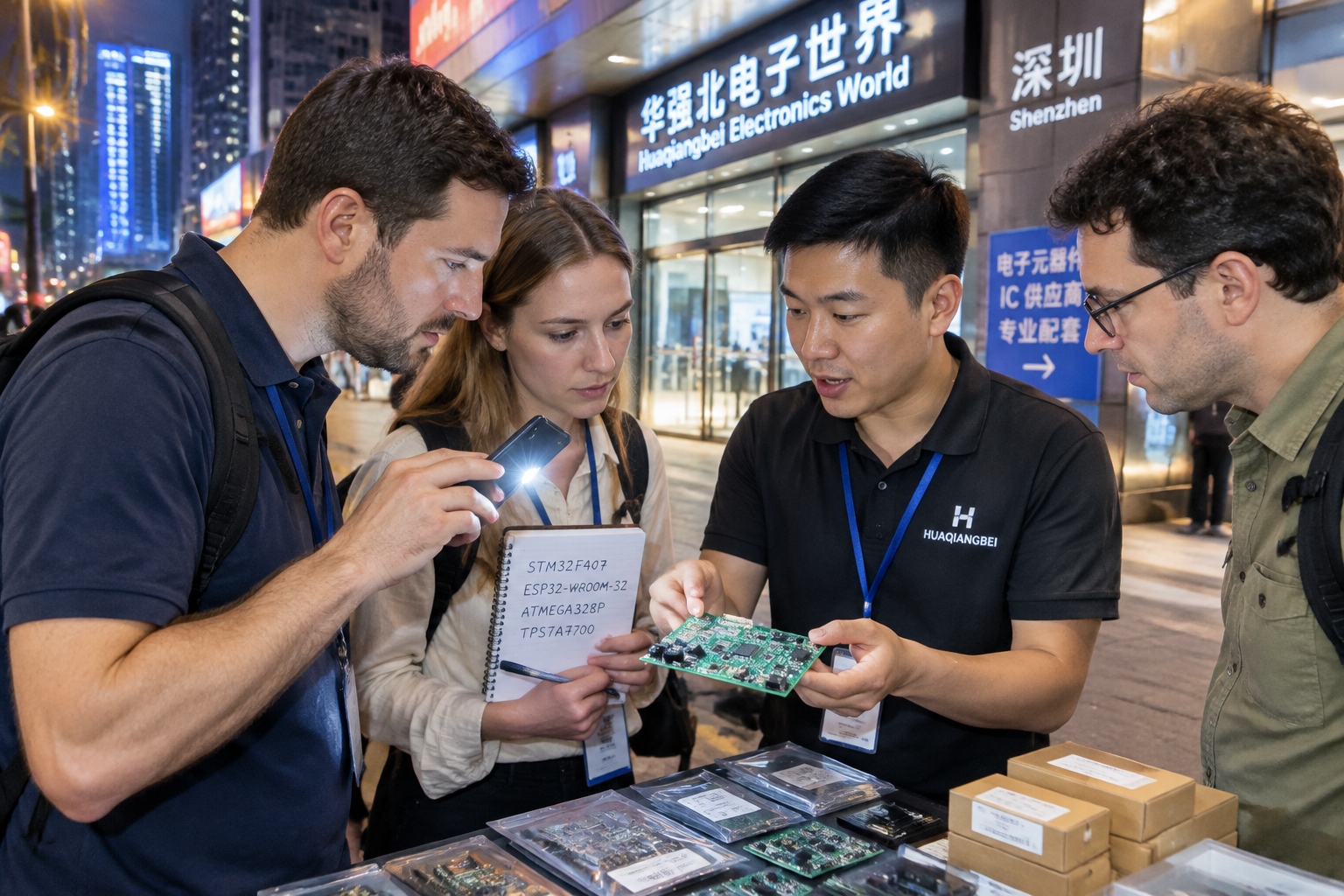
At 10:30 p.m., a group of overseas buyers gathers near a building entrance. They speak a mix of English, Arabic, and Mandarin. One man carries a notebook with handwritten model numbers. Another uses a phone flashlight to inspect the soldering on a circuit board. They are not here for souvenirs. They are here to compare suppliers.
Huaqiangbei has long been a magnet for buyers from Africa, the Middle East, South Asia, Europe, and Latin America. Some live in Shenzhen for months, moving between factories in Bao’an, warehouses in Longgang, and market stalls here. At night, the pace feels more personal. There is less room for formalities and more room for negotiation.
A buyer from Nairobi tells me he sources accessories for his shop. He can order online, but he prefers to touch the plastic, test the hinge, and see whether the logo is printed or etched. He checks the same item with three sellers. The first price is never the final price. The final price depends on quantity, shipping method, and how well he knows the seller.
The transactions are small by factory standards—fifty pieces, two hundred pieces, a sample bag—but they add up. This is the part of the global electronics supply chain that rarely appears in corporate reports. It is messy, fast, and human. It is also how many small businesses in other countries find their inventory.
Where New Gadgets Are Tested Before They Are Famous
Not everything in Huaqiangbei is brand new. Some of it is refurbished. Some of it is compatible, not original. Some of it is exactly what it claims to be. The night market mixes all three, and that is part of its reputation. Buyers learn quickly to test, ask, and not trust a shiny box alone.
But the district is also a launchpad. Shenzhen’s hardware ecosystem—engineers, mold makers, PCB factories, battery suppliers, app developers, logistics companies—is packed within a few subway stops. A prototype can be assembled in the morning, revised in the afternoon, and shown to buyers at night. That speed is the real product.
At one stall, a young woman livestreams a handheld translator. She speaks Chinese into it, and the device answers in English. A few feet away, a man demonstrates a mini drone to two buyers. Another seller shows a magnetic power bank that snaps onto a phone. These are not all breakthroughs. Many are small improvements: a better hinge, a cheaper chip, a longer battery, a new color. In Huaqiangbei, small improvements can become global products.
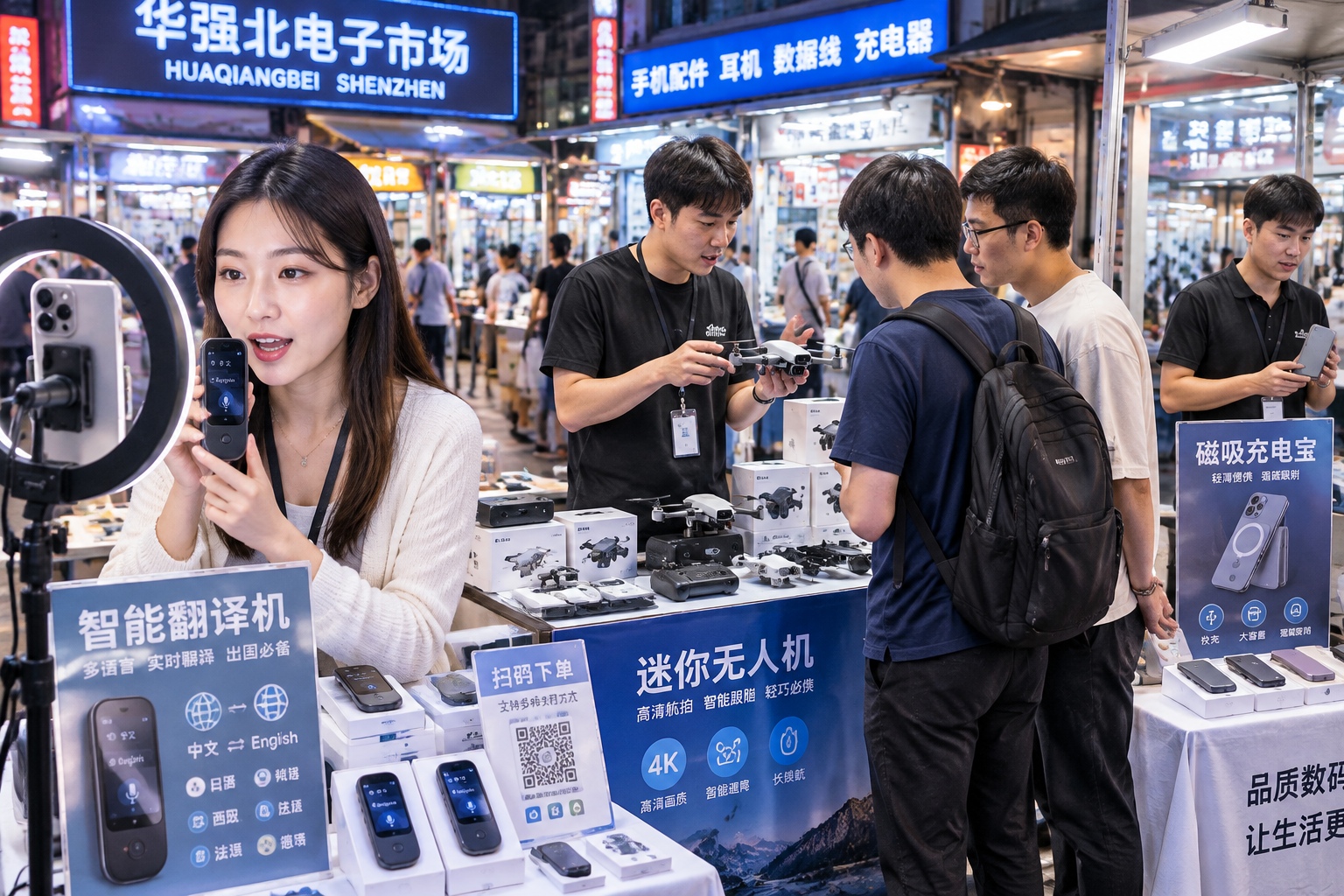
A repair technician named Lin tells me that night is when information travels. Sellers watch what buyers ask for. If ten people ask for the same rare adapter, someone will find it by tomorrow. If a new phone launches overseas, its case and screen protector may appear here within days. The market is not only selling electronics. It is reading demand in real time.
Why the Night Market Matters Beyond Shenzhen
Huaqiangbei is often described as the world’s largest electronics market. The label is easy. The reality is more layered. The daytime malls handle bulk trade, components, and legitimate brand distribution. The night trade handles speed, small batches, repairs, and the long tail of global demand. Both matter.
For a small shop in Cairo, Lima, or Warsaw, ordering 5,000 units from a factory may be impossible. Ordering 100 pieces from a Huaqiangbei seller, packed tonight and shipped tomorrow, is possible. That flexibility is a quiet engine of global e-commerce. It also creates risks: quality varies, counterfeit goods exist, and customs rules must be followed. Experienced buyers treat the market as a tool, not a miracle.
By 12:40 a.m., the streets are thinning. The LED strips are still on. Riders still wait. Chen is counting a stack of small notes and checking his phone. Tomorrow, the shutters will rise again, and the same space will become a daytime market of crowds, catalogs, and forklifts. For now, it belongs to people who work while the city sleeps.
If You Go: Practical Notes for a Night Visit
- Getting there: Take Shenzhen Metro Line 2 or 7 to Huaqiangbei Station. Exits A and D put you near the main market blocks. The area is walkable, but scooters move fast, so keep to the side.
- Best time: Most indoor malls close between 6 and 8 p.m. The street-level night activity picks up after 9 p.m. and can run past midnight. Weeknights are calmer and better for talking to sellers.
- What to bring: Cash is not essential; WeChat Pay and Alipay are everywhere. Bring a power bank, a small bag, and a phone with a good flashlight for inspecting items.
- What to buy: Phone cases, cables, adapters, chargers, small tools, and repair parts are common. Test everything on the spot. Ask about voltage, warranty, and return policy. If a price feels impossible, it probably is.
- Be respectful: Many sellers are working, not performing. Ask before taking close-up photos of people or stalls. Bargaining is normal, but aggressive bargaining over a 10-yuan item is not.
- Know the limits: Counterfeit and unsafe electronics exist. Check local import rules before flying home with batteries or radio devices. For business sourcing, use a trusted agent or inspection service.
Huaqiangbei after dark is not a polished night market. It is a working market with tired eyes, bright lights, and the smell of hot plastic. That is exactly why it is worth seeing. It shows a side of Shenzhen that does not fit on a postcard: a city that keeps moving after the official day is over.
Start the discussion at forum.chinacomes.com