


A super microscope tucked into a Dongguan factory building
In Songshan Lake, a research zone in Dongguan, Guangdong, there is a grey-white building that looks like an ordinary factory from the outside. Step inside and you find a tunnel about 600 meters long. A linear accelerator comes first, then a ring-shaped accelerator, and finally a target station. Here, a proton beam hits a tungsten target and knocks neutrons loose.
This is the China Spallation Neutron Source, or CSNS, which first produced a beam in August 2018. It is China’s first pulsed spallation neutron source and makes the country the fourth in the world to operate one, after the UK, the US and Japan. The logic is straightforward: accelerate protons close to the speed of light, slam them into a heavy metal target, and use the neutrons that fly out to study materials.
Why build something so large? Because some questions cannot be answered with X-rays.
Why neutrons instead of X-rays?
Materials scientists have always needed tools to “see” inside things. X-rays are the most familiar. They interact with the electron cloud around atoms. More electrons mean a stronger scattering signal. That is why X-rays are great for heavy metals but nearly blind to light elements such as hydrogen, lithium and carbon, which have very few electrons to scatter.
Neutrons play a different game. They carry no charge and interact directly with atomic nuclei. Scattering strength does not line up by electron count. Hydrogen, lithium, carbon and oxygen all give clear signals. Neutrons also have a magnetic moment, which means they can sense how magnetic moments are arranged inside a material. X-rays struggle to do that.
Penetration is another key difference. A few millimeters of aluminum will stop a laboratory X-ray beam. Neutrons can pass through several centimeters of steel or aluminum. That means users can put a sample inside a hot furnace, a tensile rig, a battery casing or a pressure cell and watch what happens inside while conditions change, not just on the surface.
Getting protons close to the speed of light
There are two common ways to make neutrons. A reactor produces them continuously through nuclear fission. A spallation source uses an accelerator to push protons to high energy and then strikes a heavy metal target.
At CSNS, protons reach 1.6 billion electron volts, about 0.9 times the speed of light. They hit a tungsten target, and each proton can knock out twenty or thirty neutrons. Those neutrons are slowed down by moderators, such as liquid hydrogen or water, to the energy ranges experiments need, and then guided to different instruments.
Why is the facility so long? Reaching that energy requires a long accelerator chain. The linear accelerator is about 240 meters, and the rapid-cycling synchrotron has a circumference of roughly 228 meters. Add the target station and the instrument hall, and the whole line stretches around 600 meters. None of it is decorative. Every meter of magnets, radio-frequency cavities and vacuum pipe is needed to push the protons faster.
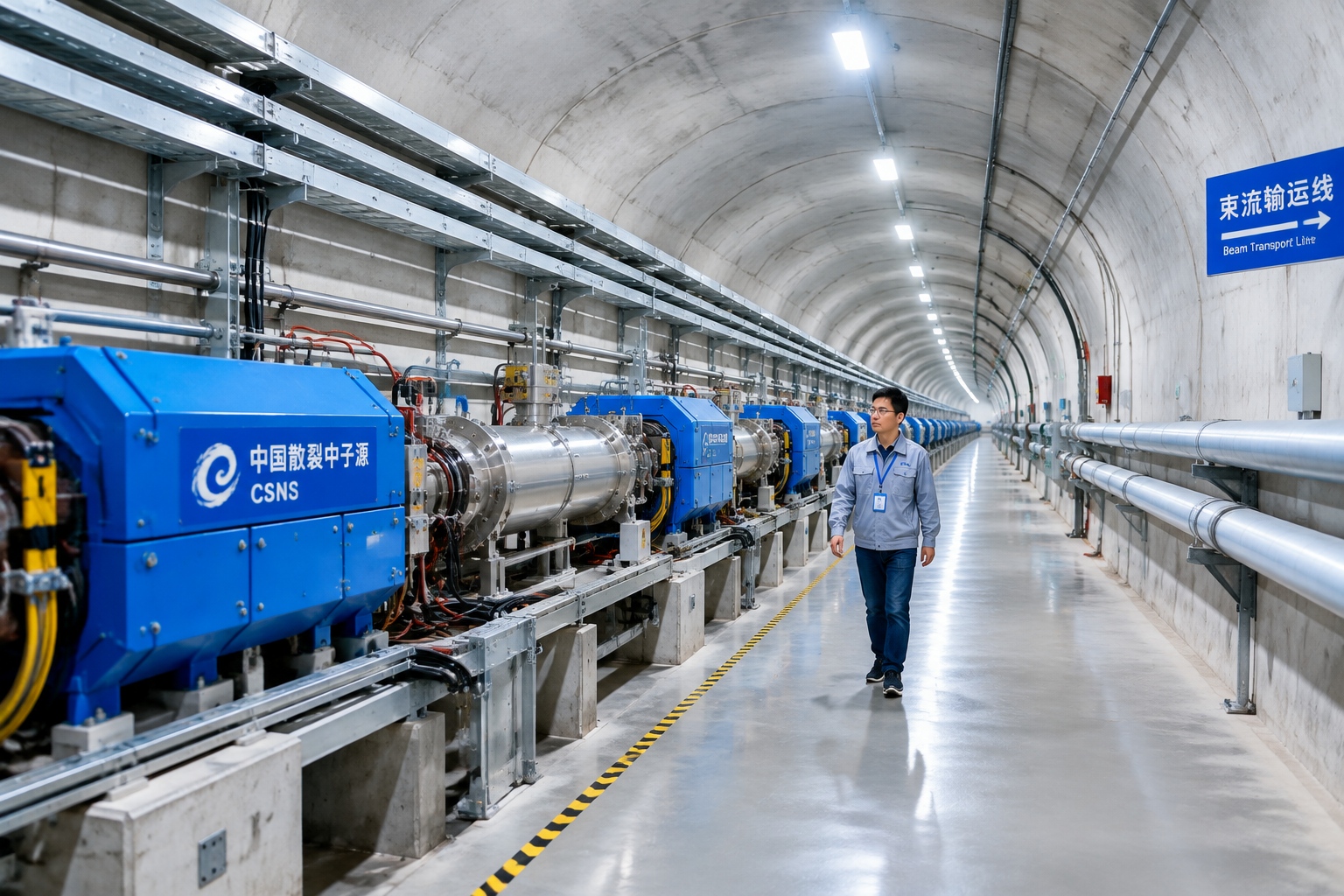
This also explains why not every country builds a spallation source. It is expensive and complex, and it needs a specialist team to keep it running. CSNS was one of China’s major national science facilities under the 11th Five-Year Plan. Construction began in 2011, and the facility was completed in 2018.
What it studies
CSNS began with three instruments and has since expanded to more than a dozen, covering physics, chemistry, materials, engineering and life science.
Lithium batteries. Researchers want to know where lithium ions go during charging and discharging. X-rays are not very sensitive to lithium, but neutron scattering can resolve its position in the crystal structure. That is useful for developing batteries with higher capacity, better safety and longer life.
Stress inside metals. High-speed train wheels, aircraft engine blades, welded pipes and pressure vessels all build up internal stress during manufacturing. Stress is invisible, but it can shorten a part’s life or cause sudden failure. Neutrons can pass through several centimeters of steel and map stress at different depths. Engineering users often mount samples on a tensile rig or loading frame and collect data while applying force.
Magnetic materials. A neutron’s magnetic moment lets scientists distinguish magnetic orientation in different regions of a material. For permanent magnets, superconductors and spintronics materials, neutron scattering provides information X-rays cannot easily deliver. X-rays can tell you where the atoms are. Neutrons can also tell you how the magnetic moments are arranged.
Biological molecules. Proteins and biomolecules contain many hydrogen atoms. Hydrogen positions matter for understanding how a molecule works, but X-ray crystallography struggles to locate them. Neutron diffraction can. By replacing hydrogen with deuterium, researchers can also make specific parts stand out more clearly, a bit like adjusting contrast in a structural photograph.
In-situ experiments. Because neutrons penetrate deeply, a sample can sit inside a complex environment that mimics real conditions: high temperature, low temperature, high pressure or electrochemical cycling. That shows how a material behaves while it is working, not just after it has been taken apart.
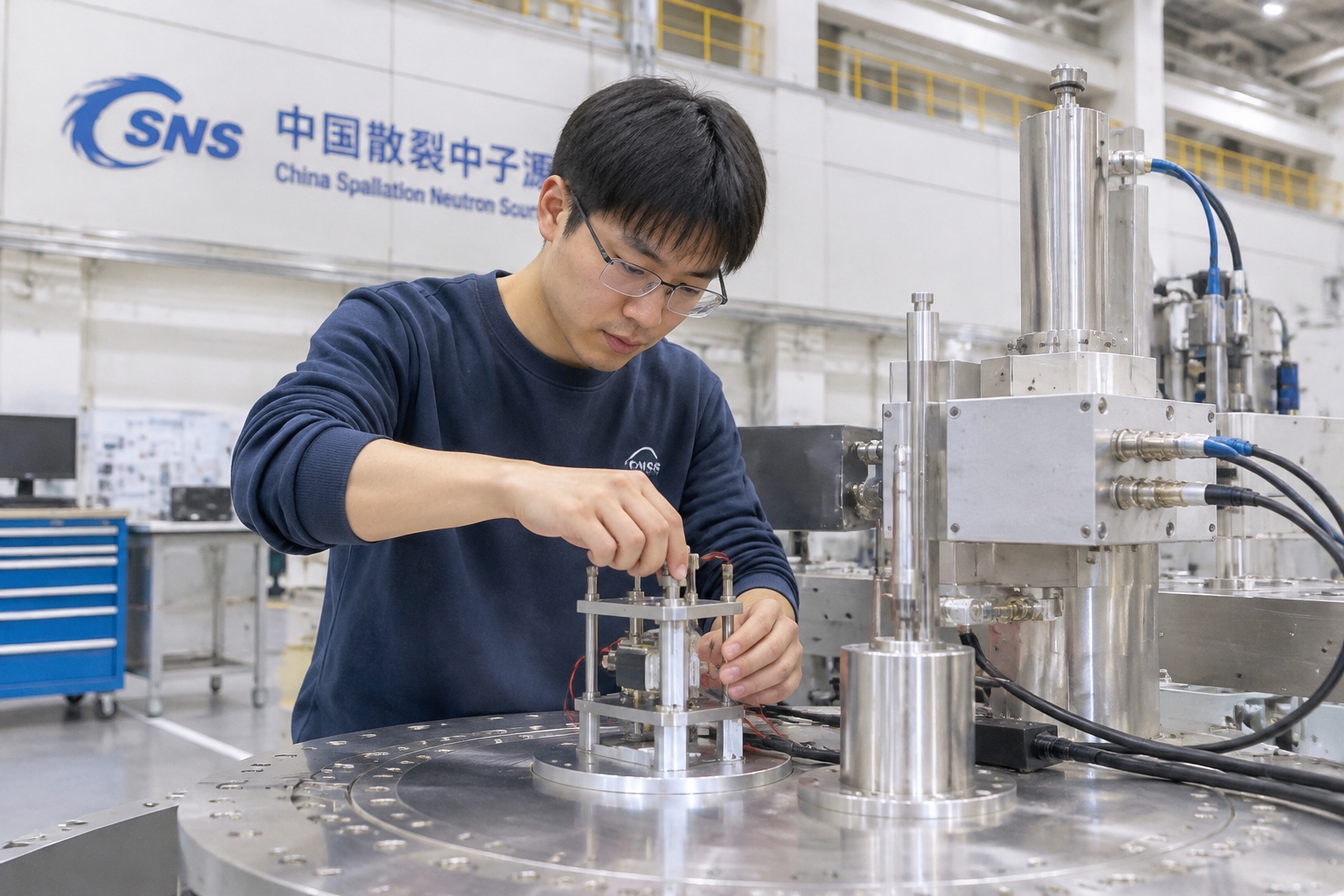
These applications share one thing: none is solved by a single glance. Users need beam time, sample environments and data analysis, and they often spend months discussing results with collaborators. A second phase of CSNS is already being planned, with more instruments and higher beam power.
How it relates to synchrotron light sources
China also operates synchrotron light sources, such as the Shanghai Synchrotron Radiation Facility and the Hefei Light Source. These machines use X-rays to do similar work: seeing inside materials.
The two are not competitors. They answer different questions.
X-rays are more sensitive to heavy elements, electronic structure, surfaces and interfaces. Neutrons are more sensitive to light elements, magnetic structure and the bulk of a material. Many projects use both. A team might first map the overall structure with synchrotron radiation, then use neutrons to confirm where the hydrogen atoms are or how the magnetic moments line up.
Think of them as two different lenses. One is good at showing the overall arrangement of atoms and electron clouds. The other is good at highlighting nuclei and magnetic signals, especially through thick materials. Choose the wrong tool and you cannot see clearly. Choose the right one and the other fills in what it misses.
How to apply for beam time
CSNS is a user facility, not a lab owned by one research group. There are two application rounds each year, and researchers from China and abroad can submit proposals. Review panels score them on scientific value, technical feasibility and requested beam time. Successful projects receive beam time free of charge.
The point of this system is to lower the barrier. A young research group at an ordinary university does not need to build its own neutron source to use a world-class tool. It needs to write a good proposal and get through review.
Competition is real. Popular instruments are often heavily oversubscribed. Industrial users are beginning to appear too. Some companies use neutron diffraction to measure residual stress in engine parts or to check weld quality. Their share is still small, partly because companies often want faster turnaround, while neutron experiments can take days.

What it cannot do
Neutron scattering has a boundary that is easy to overlook: not every experiment suits it.
Compared with synchrotron radiation, a spallation source has limited brightness. Many experiments take hours or days to collect enough data. Sample volumes are usually larger than for X-ray experiments, and many instruments struggle with micron-sized spots.
Some materials absorb neutrons too strongly and are actually hard to study. Certain isotopes of lithium and boron are classic examples. Running the facility is also costly. The accelerator needs continuous power and cooling, the instruments need calibration, and a team must be on duty.
“Super microscope” is a convenient metaphor, but it is not magic. It sees things X-rays cannot, and it has its own blind spots and costs. Understanding its limits is more useful than believing it can solve everything.
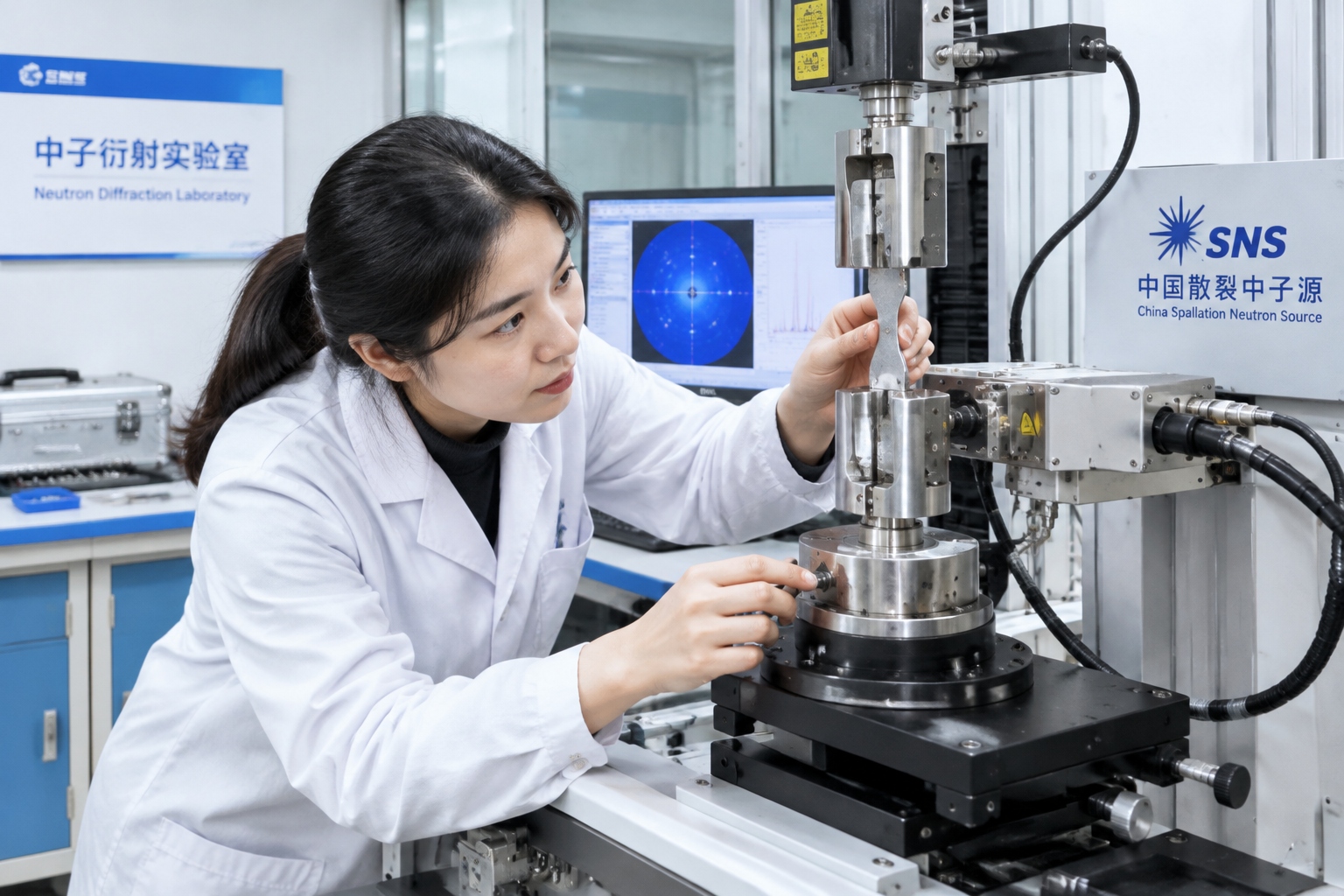
It won’t show up in your daily life, but its data will
For most people, the spallation neutron source will never appear in daily life. But its data seeps into many corners: battery life, safer trains, cheaper medical isotopes, alloys that work at higher temperatures.
At the Songshan Lake campus, researchers arrive with samples and leave with data. Their questions are usually very specific. Where exactly do lithium ions pile up after two hundred cycles? How much stress is really inside this weld under load? How do the magnetic moments in this magnet arrange themselves at low temperature?
The big machine is not the answer. It is simply a tool that lets people ask those questions.
Start the discussion at forum.chinacomes.com