

A Rock Split in Half, With Two Temples On Top
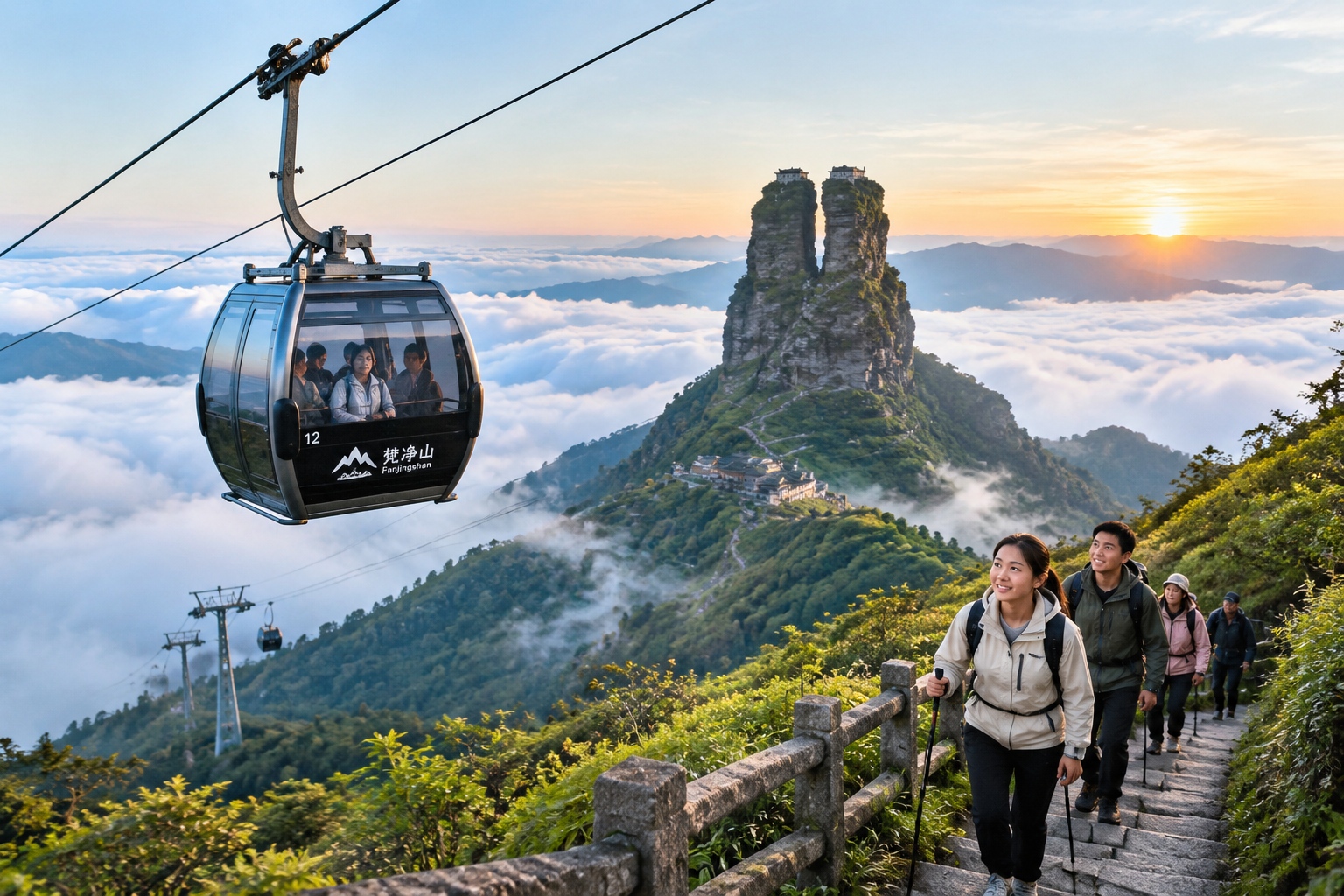
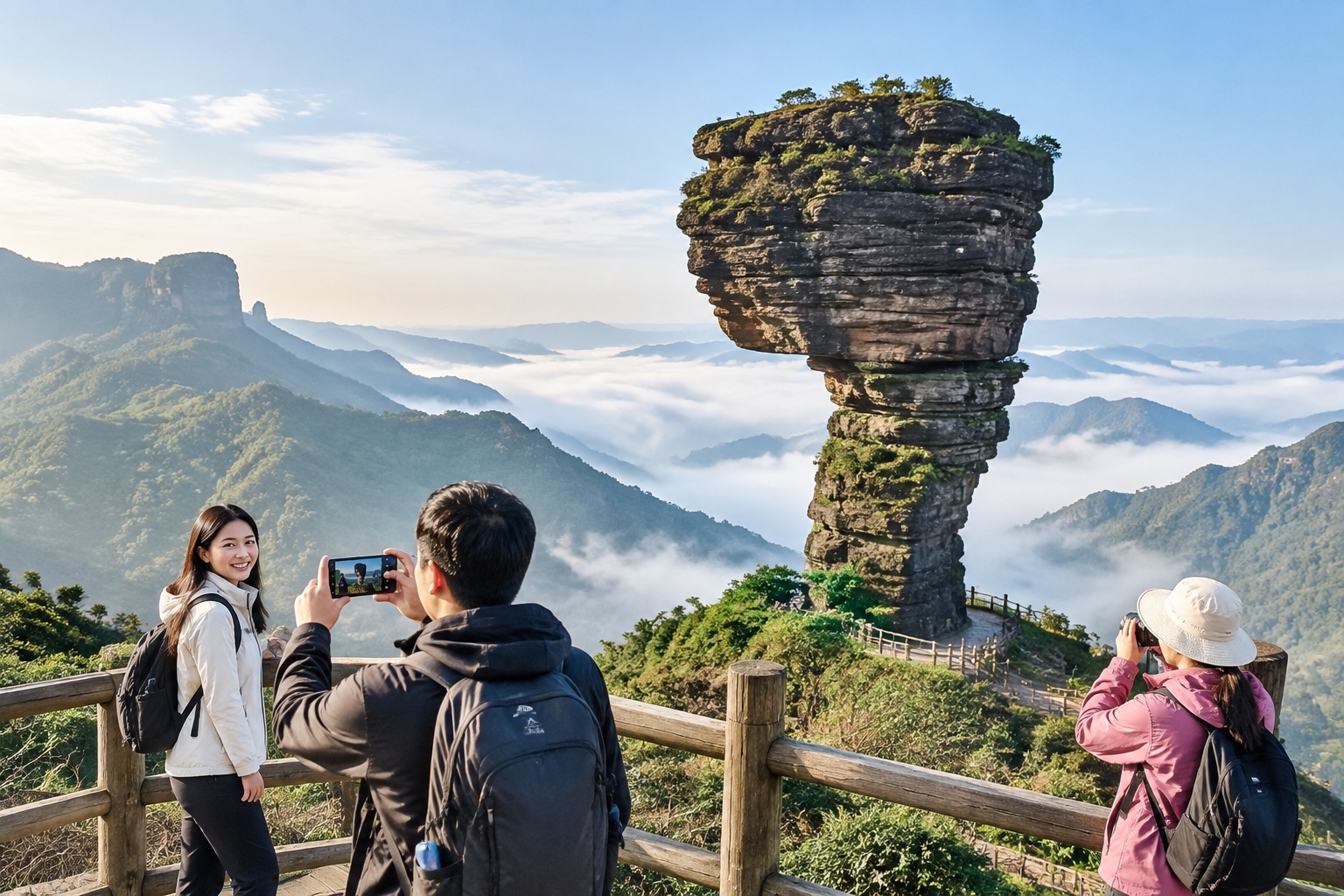
From the cable car, it looks like a mistake. A pillar of rock rises almost vertically out of the forest, split down the middle by a crack a couple of metres wide. On each half, someone has balanced a small temple. A short stone bridge joins the two. And along the outside of the rock, in single file, a line of people is climbing — small enough at that distance to look like ants walking up a wall.
That pillar is Red Cloud Golden Peak (红云金顶), the postcard image of Fanjingshan (梵净山), a mountain in Tongren, in China’s southwestern Guizhou province. It stands at 2,336 metres, part of the Wuling range, and it became a UNESCO World Heritage site in 2018 largely because of what lives on its slopes: the Guizhou snub-nosed monkey, the Fanjingshan fir, and a long list of plants and animals found nowhere else. The peak itself is why most people come. Almost nobody arrives knowing what the last hundred metres will feel like.
The Peak Is Actually Two Peaks
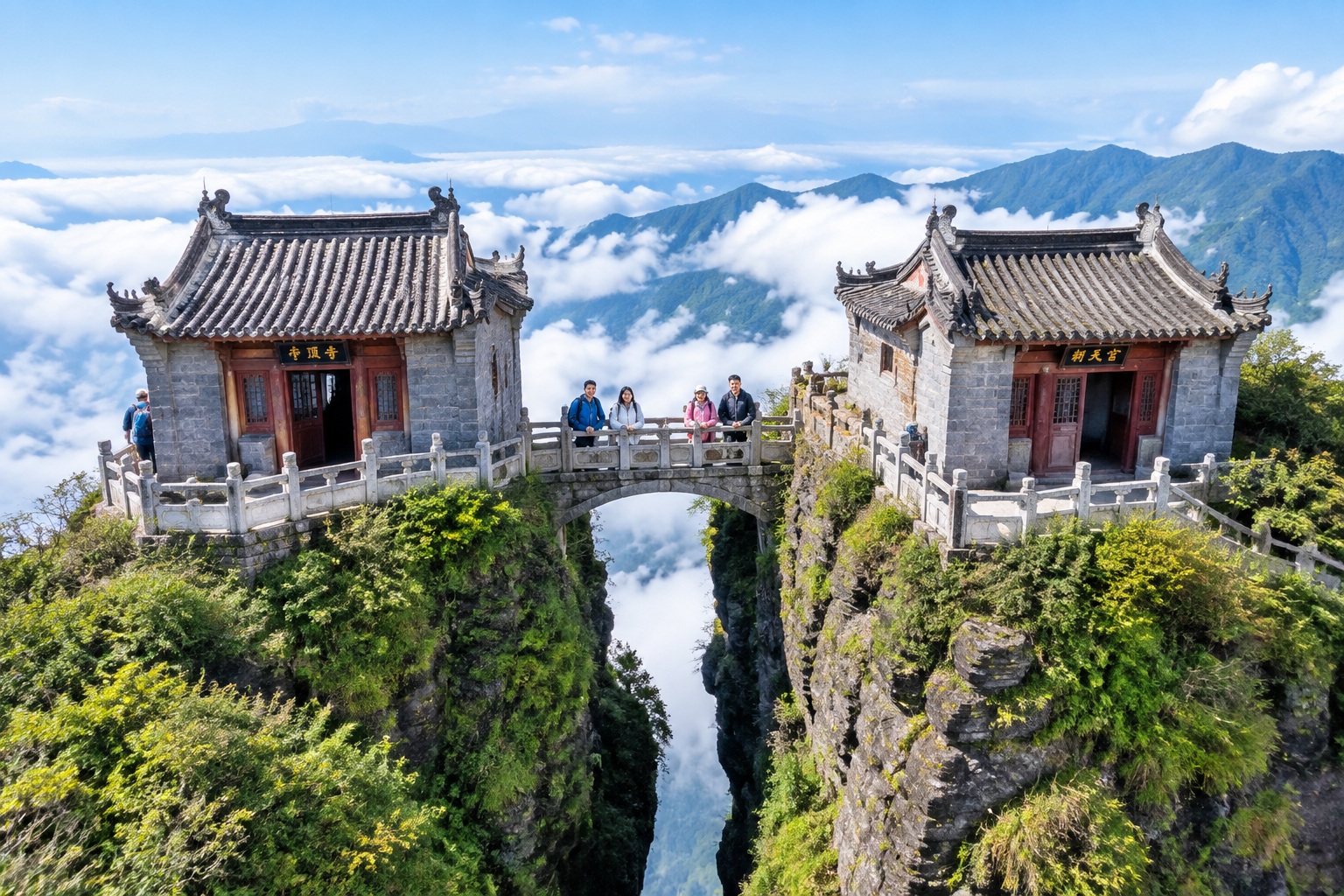
Look closely at the summit and you notice the crack is not decorative. Red Cloud Peak is a single block of rock that has been split into two towers, and the temples stand on either side: Shijia Hall (释迦殿) for Sakyamuni Buddha on one, Maitreya Hall (弥勒殿) for Maitreya on the other. The gap between them, the Golden Sword Gorge (金刀峡), is the kind of thing local legend explains with a single sword stroke. Geologists explain it with a joint in the rock and a few million years of water and frost working along it.
Fanjingshan is a Buddhist mountain — one of the country’s important ones, traditionally associated with Maitreya — and pilgrims have been climbing it for centuries. What has changed in the past decade is everybody else.
Getting to the Bottom of the Stairs
There are two ways in. The Jiangkou gate, on the south side, is where almost everyone goes: you ride a cable car for about twenty minutes over forest, then walk thirty to forty minutes along stone and wooden paths, past the famous Mushroom Rock, to the base of Red Cloud Peak. From the gate to that base, expect roughly an hour and a half to two hours, including queues.
The Yinjiang gate, on the west side, is the old pilgrim route. It is a walk-up trail of thousands of steps, generally reported at over 8,000, and it takes most people four to six hours to reach the summit ridge. Few foreign visitors use it. It is quiet, and it hurts.
The Last Hundred Metres Are the Real Story
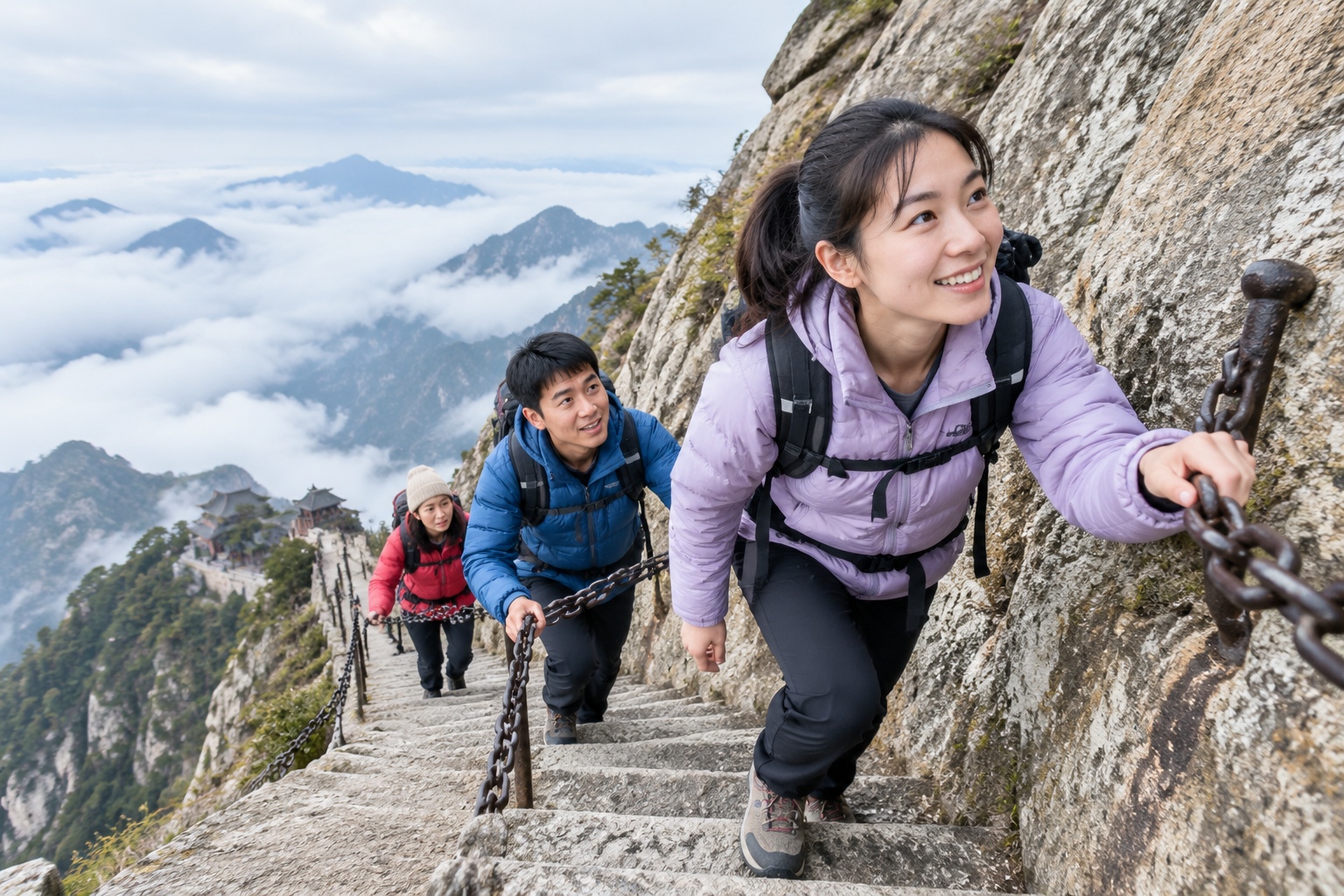
No ropes. No harness. No guide required, no technical skill. What there is instead is a staircase cut into the rock, narrow enough that it is basically a single lane, with an iron chain running along one side for your hand. Some sections lean back at sixty or seventy degrees. In places the rock wall is at your shoulder and the drop is at your other side, and the only thing between you and a very long fall is the chain and your own grip.
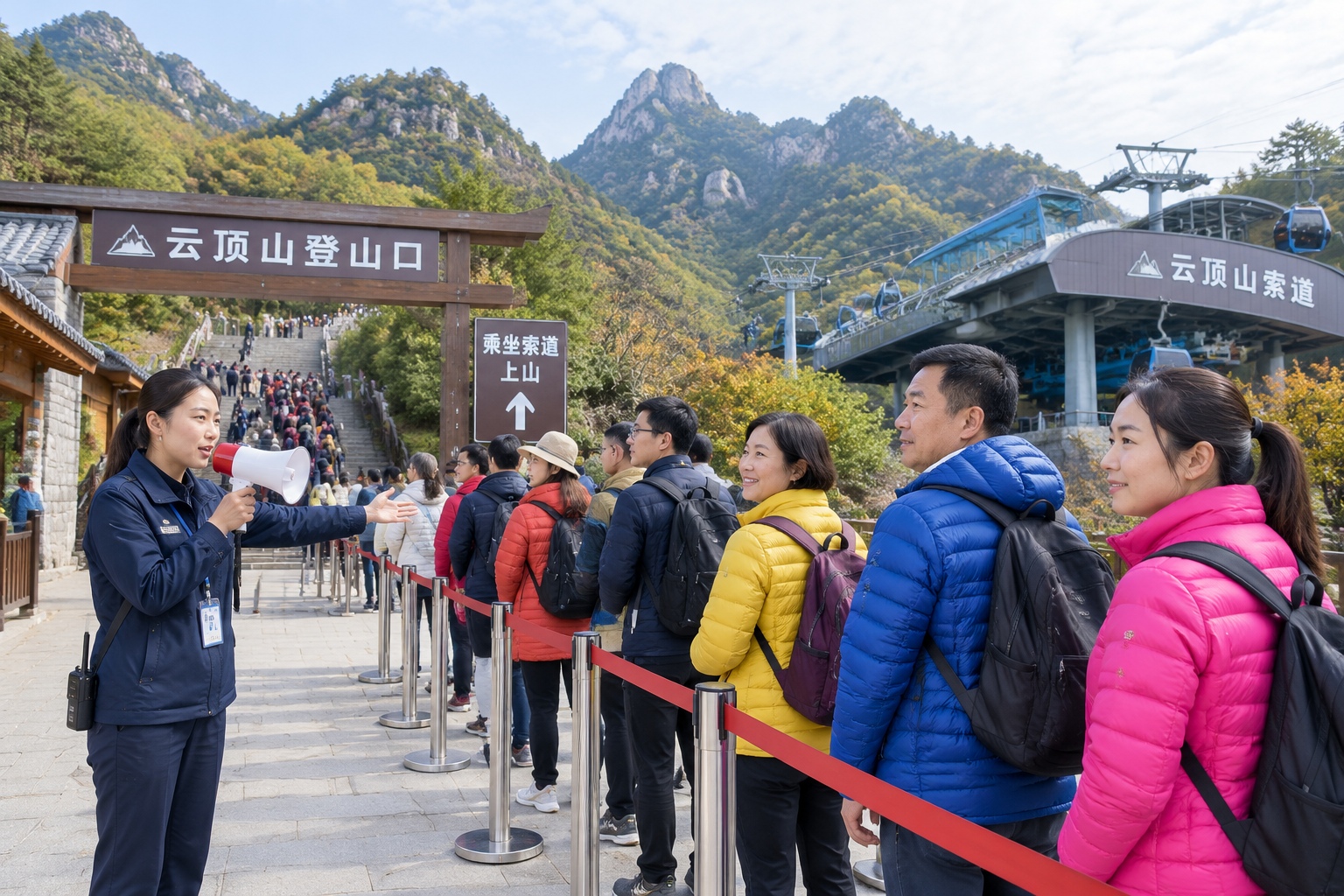
Traffic is controlled. Staff at the bottom hold people back and send them up in batches, and at points you climb in one direction and descend by a different set of steps, so you rarely pass anyone. That control is what keeps it safe. It is also why the queue at the base can take longer than the climb itself — on a busy holiday, people report waiting one to three hours for their turn, then reaching the top in twenty or thirty minutes.
And you cannot easily change your mind halfway. There is someone behind you.
So How Much Courage Does It Take?
Less than the photos suggest, and more than most people expect.
The photo that circulates — a near-vertical ladder with a person clinging to a chain above a void — is real, but it is one frame out of a forty-minute climb. Most of the ascent is ordinary steep stairs, with railings and chains the whole way. You are not climbing. You are walking up something very steep while holding on.
The people who find it hard are almost never the unfit ones. They are the ones with a bad head for heights. Watch at the first set of chains: some visitors in their seventies and some eight-year-olds go up without a second thought, while some grown adults in good running shoes look at the angle, sit down on a step, and go back the way they came. That is a respectable decision, and staff help people make it.
The other variables are physical and dull: knees, if yours are bad; grip strength, if you are holding a chain for twenty minutes; and weather. At 2,300 metres the top is often five to ten degrees colder than the valley and can be inside a cloud while the base is sunny. Wet granite steps and thin winter ice are what actually make this climb risky, not the angle.
The Practical Playbook
Tickets and timing
Fanjingshan uses timed entry and caps daily admissions, so you buy online in advance — the official booking runs through a WeChat mini-program, and you register with your passport or Chinese ID. On summer weekends and during national holidays, slots can disappear days ahead. Entry is roughly 100 yuan in peak season and a round-trip cable car around 160 yuan, with lower prices in the quiet months; check current rates before you plan a budget.
Go early. The first cable cars leave around 8 a.m. and the queue builds fast; by mid-morning on a good day it stretches back and forth across the plaza. If you want the summit without the crowd, be at the gate when it opens.
Seasons
Late April and May bring azaleas. September and October give the clearest skies. Winter is the most beautiful and the emptiest — snow on the temples, ice on the steps. The rainy stretch from May to August is the worst for views and the best for the sea of clouds, which usually shows up in the early morning after a night of rain. If that photograph is what you came for, you are gambling either way.
What to bring
Grippy shoes with a real sole. Not slip-ons, not platform sandals, both of which you will see on the mountain anyway. Layers and a rain shell, thin gloves for the cold chains, water, and nothing bulky — a large backpack is awkward on a one-lane staircase. Leave the selfie stick in the bag for the steep part; you will want both hands.
The Quieter Twin: Old Golden Peak
Red Cloud Peak is not the highest point here. Old Golden Peak (老金顶) reaches 2,494 metres and has its own steep staircase, its own small hall, and usually a fraction of the queue. Many visitors do both. If your interest is the view rather than the bragging rights, this is the smarter trade.
Getting There
Fanjingshan is not on the standard China itinerary, and that is part of the appeal. Fly into Tongren Fenghuang Airport, or take a high-speed train to Tongren or Tongren South station, then a bus or hired car for an hour to an hour and a half to the Jiangkou gate. Most people sleep in Tongren city or Jiangkou county the night before and start at dawn. Allow a full day for the mountain and a spare day for the weather.
What You Actually Remember
The summit temples are small and the view is often white. What stays with people is the queue: the strangers who hold your bag while you pull on a glove, the man who talks a nervous stranger through the last twenty steps, the teenager who climbs twice because his grandmother turned back and he wants to describe it to her. That, and the small private surprise of finding that the climb you had been nervous about for weeks was mostly just stairs.
Start the discussion at forum.chinacomes.com