

The road up, and the first cup of tea
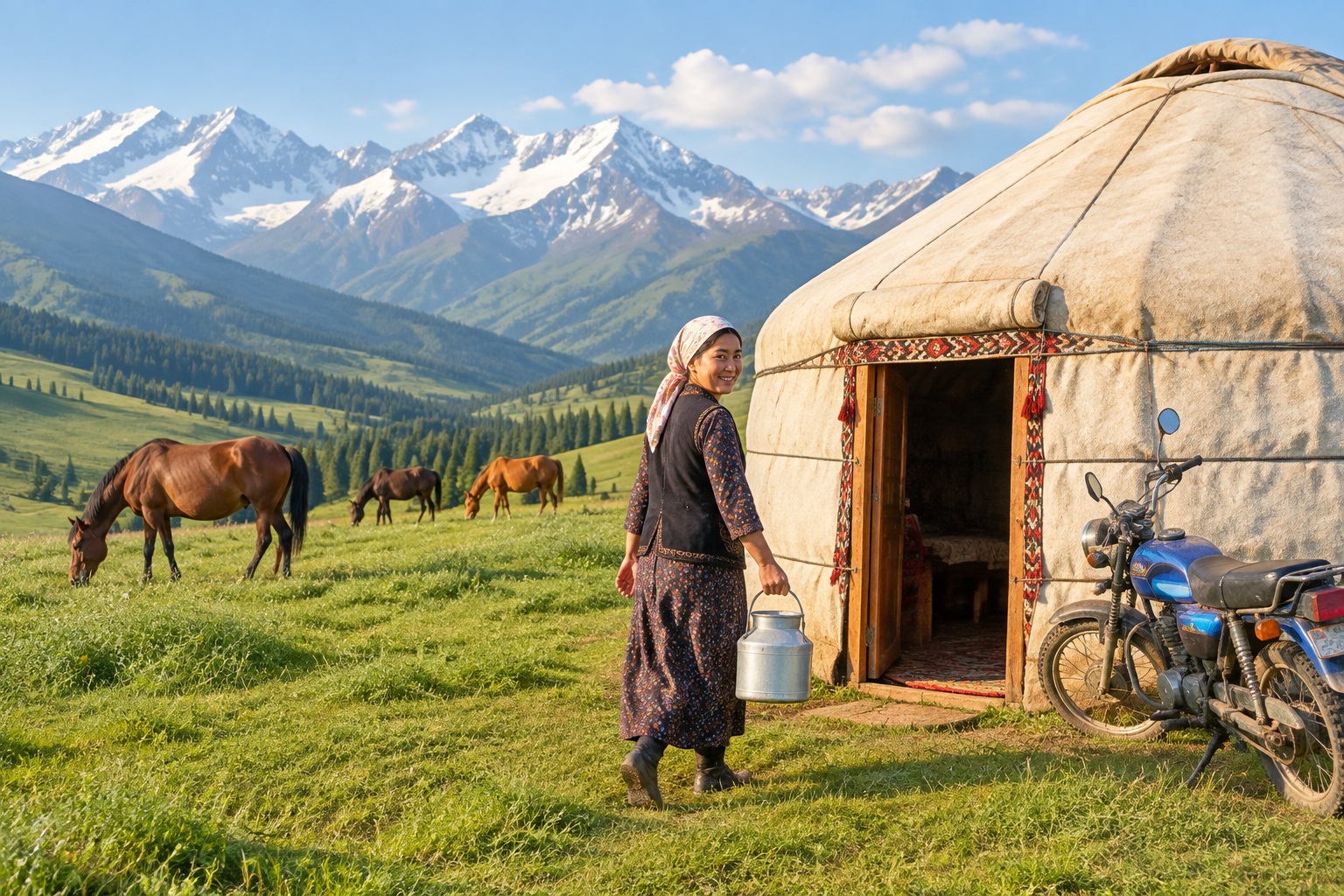
The last hour of the drive is the part you remember. Out of Xinyuan County, in the Ili Valley of western Xinjiang, the road folds itself up the flank of the Tianshan in a series of long grey switchbacks. Below, the valley floor is a grid of cornfields and poplar windbreaks. Above about 2,000 metres the land turns a green that looks almost edited, and small white dots begin to appear on the slopes. Those are yurts. Some of them have stood on the same summer ground for longer than anyone can tell you exactly.
I had come to spend a week with a Kazakh herding family. Yerbol is 68 and moves slowly in the mornings. His wife Aigul is up before anyone else. Their son Nurlan does the hard riding, Nurlan’s wife Dana runs the household, and their two children, Adil, 13, and Aigerim, 9, are on summer break from school in town. Together they keep roughly 300 sheep, 30 head of cattle and 20 horses. The Ili Kazakh Autonomous Prefecture is home to most of China’s roughly 1.5 million ethnic Kazakhs, who have been moving between winter villages and summer pastures here for generations.
The first thing that happens when you arrive is tea. Aigul poured it from a porcelain pot into a bowl, added milk and a pinch of salt, and set it in front of me before I had put down my bag. You do not refuse. You drink it, you are offered it three more times, and by the end of the week you have stopped counting bowls.
The second thing that happens is that you notice nobody is going to tell you what time it is.
Inside the yurt: felt walls, a solar panel, a phone on charge
A yurt — kiiz ui, felt house, in Kazakh — is a lattice of willow wrapped in layers of sheep’s-wool felt and canvas, tied with rope, and crowned with a wooden ring that opens to the sky. The door faces roughly south. Around the curved wall are low beds, stacked quilts, a wooden chest, a saddle on a stand, a sack of flour.
In the centre sits an iron stove. It burns dried dung and wood, and someone feeds it at 5 a.m. and again at 9 p.m. Smoke leaves through a pipe that runs up through the roof ring. On the July nights I was there the temperature dropped to around 3°C; by morning the inside of the canvas was damp and everyone stood near the stove before stepping out.
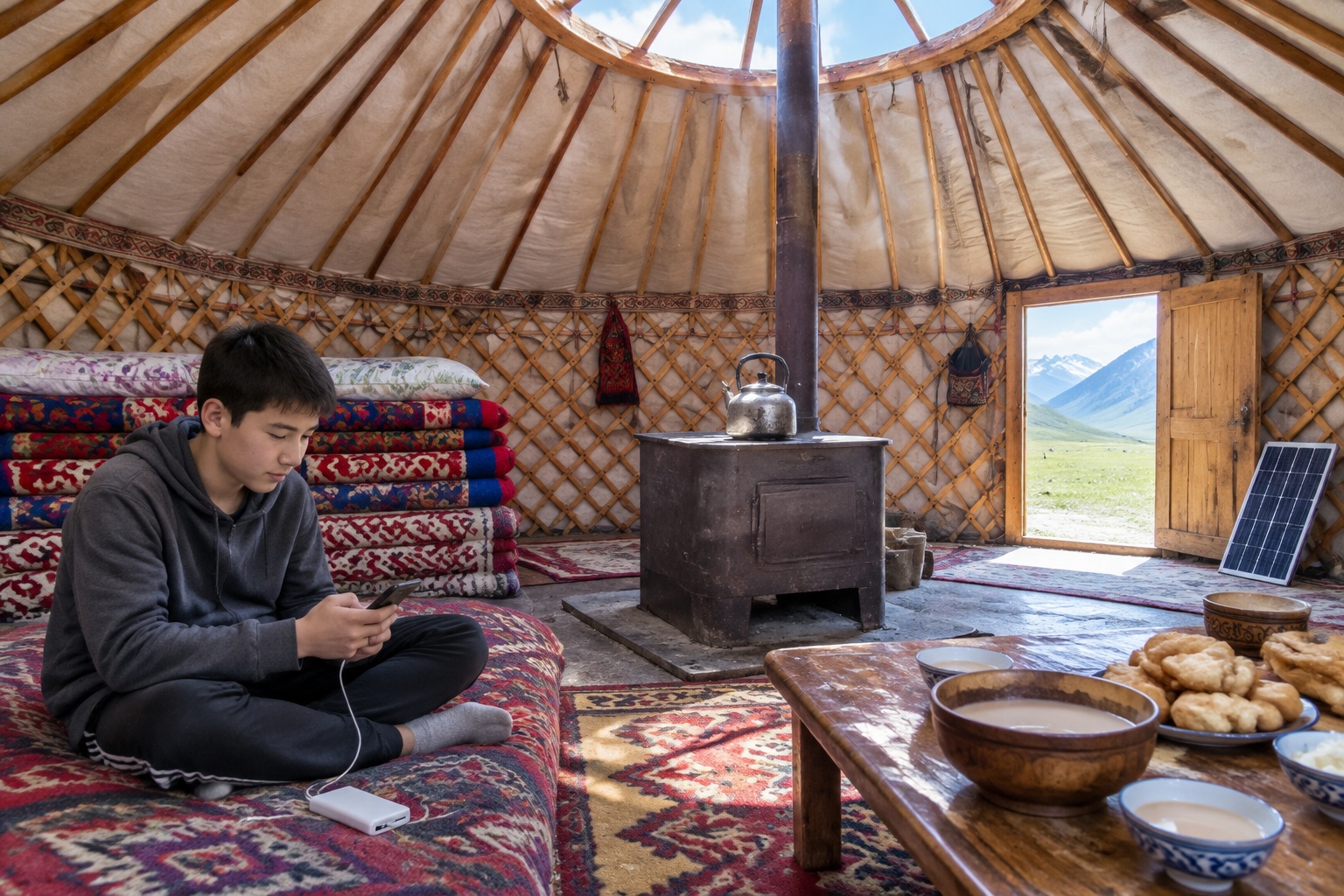
Mixed in with all of that are the things you might not expect. A small solar panel leans against the wall by the door, charging a power bank that charges two phones. A Bluetooth speaker plays Kazakh pop in the afternoon. A satellite dish is bolted to a pole next to the horse tether. Somebody’s cousin sends a voice message from Yining, and everyone listens to it twice.
A day on the summer pasture
5 a.m. — mares, kumis, and cold hands
Aigul milks the mares first, with one foal tied close by so the mare stands still. The milk goes into a wooden barrel or a leather bag, gets churned, and is left to ferment into kumis — slightly fizzy, sour, faintly smoky, and an acquired taste that I acquired by about day three. A litre sells for 20 to 30 yuan at roadside stands, mostly to passing drivers.
By the time the sun clears the ridge, tea is on again, with bread, butter, jam and baursak, small pieces of fried dough that are the most dependable food on the mountain.
9 a.m. — moving the flock
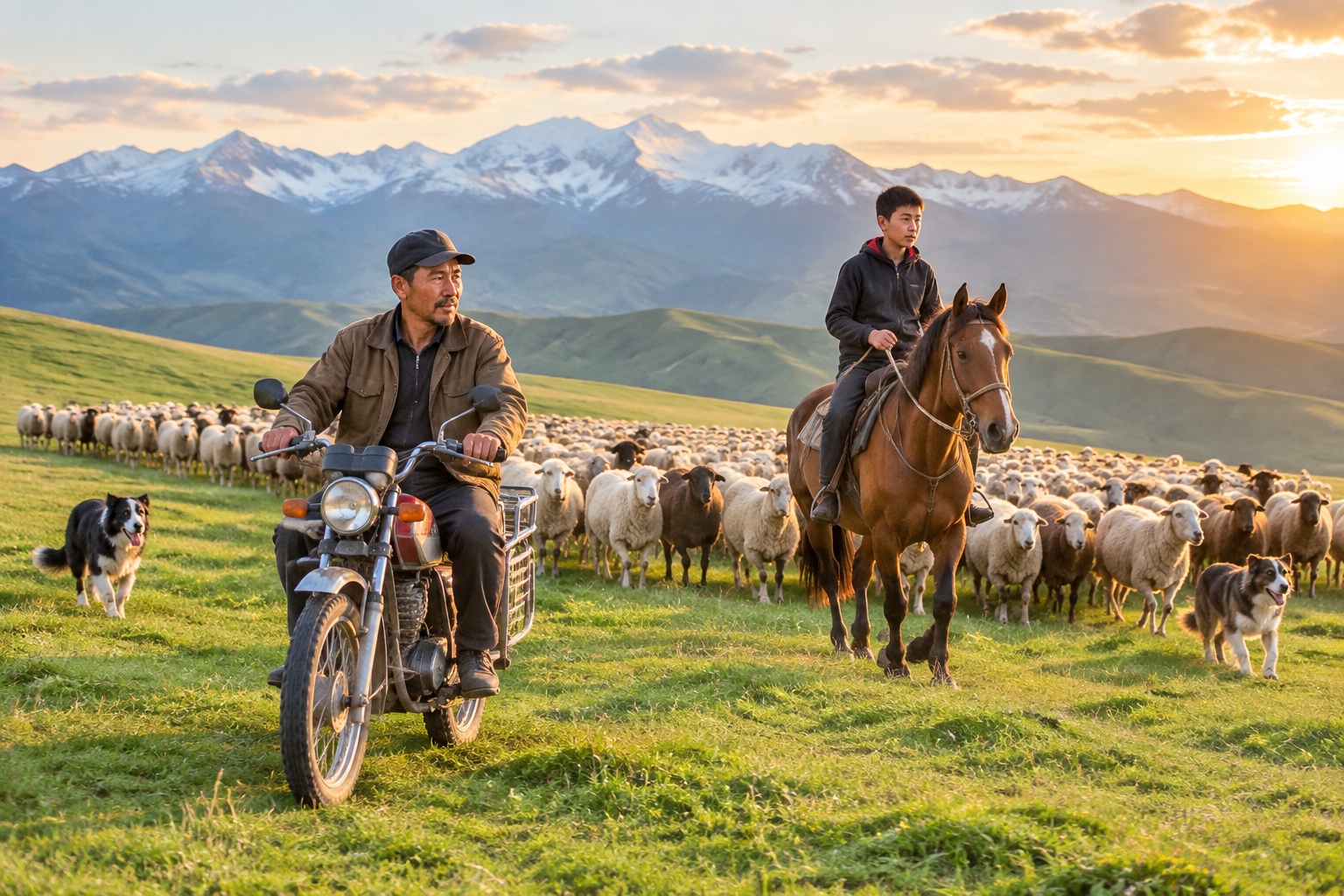
Nurlan takes the sheep up to higher grass on a Chinese-made motorcycle, the engine whining in first gear. Adil goes with him, sometimes on a horse, sometimes on foot. Two dogs work the edges of the flock — a long-haired tazy for speed and a heavier sheepdog for the corners. The sheep are not so much driven as gently argued with.
Evening — the count, and dinner
Around seven the flock comes back down. Nurlan counts them at the pen gate. He counts them every night and can tell within three or four whether one is missing. That habit is centuries old: a lost sheep is money, and out here money is one lambing season away.
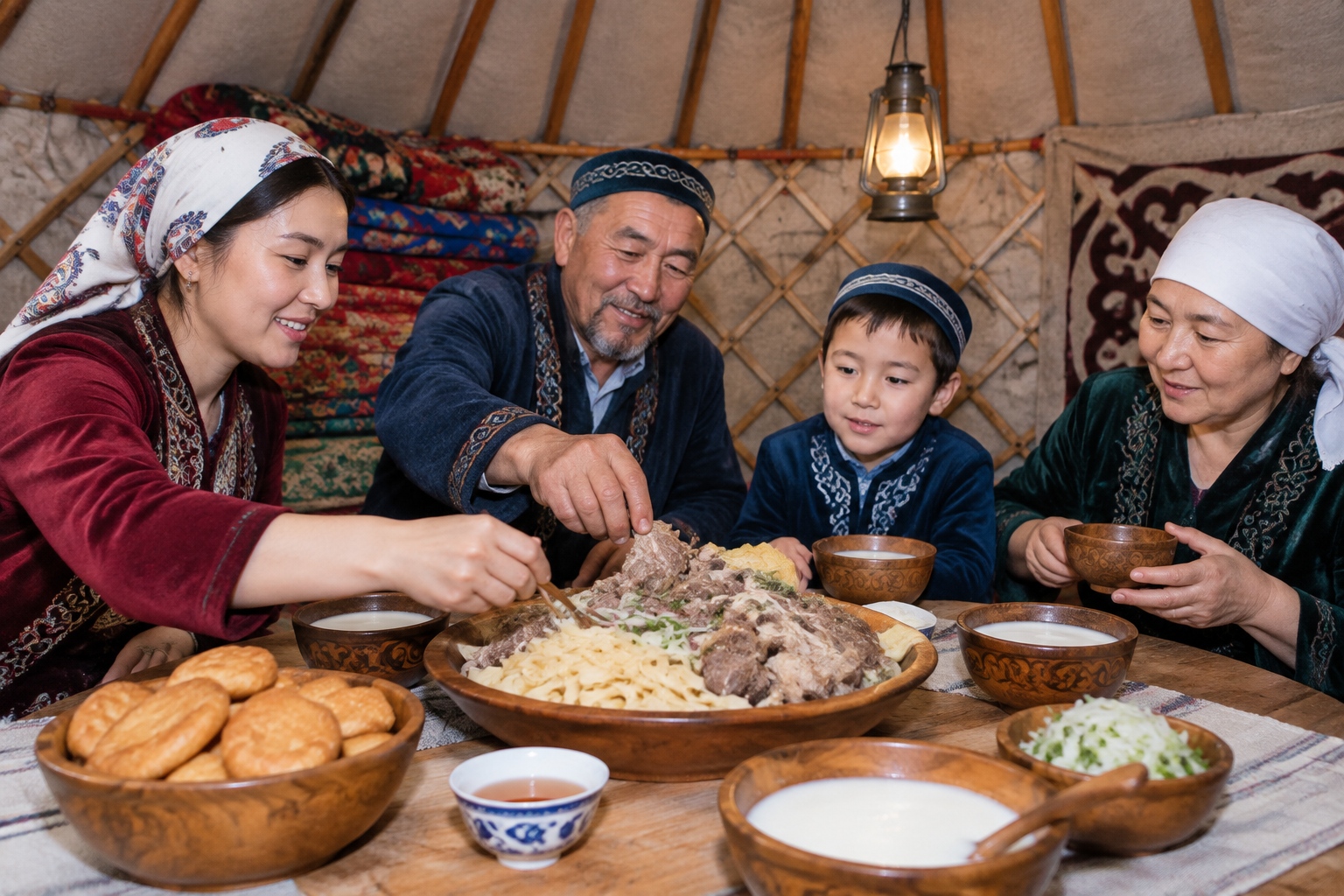
Dinner in summer is almost always mutton, boiled and then served as beshbarmak over flat noodles with onion broth poured on top. You eat it with your hands. The guest receives a specific cut, and the cut is a message: you are not a customer here, you are a guest.
What hospitality actually means on a mountain
On the steppe, hospitality is not a mood. It is closer to an insurance system. If you live half a day’s ride from the nearest household, the person who turns up at your door in bad weather may one day be the person who saves your animals, or your children. That logic is still running up here, even with 4G.
I tried to pay Yerbol for the week. He looked genuinely puzzled, the way you would look if someone tried to pay you for saying hello. So I did it the way you are supposed to: I arrived with flour, tea, sugar, cooking oil and a box of biscuits for the children, and on the last morning I gave Aigul her gift directly, quietly, rather than announcing it.
The economics of a herding family
Nobody up here is romantic about this. It is a business with weather inside it.
A fat sheep sells for somewhere between 800 and 1,200 yuan, depending on the season and the buyer. A good horse can go for several thousand, and a few top animals fetch far more. Kumis and cheese bring in cash through the summer. Some families now rent two or three yurts to visitors for 200 to 400 yuan a night, which is a meaningful addition to household income.
There is also a grassland conservation payment. Under China’s ecological subsidy scheme, herding households are paid per mu to keep grazing pressure below a set level, and families near tourist routes earn a little from guiding or selling crafts. Add it up, and a household like this one is neither poor nor comfortable by city standards. A bad spring snow that kills lambs can wipe out a year’s margin in a single night.
Phones, school, and a generation in the middle
In the evening, Adil sits near the door with his phone, scrolling short videos, half-watching a game, answering a classmate in Xinyuan. His charging routine involves the solar panel and a certain amount of negotiation with his mother, who wants the power bank for her own phone.
Both children board at school in town during term time and come back to the pasture in summer. That is normal here now. It means Adil can read and write Mandarin and Kazakh, and can also ride and count sheep — and it means the two halves of his life sit about 90 kilometres apart.
His mother’s position on his future is simple. They do not decide for him. He finishes school first. Adil likes the horses. He also likes the idea of a city, and he is 13, so both of those things are true at once.
What changed, and what hasn’t
Motorcycles instead of horses for everyday work. The truck that carries the felt and the stove up in June. The solar panel, the phone signal, WeChat Pay at the kumis stand. Children who go to school in town instead of learning at the yurt. Veterinary medicine, better fencing, plastic water tanks. The winter house with heating and a washing machine, which most families around here now have.
And then the things that have not moved. The migration up in June and down in September. The door facing south. Salt in the tea. The flock coming down at dusk and the count at the gate. Children who ride before they can spell.
If you are thinking of going
Summer only, roughly June through September. Fly to Yining or Urumqi, then drive or take a bus to Xinyuan and continue up the valley road. Bring warm layers, because nights sit near freezing even in July, plus a headlamp, sun protection and a gift for your hosts. Cash still matters in the smaller places; WeChat Pay works almost everywhere else. Ask before photographing people. Learn ten words of Kazakh — salem, rahmet — and use them.
Younger people speak Mandarin. Older people often do not, and a translation app earns its keep. Do not expect wifi, and do not treat a family’s working pasture as a museum.
The last morning
Aigul filled a bottle of kumis and put a bag of baursak in my pack, and refused to let me leave without a second breakfast. Nurlan added me on WeChat so he could send the photos he had taken of the sheep. The dogs followed the car to the edge of the grass and then stopped, because that is where their job ends.
Down in the valley, the corn was already tall and the phone signal was back. Most of what people outside China think they know about this region arrives through headlines. A week on a mountain, drinking salted tea and counting sheep, is not an argument with any of that. It is simply what it is: an ordinary working summer, at 2,000 metres, in a place most maps render as empty green.
Start the discussion at forum.chinacomes.com