

The Lights Are Off. The Machines Are Not.
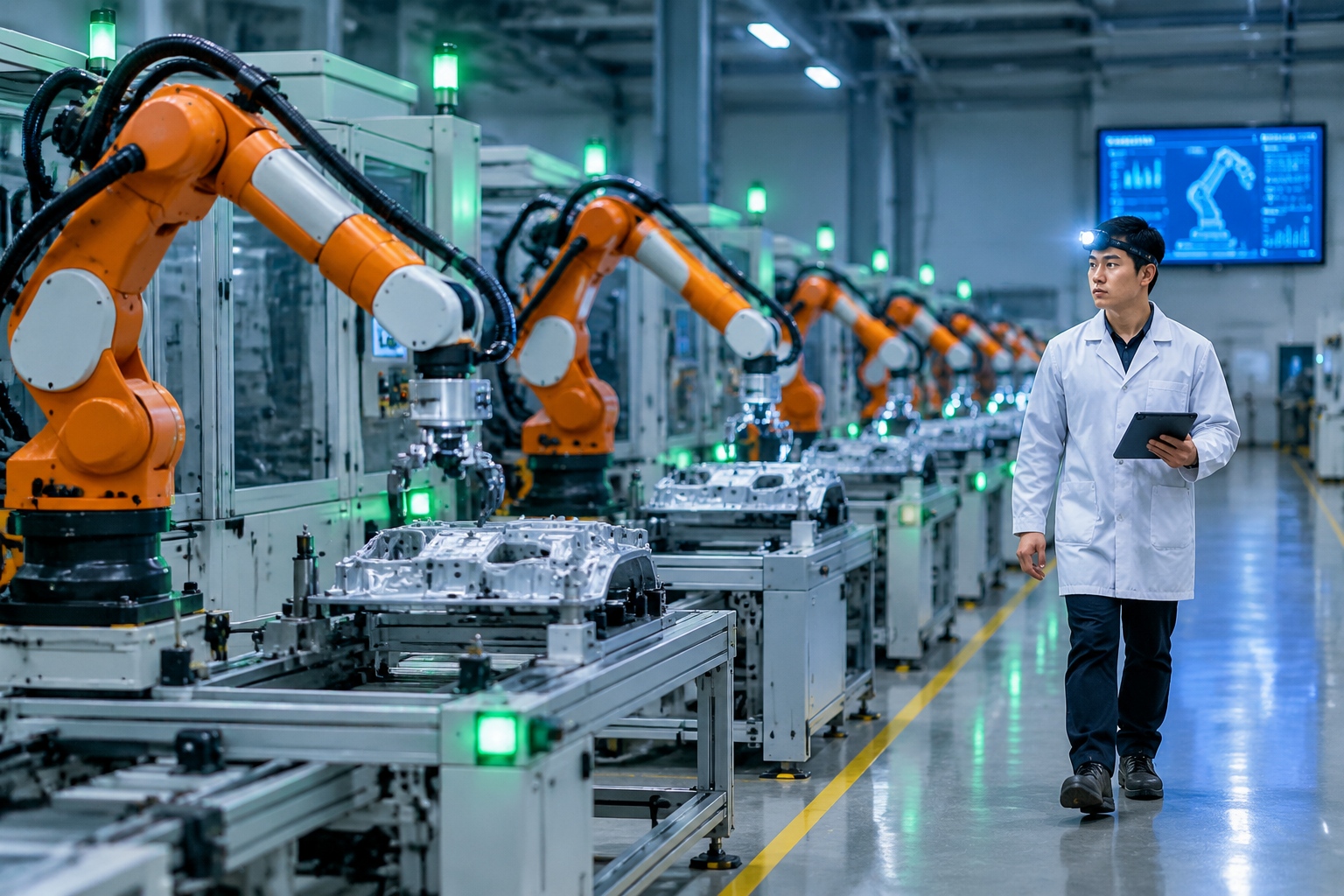
At 9:40 on a Tuesday morning, I put on a white lab coat, cloth shoe covers and safety glasses, and a door the size of a garage shutter slides up in front of me. Nobody tells me to keep my voice down. Nobody needs to. On the other side, the lighting drops to almost nothing: a few green status LEDs, the pale blue glow of a screen bolted to a pillar, the red flash of a scanner reading a barcode.
This is a factory floor in Ningbo, a port city in Zhejiang province, about three hours south of Shanghai. It belongs to a supplier that makes aluminium housings and structural parts for electric vehicles. In daylight it looks ordinary: grey walls, a mezzanine, a row of electrical cabinets. In the dark it sounds like a small orchestra tuning up. Servo motors whine, pneumatic grippers hiss, a conveyor hums at a frequency you feel in your teeth. Somewhere to my right, a robot arm the length of a bus lifts a metal block, turns it, and sets it down on a fixture with a click.
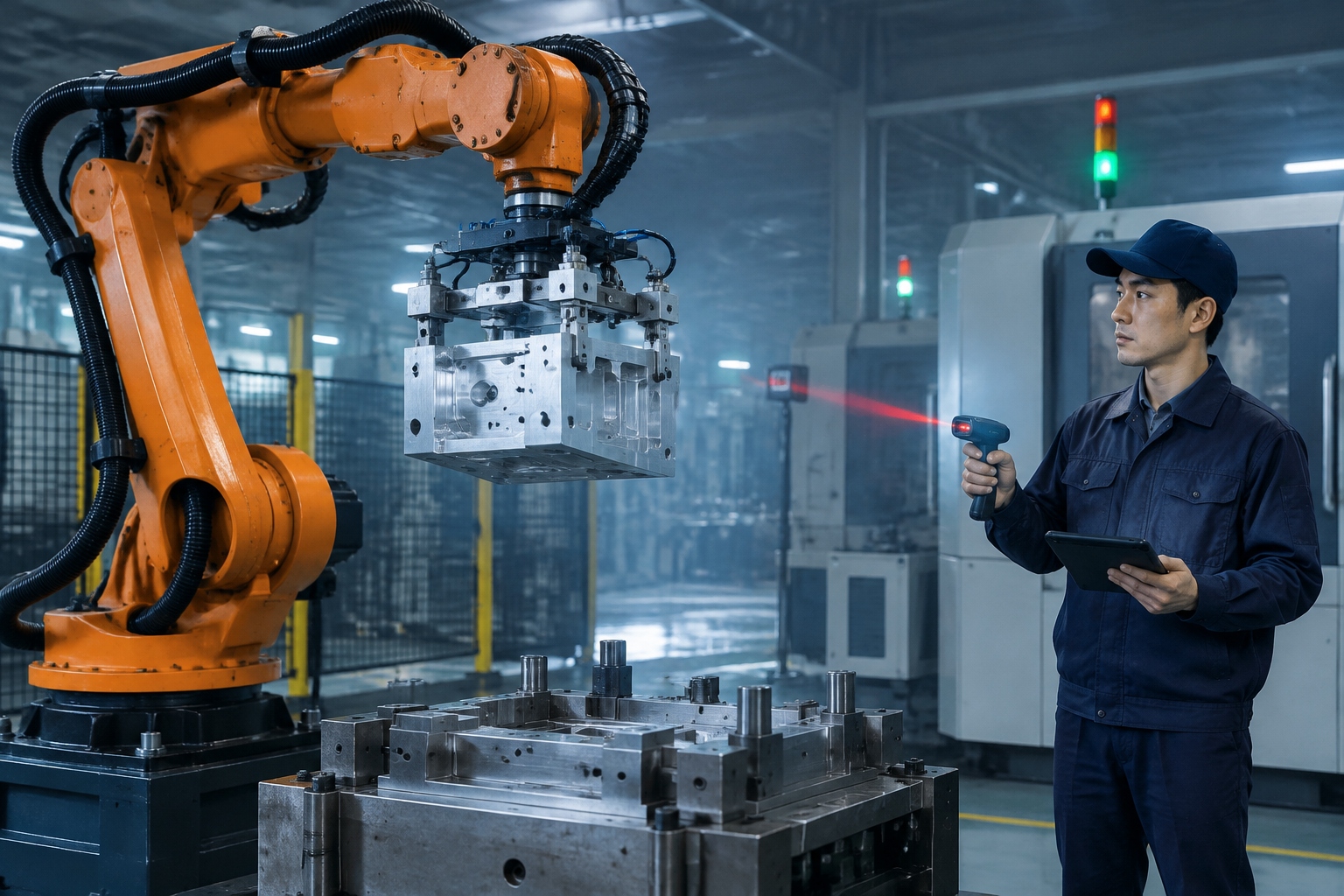
There are two people on the floor. Both wear headlamps. One of them, a technician named Chen Wei, is doing something that looks almost boring: watching a tablet and, now and then, wiping a lens with a microfiber cloth.
What ‘Lights-Out’ Actually Means
Dark factory — heideng gongchang in Chinese, literally ‘black-lamp factory’ — has become one of the most overused phrases in Chinese manufacturing. The image it suggests is dramatic: a building with no humans, machines toiling endlessly in the dark. The reality is more mundane and, in some ways, more interesting.
A dark factory is a plant where most or all of the production process can run without human intervention for long stretches, including overnight. It rests on a stack of technologies that have become cheaper and more reliable over the past decade: industrial robots, automated guided vehicles, machine vision, sensors on almost every axis, and a network — increasingly 5G — that lets machines talk to each other and to a central system with latency measured in milliseconds.
‘Dark’ does not mean the whole building is pitch black all the time. Many plants keep lights on in inspection bays, maintenance corridors and control rooms. What matters is that nobody has to stand at the machine. The work continues after the shift ends.
China’s Ministry of Industry and Information Technology says the country has built more than 4,000 ‘5G factories’ and over 10,000 5G-plus-industrial-internet projects. The World Economic Forum’s Global Lighthouse Network, which recognises factories for advanced digital manufacturing, includes more than 70 Chinese sites — the largest share of any single country. Not all are fully dark. The direction, though, is clear.
Meet Chen Wei, Who Used to Stand Here
Chen is 38. Ten years ago he stood at a CNC machine in this same building for ten hours a day, loading aluminium blanks, checking dimensions with a caliper, breathing in a fine mist of coolant oil. His back hurt. His hands were always dry and cracked. ‘The night shift was the worst,’ he says. ‘You finish at six in the morning and you can’t sleep. You just lie there.’
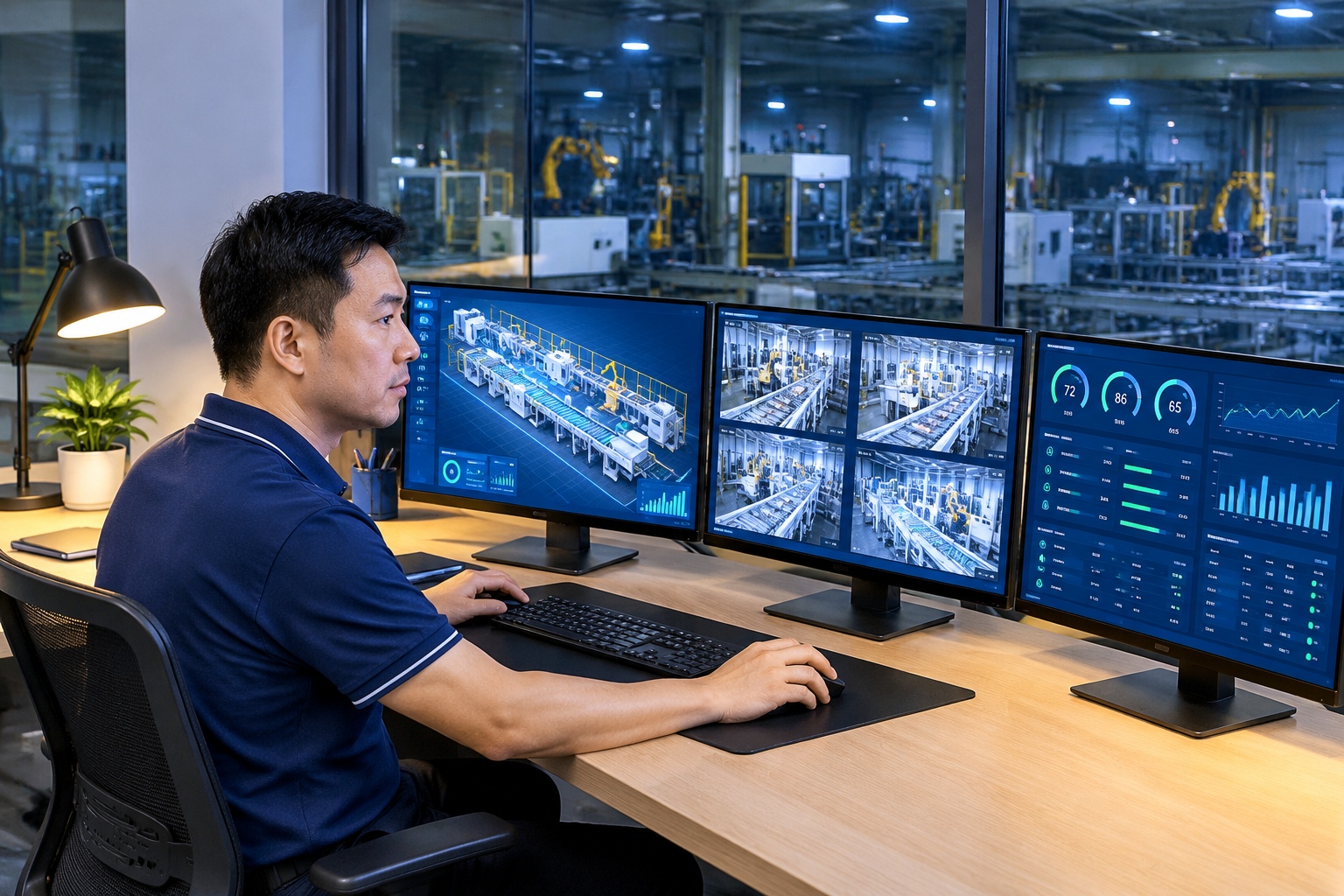
Today he is a remote operator. His station is a desk in a glass-walled room at the edge of the shop floor, with three monitors showing a digital twin of the production line, live camera feeds, and a dashboard of vibration, temperature and torque readings from about 60 machines. When something drifts outside its normal range — a spindle getting hot, a gripper losing grip force — an alert appears. He can slow the line, stop a cell, or flag it for the maintenance team.
‘The first year was hard,’ he says. ‘I had to learn to read data. I didn’t even know what a trend line was.’ He took night classes at a vocational college: basic electrical work, PLC programming, a little Python. His pay roughly doubled, from around 6,000 yuan a month to more than 12,000. He works eight-hour shifts now, not twelve. ‘I still go into the shop floor sometimes. But it’s my choice. I’m not stuck there.’
Not everyone from his old line made the same jump. Of the 22 people who worked his shift in 2014, he reckons about half are still in manufacturing — some in quality control, some in logistics, some running different machines. Others left the industry, went back to their hometowns, or took jobs in delivery and services. ‘You can’t say the factory fired them,’ he says carefully. ‘When the line changed, the jobs changed. Some people didn’t want to sit in front of a screen for eight hours. That’s real too.’
Why the Numbers Work
The case for automation in China used to be simple: labour was cheap. That is no longer true. Factory pay in the Yangtze River Delta now runs roughly 6,000 to 8,000 yuan a month, and young people increasingly prefer delivery, e-commerce or service work to standing on a line. Annual turnover at some electronics plants tops 30 percent. Training a new operator takes weeks. Loading parameters into a robot takes an afternoon.
Meanwhile, the price of a six-axis industrial robot has fallen sharply. Chinese vendors such as Estun, Inovance and Siasun now compete with Fanuc, ABB and KUKA on price and, increasingly, on software. A basic welding or handling robot that cost 200,000 yuan a decade ago can be had for well under 100,000.
The result is a plant that can run 24 hours a day, seven days a week, where downtime is planned rather than caused by fatigue. Data published by several lighthouse factories show defect rates falling 20 to 40 percent and unplanned downtime cut by about a third. Energy use tends to drop as well, because machines idle less and cooling can be targeted. For an EV parts supplier shipping to Europe and Southeast Asia, that predictability is worth as much as the saved labour.
The Human Question
It would be easy to write this as a story about robots taking jobs. The truth is messier.
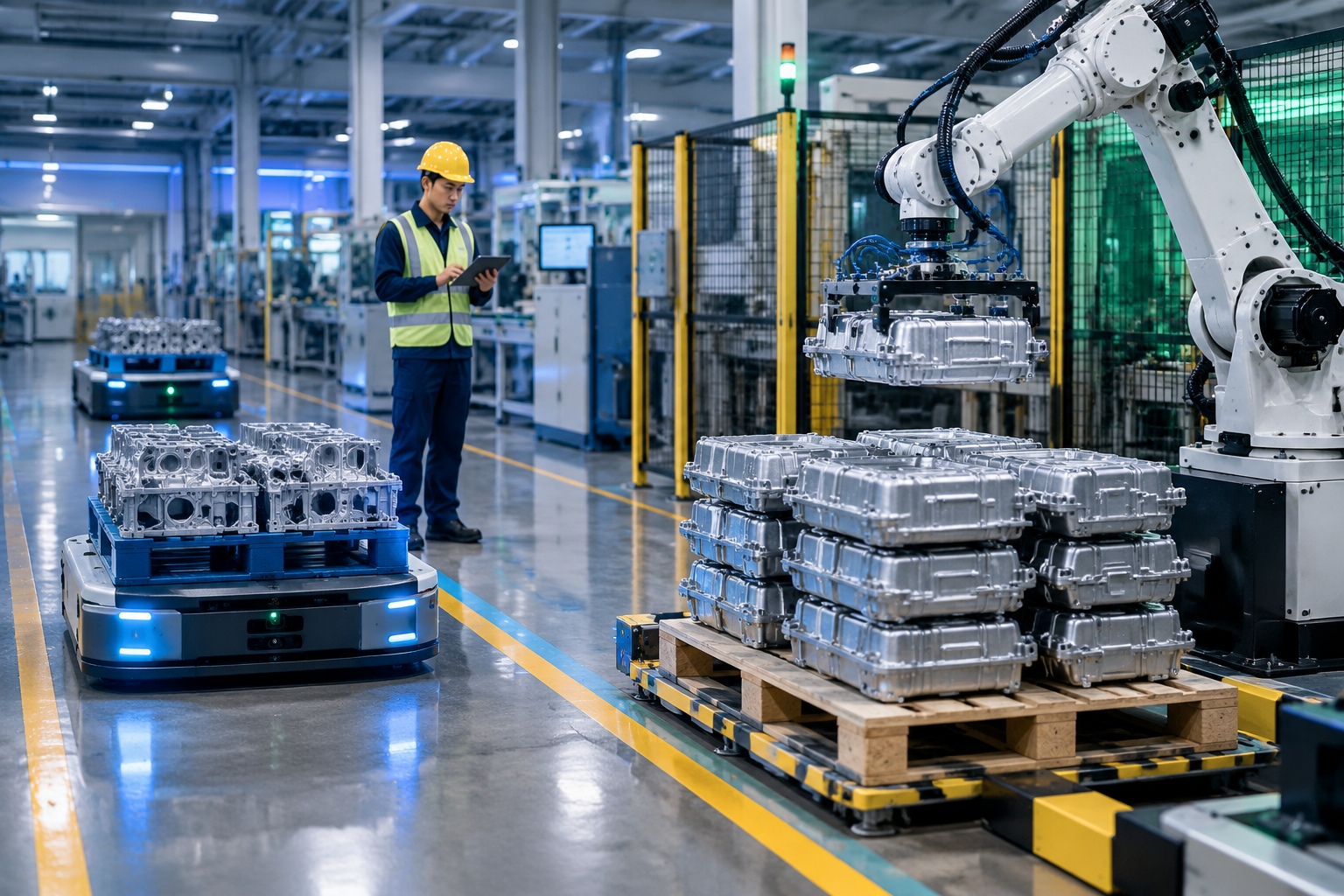
In the short run, dark factories do eliminate certain roles: the repetitive loading, unloading, inspection and packaging work that once absorbed large numbers of workers with a middle-school education. Those jobs are not coming back. A plant that once employed 400 people on the floor might now employ 120, plus 30 in engineering, data and maintenance positions that did not exist a decade ago.
At the same time, the new jobs pay better and do less damage to the body. Maintenance technicians, robot programmers, vision engineers, data analysts — these roles are growing, and they are not only for university graduates. Vocational schools across Guangdong, Zhejiang and Jiangsu have added courses in industrial robot operation and PLC programming; a two-year diploma can lead to a job paying 8,000 to 15,000 yuan a month.
The gap is generational. A 50-year-old who has spent 25 years on a line may not want, or be able, to retrain as a data analyst. For him, the dark factory is not an upgrade. It is an ending. Policy has tried to soften the transition — retraining subsidies, ‘digital workshop’ programmes that let smaller suppliers automate in stages — but nobody pretends it is painless.
Chen’s own view is pragmatic. ‘My daughter is 12,’ he says. ‘I tell her: learn how to work with machines. Don’t be afraid of them. But don’t think you can just stand there either.’
What 3 a.m. Looks Like
Before I leave, Chen takes me to the far end of the line, where a six-axis robot is stacking finished housings onto a pallet. There is no light except the robot’s own status lamps and the faint green of the safety scanner. The air smells of clean metal and a hint of lubricant. The temperature holds steady at 22 degrees Celsius.
He points to a small screen on the wall: a live feed from another factory run by the same company in a different province. ‘That one is fully dark,’ he says. ‘Nobody goes in at night. If something stops, the system calls me.’ He shows me his phone — an alert from two nights earlier, 2:47 a.m., a servo over-current. He opened his laptop at home, restarted the cell remotely, and went back to sleep. Fixed in 11 minutes.

That, more than any statistic, is what the dark factory changes. The building no longer needs a night shift. The people who used to stand inside it no longer have to be awake at 3 a.m., unless something goes wrong. For some, that is a lost identity and a job they knew well. For others, it is a trade they are willing to make. The machines do not care either way. They just keep going.
Start the discussion at forum.chinacomes.com