
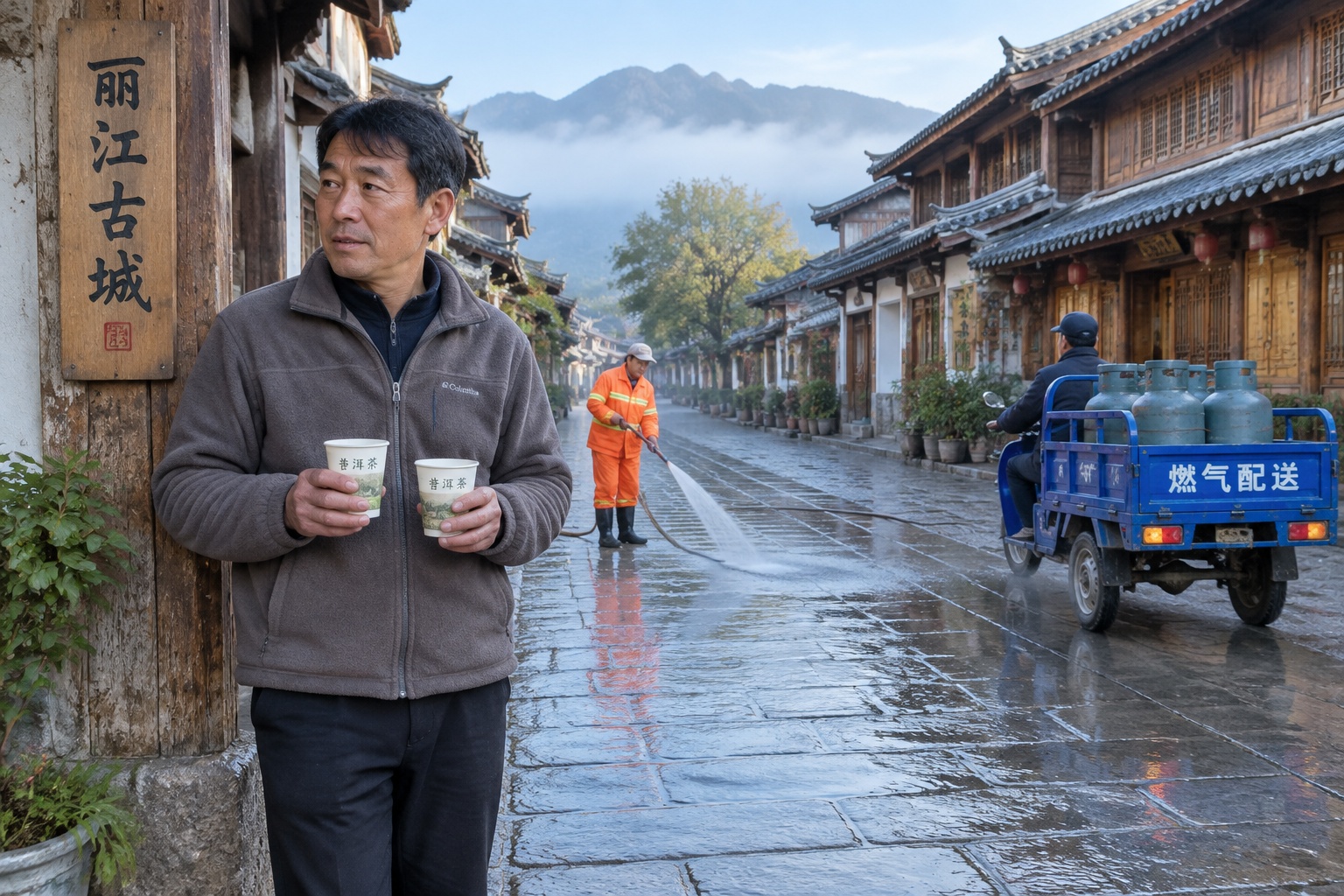

6:40 a.m., before the tour flags show up
The stone street is slick with water. A worker is hosing down the pavement in front of a bar that closed three hours ago. A tricycle rattles past carrying gas canisters. Behind some wooden door, a kettle is whistling.
He Xiaodong waits at the corner of Wuyi Street with two paper cups of tea. He is 47, Naxi, and one of a shrinking group of people who actually live inside Lijiang Old Town — a UNESCO World Heritage site since 1997 and one of China’s most-visited places.
“This is the only hour when the town belongs to us,” he says. “By nine it becomes a different city.”
If you have read anything about Lijiang lately, it was probably a complaint. Too many tourists. Too many shops selling the same dried flower cakes. Too many young women in rented ethnic costumes posing on the same bridge. Those complaints are not wrong. They are just half the picture — and the other half is a fifteen-minute walk from the main square, past the last of the selfie sticks.
“The old town didn’t die. It moved inward.”
Lijiang sits in a valley in Yunnan, southwest China, under Jade Dragon Snow Mountain. The Naxi people built it roughly 800 years ago, and their old town has no city wall — a detail guides repeat constantly, since the ruling Mu family apparently never wanted one.
What the tour buses see is Sifang Square, the central plaza, and the four main streets that radiate from it. What they rarely see is everything behind those streets: hundreds of lanes, many too narrow for anything but a bicycle and a determined grandmother.
“When I was a kid, every door on this lane opened to a Naxi family,” He says. “Now I count eleven households I know. The rest rent to outsiders.”
That is the real story of Lijiang. Not abandonment — replacement. Rising rents pushed many local families into the new city across the river, where apartments have heating, elevators and parking. Their courtyards became guesthouses, coffee shops, bars and photo studios, many run by people from Sichuan, Zhejiang or the northeast. Estimates of how many original residents remain inside the old town vary widely, but nobody who lives here argues about the direction of the trend.
“People say the town is empty of locals,” He says, turning down Xingren Lane. “They’re looking in the wrong place.”
What’s down the side lanes
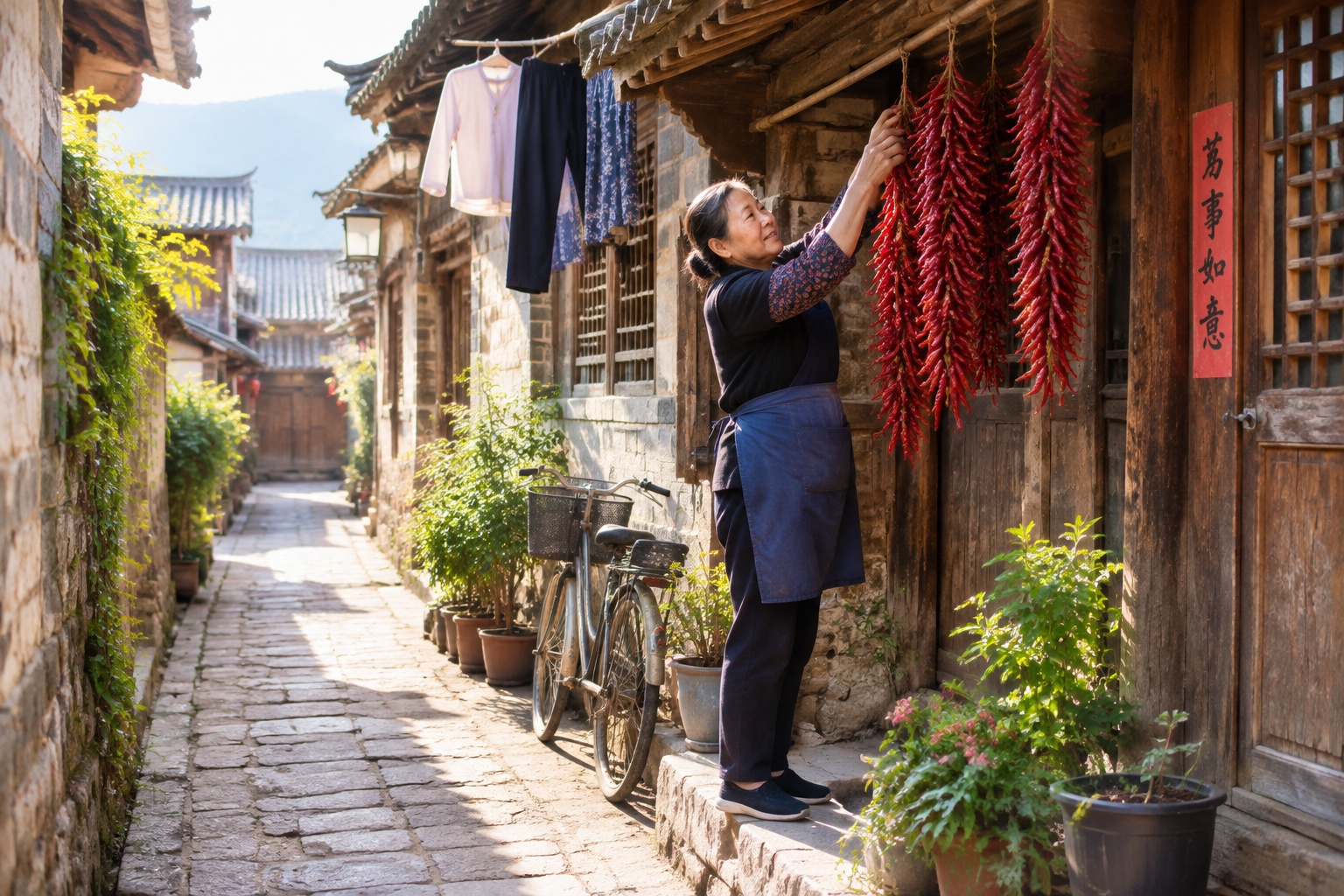
Xingren Lane is barely two meters wide. The crowd noise from the main street drops away within twenty steps. Here, a woman is hanging chili peppers under the eaves. There, an old man is repairing a chair with a bamboo strip — no shop sign, no price list.
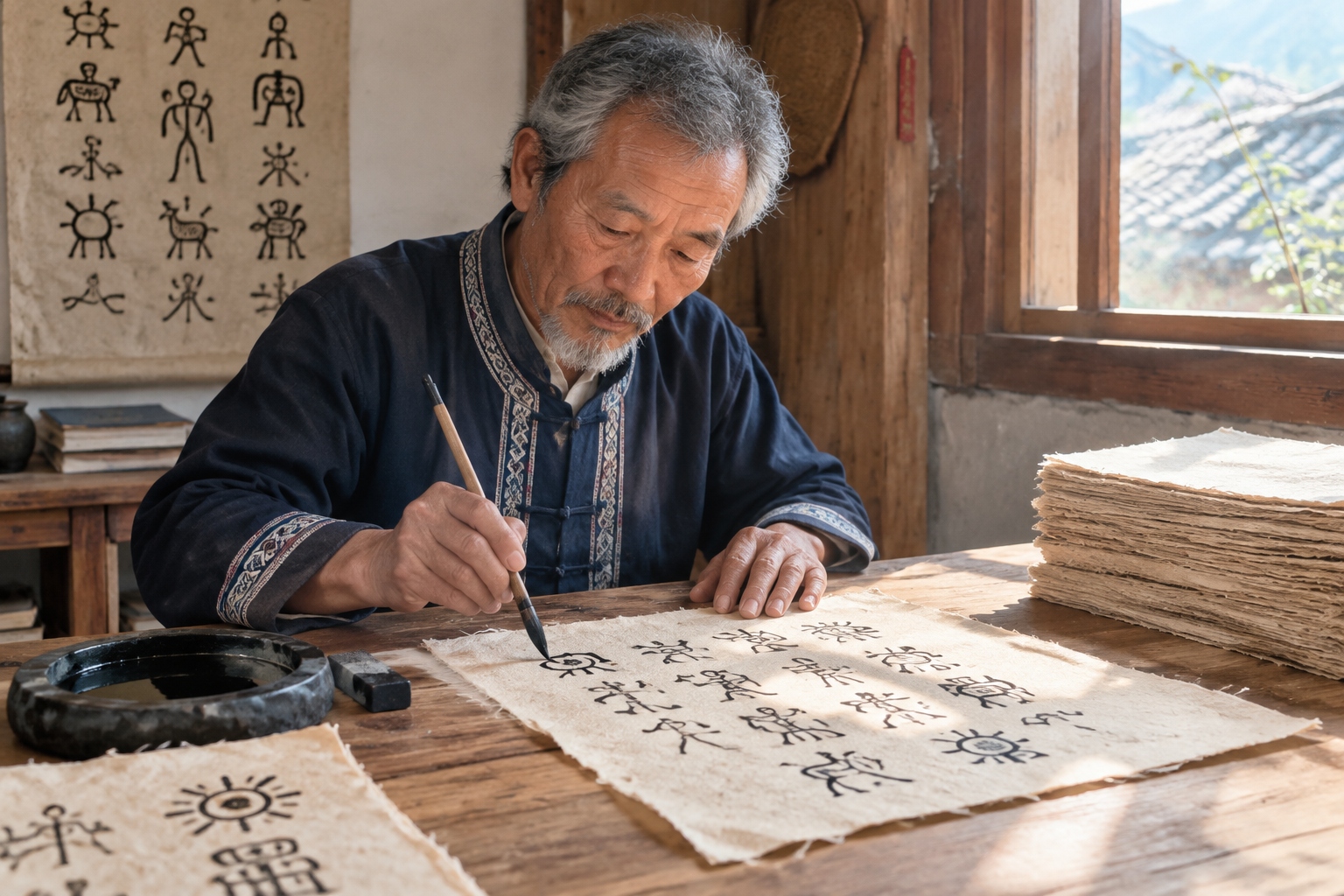
He stops at a doorway with no plaque. Inside, a man in his sixties is brushing black ink onto a sheet of thick, fibrous paper. This is Dongba script, a pictographic writing system the Naxi have used for centuries and one of the few in the world still written by living people rather than studied by archaeologists. The paper is made locally from the bark of a plant whose Chinese name means “wolf poison” — a nod to its toxicity, and one reason the paper resists insects for generations.
“Tour groups don’t come here,” He says. “There’s no room for them.”
A few lanes further on, Wenzhi Lane opens into a small courtyard where three women are playing cards at a low table. They are not performers. They are neighbors. One of them, in her seventies, points at the stone bench beside her and says something in Naxi. He translates: “She says sit down, you’re making the place look busy.”
The three wells, and the rules for using them
The most Naxi thing in Lijiang isn’t the music or the embroidery. It’s the water.
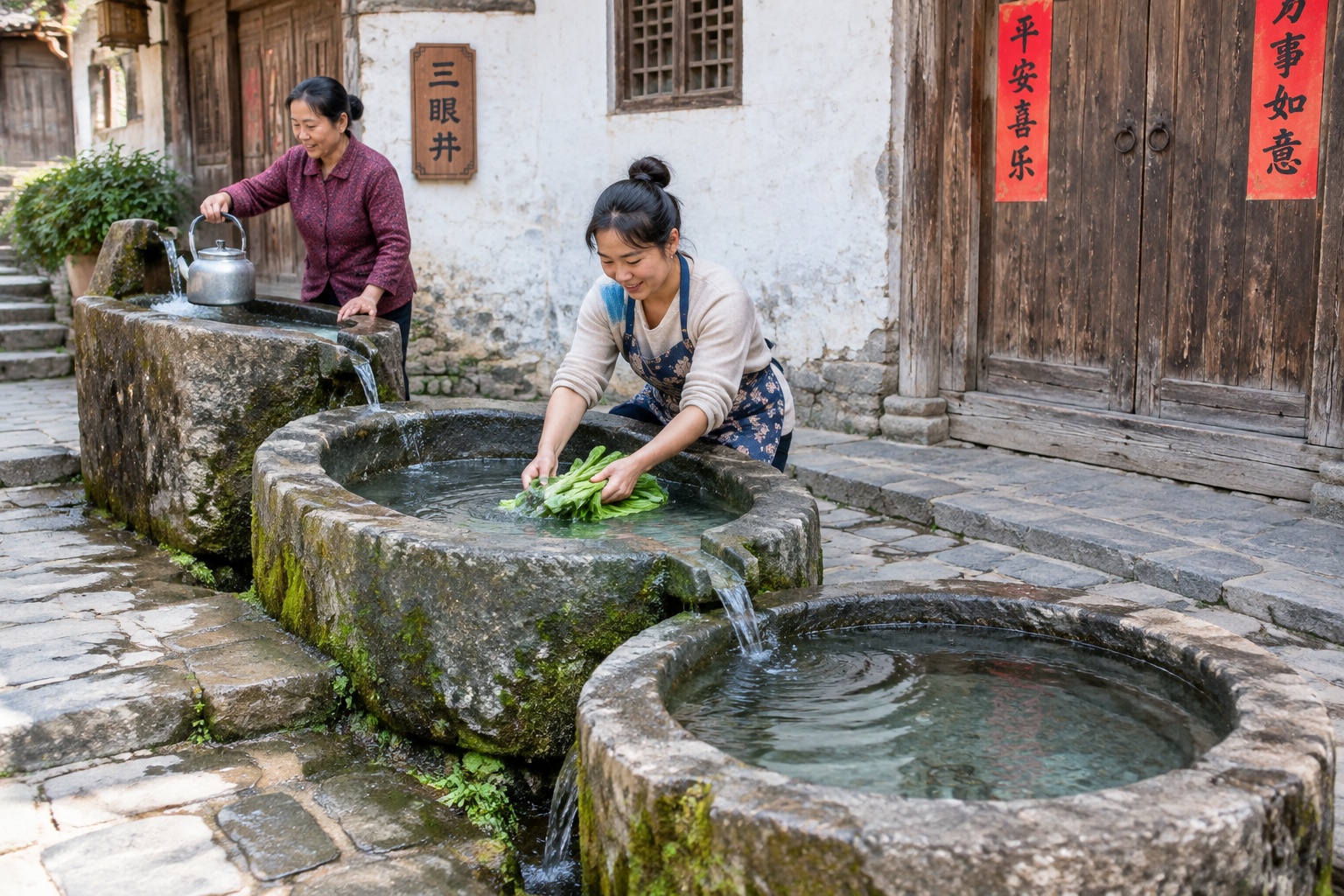
Because the old town sits on a slope, the Naxi engineered a network of channels that carries snowmelt from the mountain into every neighborhood. Where a channel meets a lane, you often find a “three-eyed well” — a single spring divided into three linked stone basins.
The rule is still taught to children: the top basin is for drinking water. The middle one, a step down, is for washing vegetables and rice. The bottom one is for laundry and cleaning. Get it wrong and you’ll hear about it — from a neighbor, not a security guard.
“It’s not a museum rule,” He says. “It’s how you live next to other people.”
These wells are everywhere, but the ones on the quiet residential lanes are where the system is still in daily use. Watch for a few minutes and you’ll see someone fill a kettle, then someone else rinse greens, in the correct order, without anyone saying a word.
Who’s actually making money here
Ask He about the economy and he doesn’t romanticize it.
“A small storefront on a good lane can rent for hundreds of thousands of yuan a year,” he says. “If you’re a Naxi family with a courtyard, renting it out can earn more than any job you’d find in the new city. So of course people rent.”
That is the trade. Families gain income; the neighborhood loses its residents; the town gains shops selling the same four things. It’s not corruption and it’s not a conspiracy. It’s a housing market with a UNESCO listing on top.
There is also a maintenance fee — around 50 yuan, down from 80 in 2019 — that visitors may be asked to pay and many quietly avoid. Local authorities have tried various ways to fund upkeep and crowd management, and the debates get heated, especially during the two big national holiday weeks, when daily foot traffic in the old town can climb past 200,000 people.
The people who stick it out tend to have found a niche. There’s a man from Dali running a four-stool noodle counter with no sign, closed whenever he feels like it. There’s a woman who has sold the same style of hand-woven belt for eighteen years and refuses to stock the plastic version. There’s He, who works as a guide for groups of four or five — no flags, no microphone.
“I charge more than the big tour companies,” he says. “Because I take you places where there is nothing to buy.”
When to come, and how to walk it
A few practical notes from someone who lives here:
- Hours matter more than dates. Between 7 and 9 a.m., and after 9 p.m., it feels like a different town. Midday in July is a crush.
- Get off the four main streets. Turn into any lane that looks too narrow for a tour group. That’s the filter.
- Go north and uphill. The lanes climbing toward Lion Hill get quieter with every step, and the courtyards get smaller and older.
- Try Shuhe and Baisha, smaller old towns a short ride away, with fewer bars and the same stone-and-water logic.
- Learn three words of Naxi. He says a single greeting changes the whole conversation. People who are tired of tourists are not tired of people.
The old town has a genuine problem: it is loved almost to death, and many of the people who made it now live somewhere else. The alley system is the reason it survives. Tour routes are linear. The town is not. Walk ten minutes in the wrong direction — which here means the right one — and the Lijiang everyone complains about simply isn’t there anymore.
Near the top of a lane on the way to Lion Hill, He stops and points down at the rooftops.
“See the ones with laundry hanging?” he says. “Those are the houses where people still live. That’s the map I’d give you.”

Start the discussion at forum.chinacomes.com