
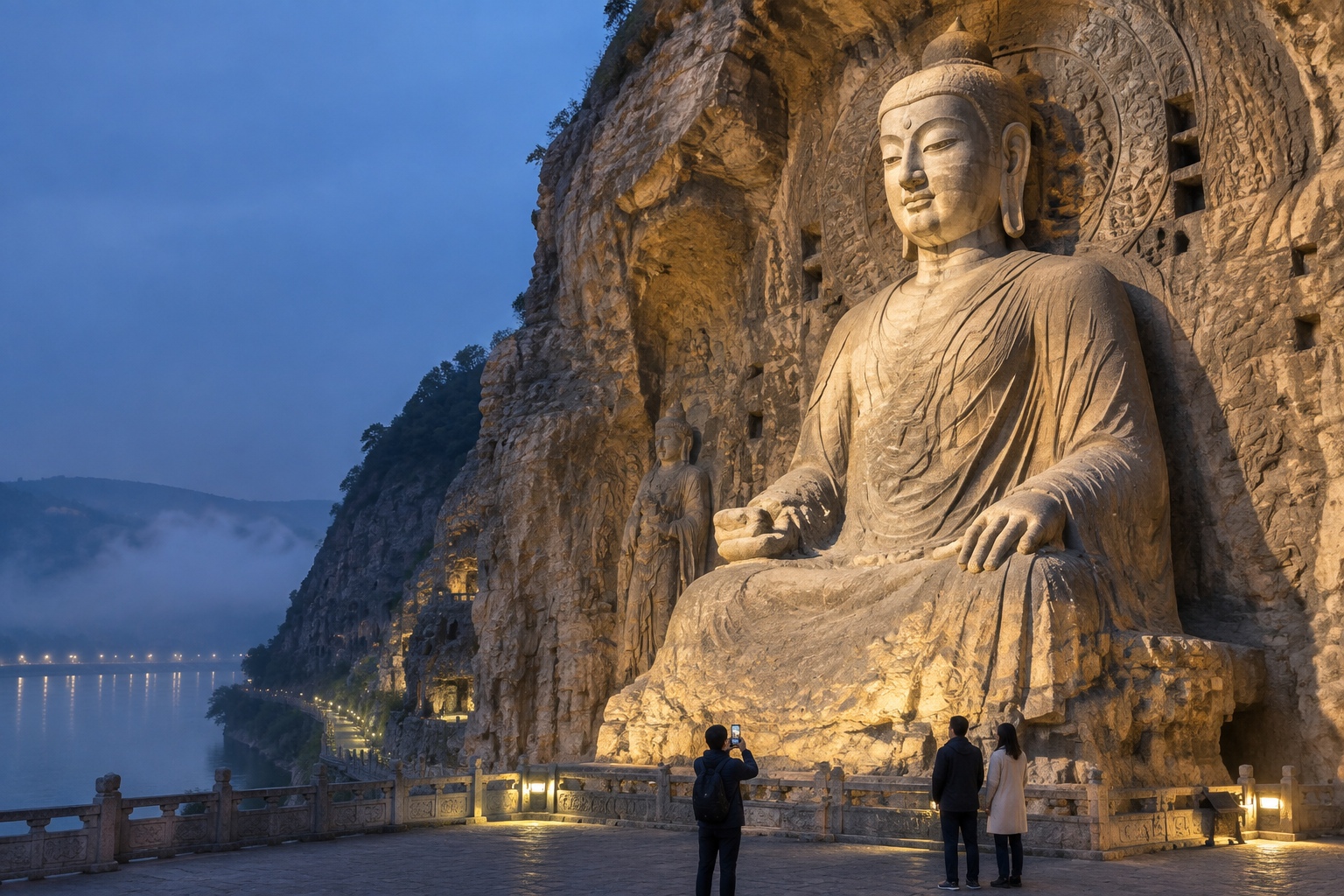

Arriving after the buses leave
It is 7:40 on a Tuesday evening at the north gate of the Longmen Grottoes, and the last daylight tour buses have pulled away. The ticket scanners have gone quiet. A woman folds up a table of bottled water, and the only sounds left are the Yi River running over stone and a pair of swallows working the cliff above the path.
The air smells like wet limestone and river water. On the west bank, the illuminated walkway curves south along the cliff face, and every twenty metres or so a cave opening glows soft amber against the dark rock. A handful of people are walking it. In the daytime this same path holds several thousand.
The Longmen Grottoes sit about 12 kilometres south of downtown Luoyang, in Henan province. Two limestone cliffs face each other across the Yi River, and between them, carved over roughly 400 years starting in 493 AD, are more than 2,300 caves and niches holding some 110,000 figures. It has been a UNESCO World Heritage Site since 2000, and by any measure it is one of the largest collections of stone carving on earth.
Almost everyone sees it between 9 a.m. and 5 p.m. The evening session is a different place, and for the single most famous statue here, it is the better one.
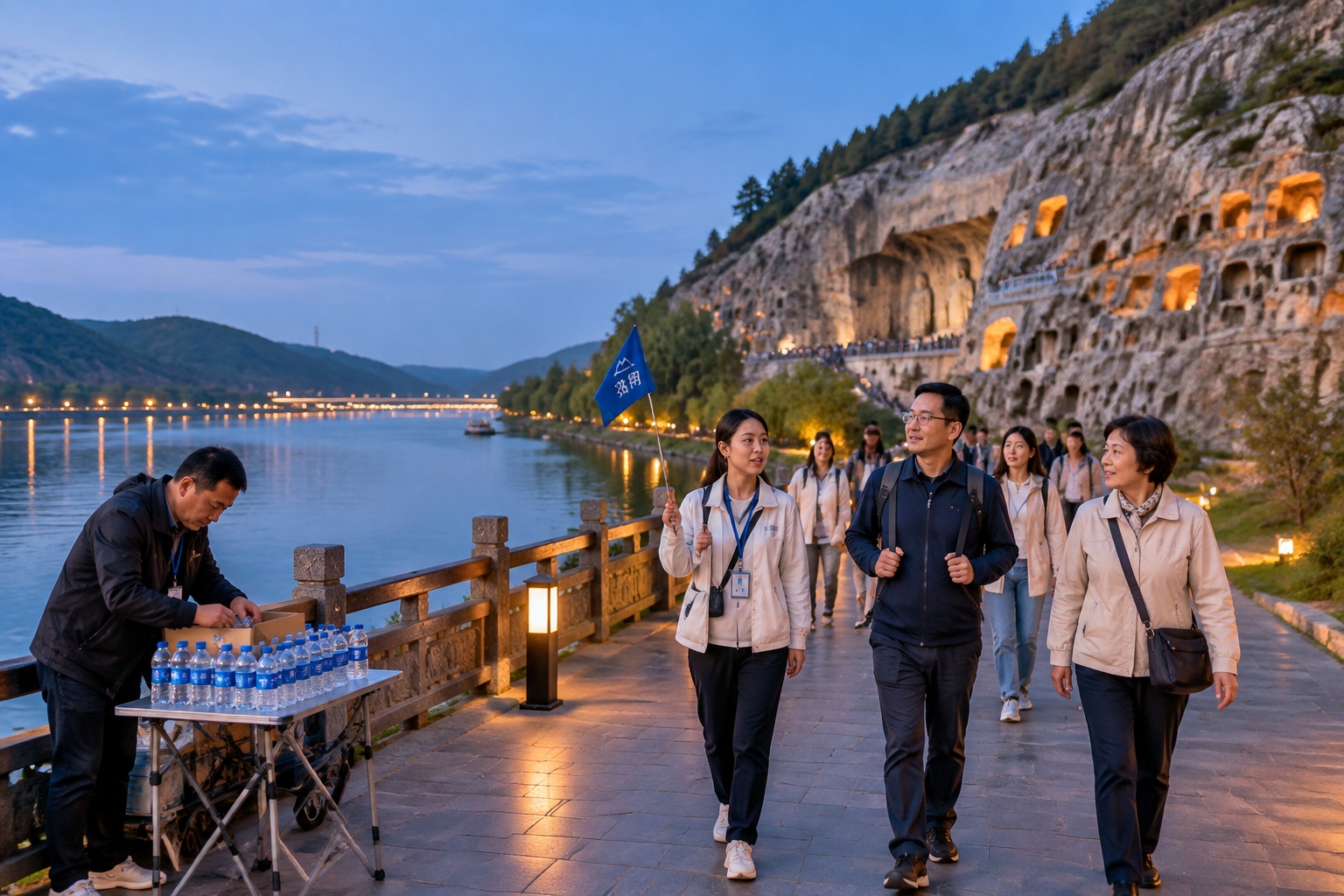
Why the lighting changes what you actually see
In full daylight, the sun sits high over the gorge and hits the carvings almost straight on. That is the worst possible light for shallow relief: everything flattens into a bright grey wall, and phone cameras blow out the highlights. The West Hill also faces west, so by early afternoon the caves on the main cliff sit in shadow while the river glares back at you.
At night the floodlights are placed low and to one side. That is how you light a sculpture if you want someone to actually look at it. Folds in a robe suddenly have depth. Eyebrows, lips and eyelids, which the Tang sculptors cut only a few millimetres deep, cast their own small shadows, and the face stops being abstract.
It also does something daylight cannot: it empties the place. At 8 p.m. on an ordinary weeknight you can stand in front of a Tang dynasty carving with nobody else in your frame. Just check the schedule first. Night openings are seasonal, usually in the warmer months, and are sometimes suspended for maintenance or events. Confirm on the official Longmen Grottoes website or WeChat account before you build a trip around it.
Climbing the steps at Fengxian Temple
The walk south along the west cliff takes 30 to 40 minutes at a normal pace, past the oldest caves at Guyang and Bingyang, and it ends at a wide stone staircase. Climb it and you are standing on a platform with the Vairocana Buddha.
The numbers do not prepare you. The statue is 17.14 metres tall. Its head alone is 4 metres; its ears are 1.9 metres. Standing at the railing, an adult reaches somewhere around its ankle. The Buddha is seated, hands resting on its knees, and the expression — half-closed eyes, the faint beginning of a smile — is the thing people photograph and then fail to describe.
At night the light comes from below and to the front. The face is lit warmly and the folds of the robe fall away into darkness, so the figure seems to be emerging from the cliff rather than sitting in front of it. Around it stand the rest of the group: two disciples, two bodhisattvas, two heavenly kings and a muscular guardian. Many are damaged. One guardian’s arm is gone. Somehow that makes the group more affecting, not less.
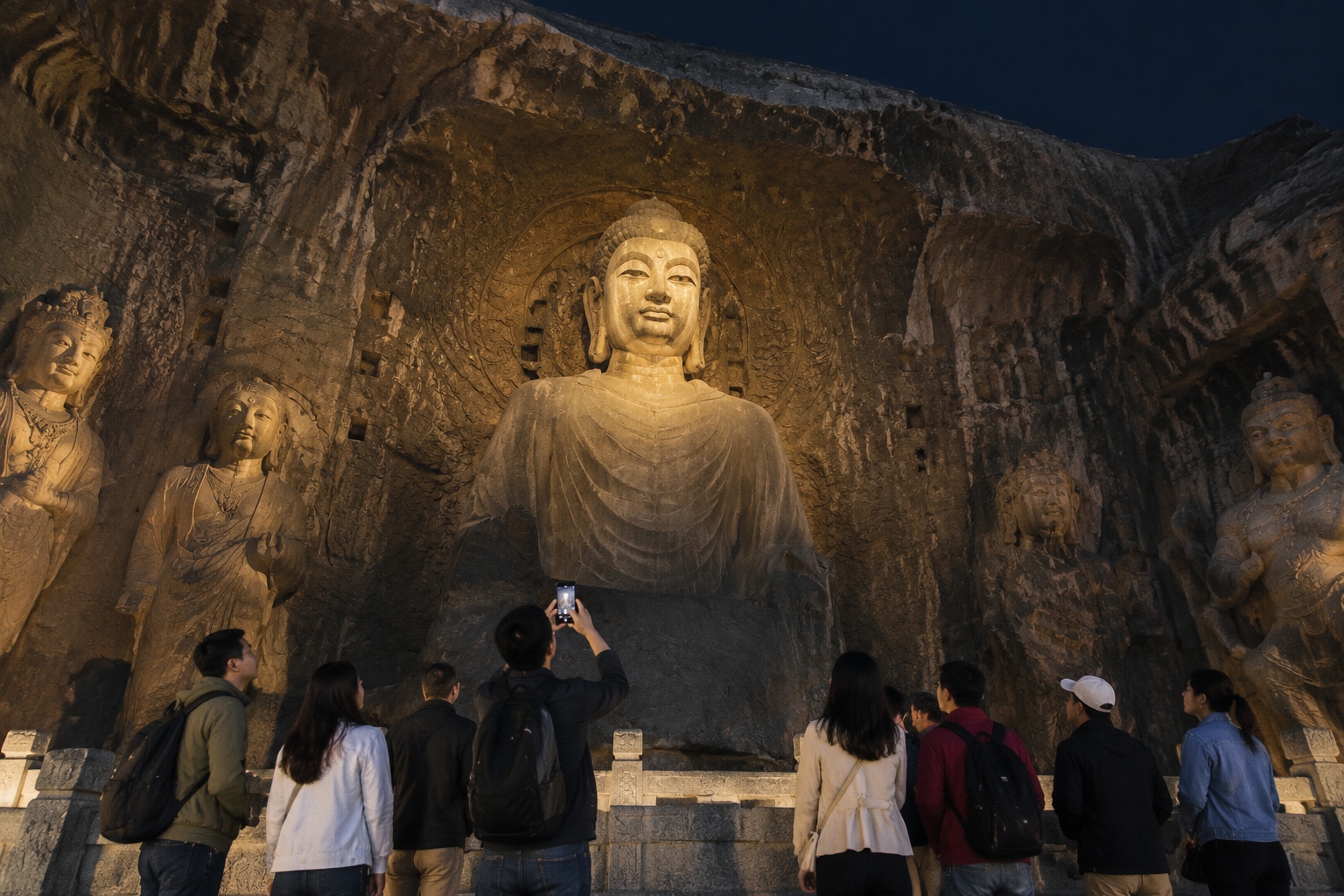
The people who paid for it
Fengxian Temple was carved between roughly 672 and 675, during the reign of Emperor Gaozong of the Tang. Court records say the emperor’s wife — Wu Zetian, who would later rule China in her own name — donated 20,000 strings of cash toward the project. It is usually read as her buying religious merit and political legitimacy at the same time.
Legend says the Buddha’s face was modelled on hers. Historians are careful about that claim: it gets repeated all over Luoyang and no document proves it. What is documented is the money, and the fact that a sculpture this large in an imperial temple was as much a statement of power as an act of devotion.
The site itself is older than the Tang. Carving began in 493 AD, when the Northern Wei moved their capital to Luoyang and started cutting into these cliffs. It continued through the Sui and Tang and then slowed. In the early twentieth century, collectors and dealers removed thousands of heads and whole reliefs; you can still see the clean cut marks. Many of those pieces now sit in museums in Europe, Japan and the United States. Looking at the empty necks at night, with the lights low, is a different experience from looking at them at noon.
What else to do after dark
Most people turn around at Fengxian Temple. Don’t. Continue south to the bridge, cross the Yi River, and walk the quieter east bank back north. From there you get the view photographers actually come for: the whole west cliff lit in a line, its reflection stretched on the black water, the caves glowing like small windows in a hillside.
The east side also holds Xiangshan Temple, rebuilt many times and still active, and the Bai Garden, the tomb of the Tang poet Bai Juyi, who retired to this hill. He is one of the few Chinese poets that plenty of people outside China have read without knowing it. Both close earlier than the grottoes, so if you want them, come back in daylight and keep the evening for the carvings.
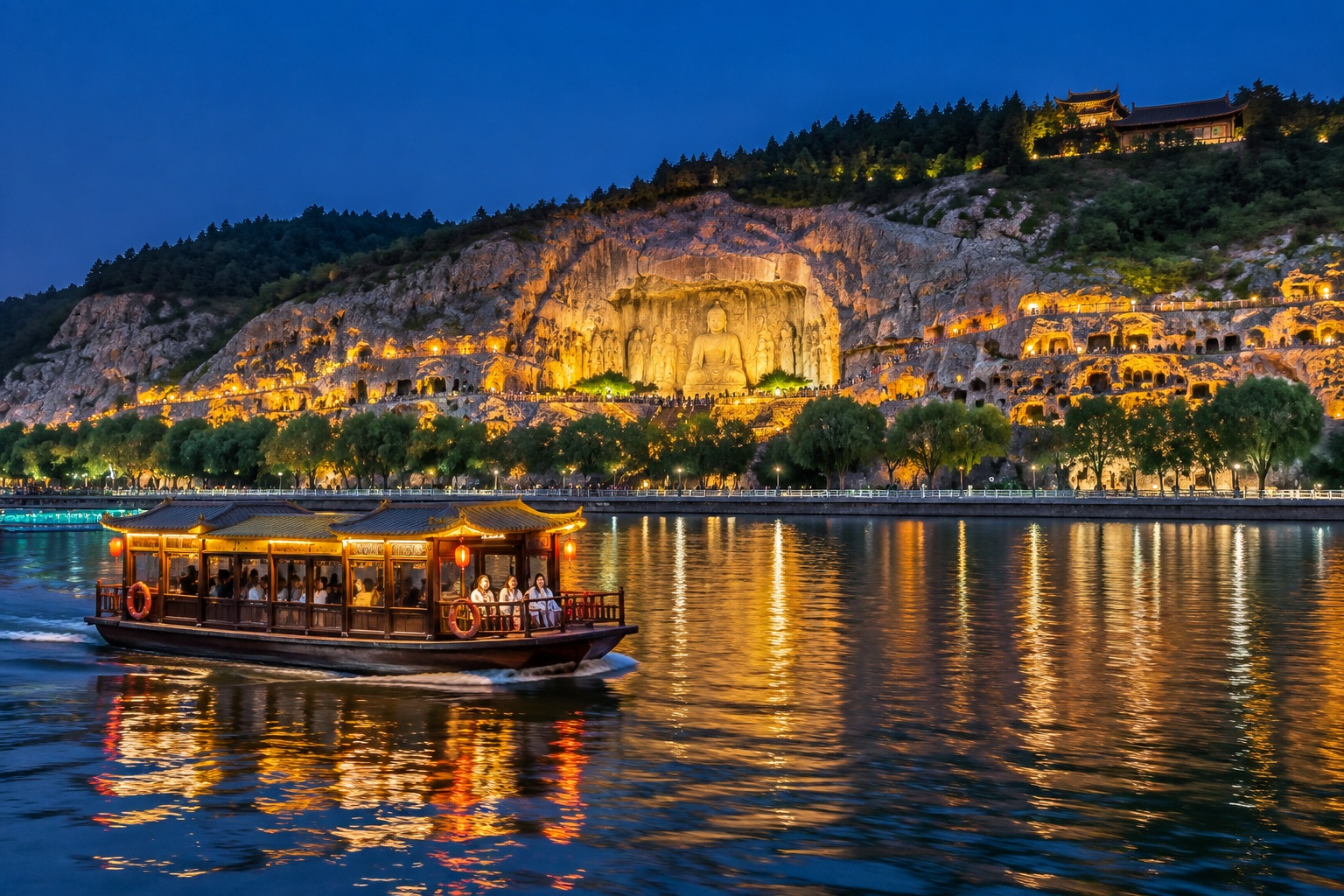
The parts that are not magical
Be honest about the trade-offs. Not every cave is illuminated. The small Northern Wei niches away from the main path are almost completely dark at night, and if you came specifically for the earliest carvings, daylight is better for those.
The walk is longer than it looks on a map. Budget two and a half to three hours, with stairs and uneven sections, and wear shoes with grip. The riverside path has mosquitoes in summer. Walkway lighting is dim in patches, so watch your step between viewing platforms.
Crowds are seasonal. During the April peony festival, the May Day holiday and the first week of October, the evening session can fill up the way the daytime one does. Go on a weekday in May or September and you will have long stretches of cliff to yourself.
If you go: practical notes
Getting there. Luoyang Longmen railway station is on the Zhengzhou–Xi’an high-speed line: about 40 minutes from Zhengzhou, roughly 90 minutes from Xi’an. From the station it is a 15 to 20 minute taxi ride to the north gate. Luoyang Metro Line 2 runs south from the city centre toward the grottoes area, with a short taxi or bus connection at the end.
Tickets and timing. Day tickets run roughly 90 to 120 yuan depending on season and whether the combined ticket including Xiangshan Temple and Bai Garden is included. Evening sessions are usually sold separately and cost less. Start times shift with the season and with sunset, typically around 6:30 to 7:00 p.m., with last entry well before closing, and the night programme does not run year-round. Check the official Longmen Grottoes site or WeChat account the week you travel — prices and hours change.
Best season. Late spring (May) and early autumn (September–October). Summer evenings are warm but humid; winter nights are cold and the light goes early.
What to bring. Comfortable shoes, a light layer, insect repellent in summer, and a phone or camera that handles low light. Tripods are restricted in some areas, so ask at the gate rather than setting one up and being told to stop.
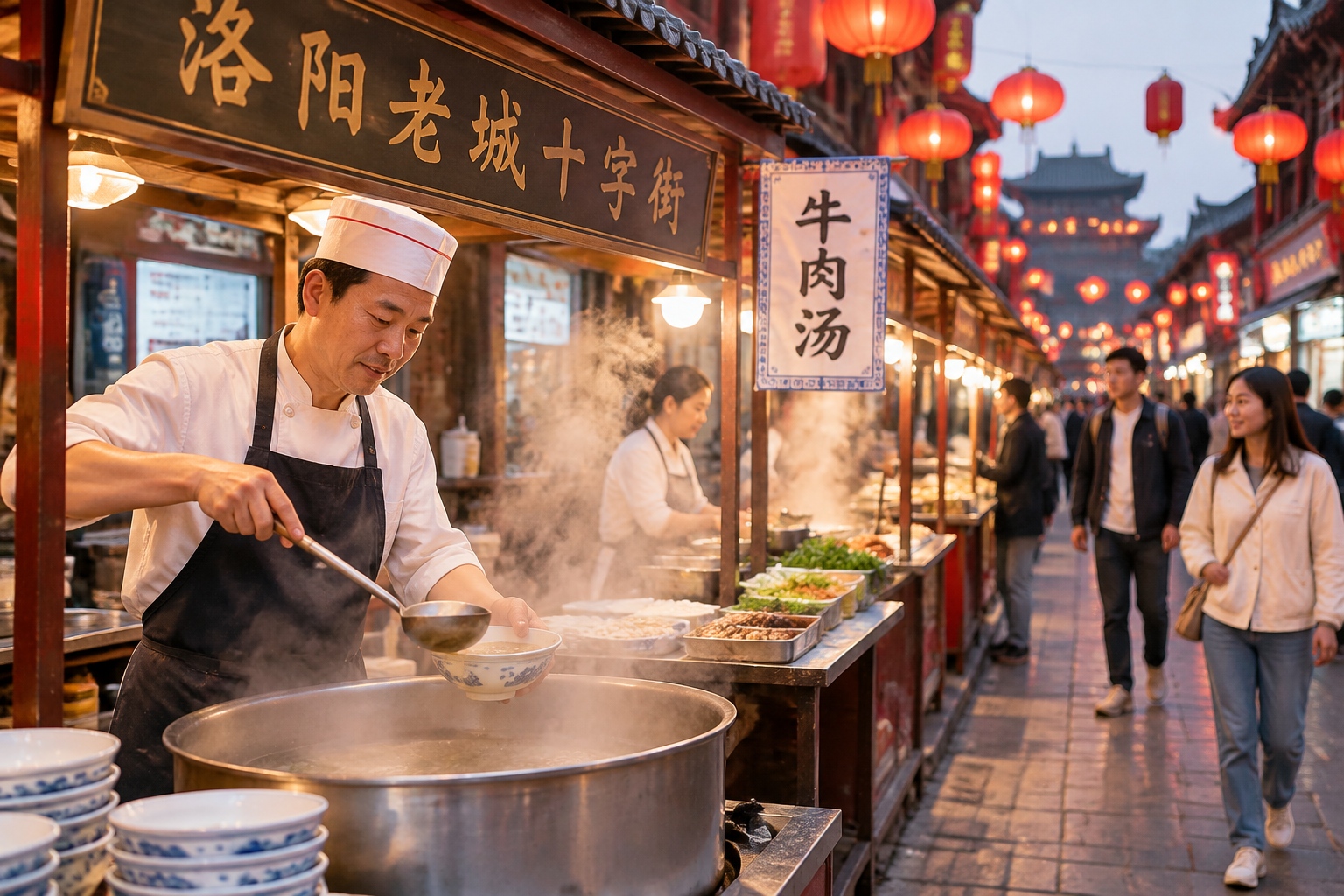
Afterwards. It is a 20 to 25 minute taxi back to Luoyang’s old town, where the Cross Street night market is still serving at 10 p.m. Order a bowl of Luoyang shui xi, the local “water banquet” — a run of soupy dishes that tastes genuinely strange the first time and genuinely good by the third bowl.
Why the night version is the one you remember
By day, the Longmen Grottoes are an impressive historic site. You walk a crowded path with a map and take photographs that look like everyone else’s photographs. At night, with the lights low and the river loud and almost nobody around, the Vairocana Buddha stops being a monument and becomes what it was carved as: a face, in the dark, looking back at you.
Start the discussion at forum.chinacomes.com