

The Portuguese egg tart is not exactly Portuguese
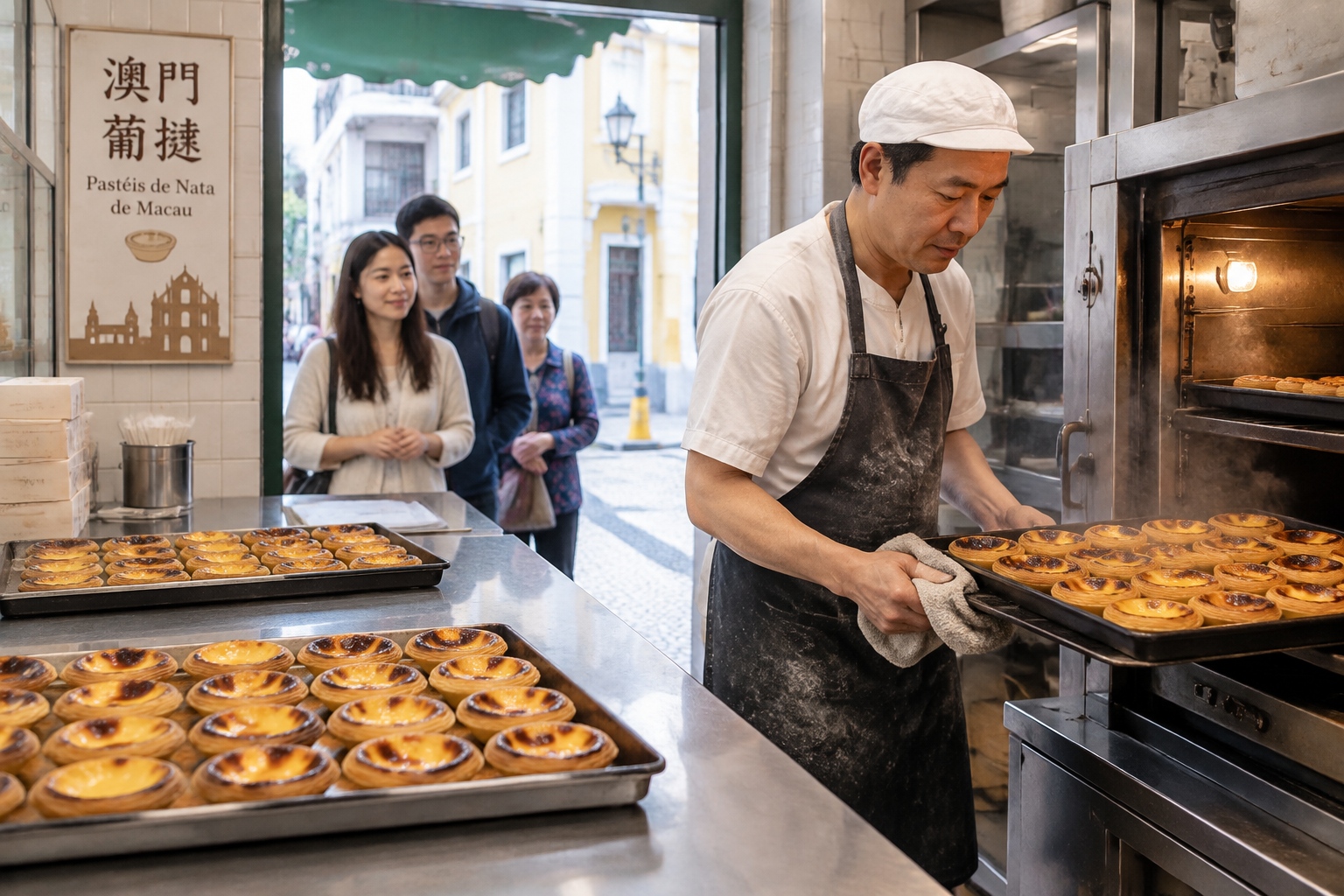
At nine in the morning in Coloane Village, on Macao’s southern tip, the queue outside a small bakery curls past the door. People wait for egg tarts — blistered brown on top, still warm, the pastry collapsing the moment you bite it.
Almost nobody in that line knows what is sitting in their paper bag. The “Portuguese egg tart” was popularised here in 1989 by Andrew Stow, an English baker, who took the Portuguese pastel de nata, cut the sugar, added cream, and baked it his own way. Portugal has pastéis de nata. Macao has something else, and named it after Portugal anyway.
If one pastry can carry that much confusion about who made it, the city around it deserves more than a photo stop at the Ruins of St. Paul’s.
What “Macanese” actually means
Portuguese traders reached this corner of the Pearl River Delta in the 1550s. Macao was administered by Portugal until 1999, when it returned to China as a Special Administrative Region — the last European colony in Asia.
Out of those four and a half centuries came a group the Chinese call 土生葡人, literally “locally born Portuguese.” In English they are the Macanese: Catholic families with Portuguese surnames, descended from Portuguese men who married Chinese, Malay, Japanese, Indian, Sri Lankan and African women. Their grandparents prayed in Portuguese, argued in Cantonese, and cooked in neither tradition exactly.
Many left in the 1980s and 1990s, before the handover, for Lisbon, Toronto, Vancouver, Sydney and Hong Kong. The community that stayed is small — estimates usually land somewhere between a few thousand and ten thousand people, in a city of about 685,000.
The food is a trade route on a plate
Portuguese food and Macanese food are two different things, and mixing them up is the fastest way to annoy a Macanese grandmother.
Portuguese cooking in Macao means bacalhau, caldo verde, grilled sardines. Macanese cooking is what happens when a Portuguese kitchen meets Cantonese ingredients and an old spice route: turmeric, coconut milk, tamarind, cinnamon, olives, Chinese sausage, soy sauce and star anise, sometimes in the same pot.
Minchi is the dish people get sentimental about — minced pork or beef fried with diced potato and soy sauce, usually topped with a fried egg. It is not fancy. It is what a Macanese child eats when they come home. Then there is tacho, a winter stew of pork, Chinese sausage and cabbage; African chicken, which is neither African nor Portuguese in any strict sense; and “Portuguese chicken,” baked with coconut and olives, a dish most Portuguese visitors have never seen at home.
In 2021, Macanese gastronomy was added to China’s national list of intangible cultural heritage. Most of it still lives in home kitchens and a handful of family-run restaurants — small rooms with a dozen tables, menus in Chinese and Portuguese, main dishes around MOP 60 to 150. Riquexó, near the city centre, has been feeding Macanese families for decades. Nobody there is chasing a Michelin star; they are keeping a recipe alive.
A language with a few dozen fluent speakers
Macao has its own creole. Patuá, sometimes called Maquista, is Portuguese in its bones, with Malay, Cantonese and old Malacca-Portuguese mixed in. Portuguese is still an official language here alongside Chinese — laws and court documents are published in both — but Patuá is something else, and it is nearly gone. UNESCO lists it as critically endangered; by most counts only a few dozen people can still hold a conversation in it.
One quatrain survives almost everywhere: “Nhonha na jinela / Co fula mogarim / Sua mãe tancarera / Selá tancarerô” — the young woman at the window with a jasmine flower; her mother keeps a shop, and so does she. It shows up on posters, in school lessons, and once a year on stage.
That stage is the annual Patuá comedy revue by Dóci Papiaçám di Macau, a local troupe that writes new sketches in a language most of the audience does not speak, with Chinese and Portuguese surtitles. It sells out. Which says something about how Macao handles its own hybridity: as heritage, as humour, and as a slightly guilty pleasure.
Houses that are neither Portuguese nor Chinese
The Historic Centre entered the UNESCO World Heritage list in 2005 — 22 buildings and eight public squares packed into a walkable strip roughly 1.5 km long. What makes it unusual is not that Portuguese buildings exist in Asia. It is that they were built by Chinese craftsmen for Portuguese merchants and wealthy Chinese compradors, using whatever either side could supply.
Look at the Mandarin’s House (Casa do Mandarim, 郑家大屋), home of the reformist thinker Zheng Guanying: a Chinese courtyard layout, grey brick, moon gates — and then Western arched windows and a two-storey veranda. The Lou Kau Mansion goes the other way, a Chinese merchant’s house fitted with Portuguese tiles and shutters.
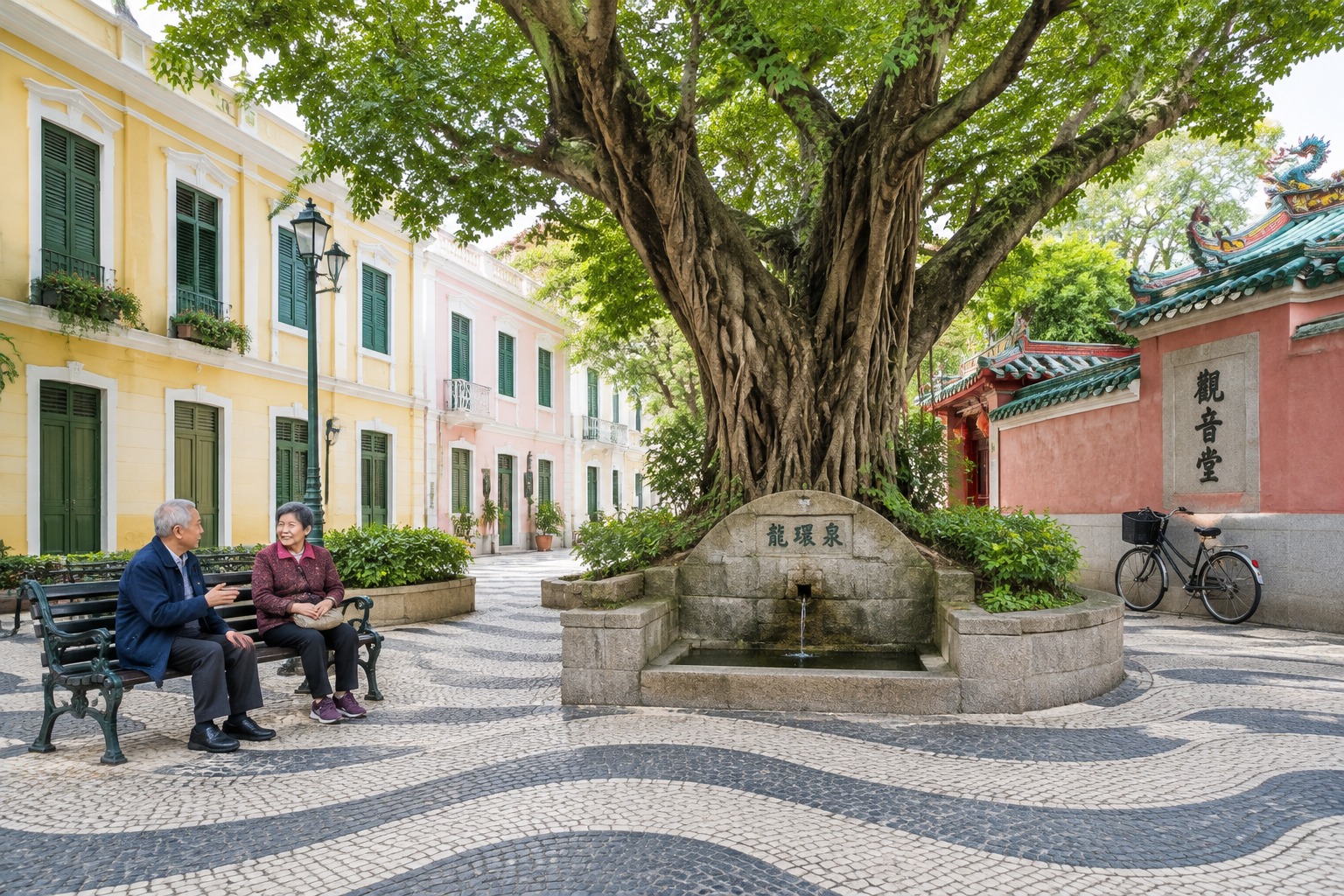
The Dom Pedro V Theatre, built in 1860, is the oldest Western-style theatre in China: a neoclassical colonnade under a roof that quietly borrows from Chinese building. Ten minutes away, Largo do Lilau is a small square with a banyan tree and a stone spring, plus a saying every Macanese knows — “Quem bebe da água do Lilau, não sai de Macau.” Drink the water of Lilau and you will never leave Macao.
Why Macao’s mixed culture survived differently
Portugal left hybrid communities in several places: Goa, Malacca, Sri Lanka, Macao. In Goa, Portuguese rule ended in 1961 and the language faded fast. In Malacca, the Portuguese creole Kristang still has a few thousand speakers and no official status.
Macao is the outlier because the handover was negotiated, and Portuguese remained an official language after 1999. Laws, court judgments and government notices are still bilingual. Portuguese-medium schools still operate. That gives the hybrid culture an institutional skeleton — and a ceiling: only about 2 percent of residents speak Portuguese at home, and it matters professionally mainly in law, government and the niche trade with Portuguese-speaking countries from Brazil to Angola.
Compare Hong Kong, an hour away by ferry or bridge. Britain’s legacy there is institutional — common law, English-medium schooling, professional norms. Macao’s Portuguese legacy sits closer to home: church calendars, family names, kitchen recipes, tiled pavements, the patios between buildings. A similar kind of colonial past, a completely different daily texture.
Half a day off the postcard route
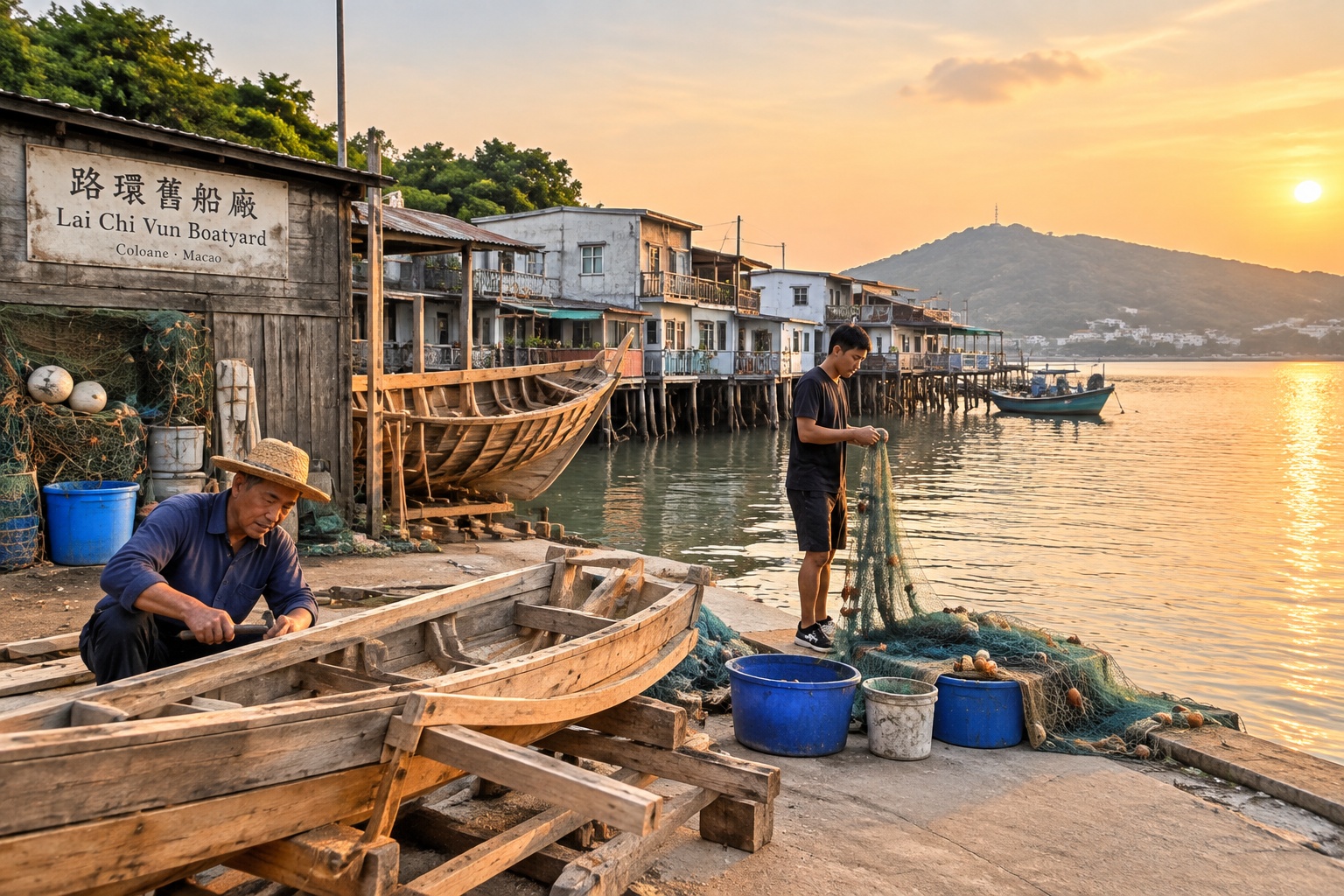
Coloane Village. Where the tart queue starts. Two minutes away are stilt houses on the water, the Tam Kung Temple, and the old Lai Chi Vun boatyards, where wooden fishing boats were built until the trade collapsed; parts of the site have been tidied up and reopened as a cultural space.
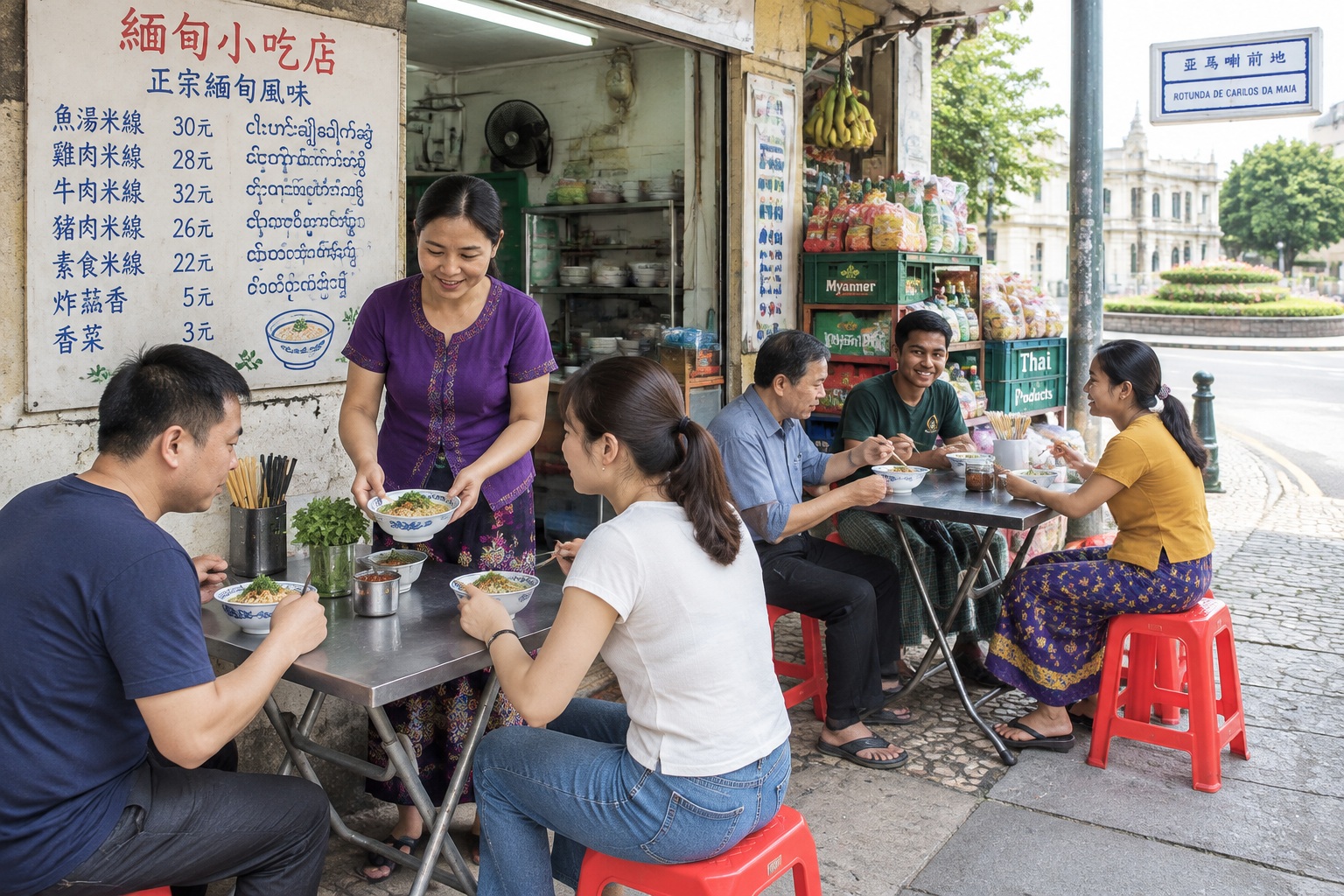
Rotunda de Carlos da Maia, known locally as 三盏灯. Ten minutes’ walk north of the city centre, this roundabout anchors a Southeast Asian corner of Macao: Burmese noodle shops, Thai groceries, and families descended from Chinese migrants who arrived from Myanmar in the 1960s and 70s. Order a bowl of noodles and watch the neighbourhood eat lunch.
St. Lazarus district (疯堂区). Quiet lanes uphill from the crowds, small galleries, an old leper hospital turned church, and the creative-industry studios that moved in after it.
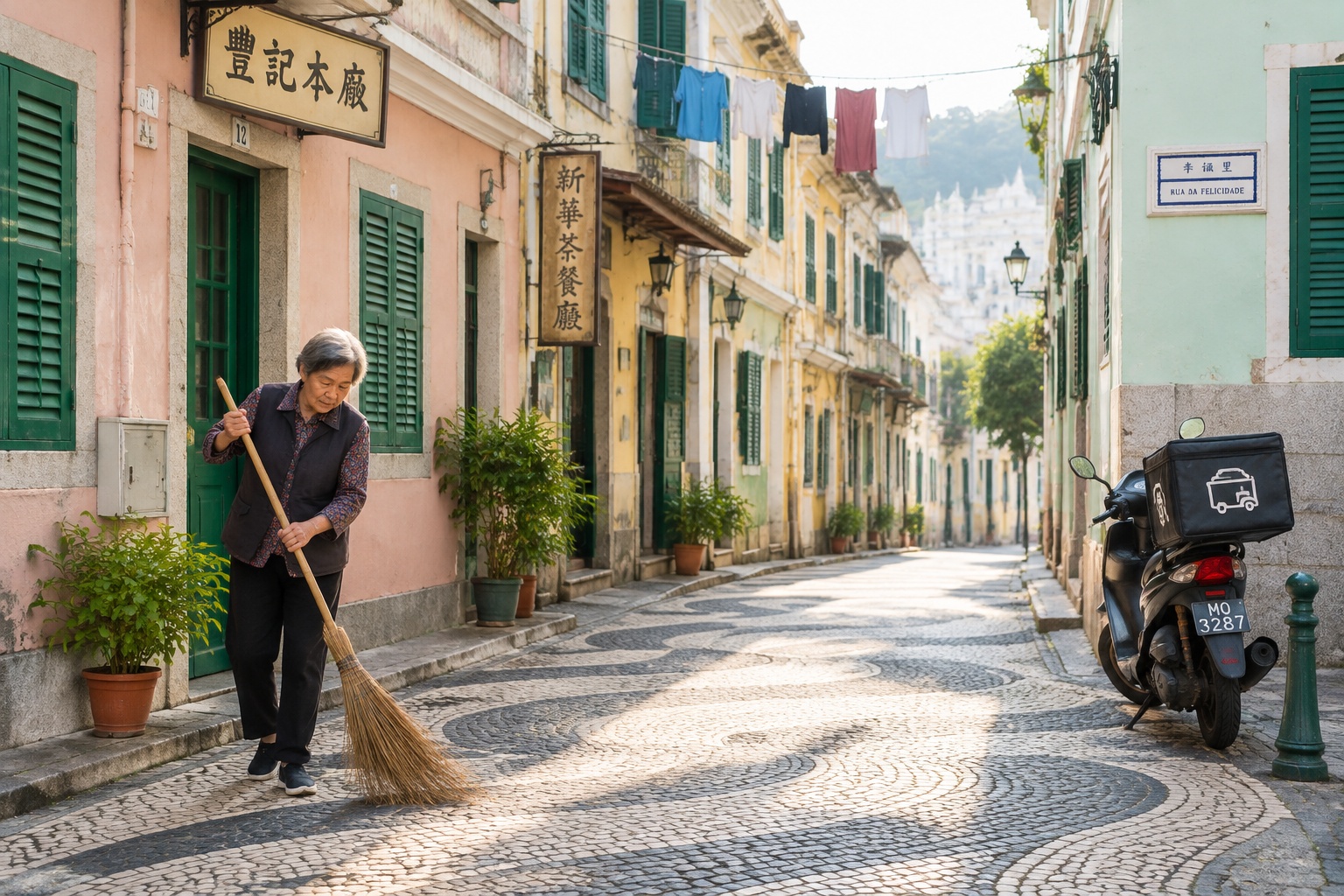
Behind the Ruins of St. Paul’s. Walk around the back and five minutes uphill into the lanes of 茨林围 and 大三巴围 — residential alleys where laundry hangs and elderly neighbours sit on plastic stools. Tourists photograph the facade; almost none of them walk behind it.
Practical notes. The historic centre is best on foot. Buses cost MOP 6, and the driverless Light Rapid Transit connects Taipa, Cotai and Barra, near the old centre. Some small shops are cash-only, so keep a few patacas. August is brutally humid; typhoon season runs roughly June to October.
What to take home
Not a fridge magnet. The useful thing about Macao is that it does not present hybrid identity as a slogan or a crisis. It presents it as a Tuesday: a Macanese family eating minchi, a Filipino and a mainland Chinese worker sharing a bus, a Buddhist temple and a Catholic church on the same block.
That comes with real losses. Patuá is dying. Most young people do not speak Portuguese. The casino economy pays better than the family restaurant. But the mixture persists in small, unmanaged places — and that is exactly where a visitor should look.
Start the discussion at forum.chinacomes.com