

The last twenty minutes
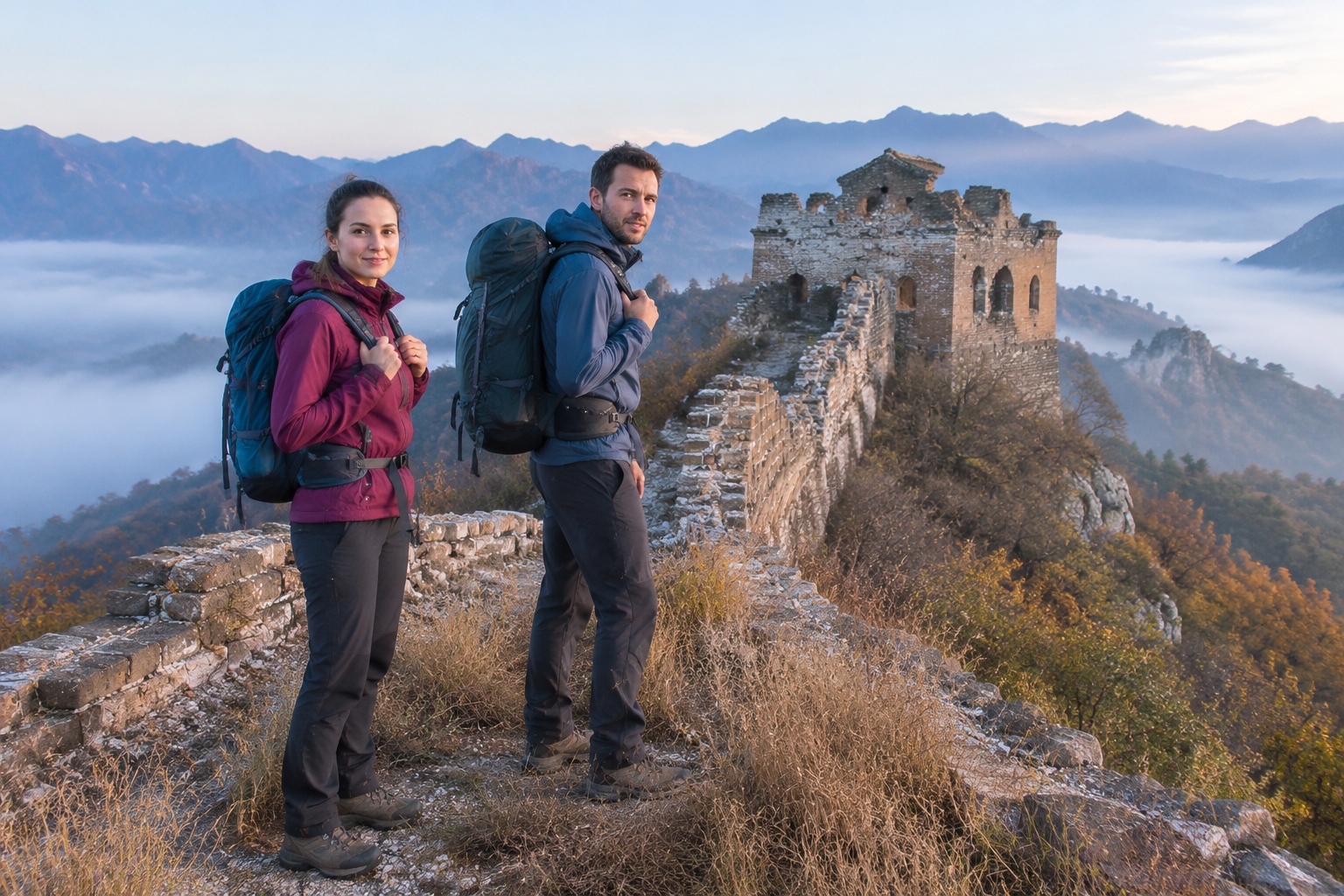
The last twenty minutes of the climb is the part nobody photographs. It is 7:40 p.m., and the stone steps above us have collapsed into a slope of loose brick and dry grass. My headlamp catches two metres of ground and the edge of a drop. Down in the valley, a dog is barking at a tour bus that has already left.
We are on the Jiankou section of the Great Wall, in Huairou district, about 70 kilometres north-east of central Beijing — two hours by car if the ring road behaves. Jiankou means “arrow nock,” because the ridge bends like a bow being drawn. It is also the steepest, most photographed and least official stretch of wall near the capital. A sign at the bottom says, in Chinese and English, that this section is not open to visitors.
People climb it anyway. So do we, slowly, with 15 kilos each and a plan to sleep in a watchtower and be gone before the first tour group could possibly arrive.
Why not Badaling
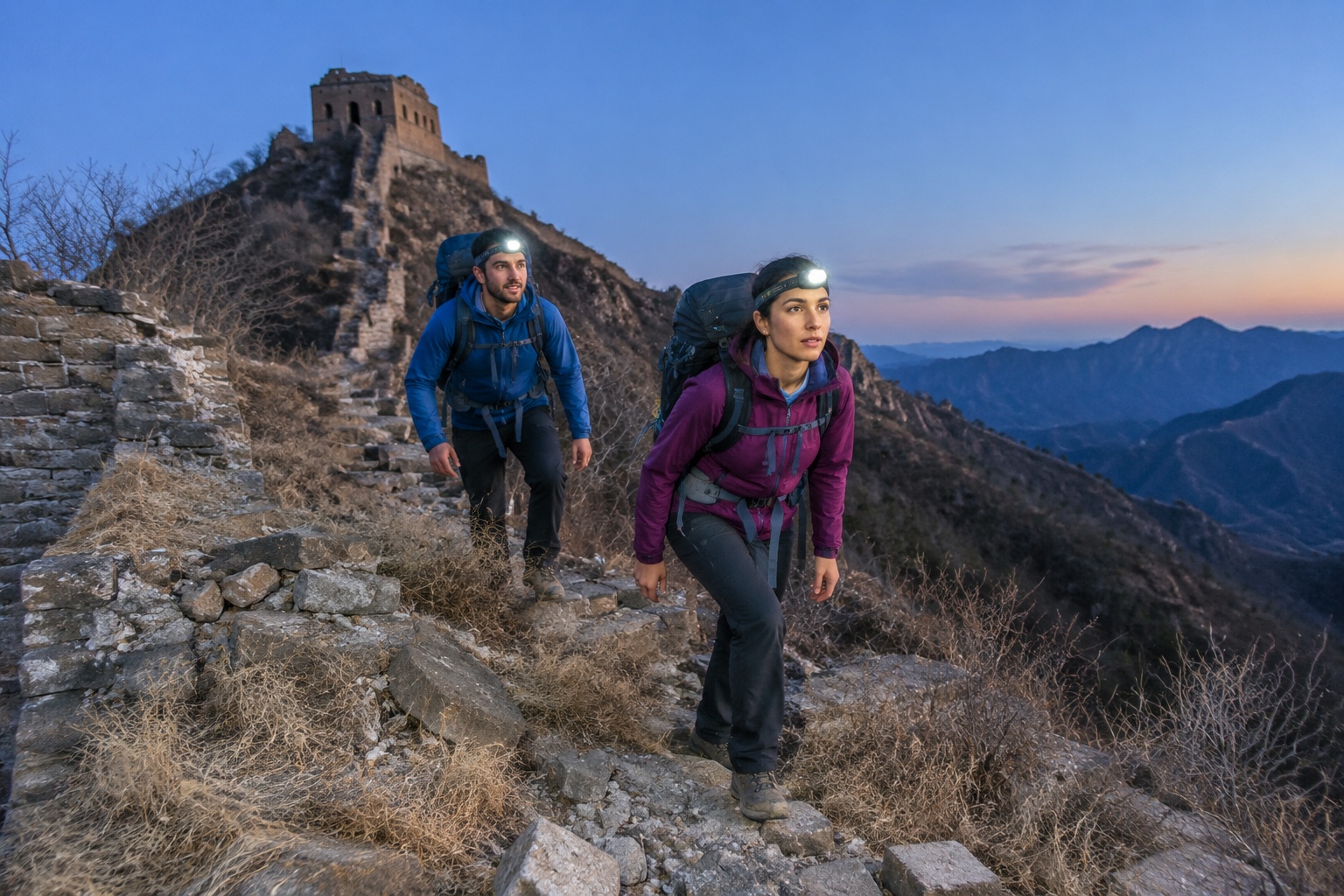
Badaling, an hour further north, is the Great Wall most visitors picture: cable car, handrails, souvenir shops, a plaque. It opened to the public in the 1950s and draws millions of people a year. On a holiday weekend the crowd moves in a slow, phone-lit current, and the wall feels less like a fortification than a very long pedestrian bridge.
Measured in full — every branch, spur and trench, across 15 provincial-level regions — the Great Wall comes to 21,196 kilometres, according to a government survey published in 2012. Beijing alone contains roughly 520 kilometres of it, spread over six districts. Only a few dozen of those kilometres are restored, ticketed and swept every morning. The rest is what people here call ye changcheng: wild wall. Brick teeth, waist-high grass, watchtowers with trees growing out of the floor.
That wildness is not a secret, and it is not exactly permitted. Beijing has tightened its Great Wall protection rules in recent years: sections that have not been formally opened cannot legally be visited, district governments are expected to keep people off them, and hikers have been turned back or fined. Where that leaves a traveller who wants to see the wall without a ticket queue is an open question, and the answer depends on which district you are standing in and who happens to be standing next to you.
Jiankou also has a reputation. The ridge is steep, the brick is loose, and emergency crews have been called up here after dark more than once. I have hiked enough to know the danger is rarely the cliff. It is the person in front of you knocking a brick loose as you pass.
The man who walks the same three kilometres
At 6:10 a.m. somebody coughs below the tower. He is in his late fifties, wearing a blue vest over a fleece, carrying a canvas bag and a walkie-talkie clipped to his belt. He is a changcheng baohuyuan — a Great Wall protection officer.
Beijing pays a few hundred of them, most of them villagers from the hamlets below the wall. The stipend is modest and varies by district. The job is unglamorous by design: walk the same three kilometres of ridge several times a week, pick up bottles and tissue, check whether any bricks have shifted since the last visit, log what you find on a phone app built for the purpose. Anything serious — a collapsed parapet, a hole dug by looters, smoke — gets photographed and passed up the chain.
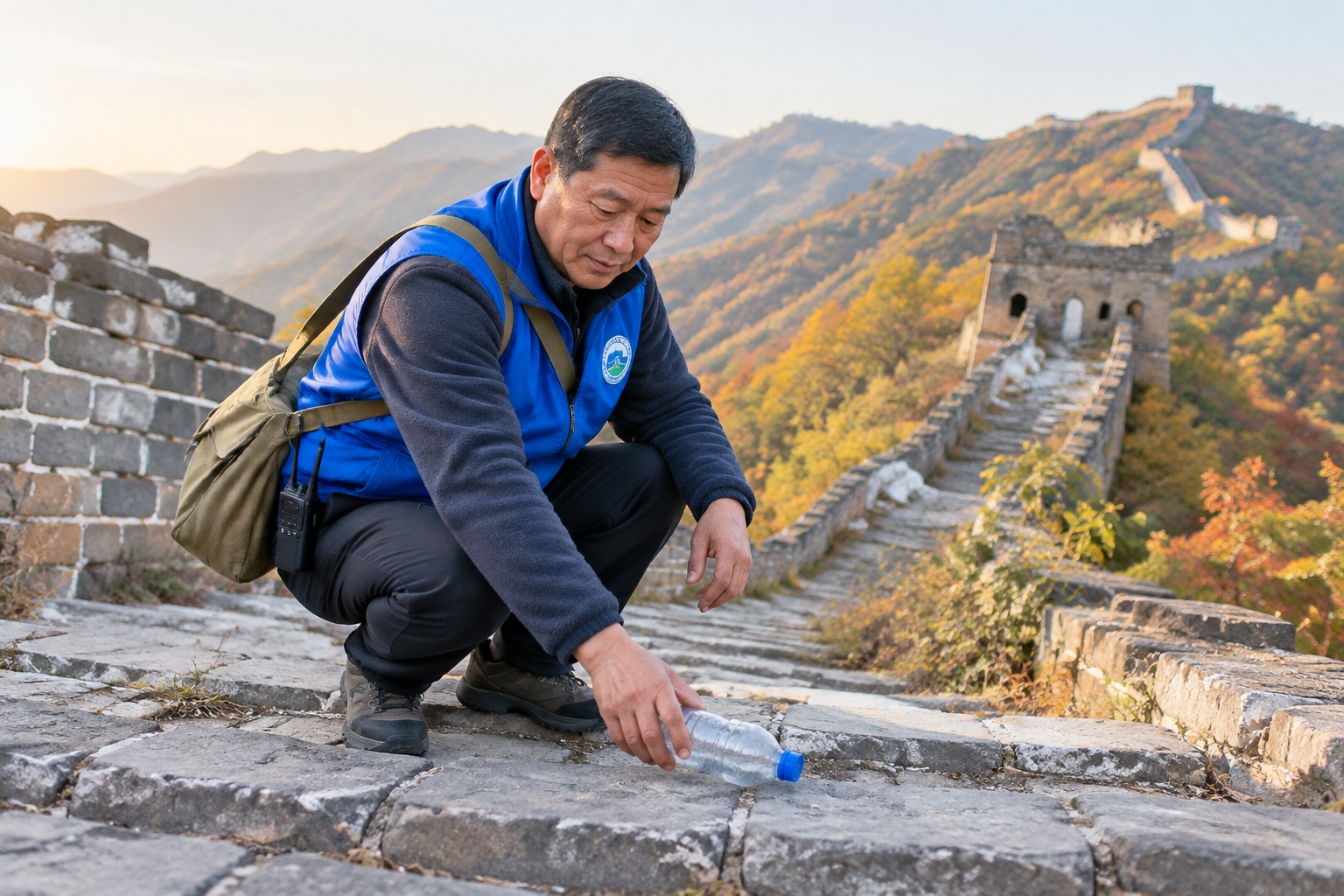
“Thirty years ago people took the bricks home,” he says, sitting on a step and cupping a cigarette against the wind. “You built a pigsty out of Great Wall brick. Everyone did. Now it’s illegal to take one brick, and everyone knows it.” He nods at the valley. “The problem now isn’t bricks. It’s bottles.”
He is not a fan of the tent. Not us specifically, he says, but because where there is one tent there are usually twenty, and the twenty leave things behind. We show him the bag we have already filled. He looks inside, half-convinced, and tells us about a group last month who lit a fire inside a tower. “Eight hundred years,” he says, “and someone burns the wooden lintel for a barbecue.”
Restoration that tries to look like nothing happened
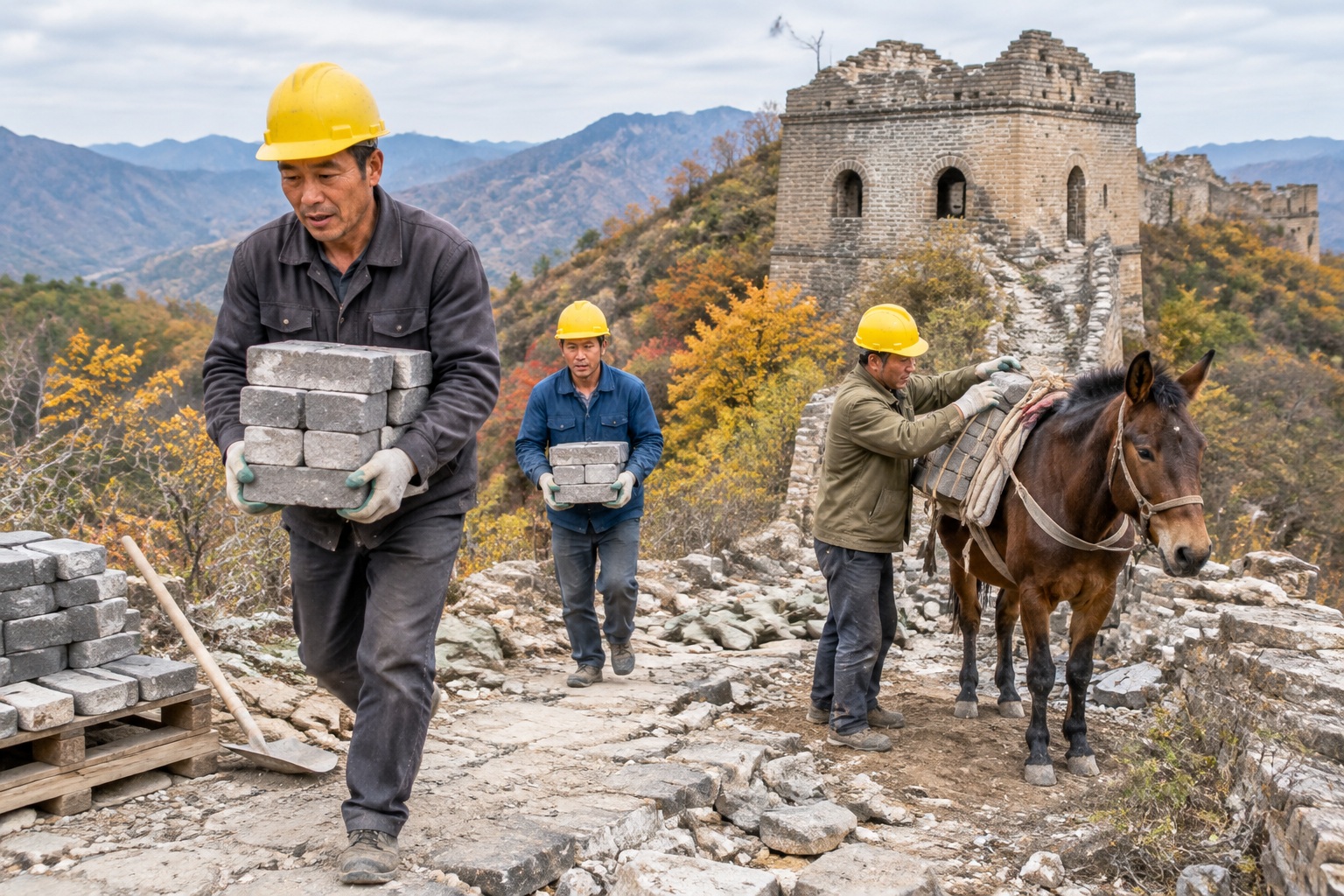
Two ridges east, a different kind of work is going on. Since 2016, Jiankou has been the site of a series of “research-based” restoration projects, run by the municipal heritage authorities with archaeologists, architects and engineers on the ground.
The philosophy is deliberately restrained. Earlier Chinese restoration sometimes rebuilt towers in crisp new grey brick, which looked tidy and told you almost nothing. The Jiankou approach is the opposite: stabilise what is standing, reuse the original bricks that have fallen, add as little new material as possible, and document every step. Workers carry bricks up by hand or on mules, because there is no road and nobody is going to build one.
Before anyone touches a stone, drones fly the length of the section and the wall is scanned in three dimensions. Every crack and leaning merlon is photographed from the same angle each year, so change can be measured instead of guessed at. The scanning has a second life online. In 2022 the China Foundation for Cultural Heritage Conservation and the tech company Tencent released a digital reconstruction of a one-kilometre stretch of the Xishuiyu section, built from thousands of high-resolution photographs, that anyone with a browser can walk through — and, in a slightly odd but very popular feature, “repair” with virtual bricks.

The people who never climb it
Below Jiankou, in a village called Xizhazi, the wall has become an economy. Guesthouses with red lanterns serve trout and stewed chicken to weekend hikers. The car park fills by nine on a Saturday. A man sells walking poles out of the back of a van. It is an unromantic truth about the Great Wall: for the people who live under it, it has always been a resource — grazing land, building material, and now, breakfast.

There is another group whose relationship with the wall is more patient. Since 1999, volunteers with an organisation called Great Wall Xiao Zhan have been walking and mapping sections nobody else was measuring, photographing towers before and after, and hauling out other people’s rubbish. Some of their records are now used by researchers. None of it is dramatic. Most of it looks like one person with a GPS unit and a plastic bag, three hours from the nearest bus stop.
What a night up there teaches you
It is cold at 3 a.m. — maybe four degrees, wind coming over the ridge in long pushes. No toilet, no water, one bar of signal that comes and goes, and a floor of brick that has been rained on for four hundred years. Around five the sky over the valley turns the colour of weak tea, and the wall runs away from us in both directions: east towards a restored stretch with a ticket gate, west into eight kilometres of rubble and hawthorn.
What stays with me is not the sunrise. It is the arithmetic. Twenty-one thousand kilometres of wall. A few hundred guardians. A budget that has to be argued for every year. The technology helps — drones see what a man on foot cannot, an app turns a villager into a data point, a digital twin keeps a copy of something that will otherwise keep crumbling. But none of it replaces the person who walks three kilometres of ridge in a blue vest, picks up somebody else’s bottle, and notices that one brick has moved.
Anyone planning to go should know the ground rules first. Camp away from restored sections and never inside a tower with a wooden lintel. Carry out everything, including food waste. No fires, ever. Check the current rules for the district, because they change and they are enforced unevenly. And if a man in a blue vest tells you to move, move.
We are off the wall by 7:30, past the sign that says it is not open, past a farmer leading two mules up the track. He does not look at us. He has watched a lot of people come down off that ridge, and he knows that most of them leave something behind.
Start the discussion at forum.chinacomes.com