

A gray afternoon in Zhuhai
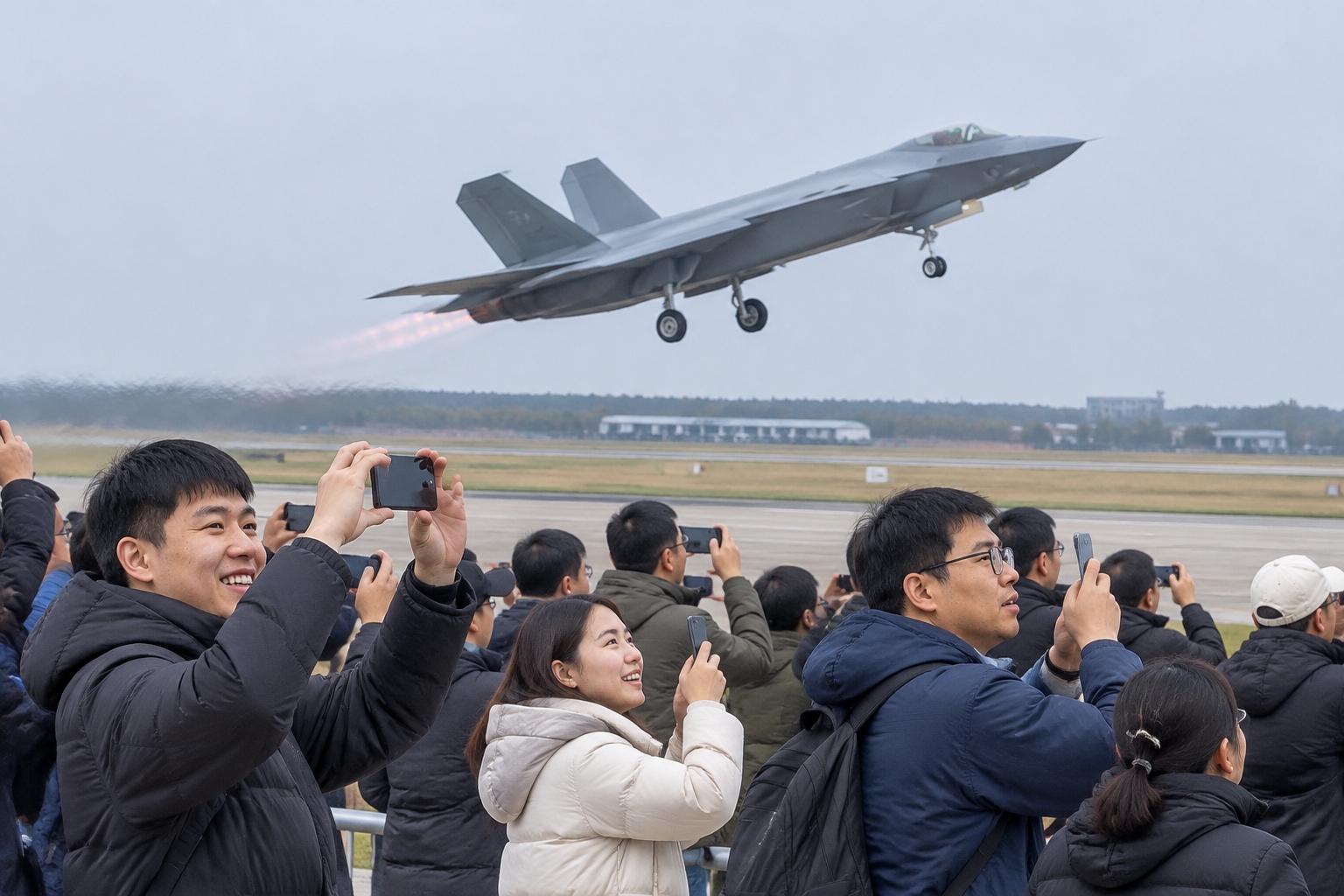
The rain had stopped by early afternoon, but the sky over Zhuhai stayed the color of wet concrete. A few thousand people were standing on the tarmac with their phones held up anyway, because the aircraft taxiing past them was one most of them had only seen in blurry photographs. Two engines. Two tail fins canted outward. A shape with almost no straight lines in it.
It took off, climbed, rolled, and came back around. The display lasted a few minutes. By the time the sound reached the crowd, the aircraft was already somewhere else.
That was the J-35A, a twin-engine stealth fighter built by Shenyang Aircraft Corporation. Its flight at Airshow China in November 2024 was the first time the type had appeared in public. It is also the second Chinese stealth fighter to be shown openly, after the J-20, which first flew in 2011.
The phrase Chinese officials and state media attached to it is “一机多型、空海孪生” — one aircraft, multiple variants; air and sea twins. It sounds like a slogan, and part of it functions as one. Underneath it, though, there is a real design decision, and that decision says more about where China’s combat aircraft programs stand than any single specification would.
What “medium” means when you are buying a fleet
Fighters are usually sorted by weight class, which is rough shorthand for size, cost and what the aircraft is expected to do. Heavy fighters — the F-22, the J-20 — carry large radars and long-range missiles a long way from home. They are also expensive to buy, expensive to fly, and they exist in relatively small numbers.
Medium fighters sit a class below. The F-35 is the obvious reference point for Western readers: a single-engine aircraft roughly two-thirds the empty weight of an F-22, and built in the thousands rather than the hundreds. China has not published dimensions, empty weight, thrust or range for the J-35A. What is public is the label — Chinese reporting consistently calls it a 中型 (medium) fighter — and the aircraft itself, which looks visibly smaller than the J-20 when the two appear in the same frame.
None of this is vanity sizing. The class decides how many squadrons you can equip, how many hours a pilot can fly in a year, and how much maintenance a single airframe demands. An air force with a few hundred heavy stealth fighters and an air force with a thousand medium ones are not the same instrument, even if their radar cross-sections were identical.
It is the same logic airlines use when they choose between narrow-body and wide-body jets. The wide-body flies farther with more payload; the narrow-body flies more people, more often, for less money per seat. Neither is the better aircraft in the abstract. The route network decides.
One aircraft, two jobs: inside the “twin” idea
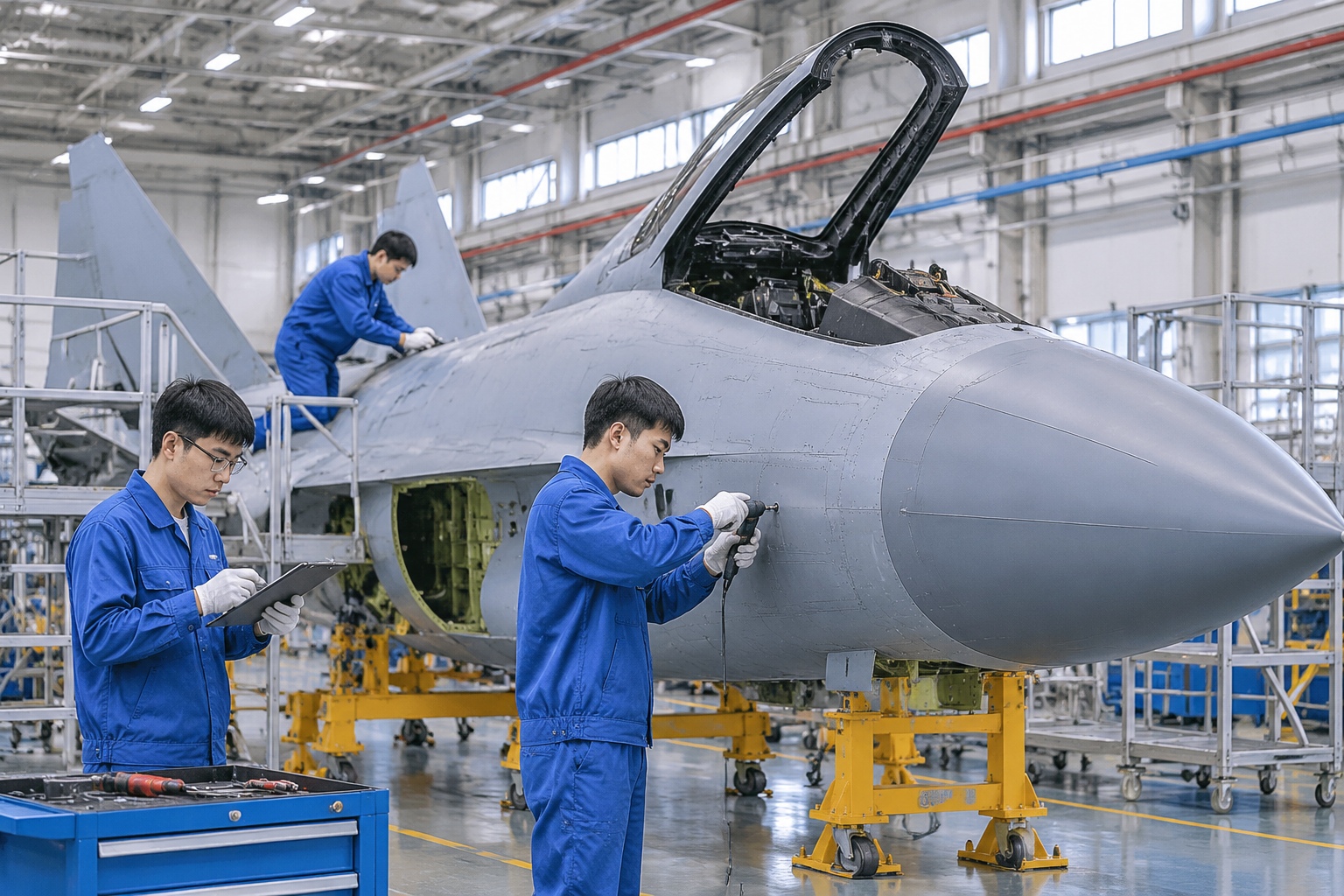
The J-35 family has been described from the beginning as a pair: a land-based version for the air force, the J-35A, and a carrier-capable version for the navy. The FC-31 demonstrator that preceded both flew in 2012. The phrase “空海孪生” — air and sea twins — describes a shared origin, not a shared configuration. It is a statement about how the aircraft was designed, not about where they are based or how many exist. Those details are not public, and reading the slogan as a deployment map is a mistake.
What has to change for carrier duty
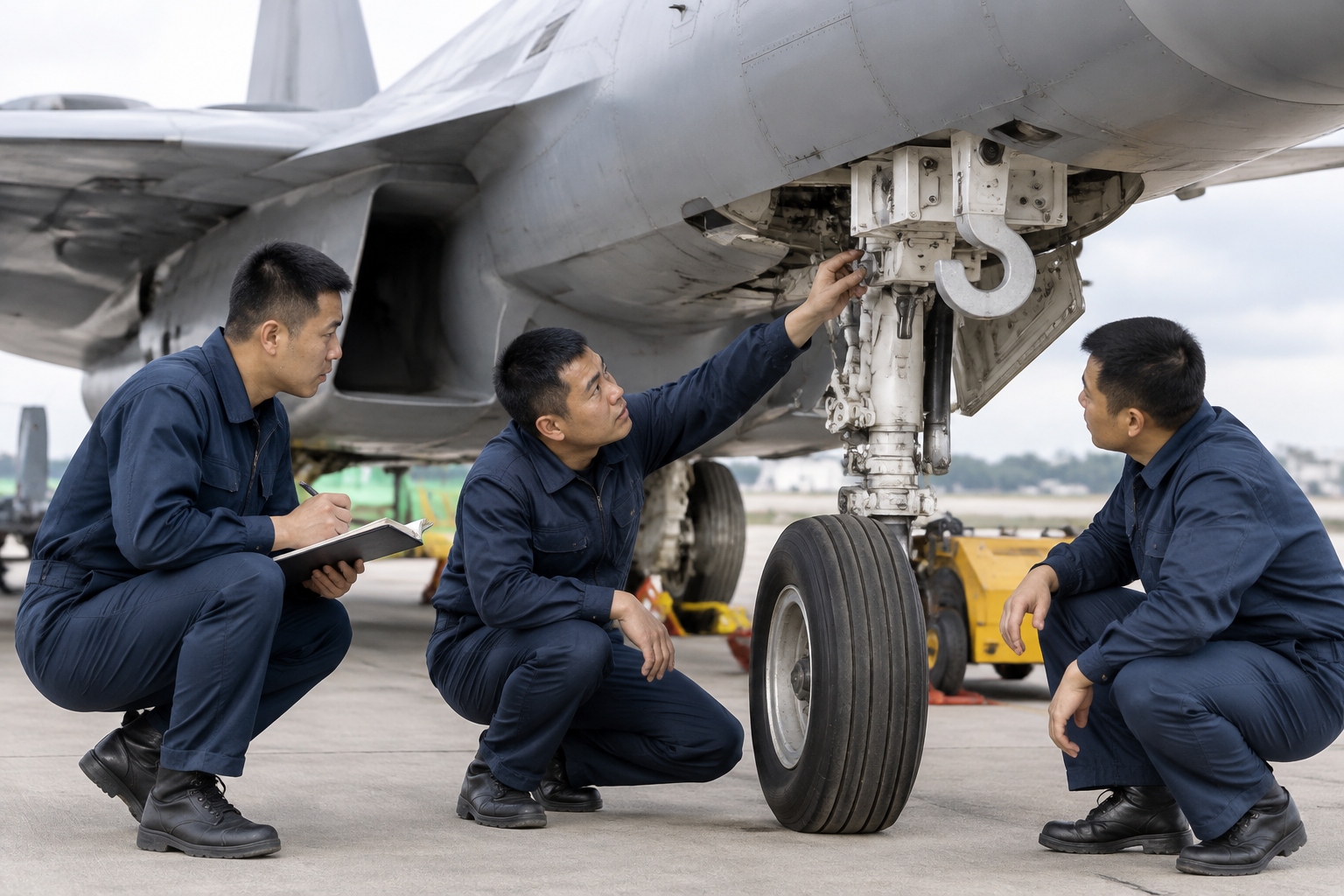
Landing on a ship is a violent business. A carrier variant needs landing gear built for a hard, sink-rate-limited impact, a nose gear strong enough for catapult launch, and an arrestor hook. It needs wings that fold so the aircraft fits on deck and in the hangar. It needs corrosion protection against salt spray, and handling qualities that stay predictable at the low speeds and high angles of attack of a carrier approach.
Each of those adds weight and complexity to an airframe that also has to stay stealthy. China’s newest carrier, Fujian, uses electromagnetic catapults rather than a ski jump, so the naval variant has to be built for catapult launch from the start. Chinese statements have framed the air force and naval versions as a parallel design effort rather than a later conversion of one into the other.
Why design them together
A common engine, common avionics and a common supply chain mean one training pipeline and one spares inventory instead of two. A navy flying the same basic aircraft as the air force spends less on logistics and can rely on a much larger industrial base behind it.
The trade-off is real. A carrier-capable airframe is heavier and draggier than a purely land-based one, so the air force version inherits compromises it would not otherwise need. Designers accept that because the alternative — two separate aircraft — costs more than either service could justify.
What you can actually see at an airshow
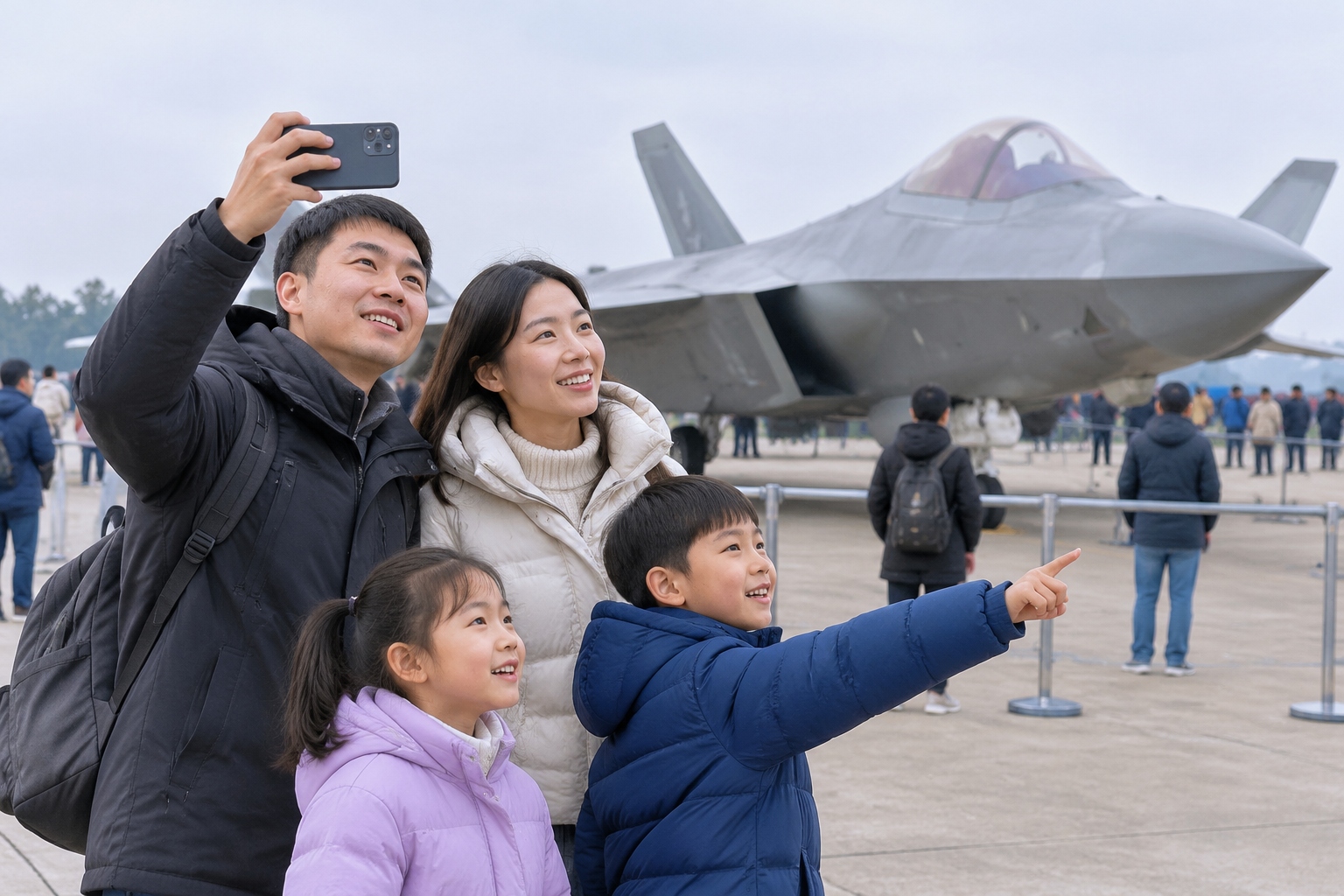
A public flight display reveals geometry and almost nothing about software. From the ground, and from the photographs that circulate afterwards, the observable facts about the J-35A are these: two engines, twin vertical tails canted outward, an inlet design with no visible boundary-layer diverters, a wing and tail arrangement built around a radar-evading planform, and no external weapons in a clean configuration.
What is not visible is the part that decides most engagements: the radar, the electronic warfare suite, the datalinks, the sensor fusion, the thrust and the fuel fraction. Chinese publications have not released those numbers. Estimates circulating among Western analysts are exactly that — estimates, usually inferred from photographs and comparisons with the F-35.
Multirole is a schedule, not a label
“Multirole” is one of those words that sounds larger than it is. In practice it means a squadron can be handed different kinds of missions without swapping aircraft: air policing and interception, escort, precision strike against ground targets, maritime strike, reconnaissance, and, increasingly, passing sensor data to other aircraft and ships.
What matters to the people who fly and fix the aircraft is not the mission list but the tempo. How many sorties can a unit generate in a day? How many maintenance hours per flight hour? How quickly can a stealth aircraft be repaired after a panel is damaged, and how much of that work needs a specialised facility? None of those numbers appear in a press release, and they are the ones that decide whether a new type changes anything.
Reading a public debut carefully
Two things are true at once about the J-35A. It is a genuine second strand in China’s stealth program: flown publicly, reported by Chinese state media as entering service, and part of a broader push that includes the J-20, advanced drones and a modernised aircraft industry. And almost every specific claim about its capabilities — radar range, weapons load, stealth performance — is either unpublished or estimated by outsiders.
The word “stealth” causes most of the confusion. It does not mean invisible. It means the distance at which a defender’s radar can detect and track the aircraft is reduced, and that reduction depends heavily on the angle from which the aircraft is seen, the frequency of the radar, and how the aircraft is flown. A stealth fighter that turns on its radar and radiates, or carries external fuel tanks, presents a different problem from one that does not.
So the honest reading of a public debut is narrow. You can confirm the aircraft exists, roughly what shape it is, and what its manufacturer says about its design philosophy. You cannot confirm how well it works.
The industrial story underneath
Medium fighters are, above all, a manufacturing problem. A heavy fighter program can succeed with a few dozen airframes. A medium fighter only makes sense if the line can produce steadily, if engines arrive on schedule, if composite panels and radar arrays and software updates are available at volume, and if there are enough trained pilots and maintainers to absorb them.
Shenyang, in northeast China, has been building aircraft since the 1950s and remains one of the country’s two main fighter design and production centres. Its tooling, its supplier network and its experienced workforce are part of why a second stealth fighter line was plausible at all. That is a less dramatic story than a flight display, but it is the one that determines whether the J-35A stays a photograph or becomes a routine sight.
Back on the tarmac
After the J-35A landed and taxied in, the crowd drifted back to the static displays — a transport aircraft, a drone, a queue for the toilets. The boy who had said something to his father during the takeoff was now holding a plastic model of something else entirely.
That is probably the right scale for this story. A new stealth fighter is not a single moment of arrival. It is a decade-long argument about engines, budgets, carrier decks and maintenance hours, most of which happens far from any crowd. What the public saw in Zhuhai was the visible end of that argument. The rest is still being worked out.
Start the discussion at forum.chinacomes.com