
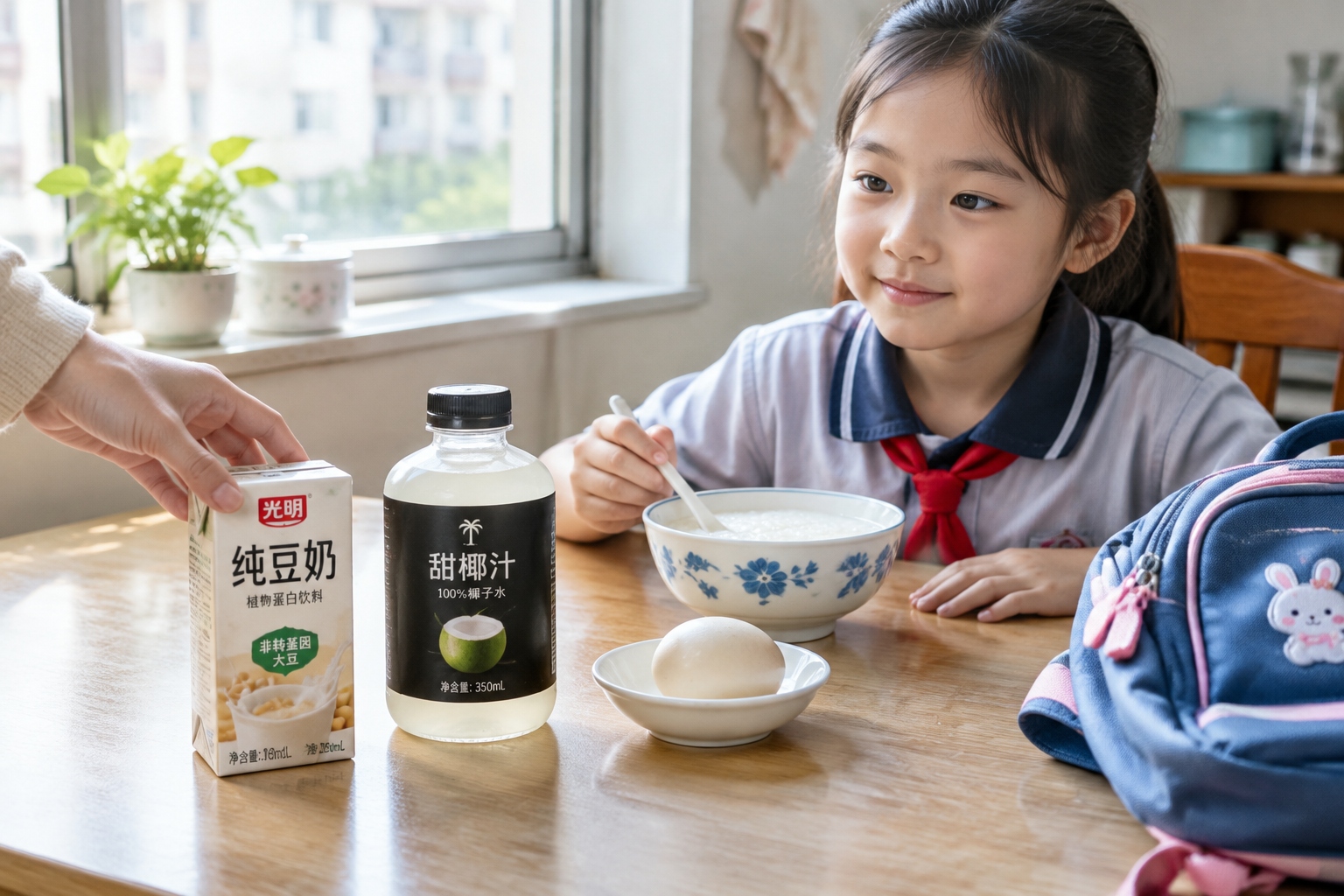

A Carton, a Straw, and the 6:50 a.m. Kitchen
If you grew up in a Chinese city in the 1990s, there is a sound you still recognise: the snap of a plastic straw punching through the foil lid of a small carton.
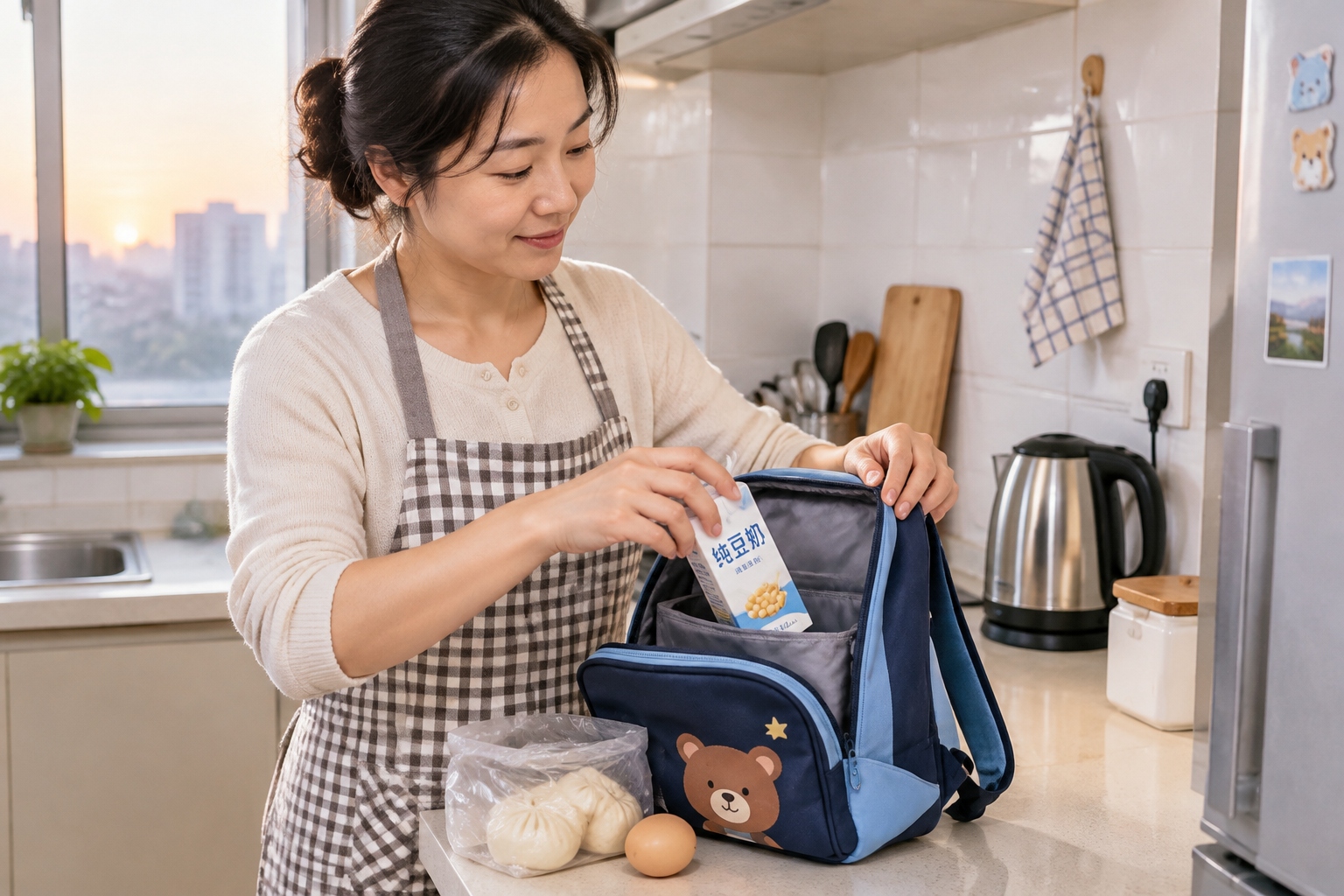
It happens at 6:50 in the morning. A mother is zipping a Vitasoy soy milk into a school bag next to a boiled egg and a plastic bag of steamed buns. Outside it is cold. The carton is cold too, and slightly too big for a nine-year-old’s hand. You drink it anyway, because breakfast in China has never been only about food — it is about getting through the day.
Thirty years later, the same carton is still in the fridge. So is a squat, black-labelled bottle of coconut juice that has barely changed its look since the mid-1990s, and which has somehow become cool again among people born after 2005.
Ask anyone in China to name the drinks of their childhood and the same two names surface: Vitasoy (维他奶) and Coconut Palm coconut juice (椰树牌椰汁). They are not the country’s best-selling beverages. They are something harder to buy — furniture of memory.
Vitasoy: The Drink You Were Allowed to Have
Vitasoy was created in Hong Kong in 1940 by Lo Kwee-seong, a businessman who had heard an American official say that milk was too expensive for poor people and that soybeans could do the same job for a fraction of the price. His ambition was not flavour. It was protein.
For decades the brand sold itself with a single line: “Vitasoy — more than just a soft drink.” When it moved into mainland China in volume during the 1980s and 1990s, it arrived at a very particular moment. Families had a little more cash, refrigerators were becoming ordinary, and parents were quietly anxious about whether their children were getting enough nutrition.
Soy milk itself is ancient, and street vendors had been selling it for centuries. What Vitasoy did was industrialise it: shelf-stable, sealed, individually packaged, and cheap enough — a 250ml carton costs roughly 3 to 5 yuan today — to be a weekday habit rather than a treat.
There is a marketing truth buried in that. Vitasoy never really sold itself as delicious. It sold itself as permitted. Millions of Chinese kids drank it because it was the thing you were allowed to have, and that is why people describe it today with a kind of fond duty rather than pure craving. It was the taste of being taken care of.
Coconut Palm: Sweet, Tropical, and Always on the Table
If Vitasoy is the weekday morning, Coconut Palm is the weekend.
The company behind it began in 1956 as a canned-food factory in Haikou, on Hainan island — China’s coconut province, which grows the vast majority of the country’s coconuts. The coconut juice arrived in the late 1980s, after a turnaround led by a manager named Wang Guangxing, and it has been the company’s main product ever since.
The drink is sweet in a way that would fail any modern dietary test. It is thick, milky-white, unapologetically sugary, and it does not taste like coconut water. It tastes like coconut flesh, sugar and cold air conditioning.
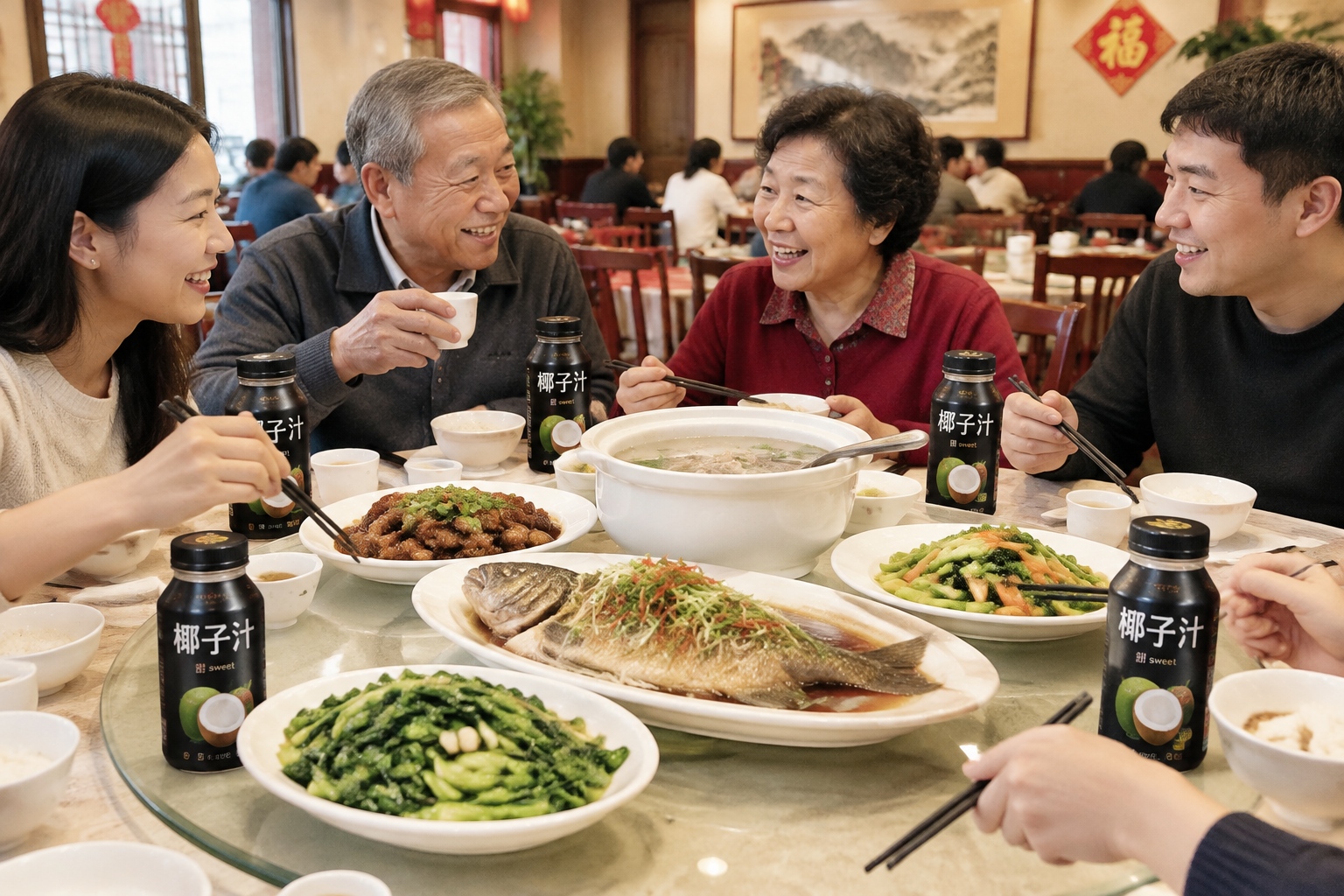
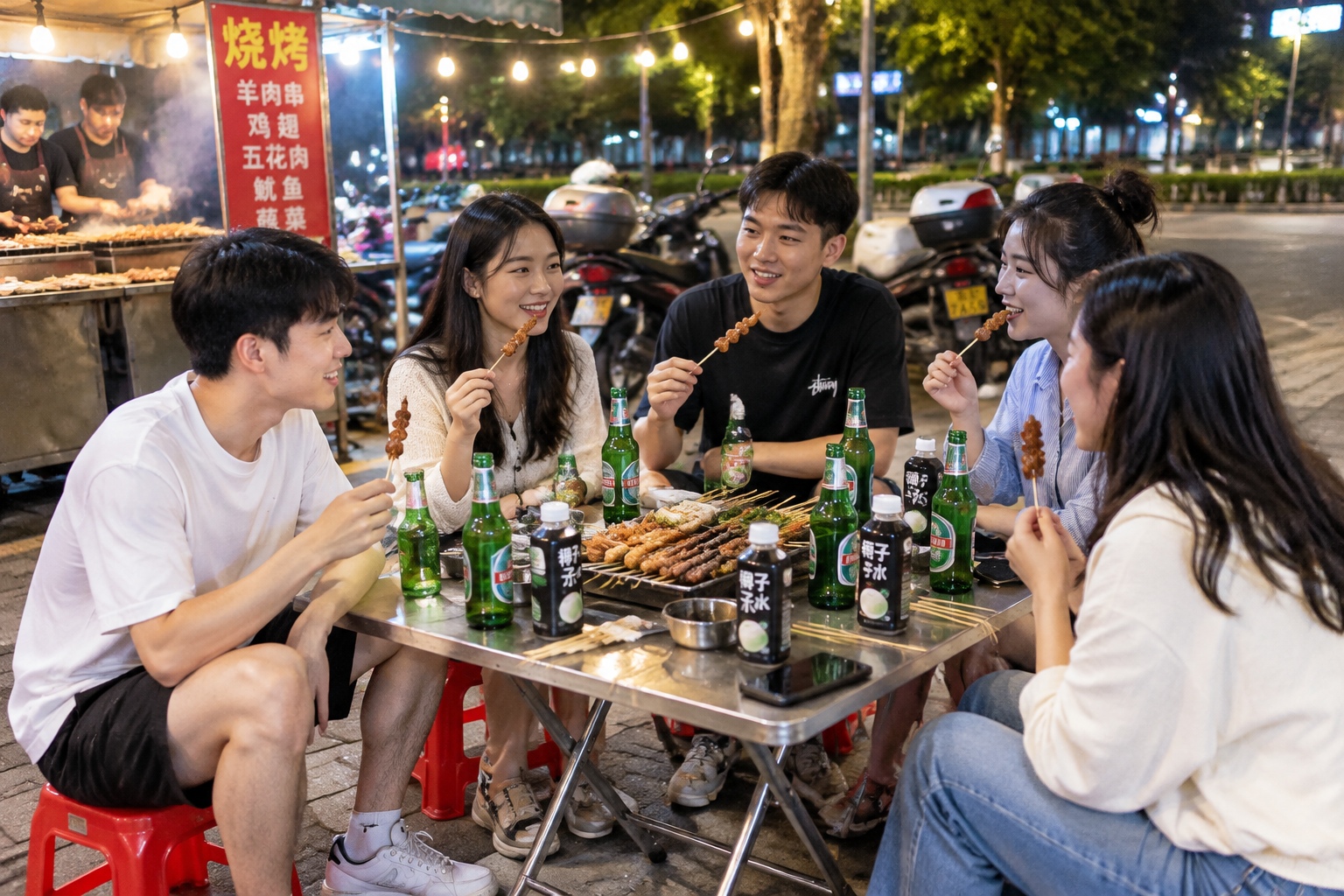
Where you find it matters. Coconut Palm shows up at Chinese New Year dinners, on restaurant tables wedged between the fish and the soup, at midnight barbecue stalls in Guangdong, and at hot pot restaurants where the entire purpose is to cool your mouth down between bites of chilli. It is not a wellness drink. It is a “the table is full of people” drink.
The Packaging Nobody Dared to Change
Here is what makes Coconut Palm strange. Its label is famously bad. Black background. Yellow, red and blue blocks of text stacked like a legal notice. Slogans piled on slogans. Designers have complained about it for twenty years. The company has mostly ignored them.
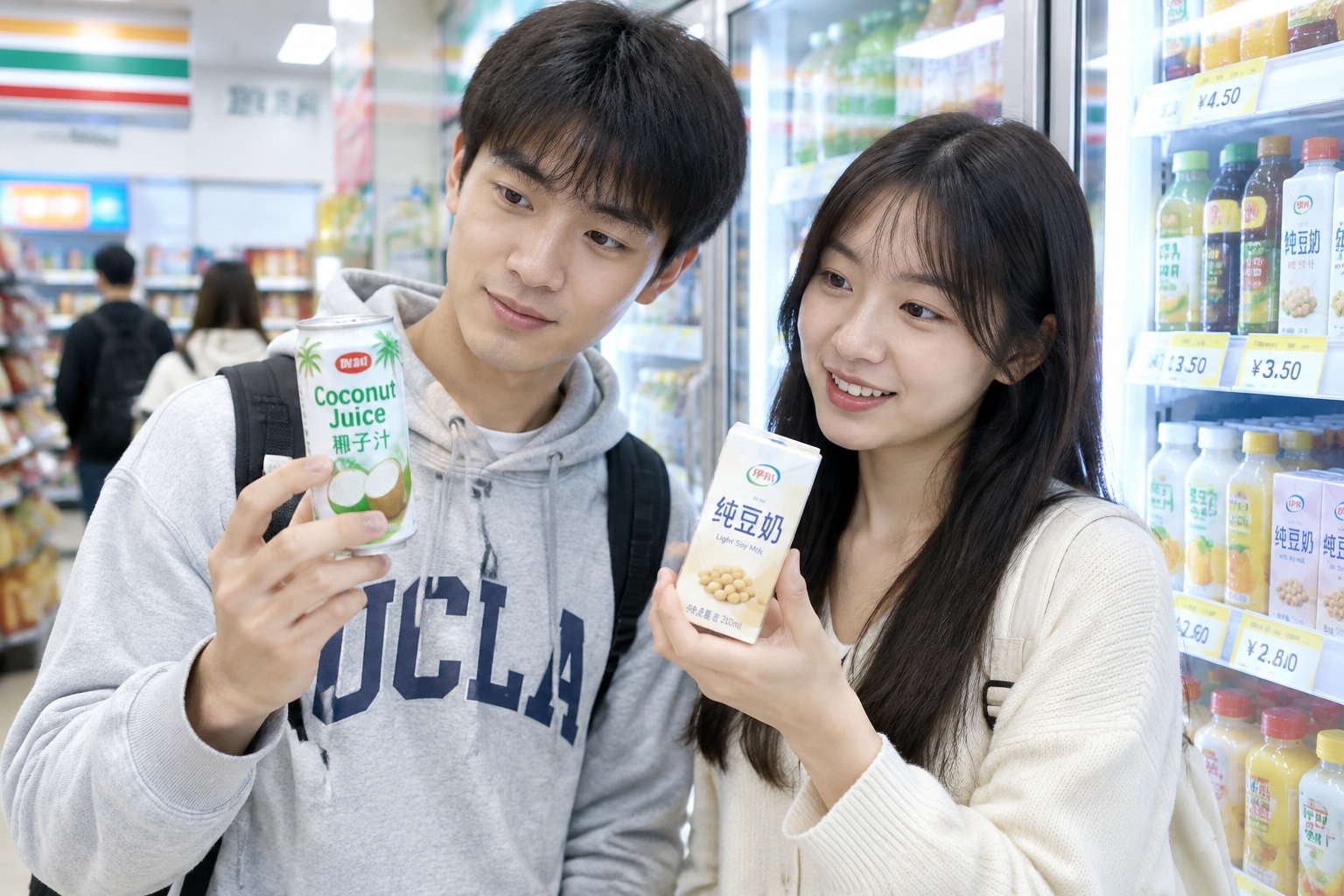
That stubbornness has turned into the brand’s personality. Around 2021, Chinese social media began treating the design as a joke — “the last designer in China who refuses to update” — and then, unexpectedly, as a style. University students bought the cans for their look. Convenience stores started shelving them next to imported craft sodas. People posted photos captioned “I have been drinking this since I was a kid,” which happens to be the brand’s own slogan.
Why Gen Z Buys the Retro Look
Vitasoy went in the opposite direction, then doubled back. It has released retro glass-bottle editions, collaboration cartons with games and animation studios, and smaller, colder formats aimed at younger drinkers. Its classic blue, white and red carton, launched in the 1970s, still anchors the shelf.
For both brands, nostalgia is not a mood. It is inventory. In a market where a new bubble tea flavour appears every month, a design that has not changed since your childhood is a surprisingly efficient form of advertising. You do not have to explain it to anyone.
How They Survived Bubble Tea, Coca-Cola and Sparkling Water
China’s beverage market is brutal. Coca-Cola and Pepsi split the cola aisle. Nongfu Spring and Wahaha dominate bottled water and tea. Over the past decade, bubble tea chains — Mixue, Heytea, Chagee — built tens of thousands of stores between them. Any supermarket now devotes an entire wall to zero-sugar sparkling water in twelve flavours.
Vitasoy and Coconut Palm did not win that war. They did something more durable: they held on to a specific slot in daily life that nobody else bothered to claim.
Vitasoy owns breakfast and school — the fridge next to the eggs, the school canteen, the desk of an office worker who wants something that is not coffee. Coconut Palm owns the restaurant table and the holiday, the moment when eight people are eating and someone says, “order us something to drink.”
Neither company is coasting. Vitasoy has reported softer mainland China sales in recent years, with rising competition and price pressure cutting into a business it once owned almost alone. Coconut Palm’s annual revenue has hovered in the billions of yuan, but it depends heavily on a single product and a single island’s coconuts.
The brand has also been genuinely controversial. In 2021, Coconut Palm was fined 400,000 yuan over a recruitment advertisement that regulators said offended public morals, and earlier campaigns drew criticism for sexist wording. Affection and discomfort sit side by side here, which is probably the honest way to describe how many Chinese consumers feel about the company.
Three Voices, Three Generations
Mei, 63, Guangzhou. “In the 1980s, Vitasoy came in a glass bottle and a man delivered it by bicycle in the morning. It cost more than a bowl of noodles. We drank it when someone in the family was sick. It was medicine and dessert at the same time.”
Chen, 34, Shanghai. “I drank Vitasoy every school day because my mother said it was good for me. I drank Coconut Palm at every family dinner because my uncle always brought it. Now I buy the old coconut cans when friends come over — not because I love the taste, but because everyone recognises them and someone always laughs.”
Lin, 20, Chengdu. “I first saw the coconut juice as a meme. I tried it and honestly, it is too sweet. But my roommate’s fridge always has one, and when we order takeout at midnight, that is what we drink. The light Vitasoy is what I buy when I am studying late.”
A Drink Is Never Just a Drink
These two brands are national icons not because they are the best-tasting drinks in China. They are icons because they were present at the moments people remember: the cold walk to school, the crowded New Year table, the midnight plastic stools on a pavement in summer.
That is also the honest limit of the story. China’s drink shelves today are far more interesting than they were thirty years ago, and most young people have moved on to fresh milk tea, cold brew and sparkling water. Vitasoy and Coconut Palm survive partly on affection and partly on habit — and habit, in a country that changes this fast, is not a small thing.
If you ever visit and want to understand something small but real, buy both. Drink the Vitasoy cold, standing up, at breakfast, in a hurry. Drink the Coconut Palm at dinner with too many people talking at once. You will understand the country a little better — and you will probably understand your own childhood too.
Start the discussion at forum.chinacomes.com