

A taxi with no one at the wheel
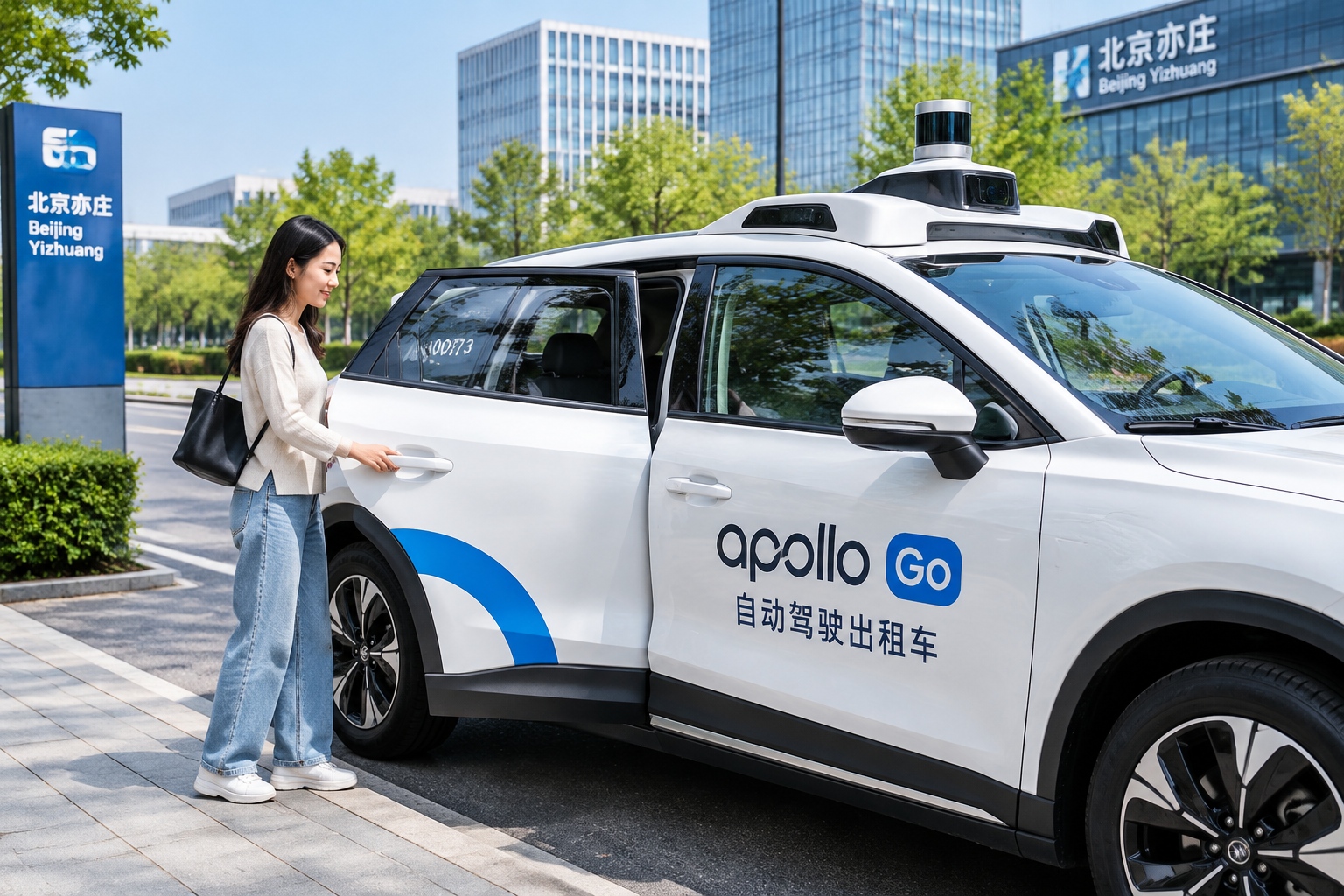
At two o’clock on a Wednesday afternoon in Yizhuang, a wide business district on Beijing’s southeastern edge, I opened an app called Luobo Kuaipao and ordered a taxi. The pickup spot was a side road lined with new office buildings and a few stubborn plane trees. Three minutes later, a white SUV rounded the corner and stopped a few meters from me. The driver’s seat was empty. The steering wheel, which could move on its own, sat motionless at first, then gave a small self-test—a slight right, a slight left—as if checking its joints. A voice came from the dashboard: “Welcome to Apollo Go. Please confirm your order in the app to unlock the door.”
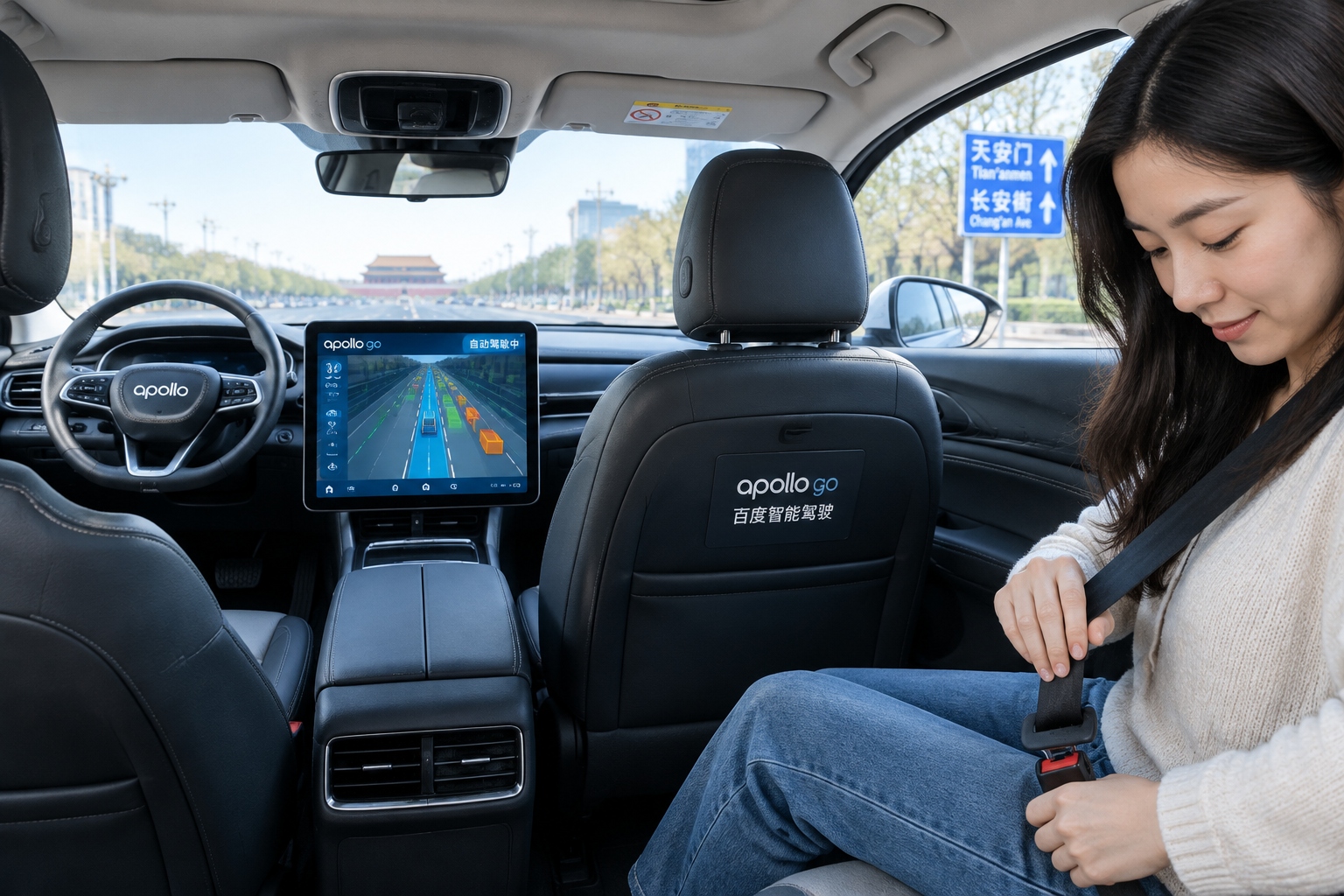
I tapped confirm. The door clicked open. I got into the back seat, fastened my seatbelt, and heard the same voice tell me to keep my hands off the steering wheel unless the car had explicitly asked me to take over. That last instruction felt both reassuring and odd. In a regular taxi, no one would ever need to say it.
Booking a robotaxi in Beijing
Luobo Kuaipao, whose English brand is Apollo Go, is Baidu’s robotaxi service. It works a little like any ride-hailing app, but with one important limit: you can only choose pickup and drop-off points that the vehicle is allowed to use inside the autonomous driving demonstration area. When I opened the map in the app, I saw clusters of blue dots where the service was available. The app politely refused to let me set a destination outside that zone.
The booking process took about as long as ordering food on Meituan. I chose a pickup point, picked a destination, and saw the fare estimate before confirming. The car arrived at the pickup point after a short wait, its emergency lights blinking. The app showed the car’s license plate and a message: “The car has arrived. Please get on quickly.”
To unlock the vehicle, I confirmed my identity in the app. In some Apollo Go models, there is a small touchpad outside the door where you type a code that appears on your phone. On the car I took, the app’s unlock button did the job. The door released with a soft click. Once I was inside, the seatbelt reminder was not a loud beep but a gentle voice telling me the car would not move until it detected, via sensors in the seat, that my belt was fastened.
Inside the car: a screen that shows what the car sees
The interior of the Apollo Go vehicle was ordinary, except for the empty driver’s seat and the screen between the two front headrests. The screen was a small, bright display with a map on one half and live sensor information on the other. As the car moved, I could see the world being translated into shapes: other vehicles were orange boxes, pedestrians were green-blue boxes that swayed slightly as people walked, bicycles were smaller and had tracking lines showing their predicted path. It felt less like a taxi ride and more like sitting inside a computer simulation that happened to be moving.
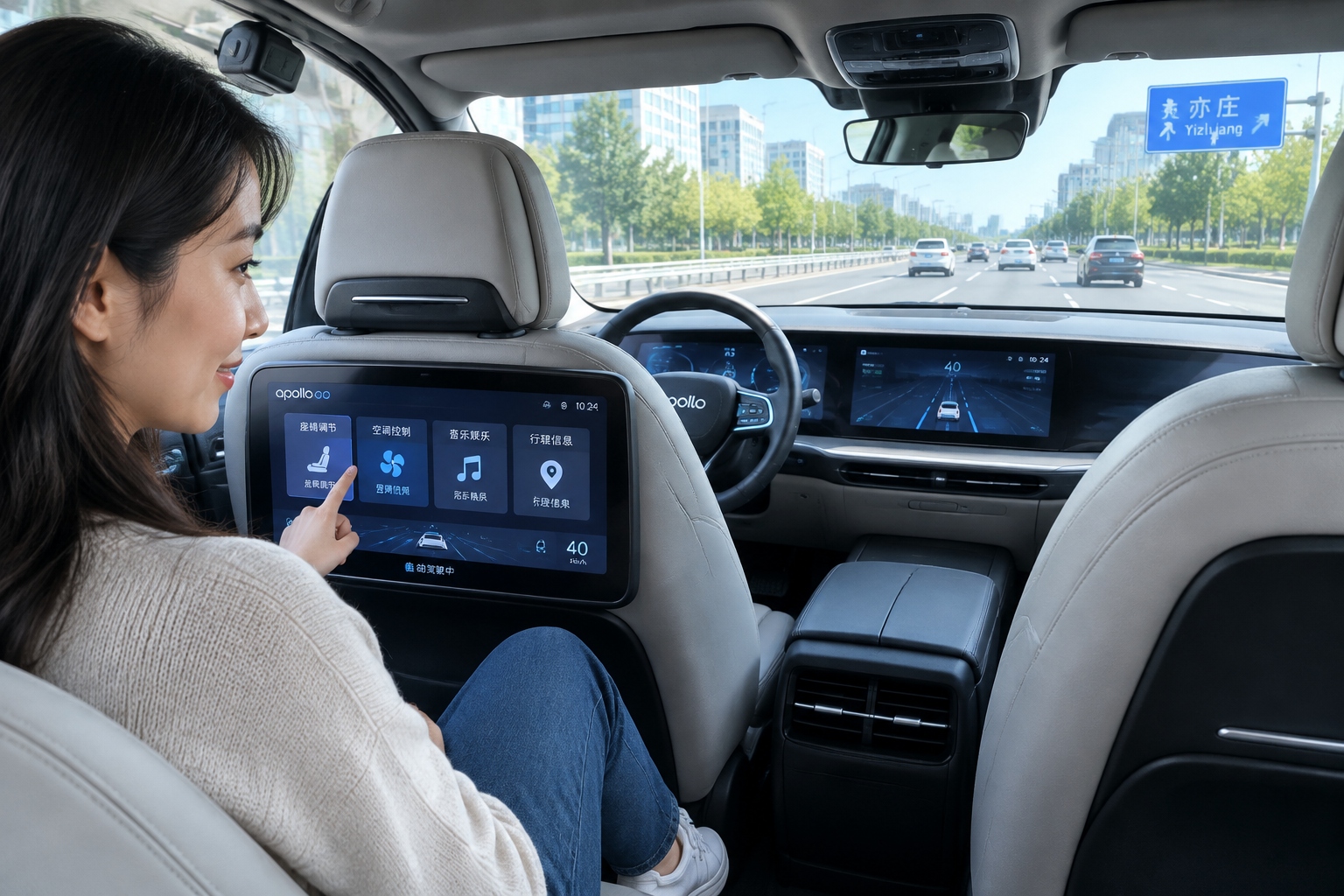
The screen also had other functions—air conditioning controls, a music playlist, a floor light option and, in the corner, a button labeled “Customer Service” and a red “Emergency Help” button. According to the app, pressing emergency help would connect me with a remote operator who can, if necessary, bring the car to a controlled stop. I didn’t test whether that was true; I trusted the small print, at least for now.
The ride: patient, careful, and sometimes too polite
The car pulled away smoothly and accelerated at a pace a careful taxi driver might choose. Our route ran through Yizhuang’s regular midday traffic: delivery scooters cutting between lanes, a sanitation truck half-parked on the sidewalk, pedestrians crossing on a countdown light. At one intersection, a man on a bicycle pushed through a red light; the robotaxi braked well before the stop line, then continued with no sudden jolt.
On a two-lane road, a white delivery van ahead slowed down to turn right, half-blocking our lane. The robotaxi waited, estimated the gap, then steered around it with extra margin, the kind of generous distance that you’d see from a very patient human driver. At a roundabout, it waited for a stream of cars to pass, then merged when the sensor display showed a safe gap. It signaled each lane change, and the voice noted it aloud: “The vehicle is now changing lanes.” It didn’t ask for my permission; it was simply narrating.
The car also dealt with more complex situations. At a busy five-way intersection near the edge of the operational zone, it stopped behind a line of cars, left enough room for a car to cut in if a driver really wanted to, and then followed the car ahead through the green light with a smooth, unhurried motion. It did not stop too close to the vehicle in front, which is more than I can say for many human taxi drivers in Beijing.
A regular passenger’s view
After my ride, I spoke with a woman in her mid-thirties who works in Yizhuang and said she uses the robotaxi at least twice a week. She asked me to refer to her as Ms. Liu. “I don’t drive, and the subway station is too far to walk from my office,” she said. “A robotaxi is usually a little cheaper than a regular taxi, especially with the app coupons, and it is much more private. No one talks to you, and you can take calls without feeling rude.”
Her first ride, she admitted, was tense. “I looked at the empty front seat and wondered what would happen if a truck came out of nowhere. After five or six rides, I realized that it brakes earlier than any human driver I’ve met. It has never scared me.” Her main complaint is the robotaxi’s cautious style. “When there is a parked car blocking the lane, it sometimes waits for a long time instead of changing lanes aggressively like a Didi driver might. You sit there and think: I have a meeting. Please go.”
A university student who uses the service when he visits his parents in Yizhuang offered another perspective. “The first time I took my cousin from Shanghai, we didn’t talk about the car itself. We talked about the little lines on the screen that predict where a bicycle will go. It’s like watching a mini map come alive. It made us both feel like we were in a video game.”
Where can you take it, and what does it cost
Apollo Go’s Beijing operation is still geographically limited. The service mainly covers the Yizhuang demonstration area, with some connections near Beijing Daxing Airport that are part of authorized pilot programs. The roads in Yizhuang are wide and relatively new, with clear lane markings and controlled intersections—conditions that make robotaxis far easier to deploy than in the narrow, messy streets of central Beijing.
Pricing is modest. A typical 4–5 kilometer ride costs between 15 and 25 yuan, or about 2 to 3.5 US dollars. That’s similar to a regular taxi, and usually slightly cheaper when there is a promotion. The cars are electric, and there is no driver to pay, which the company says should help keep prices down over time. Baidu has said it plans to expand the service to more Chinese cities and has already launched Apollo Go in places like Wuhan, Chongqing, Shenzhen, Shanghai, and Hefei. It has also announced international ambitions.
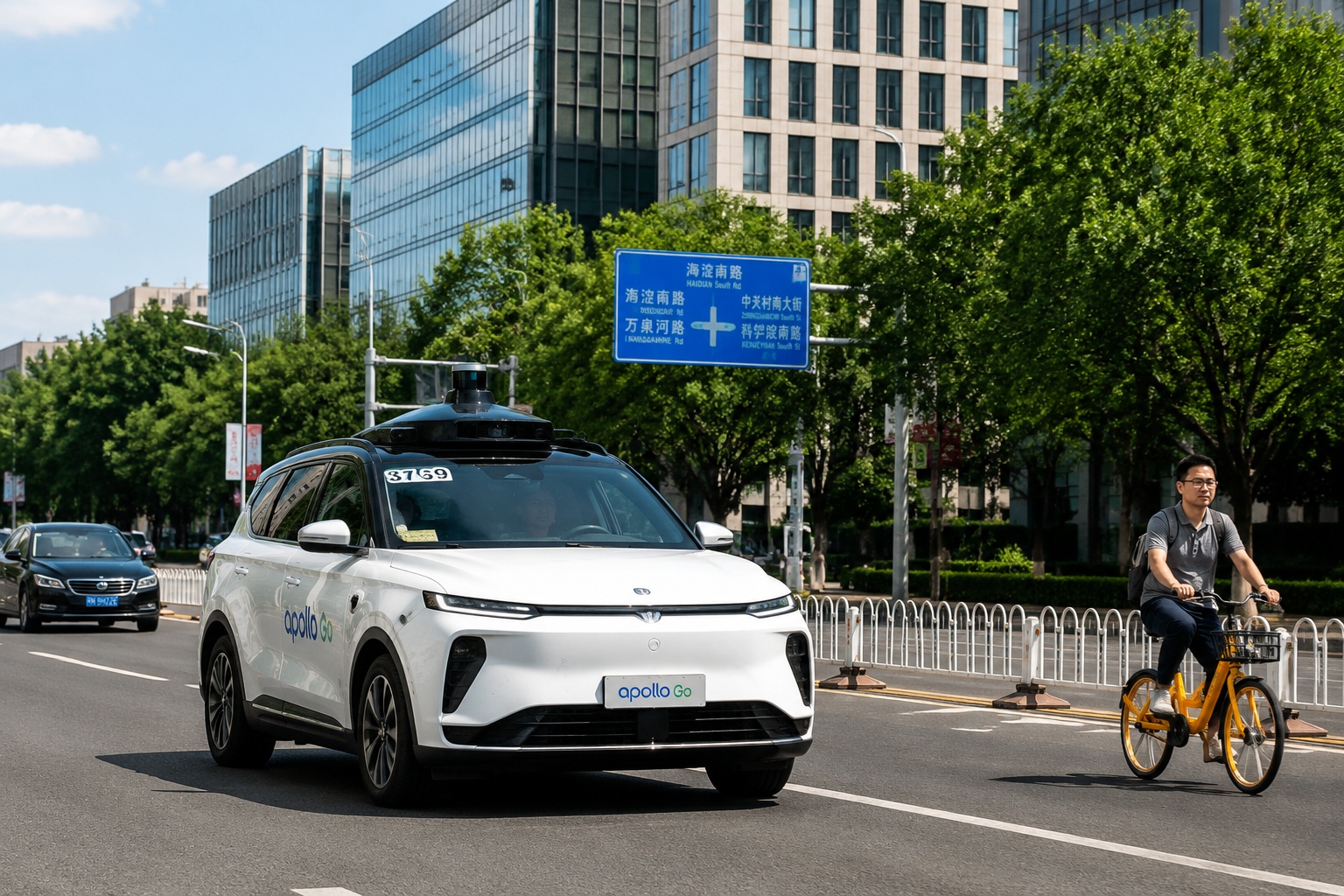
It’s worth putting the technology in context. The car I rode in did not have a safety operator in the front seat, but it was still monitored by remote humans who can take over in difficult situations. Some older or newly deployed configurations still place a test driver behind the wheel, especially during the first phase of operations in a new area. Level 4 autonomous driving is not a single leap; it is built from sensors, specialist maps, cloud support, and legal boundaries that define where the car is allowed to travel.
It feels like an ordinary ride, until you realize it isn’t
The strangest part of the trip was not the empty driver’s seat. It was how quickly that emptiness became normal. After ten minutes, I was checking my phone, adjusting the air conditioning from the back-seat screen, and looking out the window at Beijing’s familiar beige apartment blocks. The car accelerating, braking, turning by itself no longer felt like an event.
When the robotaxi reached the drop-off point, it slowed gently, put on its hazard lights, and parked at the curb. The voice said: “You have arrived. Please take your belongings with you.” I stepped out, and the car pulled away by itself, drifting back into traffic without a sound.
Standing on the pavement, I realized I was already thinking about when I would book another ride. Not because it was futuristic, but because it was simple, clean, and a little boring. And boring, in the most positive sense, may be the most honest sign that the driverless future has quietly started to arrive in Beijing.
Start the discussion at forum.chinacomes.com