

Before the sun hits the field
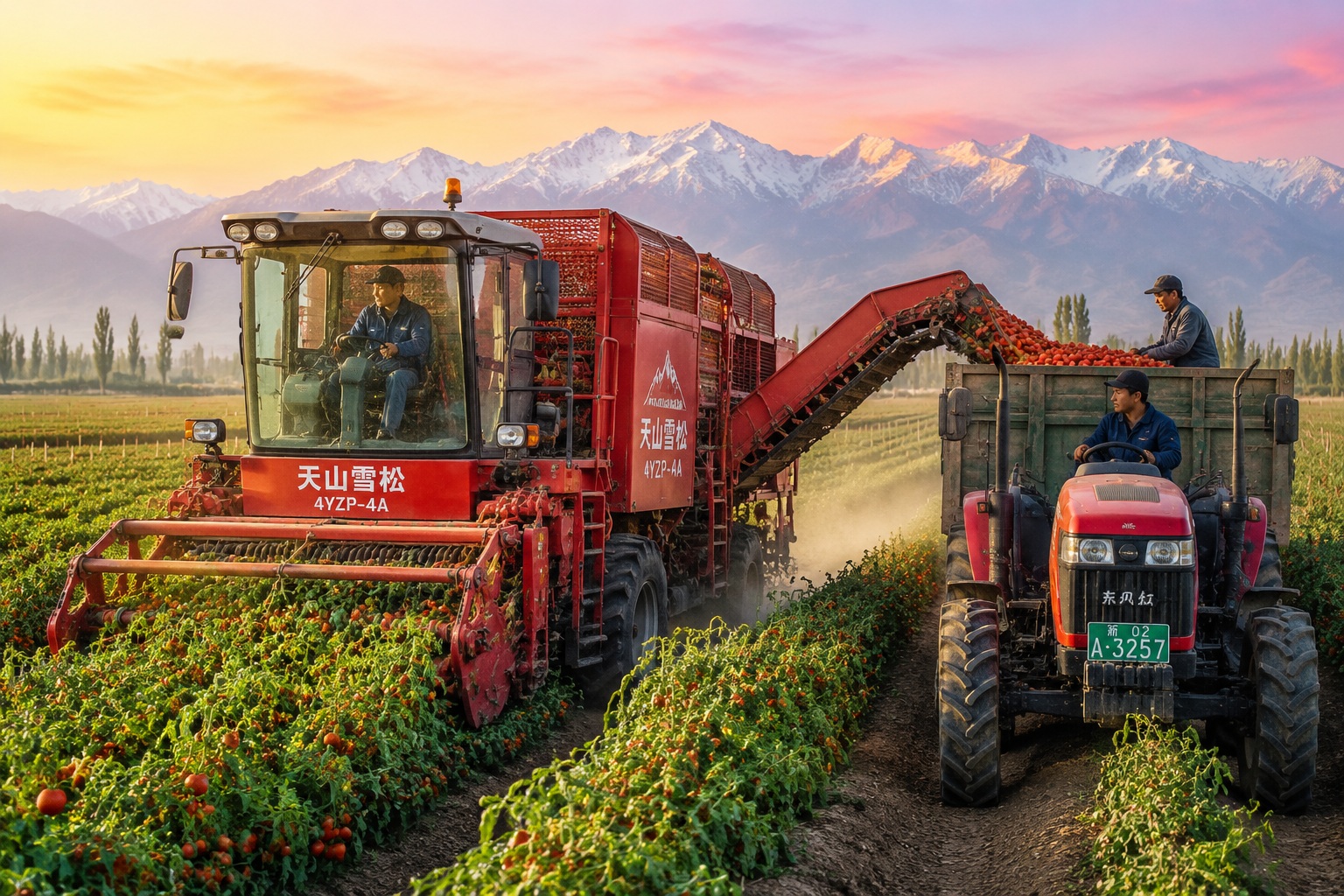
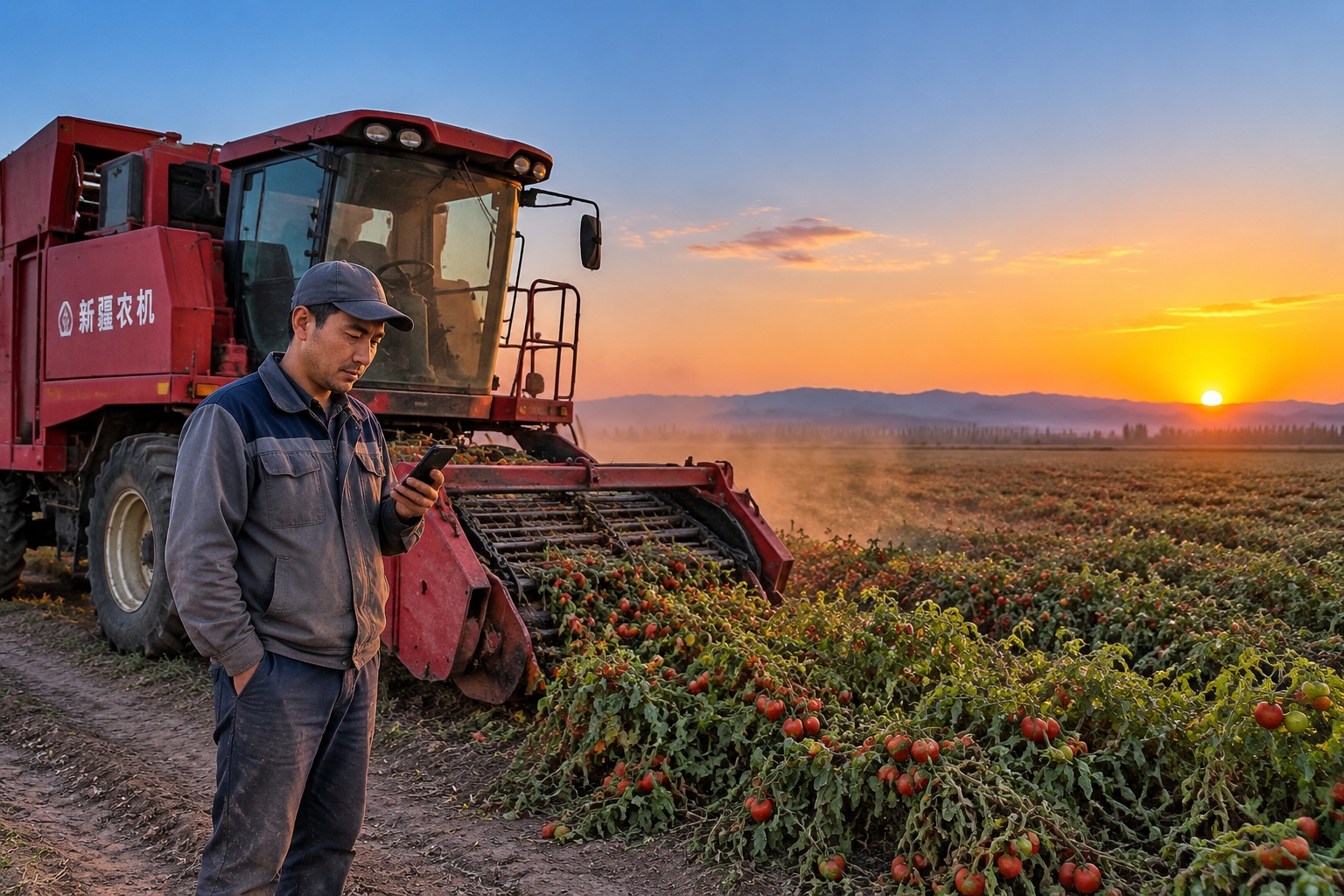
At 6:40 a.m. in late August, the air in the Yanqi Basin still carries the night’s chill. It is 14°C. Dew sits on the tomato leaves in a field outside Bohu County, Xinjiang. A red harvester, roughly the size of a small bus, idles at the edge of the row. Its driver, a 42-year-old man named Zhang Wei, climbs into the cab and runs through a checklist on a touchscreen: oil pressure, belt tension, sieve speed.
Two hundred meters away, a tractor-trailer waits. The trailer is empty now, but by noon it will be filled with 20 tons of tomatoes. Zhang’s job is to move the machine down the row at exactly 3 kilometers per hour. Any faster, and the vines will jam. Any slower, and the fruit will start to bruise.
This is the first hour of a 24-hour cycle that will end not in a field, but in a factory, and finally in a can of tomato paste on a shelf in Europe, Japan, or Africa. Xinjiang produces more than 80% of China’s processing tomatoes — the thick-skinned, high-solid variety grown not for salads but for paste. In the past decade, the harvest here has shifted from hand-picking to machines. The change is visible in the fields, and in the people who work them.
Why processing tomatoes are different
If you buy a tomato in a supermarket in Shanghai or London, it is likely a fresh-market variety: thin skin, juicy, bred for shelf life and flavor. The tomatoes in this field are a different breed. They are determinate plants — they grow to a certain height and stop, producing all their fruit in a short window. Their skins are thick, their flesh is dense, and their sugar content is measured in Brix. A good processing tomato hits 5.0 to 5.5 Brix. That density is what makes them worth harvesting by machine.
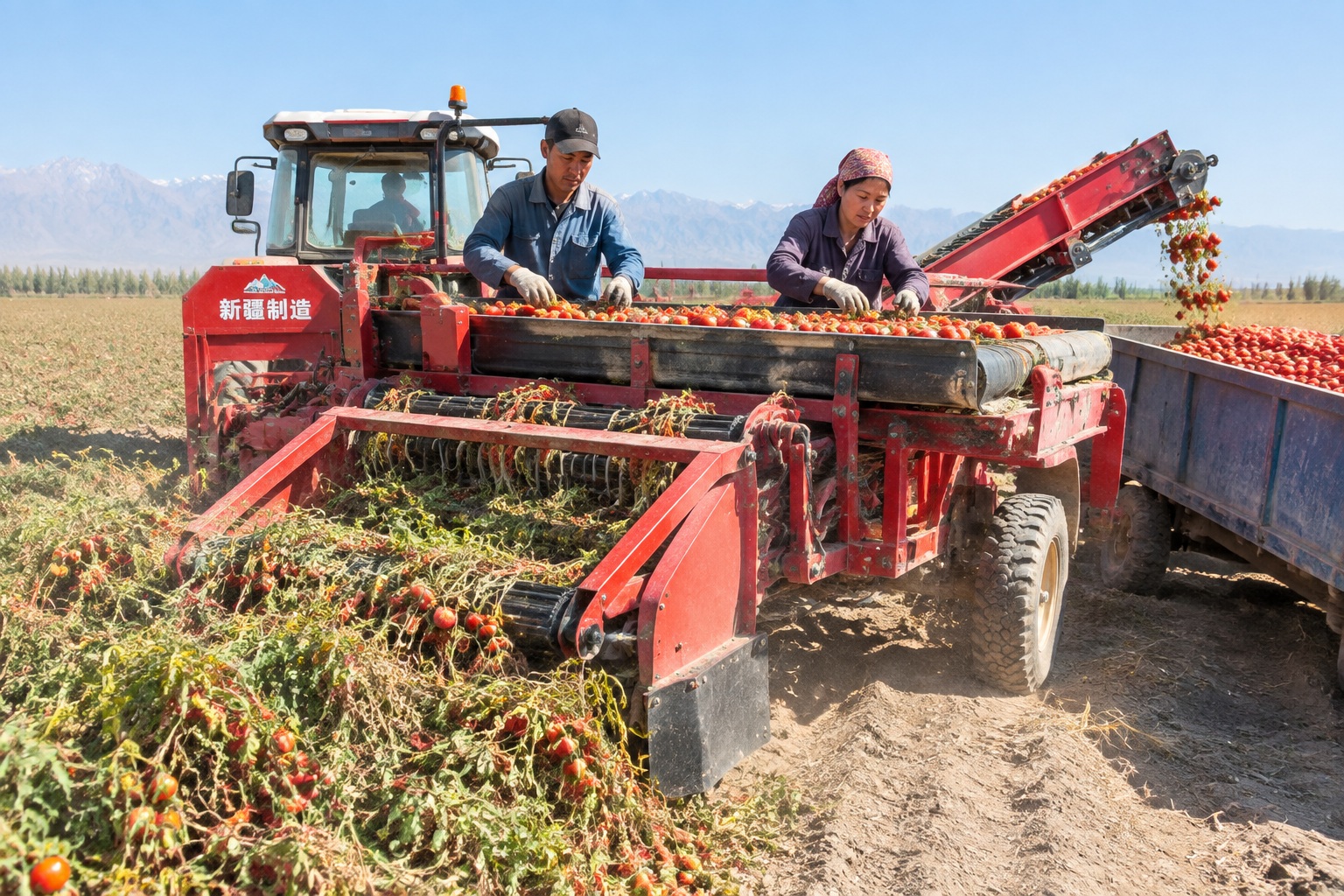
Mechanical harvest works because the fruit ripens together. A harvester cannot pick one tomato at a time. It cuts the entire plant at the base, lifts it onto a conveyor, and shakes the vines until the tomatoes fall off. Then a series of belts and rollers separate the fruit from stems, leaves, and dirt. Workers on the machine — usually two or three — stand along the line and pick out green or rotten tomatoes by hand. The rest drop into a trailer that moves alongside the harvester.
In 2010, less than 10% of Xinjiang’s processing tomatoes were harvested by machine. By 2023, in some counties, the figure was over 90%. The driver, Zhang, has been running a harvester for eight years. Before that, he picked tomatoes by hand. “You would bend over for 12 hours,” he says. “Your back would be finished by the end of the season.” A single machine like his can cover 50 to 70 mu a day — about 3.3 to 4.7 hectares — replacing the work of roughly 100 pickers.
The 24-hour clock starts ticking
Tomatoes are not like wheat or corn. Once picked, they begin to deteriorate. The clock starts the moment the fruit leaves the vine. For processing tomatoes, the industry standard is simple: get them from field to factory within 24 hours. Any longer, and the natural sugars break down, the color fades, and the paste becomes darker and less valuable.
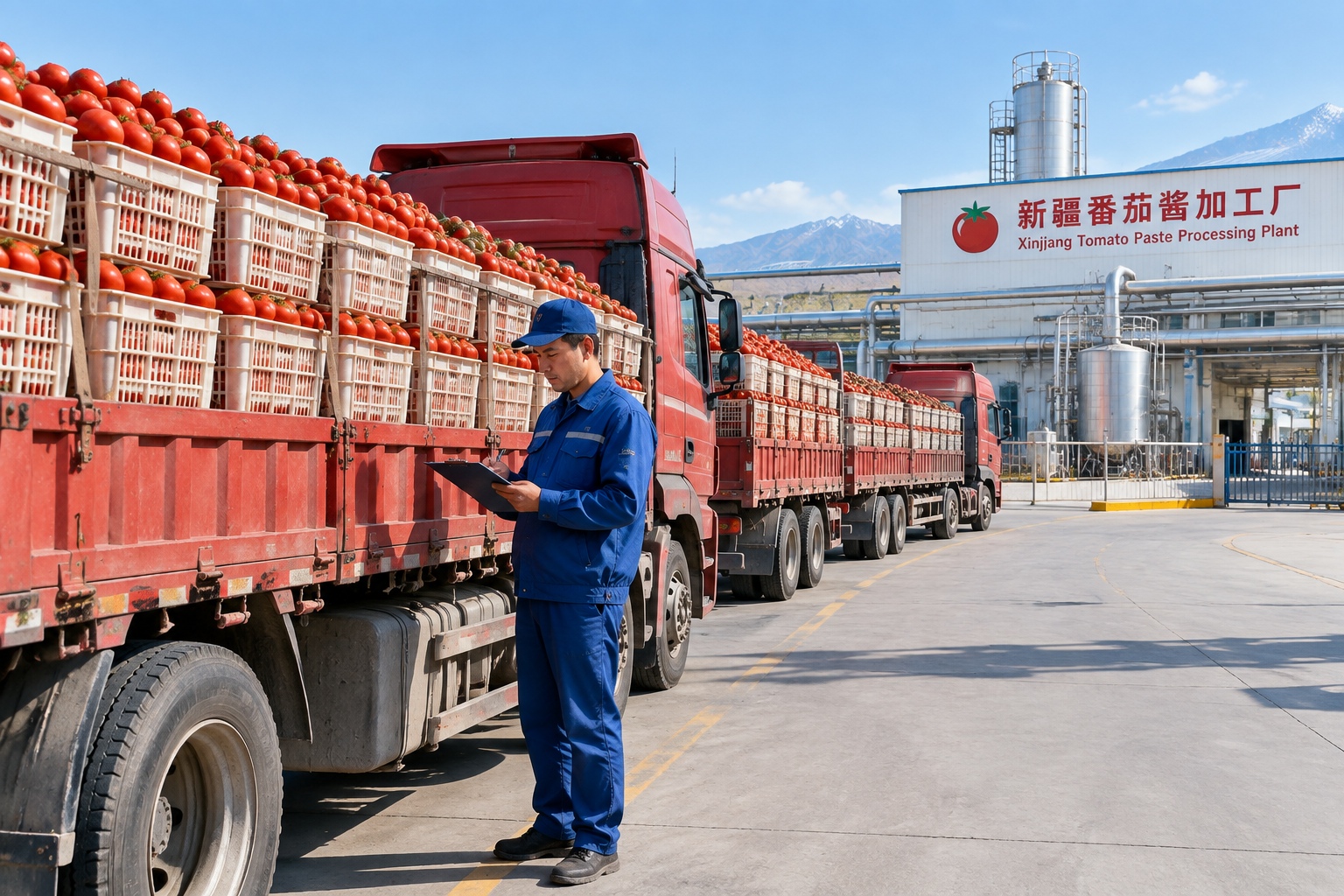
That deadline shapes everything. The harvester does not stop for lunch. The truck does not wait. The factory does not close. By 9:00 a.m., Zhang’s machine has filled its first trailer. The driver of the tractor, a man named Aihemaiti, pulls out of the field and onto a two-lane road. The trailer is open to the sky. The smell of crushed tomato vines — green, sharp, slightly bitter — trails behind it.
The drive to the processing plant takes 40 minutes. At the gate, a line of trucks has already formed. Some come from smaller farms that still harvest by hand. Others come from fields run by large cooperatives. A queue of 30 trucks can stretch half a kilometer. A clerk with a clipboard checks the load’s temperature and Brix. If the tomatoes are too warm, they go to the front of the line. If they are too green, they are rejected.
Inside the factory: from fruit to paste
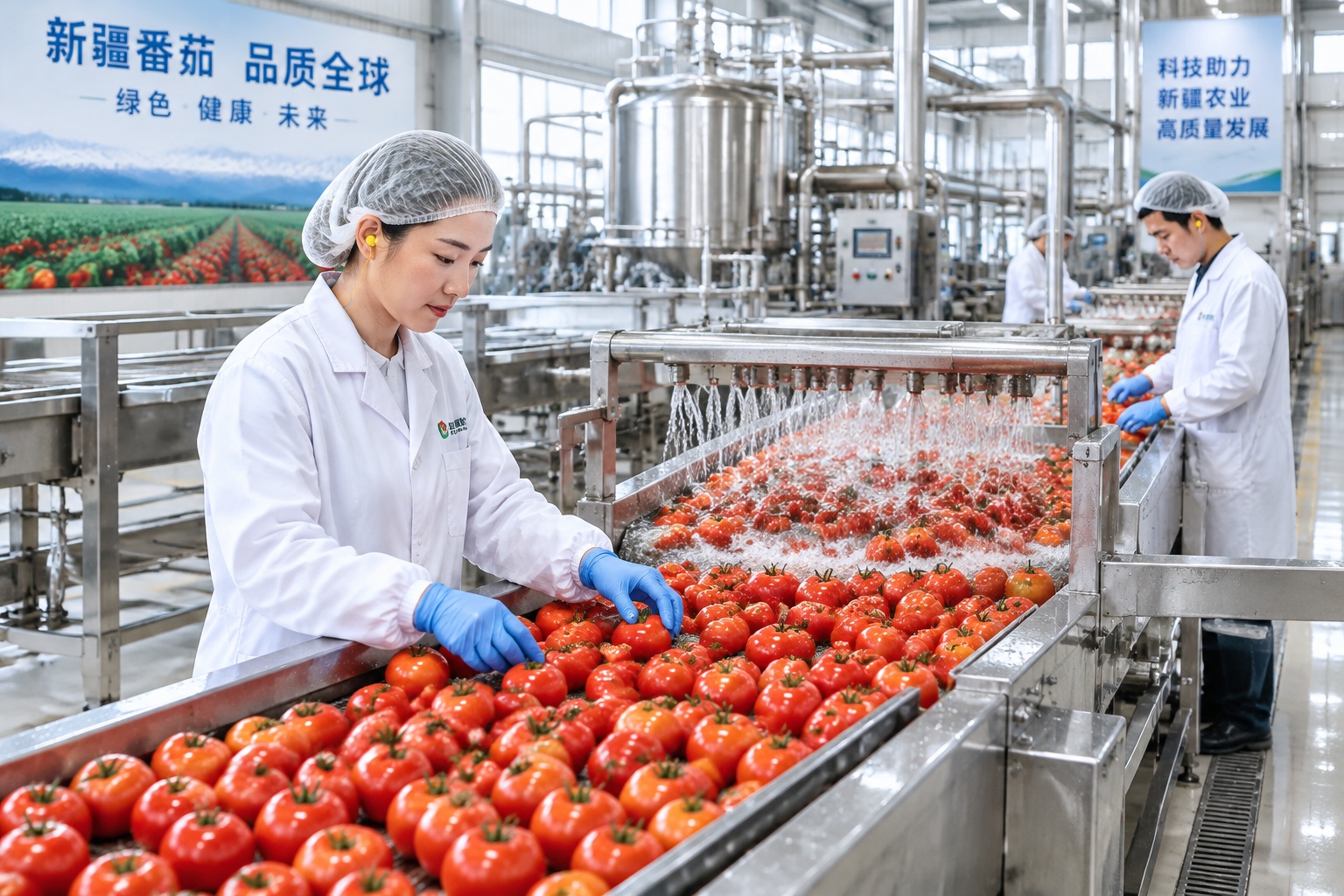
The plant is a maze of stainless steel pipes, tanks, and conveyor belts. The noise is constant — a low hum of motors and the clatter of rollers. The air smells like cooked tomatoes, sweet and acidic. Most of the workers are local, many from nearby villages. They wear white coats, hairnets, and earplugs.
The process is almost entirely automated. Tomatoes are dumped into a water flume, where they float and are washed. Stones and dirt sink. Then they move to a sorting belt, where a camera system and a few human eyes remove any remaining green or damaged fruit. Next, the tomatoes are crushed and heated to about 90°C in a “hot break” step. This deactivates enzymes that would otherwise break down the natural pectin, keeping the paste thick.
From there, the juice goes into an evaporator — a series of vacuum chambers that boil off water at low temperatures. The goal is to concentrate the tomato solids from about 5% to 28-30% Brix. Then the paste is sterilized, cooled, and filled into aseptic bags or 200-liter drums. The entire process, from unloading to sealed drum, takes about two hours.
The factory runs 24 hours a day during the harvest season, which lasts from late July to early October. Workers rotate in three shifts. A quality technician named Li Na tests samples every 30 minutes. “We check color, viscosity, and pH,” she says. “If the Brix drops, we know something is wrong upstream.” Most of the paste will be exported. China is one of the world’s top three tomato paste exporters, alongside Italy and the United States. Xinjiang’s paste goes to Italy for re-packing, to Japan for sauces, to Nigeria for stews.
What the 24 hours mean for the people in it
Mechanization has solved a labor problem. In the 2000s, Xinjiang’s tomato harvest relied on hundreds of thousands of seasonal workers who came from other provinces. They worked for 40 days, sleeping in makeshift dormitories, earning cash wages. It was hard, low-paid work. As China’s economy grew, fewer people wanted to do it. The machines arrived not as a luxury, but as a necessity.
Not everyone benefits equally. Farmers who own their land and can afford the harvest fee — about 300 to 400 yuan per mu — come out ahead. Those with small plots sometimes still pick by hand. The price of tomatoes fluctuates wildly from year to year. In 2023, a glut in the global market pushed prices down, and some farmers barely broke even. In 2024, prices recovered. The uncertainty is part of the job.
For workers like Zhang, the change is more personal. He now spends his days in an air-conditioned cab, watching a monitor. He earns more than he did as a picker. But the harvest season is still short — six to eight weeks — and the rest of the year he does maintenance or drives other farm equipment. “It’s better,” he says. “But you still live by the season.”
The next 24 hours
At 7:00 p.m., the sun drops behind the Tianshan Mountains. The field is dusty and quiet. Zhang’s harvester has finished 60 mu. The last trailer pulls away. In the factory, the night shift is just starting. The evaporator hums. The paste flows into drums.
By midnight, the tomatoes from this field will be processed. By morning, they will be sealed in aseptic bags, loaded onto a truck, and driven toward a port. Within a few weeks, they will be on a ship. Within a few months, they will be in a jar in a supermarket in Rome or Tokyo. The 24-hour clock will start again tomorrow, in a different field, with a different driver. The machine will run. The tomatoes will fall. The paste will flow.
Start the discussion at forum.chinacomes.com